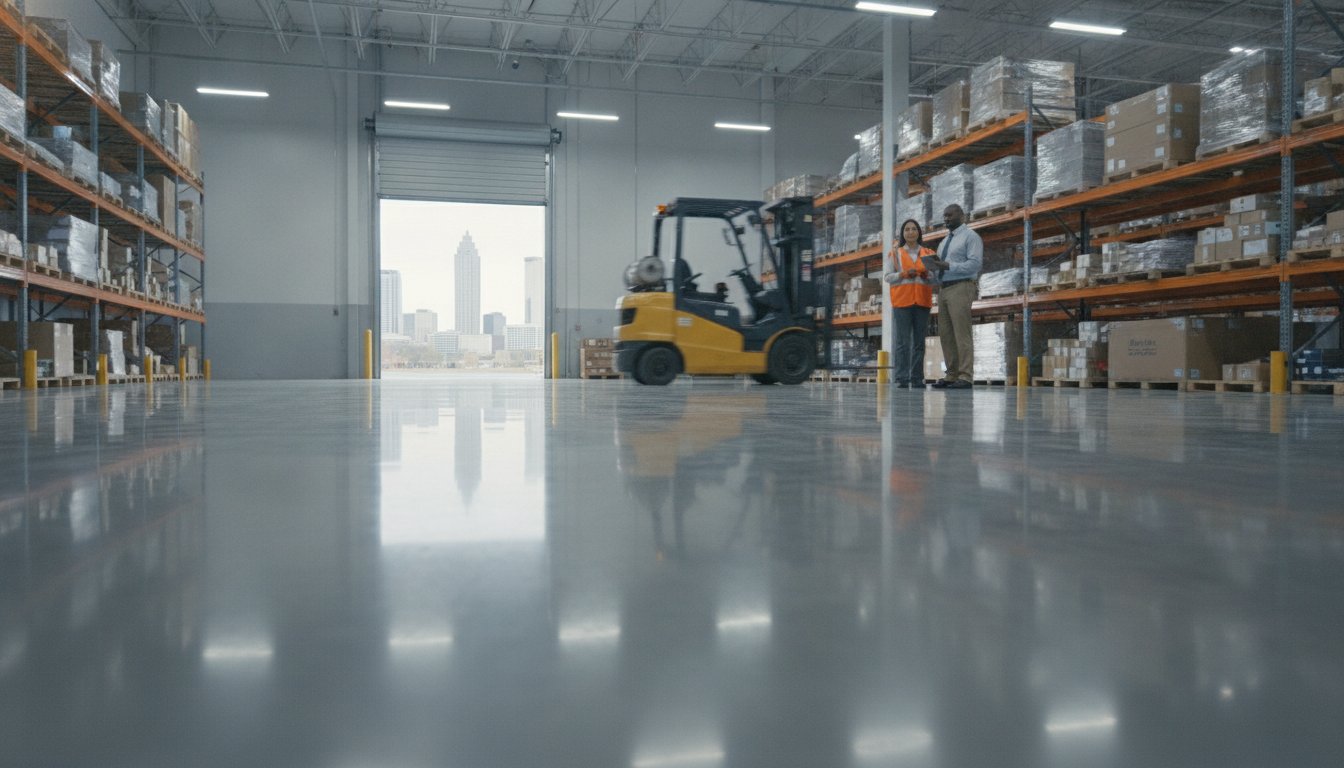
A crumbling warehouse floor isn't just a maintenance headache; it's a direct assault on your bottom line. Every crack and dusting patch represents lost efficiency and compromised safety. You deserve a surface that withstands the relentless abuse of heavy-duty machinery without requiring constant intervention. Finding the best flooring for commercial warehouse operations requires moving past temporary fixes and embracing engineered durability. We understand the frustration of seeing a new coating fail under the humid Georgia climate or watching your air quality suffer from concrete dusting. It's time to eliminate that uncertainty. Zero compromises.
This 2026 durability guide provides the definitive ranking of flooring solutions designed to maximize your long-term ROI and operational safety. You'll discover how to achieve a low-maintenance surface that lasts over 10 years while increasing ambient light reflectivity by 30% or more. We'll break down the performance of polished concrete and high-performance epoxy systems against the latest ANSI and OSHA slip-resistance standards. From moisture mitigation strategies to rigorous surface preparation, this is your roadmap to a high-performance industrial environment. No fluff. Just results.
Key Takeaways
- Identify the specific industrial stressors, from heavy point loading to constant forklift abrasion, that dictate your material selection.
- Evaluate why polished concrete is the industry gold standard for long-term ROI while epoxy remains the superior choice for high-impact chemical zones.
- Discover the definitive engineering criteria for selecting the best flooring for commercial warehouse facilities based on 2026 durability and safety standards.
- Learn how strategic light reflectivity and rigorous slip-resistance engineering can simultaneously lower facility energy costs and workplace injury risks.
- Recognize why professional surface preparation and moisture remediation are the non-negotiable foundations of a floor that lasts decades without resurfacing.
Understanding the High-Stakes Demands of Warehouse Environments
Warehouse floors are the most abused assets in your facility. They aren't just paths for travel; they are structural components that must endure thousands of pounds of point loading and the relentless friction of pallet dragging. Choosing the best flooring for commercial warehouse operations starts with acknowledging that untreated concrete is a liability, not a solution. It's porous, prone to abrasion, and fundamentally incapable of meeting modern industrial demands without professional intervention. A failure here stops production. It's that simple.
In the humid Georgia climate, the stakes are even higher. High moisture levels often lead to "Sweating Slab Syndrome," where condensation accumulates on the surface of non-permeable or poorly prepared slabs. This creates a severe slip hazard and compromises safety. Compliance with industrial standards isn't optional. Meeting OSHA requirements for walking-working surfaces requires a surface engineered for traction and long-term durability. While you can find a comprehensive overview of flooring materials to understand the basics of various surfaces, industrial environments require a level of surface density that standard commercial products cannot provide. We don't just cover the floor; we reinforce it.
The Impact of Heavy-Duty Machinery
Hard-wheeled forklifts and heavy pallet jacks exert immense pressure on every square inch of your floor. This constant cycling creates micro-fractures in the cement paste of untreated slabs. Over time, these fractures lead to spalling, joint failure, and deep structural pitting. Residential-grade sealers or thin-film coatings fail almost immediately in a commercial warehouse context. They peel. They flake. They leave your concrete exposed. We prioritize increasing the compressive strength and surface density of the slab itself. This is the only way to ensure the floor survives the daily grind of heavy-duty machinery. Engineering over aesthetics.
Dust Control and Inventory Integrity
Concrete dusting is a silent killer of warehouse efficiency. It's the result of the weak top layer of concrete breaking down into fine, alkaline particles under traffic. This dust settles on high-value inventory and infiltrates sensitive electronics in your machinery, leading to premature equipment failure. It also compromises the air quality for your staff. By utilizing professional surface densification and industrial-grade polishing, we eliminate the source of this dust. The result is a cleaner facility, lower maintenance costs, and a safer breathing environment. You get a floor that protects your assets rather than damaging them. Total control.
Comparing the Contenders: Polished Concrete vs. Epoxy vs. Sealed Concrete
Determining the best flooring for commercial warehouse operations isn't a matter of aesthetics. It's a calculated decision based on total lifecycle cost and operational resilience. You need a surface that performs under pressure without constant repair cycles. While several options exist, three primary contenders dominate the 2026 industrial landscape: polished concrete, epoxy coatings, and basic sealed concrete. Each serves a specific purpose, but the choice depends entirely on your specific environmental stressors. We don't guess; we engineer for the application.
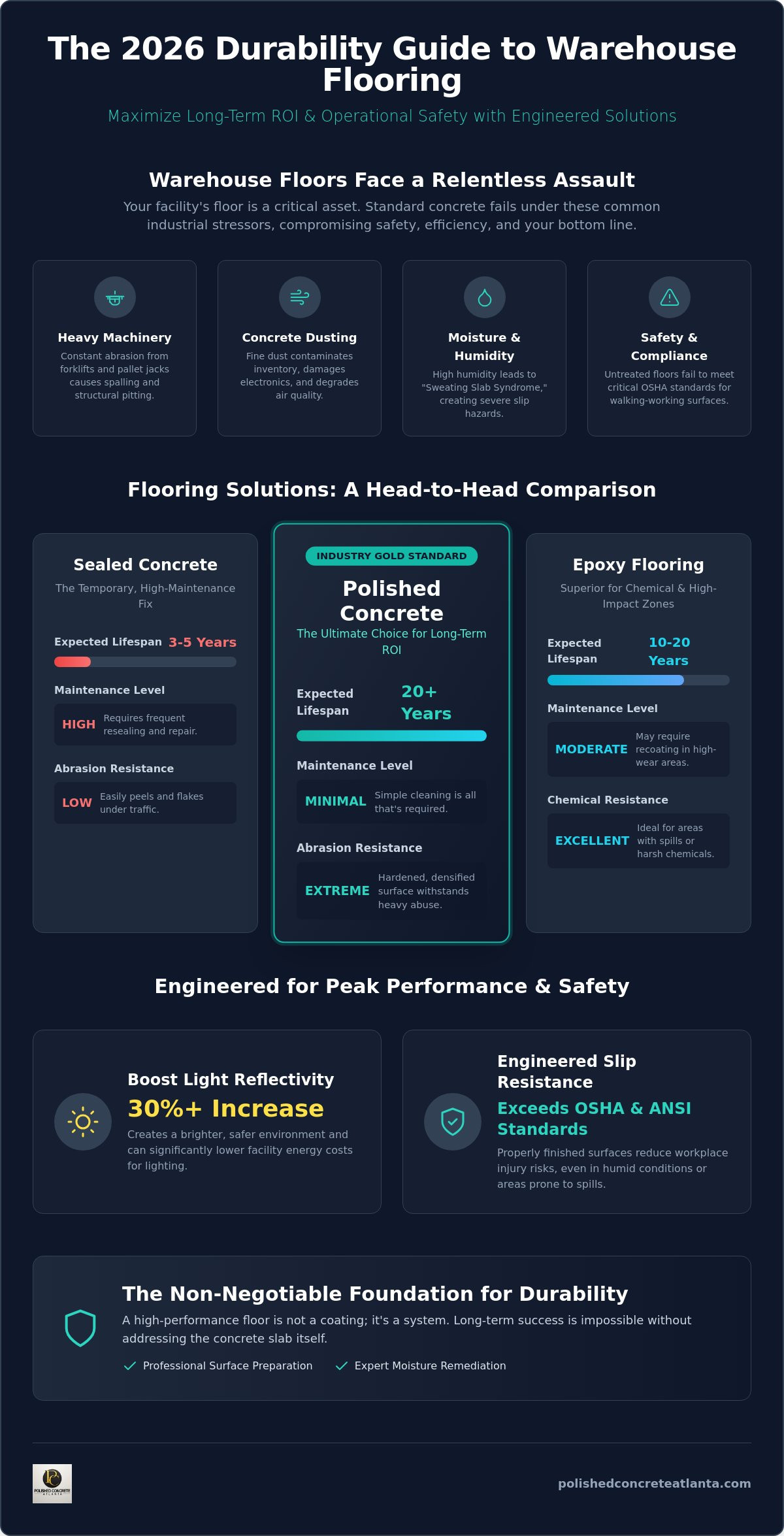
| Feature | Polished Concrete | Epoxy Flooring | Sealed Concrete |
|---|---|---|---|
| Lifespan | 20+ Years | 10 to 20 Years | 3 to 5 Years |
| Maintenance | Minimal | Moderate | High (Frequent Resealing) |
| Light Reflectivity | Highest (30%+ increase) | High | Low |
| Traffic Rating | Extreme Industrial | Heavy Impact/Chemical | Light to Medium |
Polished Concrete: The High-Luster Industrial Choice
Polished concrete represents the gold standard for high-volume logistics hubs. By grinding the existing slab with industrial-grade diamonds and applying chemical densifiers, we transform a porous slab into a rock-hard, non-dusting surface. This isn't just a shine. It's a structural upgrade that eliminates the "dusting" issues discussed previously. For modern facilities, polished concrete floors Atlanta installations offer a lifespan of 20 years or more. They also increase ambient light reflectivity by 30% or more, which directly lowers energy costs. It's the ultimate maintenance-free solution for large-scale operations.
Epoxy and Industrial Coatings for Specialized Zones
Coatings are the correct choice when your operations involve harsh chemicals, frequent washdowns, or extreme impact. High-performance industrial floor coatings Atlanta systems provide a seamless, impermeable barrier that protects the concrete substrate from corrosive spills. These multi-layer systems are engineered for resilience. While they may require recoating every 10 to 15 years, their ability to incorporate safety striping and slip-resistance additives makes them indispensable for battery charging stations or chemical storage. We ensure every installation meets the ANSI A326.3-2021 standard of 0.42 DCOF or higher. Safety is non-negotiable. If you're unsure which system fits your specific load-bearing requirements, consult with our engineering team for a site-specific evaluation.
Sealed concrete serves as a pragmatic entry point for facilities requiring basic dust control on a budget. It's a topical solution that prevents surface degradation but lacks the depth of densification found in polished systems. It's an acceptable choice for short-term leases or low-traffic storage areas where long-term ROI is less critical than immediate cost control.
Engineering for Performance: Slip Resistance, Light Reflectivity, and Maintenance
The best flooring for commercial warehouse facilities doesn't just sit there; it performs. High-performance industrial floors are active assets that contribute to your facility's safety, energy efficiency, and bottom line. Traditional maintenance cycles involving aggressive stripping and waxing are obsolete. They're expensive, time-consuming, and environmentally irresponsible. In 2026, we've moved toward engineered surfaces that require only basic mechanical cleaning. This shift eliminates the chemical build-up that often traps dirt and reduces the floor's functional lifespan. We prioritize long-term integrity over temporary shine.
Regional environmental factors are often the primary cause of floor failure in the Southeast. In humid Georgia warehouses, "Sweating Slab Syndrome" (SSS) is a critical operational risk. When warm, moist air enters a facility and hits a cool concrete slab, condensation forms instantly. This isn't just a nuisance; it's a profound safety hazard that compromises traction for both foot traffic and heavy machinery. Our approach integrates professional moisture mitigation and Sweating Slab Syndrome Remediation to ensure your floor remains dry and functional regardless of the external dew point. We solve the problem at the source.
The Economics of Light Reflectivity
A glossy polished concrete surface can increase ambient lighting in your facility by 30% or more. This "brightness boost" allows facility managers to reduce the number of active light fixtures or lower the wattage of existing LED arrays. The savings are tangible and immediate. In a 50,000-square-foot warehouse, this reduction in energy consumption significantly impacts your overhead. Light Reflectivity Value (LRV) represents the percentage of visible and usable light that reflects off a surface, directly dictating the efficiency of your facility's illumination strategy. By maximizing LRV, you create a safer, more productive environment for your staff while simultaneously lowering your carbon footprint.
Safety Standards and COF Ratings
Safety is a matter of rigorous engineering, not luck. Slips, trips, and falls account for over 200,000 serious workplace injuries annually. To combat this, we adhere to the ANSI A326.3-2021 standard, which mandates a Dynamic Coefficient of Friction (DCOF) of 0.42 or greater for level interior surfaces. High-gloss aesthetics don't have to come at the expense of traction. Experienced concrete floor polishing contractors use specific grit sequences and specialized densifiers to achieve a surface that is both reflective and slip-resistant. For high-risk areas, we integrate non-slip additives into our epoxy systems to ensure total compliance with evolving OSHA standards. We provide the documentation and the performance to give you total peace of mind.
The Strategic Decision: Calculating ROI and Lifecycle Costs
Strategic procurement in industrial facilities requires a transition from looking at initial bids to analyzing the total cost of ownership (TCO). The best flooring for commercial warehouse operations is rarely the cheapest one on day one. It's the one that remains functional for decades. While a basic topical sealer might seem like a budget-friendly entry point, its frequent failure and the need for re-application every three years make it a long-term liability. We focus on engineering surfaces that eliminate the hidden costs of floor failure. When a floor fails, you aren't just paying for repairs. You're paying for rack disassembly, production stoppages, and logistical chaos. Zero compromises.
Protecting your physical asset is equally about maintaining its resale or lease value. A high-performance floor is a significant selling point for future tenants who demand "plug-and-play" reliability. By investing in a surface that lasts 20 years or more, you're effectively future-proofing the building's infrastructure. To maximize your facility's long-term value, partner with an industrial flooring expert who understands the nuances of capital asset protection.
Initial Cost vs. 10-Year Lifecycle
The math behind industrial flooring is definitive. For a 50,000-square-foot facility, choosing polished concrete over epoxy could save over $200,000 over a 20-year period. This massive saving stems from the elimination of recurring recoating requirements. Polished concrete is a one-time structural modification to the slab itself. In contrast, even high-performance epoxy systems typically require a professional refresh every 10 to 15 years depending on traffic intensity. If you opt for a low-cost sealed concrete approach, you'll find yourself trapped in a cycle of constant re-application and downtime. We prioritize the one-and-done solution. Results over excuses.
Sustainability and LEED Credits
Sustainability in 2026 is a core business requirement, not a secondary goal. Polished concrete is the greenest choice for warehouse environments because it leverages the existing slab as the finished surface. This eliminates the need for raw material extraction and the carbon-heavy manufacturing of secondary floor coverings. Furthermore, industrial polishing is a VOC-free installation process. This ensures that air quality remains pristine during and after the project, protecting the health of your warehouse staff. These systems contribute directly to LEED certification points by improving energy efficiency through light reflectivity and utilizing sustainable construction practices. High-end craftsmanship meets environmental ethics.
Implementation Excellence: Why Professional Surface Preparation is the Foundation
Professional surface preparation isn't a suggestion; it's a structural requirement. You can invest in the highest-grade materials, but if the substrate isn't engineered for adhesion, your investment is a ticking clock. The primary cause of industrial floor failure isn't traffic; it's poor preparation. Experienced concrete surface preparation contractors understand that every slab tells a story of its past. Whether it's legacy floor glue removal from previous tenants or the remediation of deep-seated contaminants, we start by stripping the slab back to its profile. We use heavy-duty planetary grinders and precision shot-blasting to create the mechanical bond necessary for long-term performance. This technical rigor is what separates a temporary coating from the best flooring for commercial warehouse systems that actually last. Zero compromises.
Leveling and grinding are the next phases of this engineering process. We address uneven joints and floor flatness (FF) values to ensure your forklift fleet operates without unnecessary vibration or wear. If you have noticed significant slab settlement, you can discover RiseLock Concrete Lifting to professionally level and stabilize the substrate. It's about precision. A floor that isn't level is a floor that's failing your equipment. We don't just smooth things over. We build a foundation. This meticulous attention to detail ensures that the final finish remains intact under the most rigorous point loading and abrasion cycles.Moisture Mitigation and Slab Integrity
Georgia's environmental conditions demand an uncompromising approach to moisture management. Before a single drop of material hits the floor, we conduct rigorous testing for the Moisture Vapor Emission Rate (MVER). High moisture levels in a slab lead to osmotic blistering and total delamination of non-permeable coatings. This is why moisture mitigation is a standard component of our industrial protocol, not an optional add-on. If you're dealing with a compromised substrate, concrete floor restoration Atlanta services can bring a failing slab back to industrial standards. We eliminate the variables. You get peace of mind.
Selecting Your Industrial Flooring Partner
Vetting a contractor for a warehouse-scale project requires looking past the lowest bid. You need a partner with the industrial-scale capacity and specialized diamond tooling required to handle hundreds of thousands of square feet. Searching for concrete floor finishing near me should lead you to a local expert who understands the specific geological and climatic challenges of Atlanta slabs. Don't settle for a generalist. Demand a specialist who manages every detail from the initial grind to the final inspection. The next step in securing your facility's future is a professional site evaluation. We'll assess your slab's condition, identify potential legacy issues, and engineer a solution that meets your specific operational demands. No excuses. Just a floor that performs.
Secure Your Facility's Infrastructure for the Decades Ahead
Your warehouse floor is more than just a surface; it's the structural foundation of your entire supply chain. As we've established, selecting the best flooring for commercial warehouse operations isn't about finding the lowest bid. It's about engineering a slab that eliminates dusting, maximizes light reflectivity, and survives the relentless abuse of heavy-duty machinery. Whether you prioritize the long-term ROI of polished concrete or the chemical resilience of high-performance epoxy, success is built on rigorous surface preparation and expert moisture mitigation. To maintain administrative efficiency during these infrastructure upgrades, many facilities utilize temporary workspace solutions from atlantacontainertrailer.com. Don't let regional humidity or legacy slab issues compromise your production schedules.
With over 20 years of specialized industrial experience, we bring a veteran's perspective to every project. We are the definitive experts in Sweating Slab Syndrome Remediation and full-scale industrial floor preparation. We don't just apply finishes; we engineer reliability. It's time to eliminate the uncertainty of floor failure and invest in a surface that reflects the quality of your brand. Consult with our Atlanta Industrial Flooring Experts today to schedule a site-specific evaluation. Let's build something that lasts.
Frequently Asked Questions
What is the most durable flooring for a high-traffic warehouse?
Polished concrete is the definitive choice for high-traffic environments. It isn't a topical coating that can peel or flake; it's a structural modification that increases the density and hardness of the slab itself. This process ensures the floor withstands the constant abrasion of hard-wheeled forklifts and heavy pallet jacks without losing its integrity. For most facilities, it represents the best flooring for commercial warehouse operations due to its extreme resilience.
How much does polished concrete for a warehouse cost compared to epoxy?
Initial investment costs for polished concrete and epoxy often overlap, but their lifecycle costs diverge sharply. Polished concrete typically requires a higher upfront investment in specialized diamond tooling and labor. However, it eliminates the need for expensive recoating cycles. Epoxy systems are high-performance solutions but require a refresh every 10 to 15 years, making polished concrete the more cost-effective choice over a 20-year horizon. We prioritize long-term ROI over short-term savings.
Can you install epoxy over an old, oil-stained warehouse floor?
We can successfully install epoxy over oil-contaminated slabs, but professional surface preparation is a non-negotiable requirement. We use industrial-grade mechanical grinding and specialized degreasers to strip away contaminants and reach the clean, porous concrete underneath. Without this rigorous preparation, any coating will fail. We don't just cover stains; we engineer a bond that lasts. Results require precision.
How long does a polished concrete warehouse floor last?
A professionally polished concrete floor will last 20 years or more with basic maintenance. In many industrial contexts, it's considered a lifetime flooring solution for the building. Because the process densifies the concrete internally, there's no surface film to wear away or replace. It's a permanent upgrade to your facility's infrastructure. We build for the long haul.
What is the best way to clean and maintain industrial warehouse floors?
The most effective maintenance protocol involves mechanical scrubbing with clean water and a pH-neutral cleaner. You must avoid waxes, topical finishes, or aggressive acidic cleaners that can dull the surface or trap dirt. By using a routine cleaning schedule, you maintain the floor's high-luster finish and slip-resistance without the need for stripping or buffing. It's about simplicity and consistency.
Is polished concrete too slippery for a warehouse with forklift traffic?
Polished concrete is not inherently slippery, even with a high-gloss finish. We engineer our floors to meet the ANSI A326.3-2021 standard, maintaining a Dynamic Coefficient of Friction (DCOF) of 0.42 or higher. This provides ample traction for both pedestrian traffic and heavy machinery. Safety is a matter of technical grit sequences and proper densification. We eliminate the guesswork.
What is moisture mitigation and do I need it for my Atlanta facility?
Moisture mitigation involves managing the vapor emission rate from within the concrete slab to prevent coating delamination. In the humid Georgia climate, this is a critical requirement for any non-breathable flooring system. Without it, you risk Sweating Slab Syndrome and total floor failure. We conduct rigorous MVER testing to determine exactly what your facility needs to remain dry and safe. No excuses.
How long does the installation of commercial warehouse flooring take?
Installation timelines depend entirely on the square footage and the condition of the existing substrate. A standard project involves several days of intensive surface preparation followed by the actual polishing or coating application. We provide a granular, phase-by-phase project schedule after our initial site evaluation to ensure we minimize your operational downtime. We respect your production deadlines.


