The U.S. construction industry burns an estimated $2.4 billion every year on moisture-related floor failures that were entirely preventable. For commercial stakeholders, implementing professional moisture mitigation concrete floors isn't just a recommendation; it's a rigorous engineering requirement. You've likely dealt with the frustration of bubbling epoxy, delaminating finishes, or the chronic headaches caused by Sweating Slab Syndrome. These issues don't just compromise aesthetics. They threaten the structural integrity of your facility and the validity of your warranties.
We understand that you can't afford project delays or the high costs of slab remediation. This guide provides the technical expertise you need to master the mitigation process and eliminate the uncertainty of vapor transmission. We'll examine the critical ASTM F2170 standards for relative humidity, explain why surface-level tests often fail, and outline the high-performance barrier systems that guarantee a permanent solution for your commercial concrete investment. It's time to build with confidence and ensure your flooring stands the test of time.
Key Takeaways
- Understand the physics of osmotic and hydrostatic pressure to diagnose why slabs "sweat" and coatings delaminate.
- Navigate the industry standards for moisture testing, focusing on why in-situ RH probes (ASTM F2170) provide the most accurate data for your project.
- Evaluate the effectiveness of different moisture mitigation concrete floors systems, comparing high-solids epoxy barriers against crystallizing penetrating silicates.
- Follow a disciplined, step-by-step installation process that prioritizes mechanical surface preparation to guarantee maximum adhesion and system integrity.
- Shift from temporary fixes to engineered solutions that protect your commercial investment and provide peace of mind through warranty-compliant preparation.
Understanding Moisture Vapor Transmission in Concrete Slabs
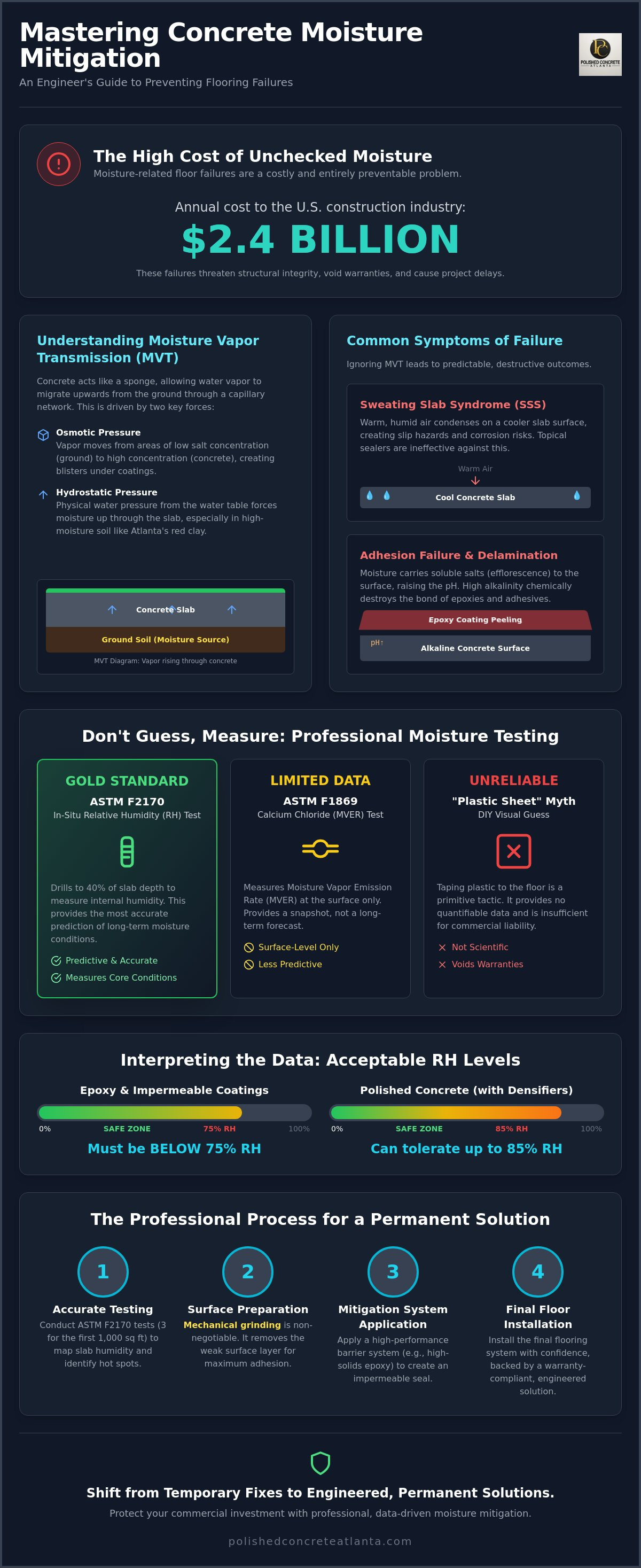
Concrete is inherently porous. It behaves like a dense, rigid sponge. Moisture vapor transmission (MVT) is the relentless upward migration of water vapor through the slab's capillary network. This isn't a static event. It's an active physical process driven by osmotic pressure, hydrostatic pressure, and capillary action. While many contractors view moisture as a minor nuisance, industry leaders recognize it as the primary catalyst for total floor system failure. Physics doesn't negotiate. If you don't account for vapor drive, your flooring investment is at risk.
In the Southeastern United States, the stakes are significantly higher. Atlanta's dense red clay soil retains moisture with stubborn efficiency, creating a constant supply of water beneath your facility. When you combine this with Georgia's notoriously high humidity, you create a pressure differential that forces vapor through the slab. This is why Understanding Damp Proofing fundamentals is essential for any commercial project. Without professional moisture mitigation concrete floors, this vapor accumulates beneath impermeable coatings. The results are predictable: osmotic blistering, delamination, and the rapid growth of mold. We don't leave these factors to chance.
Sweating Slab Syndrome (SSS) Remediation
SSS occurs when warm, humid air makes contact with a cooler concrete slab, causing immediate condensation. It's a common safety hazard in industrial warehouses that leads to slip-and-fall risks and equipment corrosion. Standard topical sealers often fail here because they don't address the underlying thermal mass or the vapor drive from below. Effective Sweating Slab Syndrome Remediation requires an engineered approach that stabilizes the slab's surface energy and manages the dew point. We don't settle for temporary drying. We implement permanent barriers that resolve the root cause.
The Science of Adhesion Failure
Adhesion isn't just about glue; it's about chemistry. As moisture moves through the slab, it carries soluble salts to the surface, a process known as efflorescence. This elevates the pH level of the concrete to corrosive heights. High alkalinity chemically destroys the bond of epoxies and adhesives. A slab that appears "dry to the touch" can still harbor enough internal humidity to push a coating right off the substrate. This is why rigorous concrete surface preparation is non-negotiable. We grind away the weak surface layers to expose the structural integrity of the slab before any mitigation system is applied. Precision is our standard.
How to Test Concrete for Excessive Moisture Levels
Testing concrete moisture isn't a suggestion. It's an insurance policy. Relying on visual inspections or "dry time" schedules is a recipe for disaster. Professional industry standards for moisture testing mandate specific, scientific protocols to ensure the slab can actually support a high-performance finish. We don't guess. We measure.
The In-Situ Relative Humidity (RH) test, governed by ASTM F2170, is the definitive industry gold standard. It involves drilling into the slab and placing probes at a specific depth, typically 40% of the slab's thickness for slabs on grade. This measures the internal humidity that will eventually migrate to the surface. In contrast, the Calcium Chloride test (ASTM F1869) measures the Moisture Vapor Emission Rate (MVER) at the surface. While MVER provides a snapshot of the top layer, RH testing tells you what's coming from the core. Both are valuable, but RH is the superior predictor of long-term success for moisture mitigation concrete floors.
Don't be fooled by the "plastic sheet" myth. Taping a piece of poly to the floor to see if it fogs up is a primitive DIY tactic. It's insufficient for commercial liability. You need data, not a visual guess. Multiple readings across the facility are non-negotiable. A standard protocol involves three tests for the first 1,000 square feet and one for every additional 1,000 square feet. This ensures we identify "hot spots" where moisture levels might spike due to poor drainage or broken vapor barriers.
Interpreting ASTM F2170 Results
Acceptable thresholds vary by finish. Most epoxy systems demand an RH level below 75% to prevent delamination. Polished concrete can often tolerate higher levels, sometimes up to 85% RH, depending on the densifiers used. You must stabilize the building's HVAC for 72 hours before testing to reflect the floor's permanent operating environment. Accurate documentation of these results is the only way to secure manufacturer warranties. If the data shows a spike, you need professional floor moisture mitigation before proceeding.
When to Call a Mitigation Specialist
Red flags in your testing data demand immediate attention. If your RH readings consistently exceed 85% or your MVER is above 3 lbs, you have a deep-slab moisture problem. This is common in older slabs with high water tables or "green" concrete that hasn't reached equilibrium. The cost of professional testing is a minor investment. The cost of a total floor failure is catastrophic. We help you interpret these red flags to ensure your investment remains secure. Precision is the only path to a permanent floor.
Comparing Moisture Mitigation Systems: Barriers vs. Membranes
Selecting a moisture control system is a strategic decision that dictates the lifespan of your facility's floor. There is no "one-size-fits-all" solution. The data gathered during your concrete moisture testing and mitigation phase determines whether you need a topical barrier or a penetrating sealer. We categorize these systems based on their ability to suppress vapor pressure and resist the high alkalinity that often accompanies wet slabs. In high-stakes commercial environments, the wrong choice leads to delamination. The right choice provides an impenetrable shield.
Moisture mitigation concrete floors typically utilize 100% solids epoxy vapor barriers as the primary line of defense. These high-performance resins are engineered to bond tenaciously to the concrete substrate, creating a non-porous layer that halts vapor drive. For projects requiring a different approach, cementitious overlays offer a breathable alternative. These are ideal for slabs where some vapor transmission is acceptable but surface integrity must be maintained. We also evaluate sheet membranes, though these are most effective as under-slab preventatives during new construction rather than as remedial top-side fixes.
The Case for Epoxy Mitigation Systems
100% solids epoxy is the industry standard for a reason. It's uncompromising. These systems are specifically formulated to withstand pH levels as high as 14, which would liquefy standard adhesives. When we prepare polished concrete floors Atlanta facility managers can trust, we often use these barriers to stabilize problematic slabs before the final finish. They provide a predictable, uniform surface that ensures topcoats and finishes remain bonded for decades, regardless of the hydrostatic pressure below.
Ashford Formula and Densification
Penetrating silicates, such as the Ashford Formula, work through a process of crystallization. They react with the calcium hydroxide in the concrete to fill the pores and increase density. This is a highly effective method for managing minor moisture issues and creating a dust-proof surface. It's a core component of high-quality sealed concrete. However, densifiers have limits. They aren't a substitute for a full epoxy barrier when RH levels are extreme. We help you identify that threshold to ensure you don't over-engineer a simple slab or under-protect a saturated one. Real-world results require that level of precision.
The Professional Process for Installing a Moisture Mitigation System
A successful moisture mitigation concrete floors installation is won or lost in the preparation phase. We don't rely on chemical cleaners or simple mopping. Our process is a disciplined, five-step engineering sequence designed to eliminate variables and guarantee a permanent bond. It begins with comprehensive surface mapping to identify high-risk zones where vapor drive is most aggressive. This data driven approach ensures we apply the right amount of protection exactly where it's needed most.
Mechanical preparation is the most critical stage. We use heavy duty planetary grinders or shot blasting equipment to achieve the specific Concrete Surface Profile (CSP) required by the mitigation manufacturer. For most high performance barriers, a CSP of 3 to 5 is non-negotiable. This process removes the weak surface laitance and opens the concrete's pore structure, allowing the mitigation agent to penetrate deeply. If you're dealing with a renovation, this stage must include professional floor glue removal Atlanta to ensure no residual adhesives interfere with the new system. We don't settle for "clean enough." We aim for structural purity.
Once the substrate is mechanically profiled, we address deep seated contaminants like oils and grease that grinders might miss. Only then do we apply the mitigation agent. We follow manufacturer specifications with surgical precision, ensuring the correct spread rate to achieve the required mil thickness. The process concludes with post application verification to confirm the barrier is monolithic and free of defects. We verify the bond so you don't have to worry about it later.
Mechanical Prep: Grinding and Shot-Blasting
Our expertise in concrete grinding and polishing Atlanta allows us to prepare slabs with a level of accuracy that general contractors often overlook. We don't just rough up the surface. We engineer the profile to maximize the surface area for chemical and mechanical adhesion. This is the only way to prevent the bond failure that plagues sub-standard installations. Precision grinding is the foundation of every shield we build.
Avoiding Common Installation Failures
One of the most common causes of concrete floor failing after coating is outgassing. This happens when air trapped in the concrete pores expands as the building warms up, creating pinholes in the curing barrier. We manage this by applying coatings during a descending temperature cycle, typically in the late afternoon or evening. This simple, professional adjustment prevents vapor from blowing through the wet resin and compromising the shield. We account for environmental variables that others ignore.
If you are ready to secure your facility's future, contact our team for expert floor moisture mitigation services today.
Why Polished Concrete Atlanta is the Authority in Moisture Remediation
Georgia's geological profile presents a unique set of challenges that generic flooring contractors aren't equipped to handle. Our mastery of moisture mitigation concrete floors is rooted in decades of navigating the state's high water tables and pervasive red clay. We don't just apply a topical coating and hope for the best. Instead, we engineer the entire concrete surface preparation sequence to ensure every chemical bond is permanent. This holistic approach is why industrial facility managers trust us with their most critical infrastructure. We eliminate the guesswork that leads to costly delamination.
Our technical expertise in Sweating Slab Syndrome remediation sets us apart as a true authority. We use advanced diagnostic tools to map moisture vapor transmission and design systems that work with the slab's thermal mass. We own the results. We manage the equipment. We lead the strategy. This uncompromising commitment to quality ensures your floor remains a high-performance asset rather than a recurring maintenance liability. We don't settle for mediocrity. You shouldn't either.
Total Project Management for Industrial Floors
We handle the entire lifecycle of your project. This includes everything from initial floor glue removal to the final high-gloss polish. You won't have to manage multiple vendors or reconcile conflicting advice. We provide a single point of accountability. Our strategies are customized to your facility's specific moisture profile, ensuring you don't overspend on unnecessary barriers or under-protect a high-risk slab. Transparent consultation is our standard. We prioritize long-term value over quick, superficial fixes. If a slab isn't ready, we tell you why and how to fix it correctly. Integrity is the core of our partnership.
Ready to Secure Your Facility's Foundation?
Floor failure isn't just an aesthetic issue; it's a major business interruption. Getting it right the first time is the only way to avoid the catastrophic costs of downtime and remediation. Professional moisture mitigation concrete floors are the ultimate insurance policy for your commercial flooring investment. We provide the technical certainty you need to move forward with confidence. For facilities requiring structural stabilization or specialized mold remediation, Foundation ResQ offers the technical expertise to address these fundamental concerns. Don't leave your facility's foundation to chance. Contact us for a professional site assessment and moisture test today. Let's build a shield that stands the test of time.
Secure Your Facility's Future with Engineered Precision
Success in commercial flooring is defined by what happens beneath the surface. You've seen that moisture is a dynamic force, capable of destroying even the most expensive coatings through osmotic pressure and high alkalinity. By prioritizing rigorous ASTM F2170 RH testing and selecting the correct barrier system, you transform a potential liability into a stable foundation. Professional moisture mitigation concrete floors are the only way to ensure your facility remains operational and your warranties stay intact. Precision isn't optional; it's the standard.
Don't leave your project's success to chance or settle for contractors who skip the critical mechanical preparation phase. We bring decades of Atlanta-specific industrial experience and advanced remediation capabilities to every slab we touch. As specialists in Sweating Slab Syndrome Remediation with advanced ASTM F2170 RH testing capabilities, we provide the technical certainty you deserve. Protect your investment—Schedule a professional moisture assessment with Polished Concrete Atlanta today. It's time to build a floor that reflects the excellence of your business.
Expert Answers on Concrete Moisture Control
What are the signs that my concrete floor needs moisture mitigation?
Visible signs include osmotic blistering, where small bubbles form under a coating, or total delamination where the floor peels away from the substrate. You may also notice efflorescence, which is a white, powdery salt deposit on the surface, or "sweating" where the slab appears damp despite no plumbing leaks. These indicators suggest that vapor drive is actively pushing moisture and alkalis to the surface, threatening any finish you apply.
Can I install epoxy over a wet concrete slab if I use a primer?
No, standard primers are not designed to withstand the hydrostatic pressure or high pH levels of a wet slab. You must use a specialized 100% solids epoxy barrier specifically engineered for moisture mitigation concrete floors. These systems create a tenacious bond that standard adhesives can't match, preventing the chemical breakdown that occurs when moisture meets high-alkalinity concrete.
How long does the moisture mitigation process take to complete?
A professional installation typically requires 48 to 72 hours from start to finish. This timeframe includes the essential mechanical surface preparation, the application of the barrier agent, and the necessary cure time before any topcoats are installed. If your facility has deep-seated contamination or extreme humidity levels, we may extend the schedule to ensure the slab is fully stabilized and the bond is verified.
Is moisture mitigation necessary for polished concrete floors?
It depends on the results of your ASTM F2170 relative humidity testing. While polished concrete is naturally breathable and handles vapor better than epoxy, excessive moisture still causes Sweating Slab Syndrome and unsightly mineral staining. If your RH readings are high, we utilize penetrating silicates or advanced densifiers to reduce porosity and protect the slab's long-term aesthetic and structural integrity.
What is the difference between a vapor barrier and a moisture retarder?
The primary difference is the material's permeability, or "perm," rating. A true vapor barrier is nearly impermeable, with a perm rating below 0.1, effectively stopping almost all vapor transmission. A moisture retarder only slows the movement of water vapor. In high-performance industrial environments, we don't settle for retarders; we specify full barrier systems to eliminate the risk of floor failure.
How much does professional moisture mitigation cost for commercial spaces?
The investment required depends on the slab's square footage, the severity of the moisture vapor emission rate, and the extent of the necessary surface preparation. We don't provide generic estimates because every slab has a unique moisture profile. Instead, we perform a detailed site assessment to determine the specific engineering requirements of your facility. This ensures you only pay for the level of protection your environment actually demands.
Will a dehumidifier solve my concrete moisture problems?
No, a dehumidifier only manages the ambient air above the floor. It doesn't address the moisture vapor drive coming from the soil through the concrete's capillary network. In some cases, running a dehumidifier can actually worsen the problem by increasing the pressure differential, which pulls even more moisture up through the slab. You need a topical or penetrating barrier to solve the issue at the source.
Does new concrete always need a moisture mitigation system?
New concrete often requires moisture mitigation if the project schedule doesn't allow for a natural drying cycle, which can take months. Even if a slab is "cured" after 28 days, it may still hold a high water-to-cement ratio that exceeds manufacturer limits for flooring. Installing a top-side moisture mitigation concrete floors system is a standard practice to ensure new construction projects stay on schedule without risking future delamination.


