In 2025, OSHA citations for silica violations in construction surged by 22 percent. It's a sobering reminder that industry standards wait for no one. For facility managers, the choice of polished concrete floors Atlanta commercial spaces require has shifted from a design preference to a strategic necessity. You've likely dealt with the relentless cycle of stripping VCT or replacing moisture-damaged carpets. It's expensive. It's disruptive. Most importantly, it's unnecessary.
You know that a floor failure means more than just a repair bill; it means operational downtime and compromised safety. We promise to show you how to achieve a premium finish that stands the test of time while meeting the newest 2026 regulatory standards. We'll examine the critical synergy between moisture mitigation and high-performance polishing to ensure your facility remains at the forefront of efficiency and durability.
Key Takeaways
- Shift your facility's paradigm from temporary topical coatings to the mechanical durability of the current Atlanta standard.
- Understand the five-step progression of diamond abrasives and why floor preparation dictates the final quality of the project.
- Address the Georgia humidity factor by implementing moisture mitigation strategies essential for long-term polished concrete floors Atlanta installations.
- Compare the life-cycle value of polished concrete against specialized epoxy systems to select the right fit for your specific operational demands.
- Learn how a dedicated partner eliminates uncertainty by solving structural issues before the first diamond grind begins.
What is Polished Concrete and Why is it the Atlanta Standard?
Polished concrete isn't a product you buy in a bucket. It isn't a topical film that eventually peels or flakes away under the Georgia sun. Instead, it's a rigorous mechanical process that transforms existing slabs into high-performance surfaces. Understanding What is Polished Concrete involves recognizing it as a multi-step refinement of the concrete itself, utilizing industrial-grade diamonds to grind, hone, and polish the surface to a specified level of gloss and aggregate exposure. When you invest in the polished concrete floors Atlanta businesses demand, you're investing in a permanent structural upgrade. No shortcuts.
Facility managers across Midtown and Buckhead are moving away from the high-maintenance cycles of VCT and carpet. Why? Because the traditional options fail. They trap moisture, require constant waxing, and eventually end up in a landfill. Polished concrete offers a permanent solution. It leverages the thermal mass of the building and dramatically increases light reflectivity. In large-scale Atlanta facilities, this reflectivity isn't just about aesthetics; it's a strategic move to reduce artificial lighting requirements and lower monthly energy expenditures. It's pragmatism meeting performance.
The Science of Densification and Refinement
True polishing requires a chemical evolution within the slab. We apply liquid densifiers that penetrate the pores of the concrete, reacting with the calcium hydroxide to create a crystalline structure. This fills the microscopic voids, making the surface significantly harder and more resistant to abrasion. There's a definitive difference between a "grind and seal" project, which relies on a thin topical layer, and true mechanical polishing. Why settle for a floor that requires a replacement every five years? Densification is the critical component that eliminates concrete dusting in high-traffic industrial environments. It turns a porous, dusty floor into a solid, impenetrable asset.
Why Atlanta Industries are Making the Switch
The transition is visible across every major sector in the metro area. In the massive logistics hubs surrounding Hartsfield-Jackson, polished concrete floors Atlanta operators utilize must withstand relentless forklift traffic. Polished concrete prevents "tire burning" and resists the heavy impact of 24/7 operations. Retailers and high-end showrooms in the Design District choose it for the mirror-like finish that elevates their brand without the constant replacement costs of luxury vinyl or tile. Even in educational and healthcare settings, the choice is clear. These floors are hypoallergenic and incredibly easy to sanitize, providing a healthy environment for Georgia's students and patients. It's about long-term value. It's about a floor that works as hard as you do.
The 5-Step Professional Polishing Process
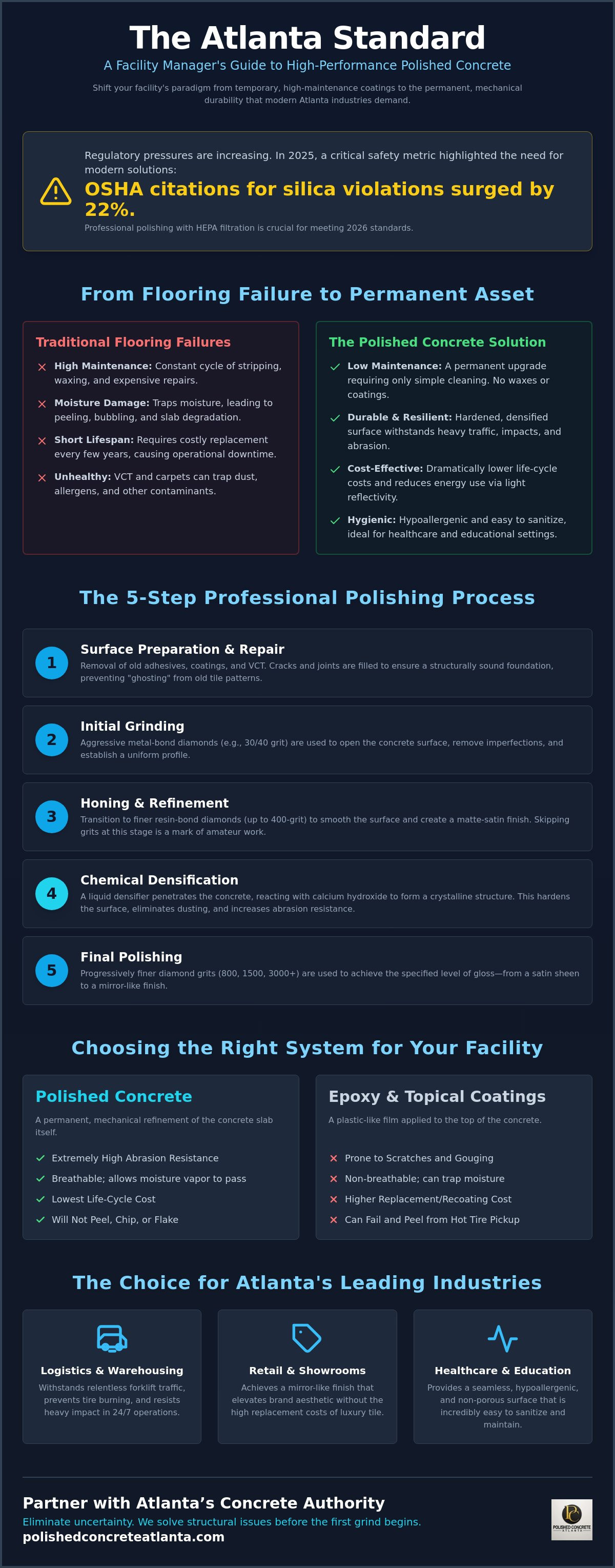
The quality of polished concrete floors Atlanta facilities rely on is determined long before the final shine appears. It's a mechanical progression that demands discipline. If the preparation is flawed, the floor is flawed. We don't mask imperfections with topical coatings; we eliminate them through systematic refinement. This process requires heavy-duty planetary grinders and specialized diamond tooling that must be used in a specific, uncompromised sequence. To ensure a safe environment, we utilize industrial HEPA-filtered vacuums to maintain a near-dustless workspace, exceeding the 2026 OSHA silica dust standards that saw a 22 percent increase in citations last year. Safety and quality are non-negotiable.
Phase 1: Surface Preparation and Glue Removal
The foundation of an elite floor is the total destruction of its predecessor. We begin by removing old adhesives, thin-set, and failing coatings that often hide beneath carpet or VCT. Without professional floor glue removal Atlanta projects often suffer from "ghosting," where the old tile patterns remain visible through the finished polish. We grind the slab down to clean, virgin concrete. This stage is also where we address structural repairs, filling cracks and joints to ensure the surface meets the 2024 International Building Code requirements now in effect across Georgia. If the slab isn't structurally sound, the polish won't be either.
Phase 2: Grinding and Honing
We transition from aggressive metal-bond diamonds to resin-bond hones. This is where the floor's personality is established. We typically start with a coarse 30/40 grit to open the surface and move methodically toward a 400-grit hone for a matte-satin finish. Skipping a single step in this grit sequence is a hallmark of amateur work. It leads to visible scratches and premature floor failure. If your project requires decorative stains or dyes, we introduce them at the end of the honing stage, allowing the pigment to penetrate deep into the open concrete pores before the surface is closed by higher grits.
Phase 3: Polishing and Sealing
The final transition is about light and protection. We use higher-grit resin diamonds to achieve the desired luster, ranging from a Level 1 matte to a Level 4 high-gloss mirror finish. While we often discuss Polished Concrete vs. Epoxy for different industrial needs, true mechanical polishing relies on an impregnating sealer or "guard." This liquid treatment penetrates the surface to protect against spills without creating a film that can peel. We finish with a high-speed burnish to "lock in" the shine and maximize slip resistance. The result is a floor that doesn't just look premium; it performs at a world-class level. If you are ready to upgrade your facility, consult with a specialist who understands the technical demands of Georgia's industrial slabs.
Solving the "Atlanta Humidity" Problem: Moisture Mitigation
Many facility managers in the Southeast have experienced the frustration of a floor that looks perfect on day one but begins to peel or cloud within months. The question is always the same: "Why is my concrete floor failing?" In Georgia, the answer is almost always beneath the surface. Atlanta's dense red clay and legendary humidity create a perfect storm for hydrostatic pressure. This pressure forces water vapor upward through the porous concrete slab, a process known as the Vapor Emission Rate (MVER). If this vapor drive isn't managed, it can delaminate coatings or cause unsightly efflorescence on even the best polished concrete floors Atlanta has to offer.
Think of moisture mitigation as a non-negotiable insurance policy. You wouldn't build a high-rise on a swamp without a foundation; you shouldn't polish a slab without understanding its water content. By adhering to the latest American Concrete Institute (ACI) standards, we eliminate the guesswork. We treat moisture as a structural variable that must be solved, not a minor detail to be ignored. If your contractor isn't talking about vapor drive, they aren't protecting your investment. Ensuring the longevity of polished concrete floors Atlanta facilities require starts with a scientific approach to sub-slab dynamics.
Testing for Moisture Before You Polish
Visual inspections are worthless. A slab can "look dry" while harboring enough moisture to ruin a finish. We utilize two primary scientific methods: Calcium Chloride tests (ASTM F1869), which measure the MVER at the surface, and Relative Humidity (RH) probe testing (ASTM F2170), which measures the moisture deep within the slab. Industry standards typically suggest that an RH level above 75% or 80% requires intervention. We don't guess. We verify. If the data shows high levels of vapor emission, we pivot to a mitigation strategy before the first diamond touches the floor. It's the only way to ensure 20+ years of performance.
Professional Mitigation Solutions
When tests reveal a high vapor drive, we deploy specialized systems to suppress it. This often involves high-performance epoxy moisture barriers designed to withstand significant hydrostatic pressure. Unlike a simple topical sealer, these systems are engineered to bond at a molecular level, creating an impermeable shield that stops water vapor in its tracks. For slabs with less severe issues, we may use deep-penetrating treatments that react with the concrete's chemistry to close off capillary tracts. You can review our technical specifications for moisture mitigation concrete floors to see how we tailor these solutions to Georgia's specific soil conditions. We solve the moisture problem so you never have to think about it again.
Polished Concrete vs. Epoxy: Choosing the Right System
Selecting the right flooring system is a technical decision that impacts your bottom line for decades. It isn't just about what looks better in a brochure. You need a system that survives your specific operational environment. While polished concrete floors Atlanta facilities install are the gold standard for durability and light reflectivity, epoxy systems have a definitive place in the industrial hierarchy. The choice depends on your facility's daily exposure to chemicals, impact, and moisture.
Epoxy flooring is the superior choice for environments facing aggressive chemical exposure, such as pharmaceutical labs or heavy food processing plants where organic acids are present. It provides a seamless, non-porous barrier that polished concrete cannot match in those specific niches. However, for high-traffic warehouses, big-box retail, and corporate lobbies, polished concrete is the undisputed winner. It won't peel. It won't flake. Unlike epoxy, which relies on a topical bond that can be compromised by sub-slab moisture, polished concrete is an integral part of the slab itself. It's a permanent solution for a permanent building.
Total Cost of Ownership (TCO) Analysis
A true Total Cost of Ownership analysis reveals the hidden traps of cheaper alternatives. VCT is a liability. The constant need for stripping and waxing creates a recurring expense that often exceeds the initial installation cost within three years. Epoxy is a robust mid-term solution, but it typically requires a sand-and-recoat every five to seven years depending on traffic. When evaluating the polished concrete floors Atlanta facility managers prefer, the primary differentiator is the 20-year lifespan. By eliminating the replacement cycle and reducing facility downtime during repairs, it offers the lowest TCO of any commercial flooring system available today.
Maintenance Protocols for High-Traffic Floors
Don't fall for the "no maintenance" myth. It doesn't exist. Polished concrete is low maintenance, but it requires a disciplined protocol to preserve its densified surface. You must use pH-neutral cleaners for daily scrubbing. Standard floor strippers or acidic detergents will etch the surface and destroy the luster you've invested in. For Level 4 high-gloss floors, a professional re-guarding and high-speed burnish is typically required every 18 to 24 months in high-traffic zones to maintain peak reflectivity and slip resistance. If you're ready to stop the cycle of temporary flooring fixes, contact our team for a professional consultation.
Partnering with Atlanta’s Concrete Authority
Since 2004, Polished Concrete Atlanta has defined the standard for high-performance surfaces in the metro area. We don't settle for mediocrity. Our legacy is built on a foundation of professional assertiveness and technical mastery. When you hire us, you aren't just getting a crew with a grinder; you're partnering with a team that views your slab as a structural asset. We solve the underlying issues that others ignore. We own every piece of our industrial equipment, from our heavy-duty planetary grinders to our advanced HEPA-filtration systems. We never sub-contract your quality. This total control ensures that the polished concrete floors Atlanta facility managers expect from us are delivered on time and without compromise.
Our "No-Nonsense" philosophy means we prioritize tangible results over polished sales pitches. We've seen every possible scenario in the Georgia landscape. From high-impact CrossFit gyms in Buckhead to sprawling distribution warehouses in Gwinnett and local school districts, our portfolio is a testament to our versatility. We understand that your facility cannot afford to stop moving. We work with surgical precision to minimize your operational downtime while maximizing the long-term value of your investment. We don't just polish; we provide peace of mind.
Our Commercial and Industrial Expertise
Large-scale projects demand a level of discipline that smaller residential outfits simply cannot match. We specialize in the high-pressure environment of commercial construction and industrial retrofits. If your project is on a tight schedule, we have the manpower and the machinery to meet it. Our consultative approach ensures that we find the exact balance of aggregate exposure and gloss level to match your brand's aesthetic and safety requirements. Honesty and transparency are the hallmarks of our strategic alliances. If a slab is a poor candidate for polishing, we'll tell you upfront and offer a viable alternative like high-performance epoxy flooring. We're here to build long-term value, not just close a sale.
Get Your Professional Floor Assessment
The path to a fail-proof installation begins with a rigorous scientific assessment. During our site visit, we don't just measure square footage. We perform a granular breakdown of your floor's current state. We handle the heavy lifting of floor prep, glue removal, and the moisture testing protocols discussed earlier in this guide. We analyze the concrete's hardness and its ability to accept densification. You'll receive a definitive roadmap for your project that eliminates uncertainty and outlines exactly how we will achieve your desired outcome. Don't leave your facility's foundation to chance. Schedule your Atlanta facility floor consultation today and experience the difference that twenty years of industry leadership makes.
Secure the Future of Your Facility Floors
The decision to upgrade your facility's foundation is a commitment to long-term operational efficiency. You've seen how a disciplined mechanical process outperforms temporary topical coatings every time. You now understand that in Georgia's humid climate, scientific moisture testing is the only way to prevent premature failure and delamination. By choosing the polished concrete floors Atlanta industries rely on for durability and high reflectivity, you are effectively eliminating the expensive, recurring cycle of stripping and waxing.
Our team has served the region's commercial and industrial sectors since 2004. As specialists in high-stakes moisture mitigation and complex floor preparation, we bring decades of field-tested experience to every project. We don't just provide a surface; we provide a permanent structural solution that protects your bottom line. It's time to stop managing floor failures and start investing in craftsmanship that lasts. Your facility deserves a floor that performs as hard as your team does.
Get a Professional Estimate for Your Atlanta Facility
Frequently Asked Questions
Is polished concrete too slippery for a commercial lobby?
Polished concrete is not inherently more slippery than other hard surfaces and often exceeds ADA friction requirements. The high-gloss finish creates an optical illusion of wetness, but the mechanical process actually increases surface contact. We can also add slip-resistant additives to the final guard for high-traffic lobbies to ensure total safety without compromising the aesthetic.
How much does polished concrete cost per square foot in Atlanta?
Pricing for polished concrete floors Atlanta projects depends on the current state of the slab and the desired aggregate exposure. Factors like old glue removal, moisture mitigation, and the number of grit stages determine the final investment. While square footage impacts the rate, every project requires a custom assessment to ensure accurate budgeting. We don't provide "ballpark" guesses because we prioritize precision.
Can any existing concrete floor be polished?
Most existing slabs are candidates for polishing, provided they are structurally sound and have sufficient compressive strength. Slabs with excessive cracking or soft, "rain-damaged" surfaces may require extensive floor preparation before the polishing process begins. We evaluate every slab's integrity during our initial site visit to eliminate uncertainty. If the concrete is too compromised, we'll recommend a more suitable industrial system.
How long does the concrete polishing process take?
A professional crew typically completes between 1,000 and 2,500 square feet per day depending on the complexity of the finish. Factors like the number of edges, the presence of old coatings, and the final gloss level will influence the timeline. We provide definitive schedules to ensure your facility's operations aren't disrupted. We respect your time and your production deadlines.
What is the difference between polished concrete and a "grind and seal"?
A "grind and seal" is a topical application where a clear coating is placed over a lightly ground surface. True polished concrete is a mechanical refinement that changes the slab's internal structure. It doesn't rely on a film that can peel. It's a permanent upgrade, not a temporary coating. The difference is found in the longevity and the maintenance requirements.
Does polished concrete help with LEED certification?
Polished concrete is a primary contributor to LEED certification in commercial buildings. It utilizes the existing slab to reduce material waste and eliminates the need for VOC-heavy adhesives or coatings. The high reflectivity can also lower the energy required for interior lighting. It's a sustainable choice that aligns with modern environmental standards for Atlanta's industrial and retail sectors.
How do I remove oil stains from a polished concrete floor?
You should treat oil spills immediately with a pH-neutral degreaser or a specialized poultice designed for concrete. Never use acidic cleaners or harsh solvents. These will etch the surface and destroy the densified finish. Regular maintenance with a neutral cleaner prevents most contaminants from penetrating the pores of polished concrete floors Atlanta facilities maintain. Quick action preserves the finish.
Why is my concrete floor "dusting" and can polishing fix it?
Concrete "dusting" occurs when the surface is weak or improperly cured, leading to a constant release of fine powder. Mechanical polishing and chemical densification solve this permanently. The process hardens the surface and seals the pores. This turns a dusty liability into a clean, industrial-grade asset that is safe for both equipment and personnel.


