

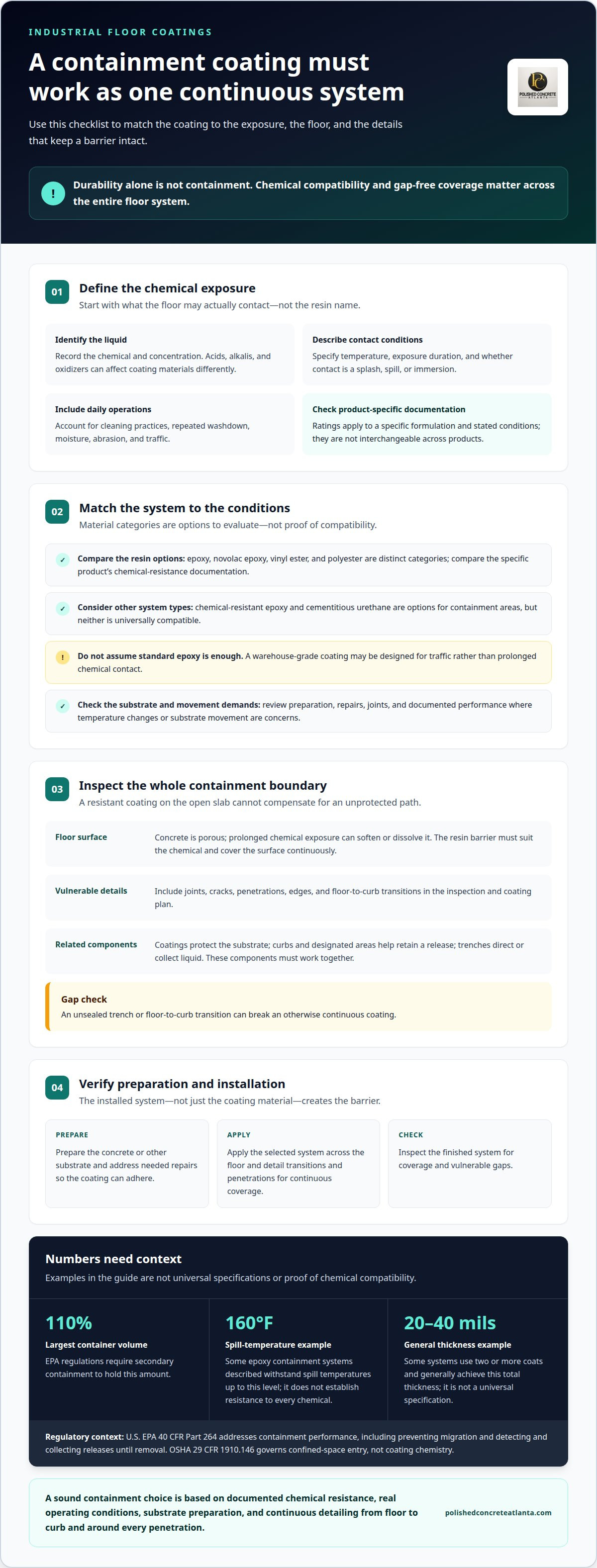
A warehouse floor coating isn’t automatically a containment system. Industrial floor coating for chemical spill containment needs to create a continuous, chemically resistant barrier, including around vulnerable transitions and penetrations. The right system depends on the chemicals involved and the conditions the floor must withstand.
An industrial floor needs to handle heavy use, but spill containment requires more than durability or an easy-to-clean finish. Chemical exposure, moisture, traffic, and the concrete’s condition all affect coating performance. Assessing these factors helps guide the system choice.
This guide explains why containment areas need specialized coatings, how epoxy and other resin systems differ, and what professional installation involves. It also covers why preparation, repairs, and careful detailing are essential to continuous coverage, along with the facility information that helps shape the project. Clear requirements support a better-informed flooring decision.
Key Takeaways
- Choose a containment coating around the chemicals and site conditions it must withstand, not appearance alone.
- Compare epoxy, novolac epoxy, vinyl ester, and polyester by their chemical resistance and the demands of the facility.
- Pay close attention to floor-to-curb transitions, cracks, and penetrations, where gaps can undermine a continuous lining.
- Expect professional installation to include concrete preparation, repairs, coating application, and checks on the finished system.
- Learn how Polished Concrete Atlanta’s epoxy flooring and floor preparation services can support an industrial flooring project.
Why is standard epoxy coating insufficient for most secondary containment applications?
A standard epoxy coating isn’t automatically suitable for secondary containment. Chemical resistance, continuous coverage, and details such as joints matter more than a general-purpose floor finish.
Resistance to Acids, Alkalis, and Oxidizers
Acids, alkalis, and oxidizers can affect coating materials differently. A system that tolerates one spill may not withstand another, so identify the chemicals, concentrations, contact conditions, and cleaning practices. Chemical-resistant epoxy and cementitious urethane are options for containment areas, but neither is universally compatible. Match the system’s documented resistance to the facility’s actual exposure.
Concrete is porous, and prolonged chemical exposure can soften or dissolve it. A continuous resin barrier can help protect concrete and steel from spilled material, but only if the coating suits the chemical and covers the surface without gaps. Consider floor joints, cracks, penetrations, and edges as well as the open floor area. A resistant coating on the main slab cannot make up for an unprotected path through a joint.
Chemical Resistance Ratings and Immersion Limits
Ratings and immersion limits describe a specific coating formulation under stated exposure conditions; they are not interchangeable across all epoxy, vinyl ester, or polyurethane products. Compare the chemical name, concentration, temperature, exposure duration, and whether contact is a splash, spill, or immersion. Some epoxy coating systems described for containment withstand spill temperatures up to 160F, but that figure alone does not establish resistance to every chemical.
For an industrial containment system, chemical compatibility comes first, followed by abrasion, moisture, and cleaning requirements. A short spill removed promptly differs from prolonged contact or repeated washdown. These conditions affect material selection and detailing. A resin’s name alone does not establish its performance.
Chemical-Resistant Coating System Options
Chemical-resistant epoxy and cementitious urethane systems can protect containment areas, but selection depends on the chemicals and operating conditions. Epoxy containment coatings can also protect concrete, plastic, steel, wood, and asphalt. The substrate matters: concrete and steel need suitable preparation and repairs so the coating can adhere and form a continuous barrier.
A coating, a containment liner, and a trench system serve related but distinct purposes. The coating protects the substrate, while curbs and designated containment areas help retain a release; trenches direct or collect liquid. The materials must work together as a complete system. An unsealed trench or floor-to-curb transition, for example, can break an otherwise continuous coating.
Federal requirements address containment performance, not a universal epoxy rating. Under U.S. EPA 40 CFR Part 264, hazardous-waste secondary containment systems must prevent waste or accumulated liquid from migrating to soil, groundwater, or surface water, and detect and collect releases until removal. EPA regulations require secondary containment to hold 110 percent of the largest container’s volume. OSHA’s Permit-Required Confined Spaces standard, 29 CFR 1910.146, governs confined-space entry, not coating chemistry. Applicable facility requirements and permits also shape Atlanta projects.
There is no single per-square-foot price that applies to every U.S. facility. The price depends on the case and is given after a quote request; factors include the chemical exposure, coating system, floor condition, repairs, and containment details.
Epoxy, novolac epoxy, vinyl ester, and polyester resins
Resin names alone don’t show whether a coating will protect a chemical containment area. Match the specific system to the liquid, substrate, temperature, and physical demands at the facility.
Failure risks include chemical attack, loss of adhesion, cracking, or gaps that allow a spill to reach the substrate. Risk increases when the coating’s documented capabilities don’t match actual exposure.
Comparing Resin Types
Epoxy, novolac epoxy, vinyl ester, and polyester are distinct resin categories, but their names don’t provide a complete chemical-resistance rating. Compare product-specific documentation for the chemicals and exposure conditions involved. Epoxy containment systems can protect concrete, plastic, steel, wood, and asphalt. A specific epoxy coating described for containment withstands spill temperatures up to 160F; that figure doesn’t establish resistance to every liquid.
Flexible Epoxy and Vinyl Ester Technologies
“Flexible epoxy” and “vinyl ester” describe material categories, not guaranteed movement tolerance or chemical compatibility. If a facility has temperature fluctuations or a substrate prone to movement, review documented performance for the specific system and exposure. Consider how the material works with joints and transitions. A seamless finish depends on the complete installed system, not the resin name alone.
Standard Epoxy Limitations
A standard epoxy coating isn’t automatically adequate for secondary containment. A warehouse-grade coating may be designed for traffic rather than prolonged contact with chemicals. Epoxy formulations also differ, so a general epoxy label can’t establish resistance to a particular acid, alkali, or oxidizer. Review the chemical exposure and temperature conditions before selecting a coating for containment.
Some epoxy containment systems are applied in two or more coats and generally achieve a total thickness of 20-40 mils. These figures describe general system practices, not a universal specification for every facility. The exposure, substrate, and system design determine what is appropriate. A coating chosen only for appearance or routine traffic may leave the containment requirement unmet.
Chemical Spill Failure Risks
If a spill exceeds a resin’s chemical resistance, the coating can deteriorate and expose the concrete or steel beneath it. Poor adhesion can cause blisters or peeling, while cracks and unsealed edges can break containment. For example, prolonged exposure to liquid that reaches porous concrete may soften or dissolve it. Chemical compatibility, substrate preparation, and continuous coverage all affect spill protection.
Before selecting a system, align chemical exposure, temperature, substrate, and physical demands with product documentation. That comparison makes the difference between a general floor finish and a coating specified for containment. For project planning, review floor coating requirements alongside the facility’s exposure conditions.
Is containment coating the same as warehouse floor coating?
No. A warehouse coating is generally selected for traffic and durability, while a chemical containment lining must also resist the facility’s chemical exposure and provide continuous protection across floors, curbs, and penetrations.
In manufacturing settings, chemical storage and transfer areas face different demands from ordinary warehouse aisles. A spill can reach joints, pipe openings, trenches, or sumps, so preparation and detailing matter as much as the coating’s resistance across the main floor.
Transitions and Penetrations Need Continuous Protection
Floor-to-curb transitions are vulnerable because the floor and curb meet at an angle and may move differently. A gap or thin coating at that junction can interrupt containment. Pipe penetrations, cold joints, cracks, trenches, and sumps can also create leak paths. A containment lining should continue across the floor and designated curb height, with transitions and penetrations detailed as part of the system.
Some flake-filled systems use fiberglass matting at wall and floor transitions to help create seamless protection. That detail doesn’t replace proper preparation: concrete still needs a sound, even surface, and existing cracks or failed coating need attention before application.
Moisture and Substrate Conditions
Concrete can move as temperatures change and moisture migrates through the substrate. This movement may contribute to cracks or shifting beneath a coating. Moisture vapor transmission can also weaken adhesion or cause blistering. A moisture mitigation system manages vapor transmission, while a vapor barrier may be installed beneath flooring in on-grade or below-grade containment areas without existing moisture protection.
Before applying a new system, preparation should account for the slab’s condition and moisture behavior. For example, coating over a blistered old layer may carry forward adhesion problems instead of solving them. Sound preparation supports continuous coverage across open floor areas and detailed edges.
Inspection, Cleaning, and Repair
Maintenance means keeping the coating clean and inspecting it for cracks, blisters, worn areas, and damage near penetrations or floor-to-curb transitions. After a spill or cleaning, note visible changes that could interrupt the containment surface. Inspection frequency should reflect the chemicals, washdown practices, traffic, and facility procedures; no single interval suits every floor.
For repairs, failed coating is removed, substrate damage addressed, and the surface prepared before relining. Existing containment pads can often be relined after failed material is removed and the substrate repaired. This sequence helps restore continuity across the affected floor, curb, trench, or sump instead of simply covering a damaged spot.
Chemical spill containment installation
Installing an industrial floor coating for chemical spill containment starts with a system design matched to the facility’s liquids, concentrations, washdown practices, traffic, and existing floor condition. Photos of visible failures can help identify problem areas. These details guide material selection, thickness strategy, and the repairs needed before application.
Preparation starts with assessing the concrete and removing failed coating or unsound material. The surface must be free of holes and irregularities that could interrupt coverage. Mechanical abrasion is recommended for concrete preparation; acid etching is not required or recommended. Repairs are essential because adhesion and service life depend on preparation quality.
Application varies by system. Epoxy containment coatings are generally installed in two or more coats, commonly at 10-15 mils per coat. A fiberglass-reinforced, trowel-applied system may reach 90-150 mils total dry-film thickness. One design embeds a 1-ounce chopped-strand fiberglass mat in its basecoat. Another uses a 9-ounce fiberglass mat in the primed trowel base coat, followed by a chemical-resistant topcoat measuring 1/16 inch.
Flake-filled systems offer another option, with dry-film thickness ranging from 40 to 140 mils. The appropriate build depends on chemical exposure and physical conditions, not a single standard thickness. At floor-to-curb transitions, penetrations, trenches, and sumps, continuous detailing helps limit paths where liquid could escape. Coating the floor and designated curb heights as a continuous lining supports containment performance.
After application, spark testing can help verify coating integrity. Installation records should document preparation, repairs, thickness strategy, and verification results. These records provide a clear reference for facility inspections and future maintenance, including the work completed in each containment area.
Design capacity is a separate part of the installation plan. An industrial secondary containment area must contain a spill for at least 72 hours. Under U.S. EPA 40 CFR Part 264, hazardous-waste containment systems must prevent waste or accumulated liquid from migrating to soil, groundwater, or surface water, and detect and collect releases until removal. Coating work supports the containment structure; it doesn’t replace broader facility planning.
For an existing pad, failed material can often be removed, the substrate repaired, and the area relined. Phased work and rapid-cure systems can help reduce downtime in critical-path areas when suitable for the exposure. A properly specified industrial floor coating for chemical spill containment brings together substrate preparation, the selected coating system, and the details needed to preserve continuity across the area.
Polished Concrete Atlanta: Epoxy Flooring
Polished Concrete Atlanta provides epoxy flooring and floor preparation for commercial and industrial concrete floors in the Atlanta area. If you’re planning a containment coating, define the chemicals, exposure conditions, floor condition, and transitions the system must address. These requirements guide material selection and preparation.
For an existing slab, floor preparation addresses surface conditions before a new finish is applied. Polished Concrete Atlanta provides epoxy flooring services for commercial and industrial concrete floors, with chemical compatibility central to the project requirements.
Contact Polished Concrete Atlanta to discuss your flooring project.
Plan the Next Step for Your Facility
Turn your containment requirements into a clear project brief before scheduling flooring work. Identify the area, how it supports facility operations, and the performance priorities for the finished floor. This focuses planning for an industrial floor coating for chemical spill containment and the concrete preparation the space needs.
Polished Concrete Atlanta offers Epoxy Flooring, Polished Concrete Floors, and Stained Concrete for commercial and industrial projects. The right option depends on the area’s purpose and the finish your facility needs. A focused conversation can connect those priorities to an appropriate flooring solution.
Bring your project requirements and questions to the next discussion. Contact Polished Concrete Atlanta today to talk through your flooring plans and move forward with clarity.
Frequently Asked Questions
What is secondary containment and why does it require specialized coating systems?
Secondary containment is a backup area or system designed to capture a leak or spill before it spreads beyond the designated space. Its coating must support that containment purpose, not simply provide a durable surface for routine warehouse traffic. For an Atlanta facility, the specification should reflect the materials stored, how they’re handled, and the condition of the floor. A general-purpose finish alone doesn’t establish spill protection.
How can a professional help you choose chemical-resistant flooring by chemical type and concentration?
Match the proposed coating system to the chemicals, concentrations, temperature, exposure duration, and cleaning practices at your facility. Provide a clear inventory of liquids used or stored, including process and washdown conditions. Occasional splashes and prolonged contact, for example, create different demands. This information helps narrow the system choice and identify where substrate condition or facility operations may affect the specification.
What coating systems are suitable for secondary containment areas?
Epoxy and cementitious urethane are coating system options for chemical containment areas; epoxy, novolac epoxy, vinyl ester, and polyester are resin categories considered for industrial applications. No resin name guarantees compatibility with every chemical. Compare the specific system’s chemical resistance information with the facility’s exposure conditions. In Atlanta, selection should also account for the existing substrate and how the containment area is used, not appearance alone.
How thick should industrial chemical containment floor coatings be?
Thickness depends on the selected containment system and its exposure requirements, so there isn’t one universal build. Epoxy containment systems are generally applied in two or more coats, with a total thickness of 20-40 mils. Fiberglass-reinforced or flake-filled designs can use different thickness ranges. Those figures describe different system types, not interchangeable targets. The specification should connect coating build to chemical exposure, substrate, and detailing.
What surface preparation and installation steps are required for chemical-resistant floor coatings?
Professional installation starts with assessing the existing floor, then removing failed material, repairing defects, and preparing the substrate for adhesion. Concrete preparation uses mechanical abrasion; acid etching isn’t recommended. The specified coating system is applied with careful attention to edges and penetrations. A spark test can help verify installation integrity. Records of preparation, repairs, and coating verification support facility maintenance and inspections.


