
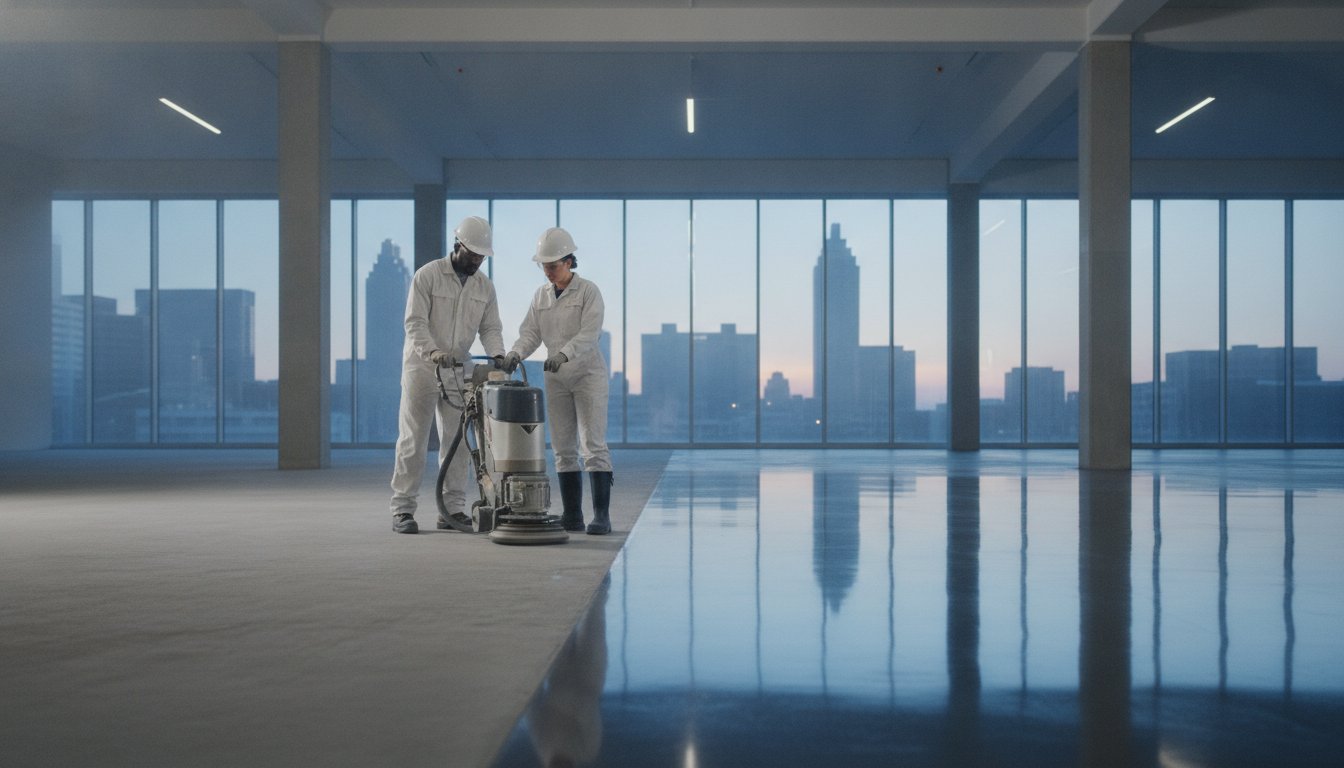
Concrete polishing is a technical engineering discipline, not a janitorial service. Many facility managers hire concrete floor polishing contractors based on a portfolio of high-gloss photos, only to watch that luster vanish once the daily wear of industrial operations begins. You shouldn't have to worry about your floor peeling or losing its profile within months of a project's completion. It's a common frustration to face unexpected costs because a crew skipped the critical surface preparation required for true durability.
You deserve total transparency in the grinding process and a floor that meets the highest ASTM standards for slip resistance. This guide will empower you to master the technical and professional criteria needed to hire a partner who delivers a long-term asset instead of a temporary fix. We'll provide a granular breakdown of the 2026 standards for silica safety, ACI 310.1-20 compliance, and the rigorous vetting steps that distinguish an elite contractor from a low-bidder who settles for mediocrity.
Key Takeaways
- Distinguish between superficial "grind and seal" finishes and true mechanical polishing to ensure your floor withstands industrial-grade wear.
- Master the technical vetting process for concrete floor polishing contractors by prioritizing moisture mitigation and adhesive removal protocols over aesthetic portfolios.
- Evaluate the impact of planetary versus rotary grinding technology on critical metrics like floor flatness and long-term surface durability.
- Secure your investment by requiring on-site mock-ups and verifying specialized commercial insurance coverage before mobilization.
- Transform your flooring from a maintenance headache into a high-performance asset through rigorous technical analysis and professional consultation.
Defining the Standard: What Makes a Professional Concrete Floor Polishing Contractor?
Concrete flooring isn't just a surface; it's a structural component of your facility. Many businesses make the mistake of viewing concrete floor polishing contractors as simple laborers who apply a finish. This is a costly misconception. In 2026, a true professional acts as a technical consultant who analyzes the chemical and physical properties of your slab before a single diamond blade touches the surface. If a contractor offers a quote based on a phone call without examining the concrete's integrity, they aren't a partner. They're a liability.
High-performance environments demand more than a glossy reflection. They require a surface engineered for durability, slip resistance, and impact. This begins with a thorough assessment of the slab's hardness and moisture levels. Without this initial rigor, even the most expensive finish will eventually fail. Elite contractors prioritize the long-term asset over the short-term aesthetic.
Mechanical Polishing vs. Topical Coatings
The difference between a topical "grind and seal" and a true mechanical polish is the difference between a temporary mask and a permanent transformation. A topical coating sits on the surface, vulnerable to peeling and scratching under heavy forklift traffic. Mechanical polishing is a multi-step process of grinding, honing, and polishing with industrial diamonds to achieve a refined surface.
This Polished concrete process relies on a strict grit sequence. Skipping a single stage in this progression creates microscopic scratches that trap dirt and dull the finish prematurely. Professional contractors also utilize chemical densifiers to harden the concrete. This isn't just a spray; it's a chemical reaction that fills the pores of the concrete, creating a dense, dust-proof surface that stands up to industrial abuse. It makes the floor harder. It makes it last.
The Industrial Expertise Requirement
Why does residential equipment fail in a warehouse? Scale and torque. Commercial concrete floor polishing contractors utilize heavy-duty planetary grinders that ensure a flat, uniform finish across thousands of square feet. They also understand the Mohs scale. Knowing the hardness of your concrete allows a contractor to select the correct diamond bond, preventing "glazing" or excessive tool wear that compromises the final profile.
Safety is equally non-negotiable. 2026 OSHA standards for respirable silica are strict for a reason. Professional crews must operate with industrial HEPA-filtered dust collection systems. This ensures your facility remains operational and your air quality stays within legal limits. Don't settle for contractors who treat dust control as an afterthought. Clean air is part of the job.
Technical Vetting: The Surface Preparation and Mitigation Checklist
A floor is only as reliable as the slab beneath it. While most concrete floor polishing contractors focus on the final shine, elite professionals obsess over the invisible variables. Concrete is a porous, breathing medium. If your contractor doesn't account for the chemical and physical state of the slab, your investment is at risk. In the humid Georgia climate, ignoring these factors often leads to "Sweating Slab Syndrome," where moisture accumulates on the surface, creating a safety hazard and compromising the finish. If they don't test, they don't know. It's that simple.
For facility managers in neighboring regions seeking this level of technical rigor, Solid Solutions LLC provides specialized concrete and site preparation services designed to eliminate these foundational risks before they compromise the final finish.
Moisture Mitigation and Slab Stabilization
Moisture testing is the first hallmark of a professional. High vapor emission rates can ruin a floor from the inside out. Standard vetting should require your contractor to perform calcium chloride testing (ASTM F1869) or in-situ RH probe testing (ASTM F2170). These aren't optional luxuries. They're essential data points. For older Atlanta slabs that lack a modern vapor barrier, moisture mitigation concrete floors require a strategic approach to prevent delamination.
According to academic research on polished concrete, the interaction between moisture and concrete pH is a primary driver of surface degradation. Proper stabilization ensures that your floor remains a long-term asset. This level of rigor is especially critical when transitioning to industrial floor coatings Atlanta facilities rely on for heavy-duty protection. If you're unsure about your slab's current state, a technical consultation with Polished Concrete Atlanta can provide the clarity you need before mobilization begins.
Adhesive and Contaminant Removal
Removing old flooring is more than just clearing the debris. It's about eradicating the "ghosting" patterns left by tile or carpet glue. These shadows often telegraph through the final polish if the surface preparation is handled carelessly. You must demand mechanical grinding over chemical stripping. Chemical agents can leach into the concrete pores and interfere with the densification process later.
Mechanical grinding provides a clean, open "canvas" for the diamonds to work. This process removes deep-seated contaminants like oils, waxes, and old resins that would otherwise prevent a uniform luster. A disciplined contractor will spend the majority of their time on this preparation phase. They know that a high-profile finish is impossible without a perfectly decontaminated base. Don't let a crew rush the grind to get to the polish. The prep is the polish.
Equipment and Material Standards for High-Traffic Facilities
High-traffic industrial environments require a level of precision that standard rental equipment simply cannot achieve. Elite concrete floor polishing contractors rely on heavy-duty planetary grinders to maintain superior Floor Flatness (FF) and Floor Levelness (FL). Unlike rotary grinders, which are often too aggressive and can leave a "wavy" profile or unsightly swirl marks, planetary machines utilize multiple heads that rotate in opposing directions. This counter-rotation creates a balanced, uniform cut across the entire slab. It's the only way to ensure your facility remains safe for high-speed forklift traffic and heavy machinery.
Transparency in materials is just as vital as the machinery used to apply them. If a contractor claims to use a "proprietary" densifier that they cannot explain chemically, consider it a red flag. They're likely masking a low-grade sodium silicate to cut their own costs at the expense of your floor's lifespan. Professional standards in 2026 favor lithium silicates for surface hardening. Lithium has a smaller molecular size, allowing it to penetrate deeper into the concrete pores for a more complete chemical reaction. This results in a surface that is significantly harder and more resistant to "dusting" than those treated with cheaper sodium or potassium alternatives.
Diamond Tooling and Grit Progression
The "Grit Standard" isn't a suggestion; it's an engineering requirement. A disciplined progression starting from 30-grit metal bonds and ending at 3000-grit resins is essential for a true mechanical polish. Metal-bond diamonds are the workhorses used to level the slab and expose the aggregate. Once the surface is flat, resin-bond diamonds refine the clarity. Never allow a contractor to skip steps and attempt to "burnish" the floor to a shine. High-speed buffing creates a temporary gloss that will disappear within weeks. It's a shortcut that hides poor workmanship. Genuine luster comes from the diamonds, not a buffer.
Chemical Densifiers and Sealer Standards
Industrial sealed concrete serves as the final line of defense against chemical spills and abrasion. In retail or high-visibility spaces, a high-performance guard or stain protector is mandatory to prevent etching from acidic liquids. Safety remains the ultimate priority. Your contractor must verify the Static Coefficient of Friction (SCOF) to ensure the floor meets OSHA slip-resistance requirements. A floor can be high-gloss without being a slip hazard. If your contractor can't provide these ratings, they haven't finished the job. Demand the data.
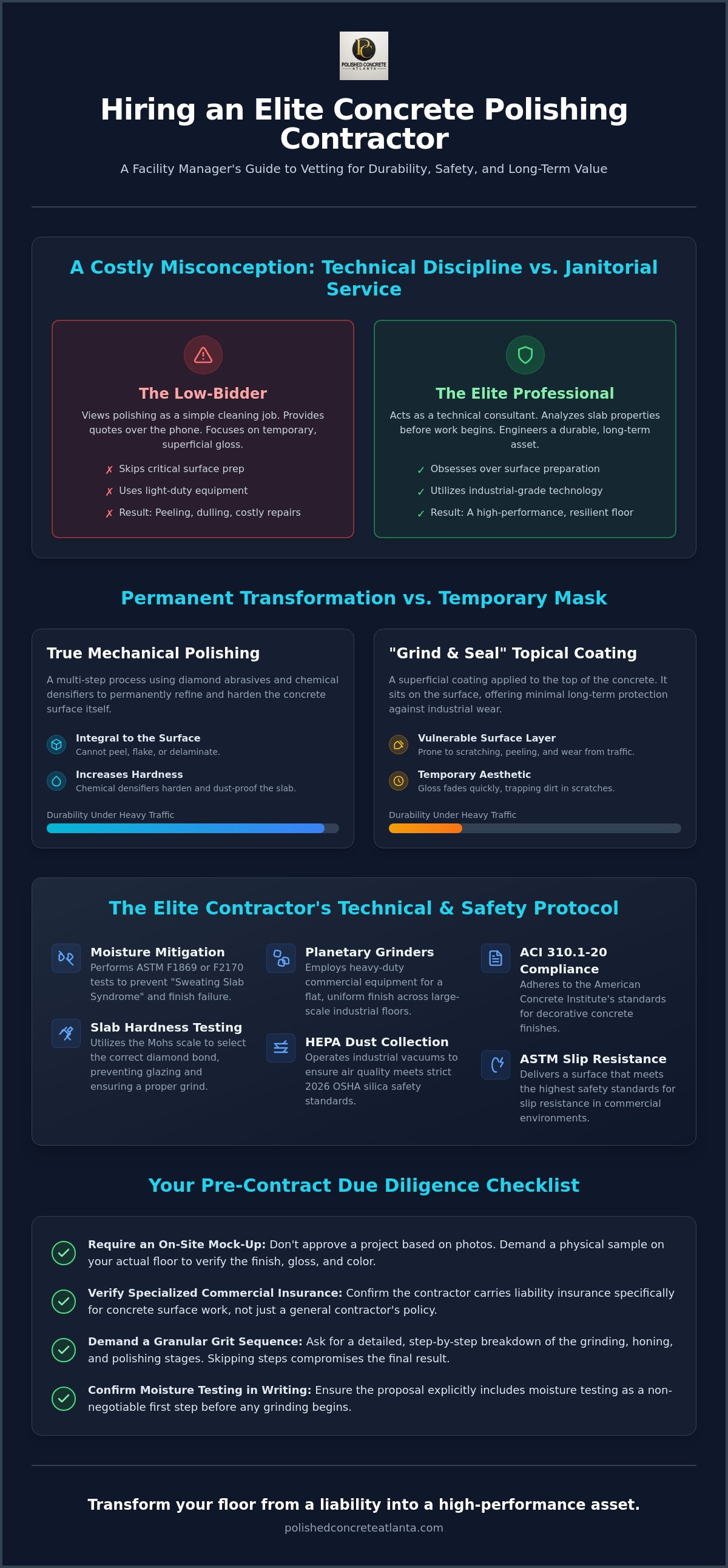
The Facility Manager’s Pre-Contract Checklist
Procurement is where your floor’s durability is actually decided. While technical specs are vital, the operational maturity of concrete floor polishing contractors determines whether your project is a success or a multi-million dollar mistake. You shouldn't settle for a crew that treats your facility like a training ground. In 2026, vetting must go beyond the estimate. It requires a rigorous deep dive into the contractor’s safety culture, insurance depth, and local reputation. If they can't produce a clean safety record and verifiable Atlanta references, they aren't ready for your floor.
Demand a mock-up on your actual slab. Photos in a brochure are curated and often misleading. A 10x10 test area in a high-traffic zone reveals the truth about your concrete's density and how it will react to the diamond sequence. This is the only way to verify the final luster and slip resistance before full mobilization. It eliminates uncertainty. It establishes the standard.
Insurance and Liability Verification
Standard general liability is a baseline, not a solution. Heavy industrial grinding involves high-torque machinery and the potential for significant property damage if handled by an inexperienced crew. You must verify that their policy specifically covers diamond grinding operations and includes comprehensive workers' compensation. In high-risk commercial environments, an underinsured contractor is a ticking time bomb. Peace of mind comes from knowing your facility is protected from every possible contingency. Don't just check the box. Read the policy.
Project Management and Communication
Who is actually running the job? A crew lead is focused on the machine. A dedicated project manager is focused on your operational timeline. You need a partner who understands "return-to-service" windows and how to minimize disruption to your daily workflow. They should provide a clear roadmap for handling unforeseen slab defects like deep aggregate exposure or structural spalling discovered mid-grind.
Transparency in the change order process is the hallmark of professional concrete floor restoration Atlanta managers can trust. If a contractor discovers a slab issue, the solution should be documented, priced, and approved with total clarity. No surprises. No hidden fees. If you're ready to move beyond vague estimates and start with a technical slab analysis, contact Polished Concrete Atlanta to schedule your site assessment today. We don't just bid projects. We engineer results.
Partnering with Polished Concrete Atlanta: The Elite Standard
Since 2004, Polished Concrete Atlanta has operated with a single, unwavering philosophy: results over rhetoric. While other concrete floor polishing contractors lead with glossy brochures, we lead with technical slab analysis. We don't just bid on projects. We engineer them. This no-nonsense pragmatism is why the most demanding facility managers in Georgia trust us with their high-value assets. We understand that a floor isn't just a surface. It's a foundation for your operational success. We don't settle for mediocrity. Neither should you.
Our approach is grounded in reliability and the elimination of uncertainty. We recognize that every commercial slab has its own chemical DNA and history of wear. By prioritizing a holistic, project-management approach, we ensure that your floor meets the highest standards for durability and safety from day one. We aren't just laborers. We are seasoned industry leaders who take pride in high-end craftsmanship and long-term value.
A Legacy of Professional Assertiveness
Our reputation as the preferred industrial flooring contractors Atlanta relies on has been built through decades of uncompromising execution. We are the partners Fortune 500 facilities choose when failure isn't an option. Our commitment to world-class standards, including the Ashford Formula installation, ensures that every square foot we polish exceeds industrial durability requirements. Transparency is our baseline. You'll never find hidden fees or skipped steps in our process. We provide a rigorous breakdown of the grinding stages, chemical densification, and protective guards before the first machine arrives on site. Quality isn't an accident. It's the result of disciplined work.
Strategic Alliances and Consultation
We act as more than a service provider. We are your creative consultants and meticulous managers of detail. From the initial moisture testing and floor glue removal to the final high-gloss finish, we maintain total project control. This holistic approach eliminates the uncertainty that plagues commercial construction. We serve the unique needs of Atlanta's industrial and commercial corridors with a blue-collar work ethic and an elite skill set. This is a premium, worry-free investment in your facility's future. We've seen every possible slab scenario and mastered the craft of remediation. Don't leave your ROI to chance with a low-bid contractor. Partner with the authority in the field.
Secure your technical consultation with Polished Concrete Atlanta today.
Secure Your Facility’s Future with Technical Precision
Your floor is a high-value industrial asset. It shouldn't be a source of constant maintenance or safety concerns. By applying the 2026 vetting standards, you've moved beyond surface-level aesthetics to a strategy grounded in engineering. You now understand that true durability depends on rigorous moisture mitigation and a disciplined diamond grit sequence. It's about choosing concrete floor polishing contractors who prioritize the integrity of your slab over the speed of the bid. Excellence is non-negotiable.
Polished Concrete Atlanta has served the local industrial corridor since 2004. We are specialists in the critical floor prep and moisture mitigation that many others ignore. Our crews utilize industrial-grade planetary grinders and HEPA-filtered dust collection to keep your facility operational and compliant. Don't settle for a temporary fix when you can have a permanent asset. Request a Professional Site Evaluation and Quote today to ensure your next project meets the elite standard of craftsmanship. Your facility deserves a floor that performs as hard as your business does. Let's get to work.
Frequently Asked Questions
What should I look for in a concrete floor polishing contractor's portfolio?
Look for projects that mirror your facility's scale and operational demands rather than just "pretty" photos. A professional portfolio should showcase heavy-duty distribution centers or manufacturing plants where durability is tested daily. Look for technical descriptions of the slab condition and the specific solutions provided. Glossy retail photos are easy to produce; industrial-grade resilience in a high-traffic warehouse is the true mark of elite concrete floor polishing contractors.
How do I know if a contractor is using the correct grit sequence?
Verify the grit sequence by monitoring the transition from metal-bond to resin-bond diamonds on-site. A correct progression never skips more than one grit level. If a contractor moves directly from a coarse 30-grit to a 400-grit resin, they are cutting corners. This shortcut creates microscopic scratches that trap dirt and dull the finish. Demand to see the tool rack and the planned progression before they start.
Why is moisture testing required before polishing concrete in Atlanta?
Moisture testing is mandatory because Atlanta’s humidity and local soil conditions often lead to high vapor emission rates in concrete slabs. Without a proper vapor barrier, moisture travels through the pores and can cause delamination or "Sweating Slab Syndrome." Testing ensures the slab is chemically stable enough to accept densifiers and sealers. It's the only way to guarantee the long-term integrity of the finish in the Southeast.
Can a contractor polish a slab that has old epoxy or glue on it?
Yes, a professional contractor can polish these slabs, provided they perform comprehensive mechanical grinding first. This process involves floor glue removal to eradicate all traces of old adhesives and coatings. Chemical stripping should be avoided as it can contaminate the concrete pores. Mechanical prep ensures a clean "canvas" that allows the diamonds to refine the actual concrete surface for a uniform, high-luster finish.
What is the difference between a residential and an industrial concrete polisher?
Industrial polishers use heavy-duty planetary grinders weighing over 1,000 pounds to achieve superior floor flatness. Residential contractors often use smaller, rotary equipment that lacks the torque and weight required for large-scale commercial slabs. Industrial projects also demand higher standards for slip resistance and silica dust control. It's a difference of engineering versus aesthetics. Industrial work is built for forklifts, not just foot traffic.
How long does a typical commercial concrete polishing project take?
A typical commercial project's duration depends on the slab's initial state and the desired finish level. For a 10,000-square-foot facility, expect a timeline of 5 to 7 working days. This includes the time required for deep grinding, densification, and multiple polishing stages. Complex repairs or extensive moisture mitigation will extend this window. A disciplined contractor provides a granular schedule that respects your "return-to-service" requirements.
What safety certifications should a professional flooring crew hold?
Professional flooring crews must hold current OSHA 10 or OSHA 30 certifications. They should also have specialized training in silica dust safety and the operation of industrial HEPA-filtered vacuum systems. These certifications aren't just paperwork; they are proof of a culture that prioritizes worker health and facility safety. Ask to see these credentials during the vetting process of concrete floor polishing contractors. Safety is a non-negotiable component of professional craftsmanship.
Does a higher shine always mean a better quality polish?
A higher shine does not always indicate better quality. Temporary gloss can be achieved through high-speed burnishing or topical "guards" that wear off quickly. True quality is found in the mechanical refinement of the concrete itself. A properly polished floor will have high clarity and meet ASTM standards for slip resistance. Focus on the depth of the polish and the flatness of the slab, not just the reflection.


