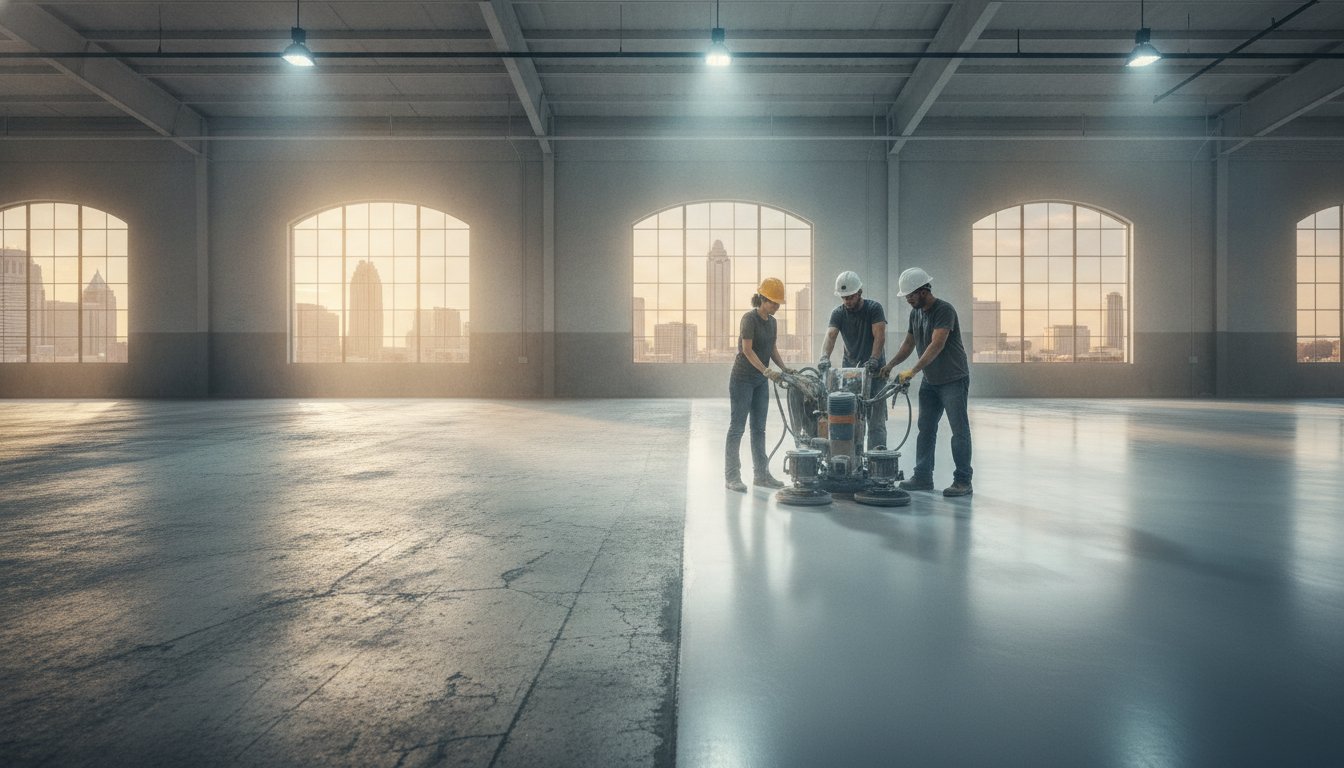
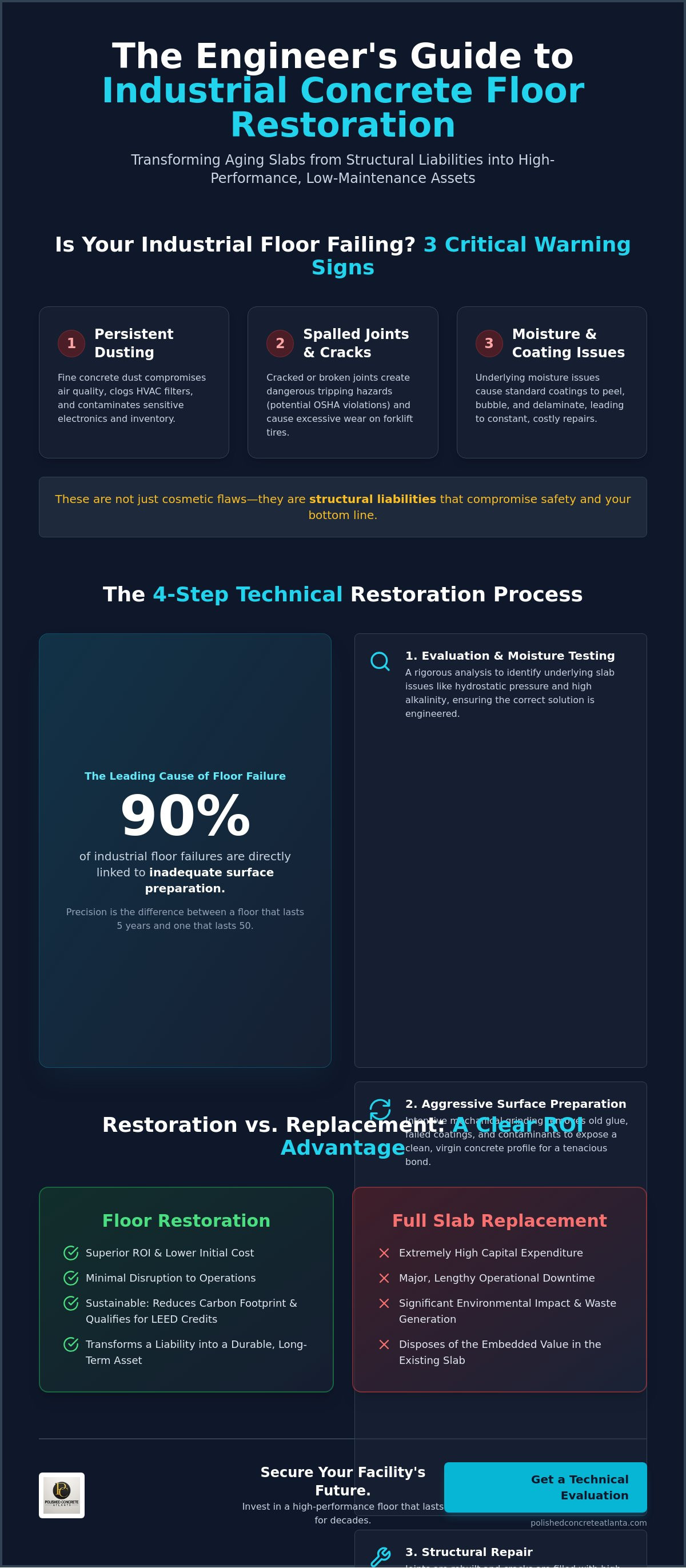
Your industrial floor isn't just a surface you walk on; it's a critical piece of machinery that dictates your facility's efficiency and safety. When that slab begins to fail, your entire operation feels the friction. You've likely seen the signs: persistent concrete dusting clogging air filters, spalled joints creating tripping hazards, or moisture issues that make standard coatings peel away. These aren't just aesthetic flaws. They are structural liabilities that compromise your bottom line and your compliance with the 2024 International Building Code. Precision is non-negotiable. Professional concrete floor restoration Atlanta is a technical engineering process, not a cosmetic patch job.
If you're wondering whether your existing slab can be saved or if a full replacement is the only path forward, you're asking the right question. We agree that a floor should be a low-maintenance asset, not a constant source of worry. This guide provides the definitive roadmap to transforming aging, damaged industrial slabs into high-performance assets through professional restoration and finishing. We'll examine the rigorous surface preparation required for long-term durability, the impact of the latest Georgia fire codes, and how the right finish can drastically increase your property value while reducing maintenance costs.
Key Takeaways
- Learn to identify the critical signs of slab failure, such as dusting and joint spalling, that threaten your facility’s air quality and machinery.
- Discover why aggressive surface preparation and floor glue removal are non-negotiable steps for achieving a high-performance bond.
- Evaluate the superior ROI of professional concrete floor restoration Atlanta compared to the high cost and disruption of a full slab replacement.
- Compare specialized finishes like polished concrete and industrial coatings to select the specific solution that meets your facility’s chemical resistance and safety needs.
- Master the technical evaluation process, including moisture testing, to ensure your restored floor remains a durable asset for decades.
Why Concrete Floor Restoration is Critical for Atlanta Industrial Assets
Concrete floor restoration isn't just a cosmetic upgrade. It's a fundamental structural intervention. Many facility managers mistake a simple cleaning or a thin sealer for true restoration. That's a mistake. Professional concrete floor restoration Atlanta involves a deep, technical renewal of the slab's integrity. It addresses the root causes of deterioration rather than just masking the symptoms. When you ignore spalled joints or surface dusting, you aren't just looking at an ugly floor. You're looking at increased wear on forklift tires, contaminated sensitive electronics, and potential OSHA violations. Precision is non-negotiable.
Atlanta serves as a primary logistics artery for the Southeast. Our warehouses and retail hubs handle massive volume. This constant throughput demands a floor that performs under pressure. Neglecting these surfaces leads to a cascading failure of facility assets. Strategic concrete floor restoration Atlanta extends the life of your existing slab by decades. It turns a liability into a high-performance asset. Reliable floors mean reliable operations. Don't settle for mediocrity when your foundation is at stake.
The Problem with Aging Concrete in Georgia
Georgia's climate presents unique challenges for industrial flooring. High humidity levels accelerate concrete carbonation. This process lowers the pH of the concrete, which eventually leads to the corrosion of internal reinforcement steel. You'll see the results in the form of spalling, where chunks of concrete break away, or crazing, which appears as a web of fine cracks. Then there's the issue of "concrete dust." This fine particulate matter isn't just a nuisance. It compromises employee respiratory health and settles on inventory, leading to significant product loss in clean-room or high-end retail environments. These issues require technical solutions, not surface-level fixes.
Restoration as a Sustainable Choice
Choosing restoration over replacement is a win for both the environment and your budget. By leveraging the existing slab, you drastically reduce the carbon footprint associated with new concrete production and disposal. This approach often qualifies for LEED credits, particularly when you eliminate the need for secondary floor coverings. The mechanical refinement used in The Polished Concrete Process further enhances this sustainability by increasing light reflectivity, which can lower your energy consumption for lighting. Concrete restoration is a strategic asset management practice that transforms a deteriorating foundation into a durable, long-term operational advantage.
The Technical Process of Professional Concrete Restoration
Executing a successful concrete floor restoration Atlanta requires a methodical, phase-based approach. We don't rely on luck. We rely on engineering. The process begins with a rigorous evaluation and moisture testing phase to identify underlying slab issues like hydrostatic pressure or high alkalinity. Once the data is clear, we initiate aggressive mechanical grinding. This stage is vital for floor glue removal and stripping away years of neglected coatings to expose the clean, virgin concrete beneath. It's messy, intensive, and absolutely necessary for a long-term bond.
Structural repair follows. We stabilize joints and fill cracks with high-performance polymers to prevent future deterioration and eliminate safety hazards. Many competitors ignore these "invisible" flaws. We don't. Finally, we apply chemical densifiers to permanently harden the concrete matrix. This isn't a surface treatment; it's a molecular upgrade. If you want a floor that stands the test of time, you need a partner who understands the technical requirements of floor preparation. Precision is the difference between a floor that lasts five years and one that lasts fifty.
Surface Preparation: The Non-Negotiable Foundation
Poor preparation is the leading cause of floor failure. Industry data suggests that nearly 90% of industrial floor failures are directly linked to inadequate surface profiling. We use precision diamond abrasives to achieve the specific Aggregate Exposure your facility demands. Whether you need a salt-and-pepper finish or a heavy-aggregate look, the mechanical bond created during this phase is what prevents future delamination. We don't cut corners here. Every square inch is profiled to meet the exact requirements of the final finish.
Densification and Hardening
We don't believe in temporary fixes. Densification involves a sophisticated chemical reaction where silicate densifiers transform soft calcium hydroxide into hard calcium silicate hydrate. This process fills the microscopic voids in the slab. The result is a surface that is virtually impenetrable to dust and liquids. Professional densification is a permanent chemical change to the concrete's molecular structure, not a temporary coating that will eventually peel. For those interested in the industry's most rigorous standards, The Technical Process of Professional Concrete Restoration provides the framework for these best practices.
Restoration vs. Replacement: Evaluating the ROI of Your Slab
Deciding between a full slab replacement and professional concrete floor restoration Atlanta is a high-stakes financial choice. Most facility managers look at a cracked, pitted surface and assume the worst. They shouldn't. A total tear-out is rarely the most efficient path to a high-performance floor. Replacement involves a logistical nightmare: heavy demolition, massive disposal fees, and the environmental burden of concrete waste. Restoration, by contrast, utilizes the existing structural mass you've already paid for. It's a strategic reuse of assets that delivers an elite finish without the premium price tag of a new pour.
Structural integrity is the only true deal-breaker. If the subgrade has failed or the slab is experiencing severe settling, restoration might not be viable. However, surface-level damage, deep cracks, and chemical erosion are precisely what we solve. We transform these liabilities into assets. The economic logic is undeniable. Why pay for a new slab when the one you have can be engineered to exceed its original specifications? Precision is the only way to ensure your investment pays off.
Hidden Costs of Concrete Replacement
Replacement isn't just about the cost of the concrete itself. It’s about the 28-day cure time. New concrete requires nearly a month of hydration before it can be polished or coated. Can your operation afford four weeks of zero production? Restoration allows for much faster facility re-entry, often within days. You also bypass the permitting hurdles and structural concerns that come with pouring new slabs in an existing building. In the City of Atlanta, where building codes are strictly enforced, avoiding unnecessary permits is a major logistical win.
The Maintenance Advantage
The real ROI reveals itself over the 10-year Total Cost of Ownership (TCO). Traditional floor coverings like Vinyl Composition Tile (VCT) demand a relentless "strip and wax" cycle. This labor-intensive process is a drain on resources and introduces harsh chemicals into your facility. Even standard epoxy coatings eventually delaminate and require re-application. A restored, polished floor eliminates these cycles entirely. You gain a high-gloss surface that increases light reflectivity, reducing your energy costs for lighting while maintaining a pristine aesthetic with simple, routine cleaning. It's a worry-free investment that pays for itself through operational efficiency. In addition to interior floor care, maintaining your building's facade is critical for long-term value; visit Poseidon Power Washing LLC to discover safe exterior cleaning solutions for your facility.
Selecting the Right Finish: Tailoring Restoration to Your Facility
Selecting the final surface is a strategic decision that dictates your facility's operational efficiency for the next decade. We don't believe in a one-size-fits-all approach. For high-end retail and modern office environments, Polished Concrete remains the gold standard. It provides a glass-like finish that is virtually indestructible. Conversely, heavy manufacturing facilities require the chemical resistance of Epoxy Flooring or advanced Industrial Coatings. These systems protect the slab from caustic spills and extreme impact. Stained Concrete offers a middle ground, merging the raw durability of a restored slab with high-end aesthetic branding. For back-of-house warehouse spaces where budget is the primary driver, Sealed Concrete provides a pragmatic, dust-proof solution without the cost of high-grit polishing.
Effective concrete floor restoration Atlanta requires matching the finish to the specific mechanical and chemical stresses of your environment. We don't settle for "good enough." We engineer solutions that eliminate uncertainty. Precision is the only way to ensure your investment delivers a permanent, high-performance asset.
Addressing Atlanta’s Moisture Challenges
Georgia’s humidity is a constant threat to floor integrity. We prioritize Floor Moisture Mitigation as the first step for any resinous installation. High Moisture Vapor Emission Rate (MVER) in a slab will cause even the most expensive epoxy to delaminate within months. We deploy technical solutions like moisture-tolerant primers to stabilize these environments. If a slab presents persistent, unmanageable moisture issues, we often recommend a "Grind and Seal" approach. This allows the concrete to breathe while still providing a protected, easy-to-clean surface.
Industry-Specific Recommendations
Your industry dictates your floor's requirements. Food and Beverage facilities must maintain antimicrobial environments; seamless resinous floors are a regulatory necessity here. In the Logistics and Distribution sector, the focus shifts to high-traffic durability and joint protection to minimize forklift downtime. Retailers, on the other hand, demand maximum gloss and the "big box" aesthetic that only high-grit polishing can deliver. If you're unsure which finish suits your operational load, contact us for a professional consultation on industrial floor systems. We provide the technical expertise to ensure your concrete floor restoration Atlanta project withstands the rigors of your specific trade.
Secure Your Facility’s Future with Polished Concrete Atlanta
Experience is the ultimate filter for quality. Since our founding in 2004, Polished Concrete Atlanta has specialized in the complex engineering required for large-scale concrete floor restoration Atlanta. We've seen the failures of cut-corner contractors and the long-term damage caused by poor surface preparation. Our approach is built on two decades of navigating the specific challenges of Georgia's industrial landscape. We don't settle for mediocrity. Every project is an opportunity to prove our standards. Reliability is our baseline.
Our "No-Nonsense" philosophy means we value your time and your budget. We provide honest assessments based on technical reality, not optimistic guesses. If a slab requires deep moisture mitigation before an epoxy application, we tell you. If a simple grind and seal is the most pragmatic choice for your warehouse, we recommend it. We prioritize tangible results and long-term value over flowery descriptions. This is how we eliminate the uncertainty that often plagues commercial construction projects. We deliver peace of mind through high-end craftsmanship.
A Partner, Not Just a Contractor
We understand that your facility can't just stop. Our collaborative process involves working around your operational schedule to minimize downtime and prevent bottlenecks. Being a localized expert means we understand how Georgia’s unique soil composition and humidity levels impact slab behavior over time. We aren't just a service provider; we're a consultant dedicated to the integrity of your floor. This partnership ensures that your flooring investment aligns with your long-term business goals. Explore our Project Gallery to see our work in action.
Request Your Technical Evaluation
Every successful project begins with data. During a site visit from Polished Concrete Atlanta, you won't get a sales pitch. You'll get a technical evaluation. We prioritize moisture vapor emission rate (MVER) tests and Mohs hardness scales to determine the exact requirements of your slab. This scientific approach ensures that the final product meets the high-performance standards of your facility. It's the most reliable way to secure a successful concrete floor restoration Atlanta. Don't leave your foundation to chance. Contact the authoritative experts in Atlanta concrete restoration today.
Engineered Durability for Your Atlanta Facility
Your floor is the foundation of your operational success. Professional concrete floor restoration Atlanta requires a technical mastery of surface preparation and moisture mitigation that many general contractors simply don't possess. We've been refining these engineering processes in high-scale industrial and retail environments across the city since 2004. We prioritize tangible results over surface-level patches. By choosing restoration over replacement, you secure a floor that isn't just visually superior; you gain a surface that is chemically hardened to withstand the rigors of heavy machinery and high-volume traffic. We eliminate the uncertainty of slab failure through rigorous testing and seasoned craftsmanship. Precision is our standard.
The choice is clear. You can continue to manage the costs of a failing slab or you can transform your facility into a high-performance environment. We provide the expertise needed to navigate Georgia's unique climate challenges and structural requirements. It's time to invest in a floor that reflects the integrity of your brand and your commitment to safety. Get a Professional Estimate for Your Restoration Project and start your facility’s transformation today. We look forward to being your dedicated partner in excellence.
Frequently Asked Questions
How long does the concrete floor restoration process typically take?
Most commercial restoration projects wrap within one to three days. The exact timeline depends on the total square footage and the current condition of your slab. We prioritize efficiency to minimize your operational downtime. Large-scale industrial facilities often require a phased approach to keep production moving. Precision scheduling is a hallmark of our project management.
Can you restore a concrete floor that has been covered in tile or carpet for years?
Yes, we can restore slabs previously hidden under old floor coverings. The process requires professional floor glue removal and aggressive mechanical grinding to strip away mastic and adhesives. We reach the virgin concrete to ensure a high-performance bond for the new finish. It's a common scenario in retail renovations where old VCT or carpet is replaced with an elite polished look.
What is the difference between concrete polishing and just sealing the floor?
Polishing is a permanent mechanical refinement of the concrete matrix, while sealing is a temporary topical film application. Polishing involves diamond grinding and chemical densification to harden the slab from within. Sealing provides a protective layer on the surface that eventually wears off. For a true concrete floor restoration Atlanta, polishing offers a significantly higher ROI and lower maintenance cycle.
How do I know if my concrete floor needs moisture mitigation before restoration?
Look for efflorescence, which is a white, powdery substance on the surface, or persistent coating failures. These are red flags for hydrostatic pressure. We don't guess; we use technical MVER (Moisture Vapor Emission Rate) testing to gather hard data. If your slab exceeds industry thresholds, moisture mitigation is a non-negotiable step to prevent future delamination of coatings.
Will the restoration process create a lot of dust in my facility?
No, our process is virtually dust-free. We utilize industrial-grade grinding equipment equipped with high-efficiency HEPA-filtered vacuum systems. These units capture 99.9% of particulates at the source. This allows us to work in sensitive environments, including active retail spaces and clean-room facilities, without compromising your indoor air quality or contaminating inventory.
Is polished concrete slippery when wet, and is it safe for commercial use?
Polished concrete is not inherently slippery and often exceeds OSHA safety standards for slip resistance. When dry, a high-gloss polished floor provides excellent traction. For areas prone to spills, we can integrate specialized anti-slip additives during the treatment process. We prioritize compliance with the latest safety codes to ensure your facility remains a secure environment for personnel and equipment.
How often does a restored concrete floor need to be refinished?
Does Polished Concrete Atlanta provide services for residential garages?
We specialize exclusively in the commercial and industrial sectors. Our equipment and project management processes are tailored for the complexity and scale of high-volume facilities, retail hubs, and manufacturing plants. While residential garages are common, our focus remains on delivering the rigorous standards required for large-scale concrete floor restoration Atlanta projects.


