The most expensive floor coating in the world is worthless if it doesn't stick. Most industrial floor failures have absolutely nothing to do with the quality of the epoxy or the skill of the applicator. They fail because the substrate was never properly engineered for adhesion. You've likely seen the results: bubbling, peeling, or delamination that shuts down operations and wastes capital. It's a frustrating, avoidable disaster. Professional concrete surface preparation contractors know that a floor is only as reliable as the profile beneath it. Quality isn't an accident; it's a mechanical certainty.
You deserve a floor that lasts ten years, not ten months. This guide explains why professional surface preparation is the single most critical factor in the success or failure of industrial and commercial flooring. We'll examine the technical requirements for a professional bond that survives Georgia's relentless humidity and stubborn mastic residues. You'll learn how to manage moisture vapor emission rates (MVER) below the critical 3-pound threshold and why partnering with a team that owns its own heavy-duty grinding equipment is the only way to guarantee results. We're moving past the guesswork to focus on the grit and science of a permanent bond.
Key Takeaways
- Understand the technical difference between a chemical bond and a superior mechanical bond to prevent common failures like peeling and delamination.
- Learn how to navigate the ICRI Concrete Surface Profile (CSP) scale to ensure your substrate's texture matches your specific finish requirements.
- Discover how professional concrete surface preparation contractors utilize heavy-duty grinding and shot blasting to engineer a surface built for a ten-year lifespan.
- Identify the critical remediation steps for floor glue removal and moisture mitigation to protect your facility against Georgia’s high humidity.
- Gain a practical checklist for vetting industrial partners to ensure you receive meticulous, owner-operator level care on every project.
The Science of Adhesion: Why Surface Preparation Dictates Floor Longevity
Concrete surface preparation is the deliberate mechanical process of opening the concrete's capillary pores and removing surface contaminants to ensure a permanent bond. It isn't a preliminary chore. It's the strategic engineering of a substrate. Many facility managers assume a broom-clean slab is ready for resinous coatings, but professional concrete surface preparation contractors know that visibility is a poor metric for adhesion. A floor that looks clean to the naked eye is often a ticking time bomb. Without the correct mechanical profile, even the most expensive industrial epoxy will eventually peel, bubble, or delaminate under the stress of daily operations.
Mechanical vs. Chemical Bonding
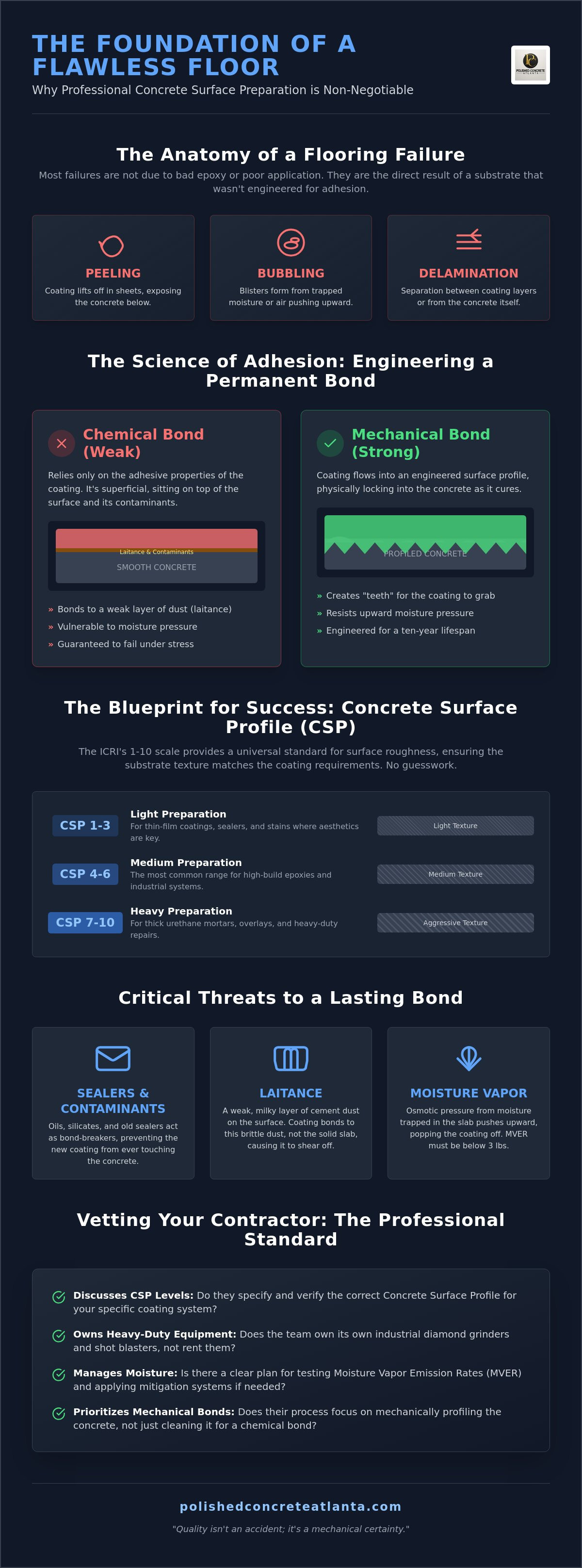
To understand why floors fail, you have to understand how they stick. A chemical bond relies solely on the adhesive properties of the liquid coating. It's superficial. Conversely, a mechanical bond occurs when the coating flows into the open pores of the concrete and "locks" into place as it cures. It needs "teeth" to grab onto. Most industrial slabs are finished with a power trowel, creating a dense, smooth surface that's naturally repellent to high-performance coatings. If you don't break that surface tension, the coating sits on top like water on a waxed car. Contaminants like oils, silicates, and old sealers act as bond-breakers, ensuring the coating never truly integrates with the slab. When concrete is mechanically ground, honed and polished, these barriers are stripped away to reveal a receptive, porous surface.
The Anatomy of a Flooring Failure
The most common culprit in delamination is a substance known as laitance. Laitance is the milky, weak layer of cement dust and lime that rises to the surface during pouring. It's brittle and lacks structural integrity. If you apply a coating over laitance, you aren't bonding to the slab; you're bonding to a thin layer of dust. When the coating undergoes thermal expansion or heavy traffic, the laitance shears off, taking your expensive floor with it.
Beyond surface debris, unprepared slabs are vulnerable to osmotic pressure. This occurs when moisture vapor trapped in the concrete pushes upward against a non-breathable coating. Without a deep mechanical bond to resist this force, the moisture creates enough pressure to pop the coating right off the concrete. This leads to the unsightly bubbling and blistering that plagues poorly executed projects. Skipping the prep phase might save a few dollars today, but the "High Cost of Cheap Prep" always manifests as a total floor replacement within eighteen months. Professional concrete surface preparation contractors eliminate this uncertainty by removing the weak top layer and creating a profile that survives the test of time. Results matter. Guesswork doesn't.
Decoding CSP: Understanding Concrete Surface Profile Standards
Measurement is the antidote to uncertainty. In the industrial flooring world, we don't rely on "feel" or visual guesswork to determine if a slab is ready. The International Concrete Repair Institute (ICRI) established the Concrete Surface Profile (CSP) standards to provide a universal, quantitative language for surface roughness. This 1-10 scale defines the texture required for specific coating thicknesses. It's a technical blueprint for success. Amateurs treat every slab the same; professional concrete surface preparation contractors treat every slab as a unique engineering challenge. If your contractor isn't talking about CSP levels, they aren't preparing your floor. They're just making dust.
Different flooring systems require different "teeth" to achieve a permanent mechanical bond. A thin-film sealer will telegraph every scratch from an overly aggressive prep, while a heavy-duty urethane mortar will delaminate from a surface that's too smooth. To eliminate errors, we use physical CSP chips, molded from actual concrete samples, to verify the texture against the project specifications. This ensures total alignment between the substrate and the finish. Guesswork is a liability. Precision is an investment.
CSP 1-3: Light Preparation for Thin-Film Coatings
This range is reserved for high-end aesthetics and light-duty protections. Think stains, clear sealers, or the standard for polished concrete floors in Atlanta. Diamond grinding is the primary method here. It removes the surface laitance and opens the pores without creating deep gouges. The result is a refined, receptive surface that allows the beauty of the concrete to shine through while ensuring the protective layer actually integrates with the slab. It’s about achieving a surgical level of cleanliness and porosity.
CSP 4-9: Aggressive Profiling for Industrial Overlays
Industrial environments demand brute force applied with technical precision. When installing thick epoxy systems or urethane mortars, we need a profile that feels like coarse sandpaper or looks like miniature "cornrows." Shot blasting and scarifying are mandatory for these levels. These methods physically fracture the concrete surface to create massive surface area for the resin to grip. Concrete surface preparation contractors must balance this aggression to ensure they don't cause micro-cracking in the substrate while still achieving the necessary bite.
Achieving the correct CSP is the single most important step in protecting your facility's infrastructure. If you're looking for a partner who understands the physics of adhesion, consult with the experts at Polished Concrete Atlanta to engineer a floor that stands the test of time. We don't just prep floors; we build foundations for long-term performance.
Professional Methods: Grinding, Shot Blasting, and Scarifying
Owning a fleet of heavy machinery doesn't make a company an expert. The true value of concrete surface preparation contractors lies in their ability to diagnose a slab and select the precise mechanical method required for the target CSP. We don't just show up with a machine; we arrive with a strategy. Equipment choice is dictated by the current state of your concrete and the specific requirements of the final finish. Using a shot blaster when a planetary grinder is needed will result in a "telegraphed" profile that ruins a high-luster finish. Conversely, using a grinder when a shot blaster is required for a heavy mortar overlay ensures a bond failure. We eliminate that risk through technical expertise.
Safety and cleanliness are just as critical as the mechanical profile itself. Modern industrial standards, specifically OSHA 29 CFR 1926.1153, mandate strict control of respirable crystalline silica. We utilize high-capacity, HEPA-filtered industrial vacuums that connect directly to our equipment. This creates a dust-free environment, protecting your facility's air quality and ensuring that no fine particulates remain in the concrete pores to act as bond-breakers. A comprehensive prep plan also includes "crack chasing" and joint clean-out. We use specialized saws to open existing cracks and remove old, failing joint fillers, creating a clean channel for high-performance semi-rigid fillers. If the joints aren't stabilized, the floor will fail regardless of the surface prep.
Diamond Grinding for Precision and Leveling
Diamond grinding is the most versatile tool in our arsenal. It utilizes horizontal rotating heads equipped with diamond-segmented blades to shave away the top layer of concrete. This method is ideal for removing high spots, leveling minor imperfections, and stripping away thin-film coatings or old sealers. By varying the diamond grit and the weight of the machine, we can achieve everything from a coarse CSP 2 to a glass-like finish. For facility managers looking for a refined aesthetic, understanding the process of concrete grinding and polishing in Atlanta is essential. It’s a surgical approach to floor preparation.
Shot Blasting for Maximum Bond Strength
When the project calls for a CSP 3 to CSP 7, shot blasting is the undisputed gold standard. This process involves firing thousands of tiny steel shots at the floor at high velocity, which "blasts" away the surface laitance and creates a deep, uniform texture. The machine then recovers the shot and the concrete dust, recycling the steel and depositing the waste into a vacuum. It is incredibly efficient for large-scale warehouse facilities. Because it creates a massive amount of surface area for resinous coatings to grip, it’s the preferred method for high-performance industrial epoxy and urethane systems. It provides a level of mechanical "bite" that grinding simply cannot match. Precision meets power.
Critical Remediation: Moisture Mitigation and Adhesive Removal
Remediation isn't a cleaning task. It's a rescue operation for your substrate. In older Atlanta buildings, the slab is often a graveyard of previous flooring attempts. Layers of black mastic, brittle thin-set, and stubborn yellow carpet glue create a barrier that no coating can penetrate. Professional concrete surface preparation contractors don't just scrape the surface; they surgically remove these contaminants to restore the concrete's original porosity. If these residues aren't completely eliminated, you're essentially building your new floor on a foundation of failure.
This commitment to substrate integrity is universal in high-end restoration; for example, Surfprep utilizes superheated steam technology to restore brick and stone surfaces, ensuring they are perfectly prepared for long-term preservation.
One of the most dangerous mistakes a facility manager can make is allowing the use of chemical strippers or solvent-based cleaners. These products are designed to liquefy adhesives, but they also drive those liquified contaminants deeper into the concrete’s capillary system. Once the slab is chemically contaminated, achieving a permanent mechanical bond becomes nearly impossible. We rely exclusively on mechanical scraping and heavy-duty diamond grinding to ensure the slab remains "pure" and receptive to new high-performance systems. Results require grit, not chemicals.
Precision Floor Glue and Mastic Removal
Removing old VCT adhesive or stubborn black mastic requires specialized equipment and a meticulous eye for detail. Black mastic is particularly problematic because it often contains asbestos in buildings constructed before the mid-1980s. Identifying asbestos-containing materials (ACM) is a non-negotiable first step in our safety protocol. Once safety is established, we use specialized PCD (polycrystalline diamond) grinding segments to shear the adhesive from the slab. This process doesn't just remove the glue; it prepares the underlying concrete for its next life cycle without the risk of cross-contamination or bond failure.
Moisture Vapor Transmission (MVT) Remediation
In the Southeast, moisture is your floor's greatest enemy. Moisture vapor transmission (MVT) occurs when water travels through the slab and condenses beneath a non-breathable coating, leading to "Sweating Slab Syndrome." This invisible pressure can easily exceed the bond strength of a standard epoxy, causing massive delamination and bubbling. We utilize rigorous testing methods, including calcium chloride tests and in-situ relative humidity (RH) probes, to measure the moisture vapor emission rate (MVER). If your slab exceeds the industry standard of 3 pounds per 1,000 square feet per 24 hours, professional mitigation is mandatory.
Treating moisture mitigation as an afterthought is a recipe for expensive litigation and operational downtime. We position our remediation services as a technical insurance policy for your facility infrastructure. Don't leave your investment to chance. Secure your substrate by partnering with the experts in floor moisture mitigation to ensure a failure-proof finish that stands up to Georgia's humidity.
Selecting Concrete Surface Preparation Contractors: The Professional Standard
The success of your facility’s infrastructure hinges on a single decision: who prepares your substrate. Many general laborers claim they can grind a floor, but true expertise is rare. Professional concrete surface preparation contractors don't just provide a service; they act as technical consultants who understand the physics of a mechanical bond. When you're vetting a partner, you aren't just buying labor. You're investing in the longevity of your asset. A low bid is often a warning sign of skipped steps, inadequate equipment, or a lack of technical depth. If the floor fails, the "savings" from a cheap quote evaporate instantly in the face of operational downtime and costly re-installation.
Demand an "owner-operator" level of care. There is a massive difference between a dedicated team of specialists and a contractor who relies on subcontracted labor or day workers. Subcontractors often lack the specialized training required to navigate complex slab issues like moisture vapor transmission or chemical contamination. You need a partner who takes personal responsibility for the integrity of the final product. We believe in transparency and professional character. Results are the only metric that matters.
The Equipment and Training Benchmark
Before signing a contract, perform a rigorous audit of the contractor’s capabilities. A professional firm should be able to answer these questions with absolute certainty:
- Equipment Ownership: Does the contractor own a fleet of heavy-duty planetary grinders and shot blasters, or do they rent equipment per job? Rental machines are often poorly maintained and lack the precision of owner-operated assets.
- Dust Containment: Can they prove the use of high-capacity, HEPA-filtered industrial vacuums? Protecting your facility’s air quality and sensitive machinery is a non-negotiable safety requirement.
- Technical Standards: Does the crew understand and utilize ICRI CSP standards? If they can't define the specific profile level required for your coating, they're guessing with your money.
The Polished Concrete Atlanta Advantage
We specialize in the high-stakes environments of industrial and commercial facilities. Our approach is grounded in "no-nonsense" pragmatism and a commitment to high-end craftsmanship that eliminates uncertainty. We don't settle for mediocrity because your facility can't afford it. By leveraging industrial-grade equipment and a deep understanding of Georgia’s unique environmental challenges, we ensure your floor performs for a decade or more. We act as your creative consultant and meticulous manager of details, moving from vision to execution with disciplined precision. Don't leave your substrate to chance. Schedule a professional slab assessment with our experts today.
Secure Your Infrastructure with Engineered Adhesion
Surface preparation isn't just a preliminary step; it's the strategic engineering of a failure-proof bond. We've established that the difference between a ten-year floor and a total delamination disaster lies in the mechanical profile of the substrate. Whether you're navigating complex CSP standards or battling Georgia’s specific moisture issues, the technical requirements remain uncompromising. You need a partner who views your floor as a critical asset rather than just another job site. Working with elite concrete surface preparation contractors ensures that every square foot of your facility is optimized for long-term performance, much like how Pressure Pros of Palm beach provides specialized exterior maintenance for roofs and pavers to protect a property's overall structural integrity.
Since 2004, Polished Concrete Atlanta has operated as a veteran-owned specialist in heavy-duty industrial prep. We bring meticulous attention to every stage of the process, from comprehensive glue removal to advanced moisture mitigation. We don't settle for mediocrity because we know your facility can't afford the cost of failure. Contact Polished Concrete Atlanta for a Professional Surface Assessment today to eliminate uncertainty and invest in a floor that truly lasts. Your facility deserves the peace of mind that comes with high-end craftsmanship and tangible results. Let's build a foundation that stands the test of time.
Frequently Asked Questions
Why is concrete surface preparation so expensive?
Surface preparation is an investment in the long-term integrity of your facility rather than a simple expense. The cost reflects the use of specialized industrial machinery, diamond-segmented abrasives, and highly trained technicians who understand the physics of adhesion. Cutting corners here leads to delamination, which costs significantly more to repair than doing the job correctly the first time. We prioritize tangible results over the illusion of a low bid.
Can I just acid wash my concrete instead of mechanical grinding?
Acid washing is an outdated method that we do not recommend for industrial or commercial environments. It is unreliable because it often fails to open the concrete pores deeply enough and can leave behind chemical residues that act as bond-breakers. Mechanical grinding or shot blasting provides a consistent, measurable profile that acid simply cannot match. Professional standards require a mechanical bond for any high-performance coating system.
What is the most common reason for epoxy floor failure?
Inadequate surface preparation is the primary cause of nearly all epoxy floor failures. When coatings peel or bubble, it is usually because they were applied over laitance, oils, or moisture-saturated slabs. Without a deep mechanical bond, the coating cannot withstand the stresses of thermal expansion or heavy forklift traffic. Adhesion failure is almost always a preparation failure. We eliminate this uncertainty through rigorous mechanical profiling.
How long does the surface preparation process take for a 10,000 sq ft warehouse?
A 10,000 square foot facility typically requires two to three business days for comprehensive mechanical preparation. This timeline assumes a standard slab condition; however, factors like thick mastic removal or significant leveling can extend the duration. We utilize high-capacity equipment to maximize efficiency without compromising the meticulous details required for a professional bond. Precision takes time, but it saves years of maintenance headaches.
What is a CSP level, and which one do I need for my floor?
CSP stands for Concrete Surface Profile, a technical scale from 1 to 10 developed by the ICRI to measure surface roughness. A thin-film sealer might only require a CSP 2, while heavy-duty urethane mortars often demand a CSP 5 or higher. Choosing the wrong level ensures failure. We use physical CSP chips to verify that the substrate texture perfectly matches the requirements of your specific flooring system.
Is dust a major concern during the grinding or shot blasting process?
Dust is not a concern when you partner with professional concrete surface preparation contractors who utilize HEPA-filtered industrial vacuum systems. Our equipment connects directly to high-capacity extractors that capture 99.97% of particulates at the source. This protects your facility’s air quality and ensures that the concrete pores remain clean and receptive to the new coating. We maintain a clean, surgical environment throughout the process.
Can you remove old floor glue and paint in a single pass?
Heavy-duty planetary grinders equipped with polycrystalline diamond segments can often strip multiple layers of old adhesives and coatings in a single pass. This mechanical approach is far superior to chemical strippers, which can drive contaminants deeper into the concrete capillaries. We focus on restoring the slab to its original, pure state. This ensures that your new floor system is bonding to solid concrete rather than old, failing residues.
Do I need moisture mitigation if my concrete slab is 20 years old?
Age does not protect a concrete slab from moisture vapor transmission. Even a twenty-year-old slab can experience "Sweating Slab Syndrome" if there is no effective vapor barrier beneath it, which is common in older Georgia constructions. Moisture travels from the ground through the porous concrete and can pop a non-breathable coating right off the surface. Testing is the only definitive way to identify if concrete surface preparation contractors need to include mitigation in your project.


