Your floor is not a mere surface. It is a precision-engineered component of your facility's logistics and safety infrastructure. If you treat it as an afterthought, you're inviting the high-maintenance downtime and delamination failures that plague mediocre operations. To survive the most demanding environments, you need heavy duty industrial flooring that prioritizes durability over aesthetics. Precision matters. Results count.
We understand that you're looking for a solution that eliminates uncertainty and maximizes your infrastructure ROI. You want a floor that meets the strict 2026 OSHA standards, including the mandatory 0.5 coefficient of friction on level surfaces, without requiring constant intervention. This article provides the definitive roadmap to achieving that standard. We'll explore the engineering benchmarks, emerging material trends, and critical selection criteria necessary for a high-performance facility. Discover how to transition from reactive repairs to a strategic, long-term flooring investment that secures your operational future.
Key Takeaways
- Master the technical metrics that define 2026 performance, including Shore D hardness and specific load-bearing capacities.
- Discover why polished concrete has become the uncompromising choice for heavy duty industrial flooring in sustainable, high-output facilities.
- Learn to prioritize substrate engineering and mechanical bonding as the only way to eliminate delamination and ensure a permanent bond.
- Evaluate industry-specific challenges, such as the shear forces of constant forklift traffic, to select a surface that withstands your unique operational demands.
- Calculate the total cost of ownership to avoid the high-maintenance pitfalls of low-bid solutions and maximize your facility's long-term ROI.
Defining Heavy Duty Industrial Flooring in 2026
The era of judging a floor by its thickness is over. In 2026, high-performance facilities recognize that heavy duty industrial flooring is a result of meticulous engineering rather than sheer volume. We no longer settle for a "thick" slab and hope for the best. Instead, we specify surfaces based on quantifiable performance metrics that dictate operational success. Precision is the new standard. Reliability is the only acceptable outcome.
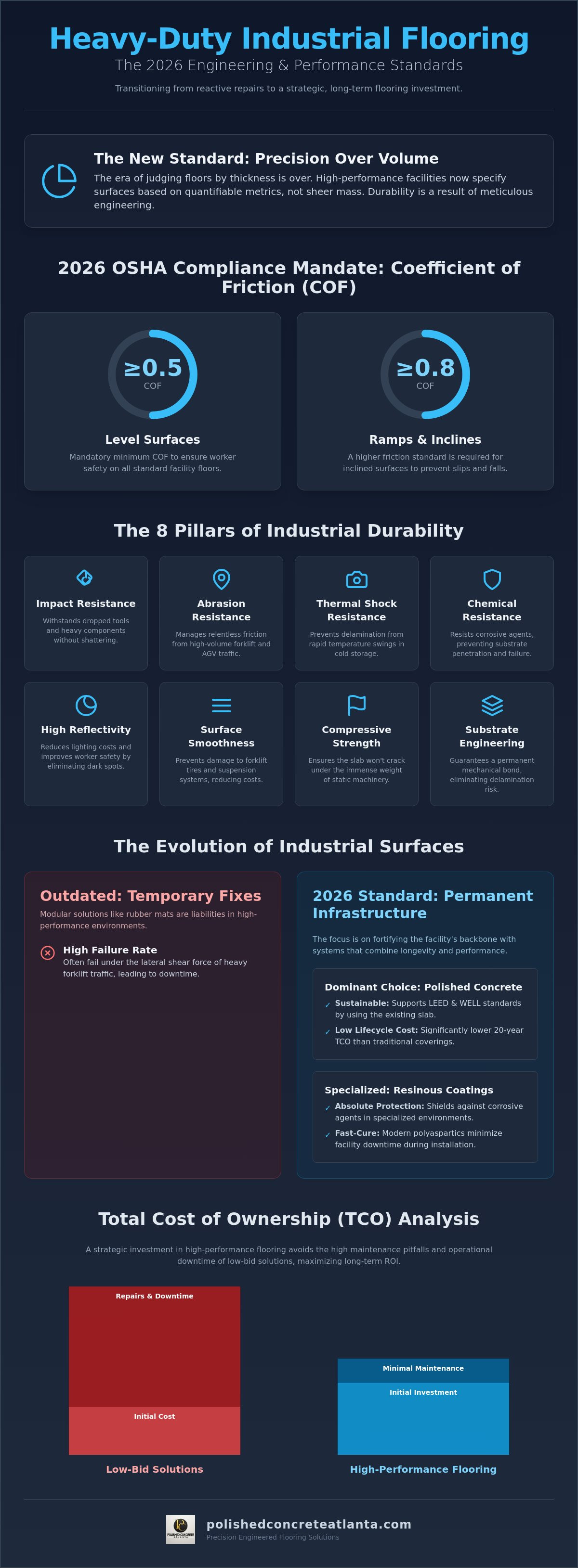
True durability is measured through specific technical data points. Shore D hardness determines a surface's resistance to permanent indentation from static loads. Load-bearing capacity ensures the slab won't crack under the weight of massive machinery. Most critically, the coefficient of friction (COF) has moved from a suggestion to a legal mandate. As of Q4 2026, OSHA requires a minimum COF of 0.5 on level surfaces and 0.8 on ramps and inclined surfaces. Achieving these numbers while maintaining a cleanable surface is the hallmark of modern engineering.
The definition of "heavy duty" remains relative to your specific facility traffic. A logistics hub managing the shear force of 24/7 forklift operations faces different stressors than a chemical processing plant. Structural integrity depends heavily on the floor's ability to resist corrosive agents that could otherwise penetrate the substrate. By selecting the right industrial flooring materials, you prevent chemical degradation from turning into a total facility failure. We don't accept compromises in structural health.
The 8 Pillars of Industrial Durability
A floor must do more than just sit there. It must perform. Impact resistance is non-negotiable in manufacturing sectors where dropped tools or heavy components are daily occurrences. Without it, your investment shatters. Abrasion resistance manages the relentless friction of high-volume forklift and automated guided vehicle (AGV) traffic. For food processing and cold storage, thermal shock resistance is the priority. Rapid temperature swings can cause inferior floors to delaminate. We ensure your surface remains intact regardless of the thermal environment.
Operational Efficiency and Floor Performance
Your floor impacts your bottom line in ways you might not see immediately. High reflectivity reduces lighting costs and improves worker safety by eliminating dark spots. Smoothness is equally vital. A jagged or uneven floor destroys forklift tires and strains suspension systems. Industrial durability is the strategic combination of high compressive strength and absolute chemical inertness.
The Evolution of Industrial Surfaces: 2026 Trends
Temporary fixes are a liability in high-performance environments. We've seen a decisive shift away from modular solutions like rubber mats, which often fail under the lateral shear force of heavy forklifts. Facility managers in 2026 now prioritize permanent resinous infrastructure. This isn't just about covering concrete; it's about fortifying the facility's backbone. With the global industrial flooring market projected to reach $8.39 billion this year, the focus has sharpened on systems that combine longevity with uncompromising performance. If you are specifically looking for anti-static resinous solutions to protect sensitive electronics, visit their website to see how specialists like Epoxy Solutions™ provide advanced ESD protection. We don't settle for "good enough" when the integrity of your operations is on the line.
The Dominance of Polished Concrete
In 2026, polished concrete floors Atlanta have become the undisputed standard for logistics hubs and high-output facilities. The logic is simple: it's the ultimate sustainable finish. By utilizing the existing slab, we eliminate the carbon footprint associated with manufacturing and transporting secondary floor coverings. This approach directly supports LEED and WELL building standards, providing a professional, low-VOC path to heavy duty industrial flooring excellence. From a lifecycle perspective, the 20-year cost of a polished system remains significantly lower than traditional coverings, especially when you factor in the reduced maintenance requirements and compliance with OSHA safety standards for floors. It's a "set it and forget it" solution for the modern manager.
High-Performance Resinous Coatings
Specialized environments often require more than just a polished surface. They need chemical resistant floor coatings that offer absolute protection against corrosive agents. We've moved beyond basic epoxies. The 2026 standard emphasizes fast-cure polyaspartics, which offer a lifespan of 10 to 15 years compared to the 3 to 5 years seen with traditional systems. These next-generation coatings allow for minimized facility downtime, ensuring your operations return to full capacity within hours. We're also seeing the rise of smart coatings that integrate anti-microbial properties for food safety or ESD protection for electronics assembly. If you're ready to upgrade your facility's resilience, it's time to consult with a professional industrial flooring partner. Precision in selection prevents failure in execution. These systems aren't just for show; they create a seamless, non-porous barrier that withstands aggressive cleaning and heavy impact while integrating your brand's identity directly into the workspace.
Why Substrate Engineering is the Foundation of Durability
A high-performance floor is only as resilient as the substrate beneath it. We refer to this as the "Invisible Asset." If your substrate is compromised, your heavy duty industrial flooring will fail, regardless of how expensive the topcoat was. Adhesion is a science. It's not a matter of luck. Many competitors overlook the critical physics of the mechanical bond, opting for shortcuts like acid etching that merely clean the surface without creating the necessary profile. We demand better. Mechanical grinding is the only way to ensure the resin or polish integrates into the concrete matrix itself.
In Georgia, we face a unique challenge: the Atlanta Factor. High humidity and fluctuating temperatures create a breeding ground for moisture-related failures. Without proper management, vapor transmission will push your coating right off the slab. This often manifests as Sweating Slab Syndrome, where moisture condenses on the surface, creating a lethal safety hazard and destroying the bond. We address these issues through rigorous testing and remediation before a single drop of finish is applied. Reliability starts at the bottom.
The Necessity of Surface Preparation
Your choice of concrete surface preparation contractors is the single most important decision in your facility upgrade. We utilize the Concrete Surface Profile (CSP) scale to match the preparation intensity to the specific coating requirements. Whether it's a light grind for polished finishes or a heavy shot blast for high-build resins, the profile must be exact. This process includes professional floor glue removal to eliminate legacy adhesives that would otherwise contaminate the new system. Following the Guide to Concrete Floor and Slab Construction ensures that every square foot meets the highest engineering standards for structural integrity.
Moisture Mitigation Strategies
Vapor transmission is a silent killer of industrial infrastructure. It causes osmotic blistering and catastrophic delamination. To prevent this, we move beyond outdated calcium chloride tests. Instead, we use relative humidity (RH) probes to measure the moisture deep within the slab. If the levels exceed safety thresholds, we install high-performance moisture barriers. These systems act as a permanent shield, protecting your investment from the inevitable Georgia humidity. We don't guess. We measure. We execute with precision. This proactive approach eliminates the uncertainty that leads to expensive rework and operational downtime.
Industry-Specific Applications for Atlanta Facilities
Atlanta's industrial landscape isn't monolithic. A one-size-fits-all approach to heavy duty industrial flooring is a recipe for premature failure. We tailor our engineering to the precise stressors of your sector. Whether you're managing a high-velocity fulfillment center or a sterile biotech lab, the surface must match the mission. We don't settle for "standard" when your operations are unique. Precision is the new baseline. Results are the only metric that matters.
Logistics and Distribution Centers
Modern warehousing demands more than just a flat slab. High-reach narrow aisle (VNA) racking requires extreme floor leveling to prevent mast sway at height. We also prioritize joint stability to eliminate the relentless impact on forklift tires that leads to vehicle wear and operator fatigue. Utilizing sealed concrete is the standard for dustproofing, ensuring your inventory remains pristine in a 24/7 environment. We don't just treat the floor; we optimize the logistics flow with integrated safety striping and permanent floor markings that won't peel under heavy traffic.
Specialized Industrial Environments
In manufacturing and assembly, impact resistance is the priority. We engineer surfaces to withstand the shock of heavy component drops without fracturing the substrate. For food and beverage facilities, we meet rigorous USDA and FDA standards for hygiene. These floors must handle thermal shock from steam cleaning and aggressive chemical washdowns without delaminating. Atlanta's booming film and tech sectors present a different challenge. They require high-gloss, camera-ready floors that are as aesthetically elite as they are durable. This is heavy duty industrial flooring redefined for the digital age.
Aviation hangars demand resistance to caustic fluids like Skydrol, which can melt standard coatings in minutes. Data centers require specialized ESD-safe flooring to protect sensitive server infrastructure from static discharge. In the pharma and biotech sectors, seamless resinous systems are the only choice for maintaining sterile, non-porous environments. Each application requires a specific technical profile. We provide the expertise to navigate these complexities and eliminate the guesswork. If you need a floor that performs under pressure, contact our industrial flooring specialists today to secure your facility's future. We're dedicated partners in your infrastructure investment.
Strategic Selection: Investing in Long-Term Facility Assets
Selecting heavy duty industrial flooring is a strategic business decision that extends far beyond the initial bid. If you base your choice solely on the lowest upfront cost, you're likely ignoring the total cost of ownership (TCO). In 2026, the average 20-year lifecycle cost for an industrial floor system ranges from $12 to $35 per square foot. We focus on the long-term. A cheaper, inferior installation might save money today, but the resulting maintenance downtime and premature failure will erode your operational margins within years. Precision in selection is the only way to protect your bottom line. We don't settle for mediocrity in our infrastructure.
Evaluating the Return on Investment
Your ROI calculation must account for more than just material and labor. It must include the cost of operational downtime during installation and the projected lifespan of the surface. For instance, while high-build epoxy systems provide elite chemical resistance, polished concrete often offers a lower TCO for logistics hubs due to its 20-year durability. Quality flooring also directly impacts facility resale and lease value. A well-maintained, high-performance floor signals structural integrity to future stakeholders. High-performance flooring is a capital improvement, not a maintenance expense.
The Professional Partnership
Choosing the right partner is as critical as choosing the material. When you vet industrial flooring contractors Atlanta, look for those who prioritize technical transparency. Demand technical data sheets and specific abrasion loss ratings, such as ASTM D4060 results. We don't accept vague promises of durability. We rely on hard data. A strategic alliance with a professional contractor ensures that your multi-facility management remains consistent across your entire portfolio. This holistic approach eliminates the uncertainty that plagues unmanaged infrastructure.
The final verdict between polished concrete and resinous coatings depends on your environment's specific stressors. If sustainability and light reflectivity are your primary drivers, polished concrete is the definitive choice. If your facility handles caustic chemicals or requires a sterile environment, a seamless resinous system is non-negotiable. Regardless of the path, your maintenance protocols must be rigorous. Regular cleaning with PH-neutral agents and scheduled inspections will extend your floor's life by decades. We build for the future. We don't settle for anything less than excellence.
Secure Your Facility's Foundation for 2026 and Beyond
Your facility's operational efficiency depends entirely on the integrity of your surface. We've established that the 2026 standard for high-performance environments demands more than just a coating; it requires a precision-engineered substrate and a commitment to total cost of ownership. From meeting strict OSHA coefficient of friction mandates to proactively remediating moisture issues before they lead to delamination, success is found in the technical details. Don't settle for temporary fixes that invite maintenance downtime and safety hazards. Precision matters. Results are non-negotiable.
Investing in heavy duty industrial flooring is the definitive strategic move to future-proof your operations and maximize infrastructure ROI. We bring over 20 years of uncompromising Atlanta craftsmanship and specialized industrial moisture mitigation expertise to every project. Our rigorous surface preparation standards eliminate the uncertainty of floor failure and ensure a permanent, mechanical bond. Partner with the Atlanta experts in high-performance industrial flooring today. You've built a world-class operation; it's time your floors reflected that same level of elite excellence and disciplined work ethic.
Frequently Asked Questions
What is the most durable industrial flooring for high-traffic warehouses?
Polished concrete is the uncompromising choice for logistics hubs, while high-build polyaspartic systems lead in chemical processing. Polished systems provide the hardness required to withstand the lateral shear of 24/7 forklift operations. These systems aren't just finishes; they're engineered components of your facility. We specify the solution based on your specific traffic patterns and load-bearing requirements. Precision prevents failure. Results are the only metric that matters.
How long does heavy duty industrial flooring typically last?
Lifespans vary by material and maintenance. Polished concrete frequently lasts 20 years or more with minimal intervention. In contrast, polyaspartic coatings offer a 10 to 15 year lifespan, significantly outperforming traditional epoxy which typically requires replacement every 3 to 5 years. Choosing heavy duty industrial flooring with a longer lifecycle reduces your long-term capital expenditure. We build for decades, not just a few seasons. Reliability is our standard.
Can I install industrial epoxy over old, oil-soaked concrete?
You cannot install any coating directly over oil-soaked concrete without aggressive remediation. Oil acts as a bond-breaker, ensuring immediate delamination. We utilize specialized degreasers and deep mechanical grinding to achieve a clean Concrete Surface Profile (CSP). If the oil has penetrated too deeply, we implement specific primers designed to block hydrocarbons. Shortcuts lead to catastrophe. We don't take them. We ensure a permanent bond through rigorous preparation.
How does moisture in the concrete slab affect floor coatings?
Excess slab moisture is the primary cause of osmotic blistering and coating failure. High vapor transmission rates push the coating off the substrate from the inside out. We use relative humidity (RH) probes to measure internal moisture levels before installation. If levels are high, a moisture mitigation barrier is mandatory to protect your investment. We eliminate the guesswork through rigorous testing protocols. We don't guess; we measure.
What is the difference between sealed concrete and polished concrete for industrial use?
Sealed concrete uses a topical film that sits on the surface, while polished concrete is a mechanical refinement of the slab itself. Sealing is a temporary solution that requires frequent reapplication as it wears down under traffic. Polished concrete is a permanent, high-performance finish that won't peel or flake. For heavy duty industrial flooring applications, polishing is the superior long-term asset. It's a "set it and forget it" solution for modern managers.
How much downtime should I expect for a professional industrial floor installation?
Downtime depends on the system complexity and the required substrate preparation. Fast-cure polyaspartic systems often allow for a return to service in as little as 24 hours. Polished concrete projects can sometimes be completed in sections to keep your facility operational. We coordinate with your logistics team to minimize disruptions. A well-managed project plan ensures we hit your deadlines without compromising on craftsmanship. Efficiency is part of our expertise.
Is polished concrete slip-resistant in an industrial setting?
Yes, a professionally polished floor meets or exceeds the 2026 OSHA safety standards. We ensure every surface achieves a minimum coefficient of friction of 0.5 on level floors and 0.8 on ramps. Despite the high-gloss appearance, the mechanical refinement provides excellent traction. We also offer slip-resistant additives for environments prone to frequent spills. Safety is a measurable metric, not a guess. We prioritize your workers' security through technical precision.
What maintenance is required for heavy-duty industrial floors?
Maintenance is straightforward but non-negotiable. You must use PH-neutral cleaners and soft-bristle scrubbers to preserve the surface integrity. Avoid harsh acidic cleaners that can etch the concrete or degrade the resinous bond. Regular sweeping prevents abrasive dust from acting like sandpaper under forklift tires. We provide a definitive maintenance roadmap for every facility we serve. Reliability requires discipline. We help you protect your infrastructure investment for the long haul.


