
The most expensive resin in the world won't save a floor that hasn't been engineered for the Georgia climate. Most facility managers assume failure is a product of poor materials. It isn't. In reality, premature peeling and moisture-related blistering are almost always the result of inadequate surface preparation and a failure to account for local humidity. You've likely dealt with the disruption of unexpected downtime and the high cost of floor failure. It's an avoidable waste of capital that no high-performing facility should tolerate.
You deserve a surface that remains maintenance-free for over a decade. This guide provides the technical blueprint you need to master industrial floor coatings Atlanta, ensuring your facility achieves absolute chemical resistance and structural integrity. We'll examine the critical shift in 2026 building codes, the rigorous mechanics of moisture mitigation, and the logistics of rapid installation. By the end, you'll have the confidence to select a system that doesn't just look elite but performs with uncompromising reliability under the most punishing industrial conditions. Results matter. Let's build for the long term.
Key Takeaways
- Master the technical standards for industrial floor coatings Atlanta to ensure your facility meets the high-performance durability requirements of 2026.
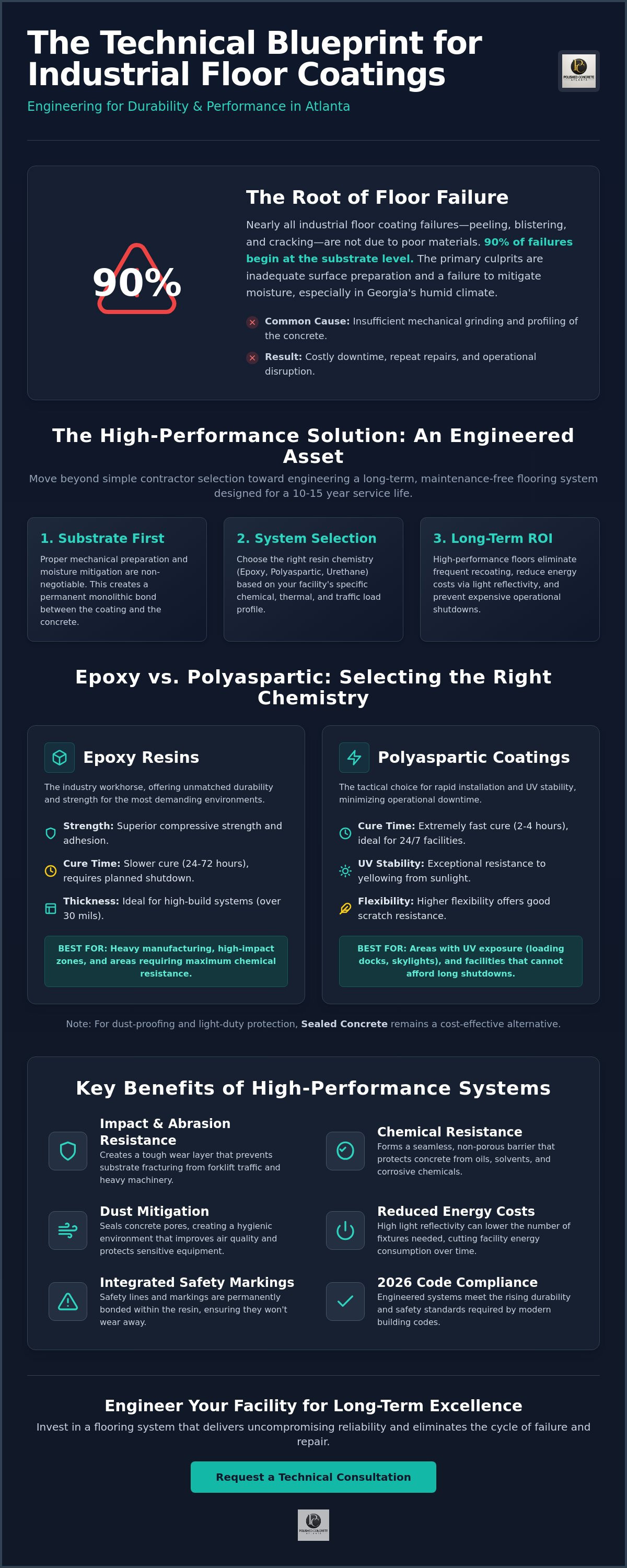
- Understand why 90% of industrial floor failures begin at the substrate and how proper mechanical preparation prevents peeling and blistering.
- Learn to differentiate between epoxy, polyaspartic, and urethane chemistries to select the optimal resin for your specific chemical and thermal exposure.
- Identify your facility’s "Load Profile" to strategically allocate resources between high-build coatings and heavy-traffic polished concrete zones.
- Gain the technical insight required to move beyond simple contractor selection toward engineering long-term, maintenance-free flooring solutions.
Industrial Floor Coatings in Atlanta: The 2026 Standard for Facility Excellence
Atlanta’s industrial landscape doesn't tolerate weakness. As the city cements its status as a premier global logistics hub, the demand for industrial floor coatings Atlanta has shifted from aesthetic preference to structural necessity. We aren't talking about residential garage paint or thin-film decorative flakes found in big-box stores. We're discussing high-performance resinous systems engineered to withstand the brutal mechanical stresses of a 24/7 facility. These systems, primarily composed of epoxy resins, polyaspartics, and specialized urethanes, form a monolithic bond with the concrete substrate. It’s a capital asset, not a line-item expense. If you treat your floor as a secondary concern, you're planning for failure. Results in 2026 demand a no-nonsense approach to durability.
Why Industrial Coatings are Critical for Atlanta Infrastructure
Impact resistance is the baseline. In a high-velocity distribution center, the constant shearing force of forklift tires and the dead weight of heavy machinery will pulverize untreated concrete. Industrial coatings provide a sacrificial yet incredibly tough wear layer that prevents substrate fracturing. Beyond physical protection, these systems are essential for dust mitigation. In precision manufacturing, concrete dust is a contaminant that compromises both product quality and air filtration systems. A seamless, high-build coating seals the pores of the slab, creating a hygienic environment that meets modern air quality and OSHA safety standards. High-visibility safety markings aren't just painted on; they're integrated into the resin for permanent, wear-resistant compliance.
The Economic Impact of High-Performance Flooring
The math is simple. A cheap floor fails, causing downtime that costs significantly more than the original installation. High-performance systems eliminate the cycle of frequent re-coating and emergency repairs that plague inferior facilities. There's also a hidden energy benefit. The high light reflectivity of a professional industrial coating can reduce the number of lumens required to light a massive warehouse, cutting energy costs over time. True ROI in industrial flooring is defined as the ratio of initial capital expenditure to the total years of service life maintained without structural failure or significant operational downtime. When you engineer for a 15-year lifecycle, the high-end floor quickly becomes the most profitable choice on your balance sheet. It's about long-term value, not short-term savings. This commitment to specialized service is universal; for example, you can explore Specialized European Auto Repair to protect your automotive investments with the same level of expert technical care.
High-Performance Coating Systems: Beyond Standard Commercial Epoxy
Don't be misled by "commercial grade" marketing. Most standard retail epoxies are low-solids products that evaporate during curing, leaving a thin, brittle film that cracks under pressure. True industrial floor coatings Atlanta facilities require 100% solids resins. These systems don't shrink. They fill the microscopic voids in your concrete, restoring structural integrity while providing a high-build wear layer that can exceed 30 mils in thickness. This isn't just a covering; it's a reinforced surface engineered to handle the relentless grinding of heavy machinery. For environments where a full resinous system isn't necessary, sealed concrete remains a high-performance, cost-effective alternative for dust-proofing and light-duty protection. The best system is never a universal choice. It's an application-specific decision based on your facility's unique load profile.
Epoxy vs. Polyaspartic: Tactical Differences
Epoxy is the industry workhorse. It offers unmatched compressive strength and superior adhesion, making it the definitive choice for heavy manufacturing zones. However, it requires a longer cure window. If your facility operates 24/7 and can't tolerate a three-day shutdown, polyaspartic systems are the tactical answer. They cure in hours, not days. Beyond speed, polyaspartics provide exceptional UV stability. They won't yellow or amber when exposed to the intense sunlight common in loading dock areas or facilities with large skylights. Choosing between them is a balance of performance needs and operational logistics.
Specialized Industrial Formulations
High-performance flooring often requires specialized chemistry to meet rigorous safety and operational demands. We engineer solutions for specific threats:
- Chemical Resistance: Specialized novolac epoxies protect against battery acid in charging stations and corrosive agents in processing plants.
- ESD Flooring: Electrostatic Dissipative systems are non-negotiable for electronics manufacturing to prevent catastrophic static discharge.
- Urethane Cements: These are the only viable option for cold storage or food processing areas where thermal shock from steam cleaning would delaminate standard epoxy.
Safety is also a structural component. We integrate high-visibility markings that comply with OSHA safety standards directly into the coating layers. This ensures your safety lanes and hazard zones remain permanent and legible for years. If you're ready to move beyond generic coatings and engineer a specific solution for your facility, the team at Polished Concrete Atlanta can provide the technical consultation you need to ensure a worry-free investment.
The Foundation of Longevity: Surface Preparation and Moisture Mitigation
Ninety percent of industrial floor failures start with poor surface preparation. This is a definitive fact. While many contractors focus on the shine of the topcoat, the integrity of your facility's floor is decided before the first gallon of resin is even mixed. If you're asking why professional preparation is a significant investment, you're looking at the wrong metric. The real cost isn't the preparation; it's the catastrophic failure of the system. A floor that peels or blisters in eighteen months creates operational downtime and safety hazards that far exceed the initial cost of doing the job right. High-quality industrial floor coatings Atlanta require a mechanical bond that only rigorous, uncompromising preparation can provide. Anything less is a liability.
Mechanical Grinding and Adhesive Removal
Do not trust a contractor who suggests acid etching for an industrial environment. It's a superficial, outdated method that fails to create the necessary "tooth" for heavy-duty resins. We utilize industrial-scale diamond grinding to achieve a specific Concrete Surface Profile (CSP). A CSP-3 is the minimum standard for most high-build industrial epoxies to ensure a permanent bond. This process also includes comprehensive floor glue removal. Any residual adhesive or old mastic from previous flooring acts as a bond-breaker. If these contaminants aren't mechanically removed, the new coating will eventually delaminate under the shearing force of forklift traffic. We don't leave this to chance. We grind until we reach clean, sound concrete.
Moisture Mitigation in Georgia’s Humid Climate
Georgia’s humidity is a relentless threat to industrial infrastructure. Moisture Vapor Transmission (MVT) is the silent cause behind most blistering issues. When moisture rises through the concrete slab and meets an impermeable resinous coating, it creates osmotic pressure. This pressure eventually forces the coating away from the concrete, resulting in unsightly and dangerous blisters. Expert industrial flooring contractors Atlanta prioritize data over guesswork. We use calcium chloride tests and in-situ RH probes to measure exactly how much moisture is moving through your slab. If the levels are too high, we apply specialized moisture vapor barriers to "lock" the slab. This technical step ensures your floor remains stable and compliant with OSHA safety standards, providing a worry-free surface that stands up to the local climate. We engineer for the environment we're in, not the one we wish we had.
Selecting the Right System: Application-Specific Flooring Strategies
A floor is only as good as the strategy behind its selection. Choosing industrial floor coatings Atlanta isn't a matter of aesthetic preference; it's a rigorous assessment of your facility's operational reality. We don't guess. We analyze the Load Profile, Chemical Profile, and Maintenance Profile of every zone before recommending a specific resinous system. While polished concrete floors Atlanta are the gold standard for high-traffic abrasion resistance in open warehouse lanes, high-performance coatings are non-negotiable for areas requiring chemical containment or extreme impact protection. You must distinguish between static loads, such as heavy racking, and dynamic loads, like high-speed forklifts. Each demands a different technical response to prevent substrate failure.
Warehouse and Distribution Center Standards
Efficiency in a distribution center depends on joint stability. When high-reach forklifts travel over uneven or crumbling joints, the resulting vibration damages both the equipment and the inventory. We engineer systems that prioritize extreme abrasion resistance and seamless transitions. Dust-proofing is another critical factor. In facilities housing sensitive electronics or consumer goods, concrete dusting isn't just a maintenance nuisance; it's a product failure risk. High-build industrial floor coatings Atlanta eliminate this risk by sealing the slab entirely. We also focus on light reflectivity. A high-gloss, light-colored coating improves employee safety by illuminating work zones while reducing the total energy load required for facility lighting. It's a strategic move for safety and the bottom line.
Manufacturing and Heavy Industrial Environments
Manufacturing zones face a more aggressive set of threats. Impact resistance is paramount here. When heavy tools are dropped or machinery vibrates at high frequencies, a standard commercial coating will shatter. We utilize reinforced systems designed to absorb these shocks without delaminating. For facilities handling hazardous liquids, secondary containment is a legal and operational requirement. We install chemical-resistant novolac resins that create an impermeable basin, protecting your slab and the environment. Thermal shock is the final hurdle. In facilities where high-temperature washdowns occur, standard resins will fail due to differential expansion. We deploy urethane cements that expand and contract at a rate similar to the concrete slab, ensuring the bond remains intact under extreme temperature fluctuations.
Your facility's durability is too important to leave to an amateur. If you're ready to engineer a floor that outlasts the competition, contact Polished Concrete Atlanta for a technical assessment that prioritizes tangible performance over empty promises.
Executing Industrial Excellence: The Polished Concrete Atlanta Standard
Mediocrity is a choice we refuse to make. When you partner with us for industrial floor coatings Atlanta, you aren't just hiring a contractor; you're securing a strategic alliance with an industry leader. We approach every facility with a "no-nonsense" pragmatism that prioritizes long-term performance over superficial speed. Our reputation is built on the elimination of uncertainty. We understand that in an industrial environment, the cost of a mistake is measured in thousands of dollars of lost productivity. That's why we don't just sell products. We engineer comprehensive flooring solutions that account for the unique environmental stresses of the Georgia climate and the specific mechanical demands of your operation. Quality is our baseline. Results matter.
The Strategic Alliance: From Consultation to Execution
Our project management approach is designed to remove the burden of logistics from the facility manager. We provide total transparency from the initial site evaluation to the final walkthrough. This means no vague fluff or hidden costs; just tangible results delivered on a predictable timeline. Every square foot of floor preparation is executed to the most rigorous standards in the industry. We treat the substrate with the respect it deserves because we know it’s the only way to guarantee a bond that lasts. This level of discipline ensures that when we hand over the finished floor, it’s a premium asset ready for immediate service. We manage the details so you can manage your business.
Why Settle for Less Than the Industry Leader?
We've mastered the craft of industrial flooring at a massive scale. Whether you're managing a local distribution center or a complex manufacturing plant, our team brings the gravitas of seasoned veterans who have seen every possible scenario. We take immense pride in our high-end craftsmanship. It’s an elite skill set grounded in a blue-collar work ethic that doesn't quit until the job is perfect. Investing in a professional installation today prevents the high-cost headaches of tomorrow. Don't gamble with your facility's foundation. Contact Polished Concrete Atlanta for a professional facility evaluation and experience the definitive standard for industrial floor coatings Atlanta. Let's build something that lasts.
Engineering Your Facility’s Legacy for 2026 and Beyond
A high-performance floor isn't a luxury; it's a structural requirement for any facility aiming to dominate Atlanta’s logistics and manufacturing sectors. You've seen that durability is won or lost in the technical details of mechanical preparation and moisture mitigation. Founded in 2004, Polished Concrete Atlanta brings over two decades of local expertise to every project. We don't settle for mediocrity because we know that Georgia's humidity and your facility's heavy loads demand a definitive, engineered response. Our technical mastery of high-performance resinous systems ensures that your investment remains a maintenance-free asset for the long term.
Don't leave your infrastructure to chance with contractors who ignore the science of industrial floor coatings Atlanta. It's time to eliminate uncertainty and embrace the peace of mind that comes with elite craftsmanship and rigorous standards. We're ready to partner with you to solve your most complex flooring challenges through transparent project management and tangible results. Secure Your Facility’s Future with a Professional Industrial Flooring Consultation. Your facility deserves a foundation that matches your ambition. Let's get to work.
Frequently Asked Questions
How long do industrial floor coatings typically last in a high-traffic warehouse?
A professionally engineered high-build system typically lasts between 10 and 15 years in high-traffic environments. Longevity is determined by the quality of the substrate preparation and the thickness of the wear layer. If the floor is subjected to constant forklift shearing forces without proper joint stabilization, that lifespan can decrease. We focus on durability that outlasts standard commercial applications through rigorous mechanical bonding.
What is the difference between an epoxy coating and a concrete sealer?
An industrial coating is a high-build resinous system that creates a new, thick wear layer over the concrete. In contrast, a sealer is a thin, penetrating film designed primarily for dust-proofing and light-duty moisture resistance. While sealers are cost-effective for low-impact zones, they don't provide the impact or chemical resistance required for heavy manufacturing or logistics hubs. Coatings offer structural reinforcement; sealers offer surface protection.
Can industrial coatings be applied over damaged or oil-saturated concrete?
Yes, but only after uncompromising mechanical preparation. Oil-saturated slabs require specialized degreasers and deep diamond grinding to reach clean, sound concrete. If the damage is structural, we perform concrete leveling and patching before applying the resin. We don't coat over failure; we remediate the substrate to ensure a permanent bond. A floor is only as reliable as the concrete beneath it.
How much downtime should I expect during an industrial floor coating installation?
Standard epoxy systems usually require a 72-hour window for full cure and return to heavy traffic. However, polyaspartic formulations can reduce this downtime to less than 24 hours. We coordinate every project to minimize operational disruption, often working in phases to keep your facility running. The specific timeline depends on the complexity of the preparation required and the resin chemistry selected for your load profile.
Why is moisture mitigation necessary for concrete floors in Georgia?
Georgia’s high humidity and high water table create significant moisture vapor transmission through concrete slabs. Without proper moisture mitigation, this vapor pressure causes osmotic blistering and delamination of the coating. We use technical testing to determine the vapor emission rate and apply specialized barriers to lock the slab. It's a non-negotiable step for industrial floor coatings Atlanta to ensure a worry-free investment.
Are industrial floor coatings slip-resistant when wet?
We engineer every system to meet specific safety requirements by integrating anti-slip aggregates like aluminum oxide or quartz. The level of texture is customized based on whether the floor is typically dry, wet, or oil-slicked. This ensures your facility remains compliant with safety standards while maintaining a surface that is still easy to clean. Safety and performance must coexist to protect your workforce and your liability.
What is the maintenance protocol for a high-performance epoxy floor?
Maintenance is straightforward but critical for maximizing service life. Routine sweeping and mechanical scrubbing with pH-neutral cleaners will remove abrasive debris that can dull the finish over time. Because the surface is seamless and non-porous, it doesn't trap contaminants like bare concrete. We provide a specific maintenance protocol tailored to your facility's traffic and spill profile to ensure long-term aesthetic and functional excellence.
Is polished concrete better than epoxy for heavy manufacturing facilities?
Polished concrete is superior for high-traffic areas requiring extreme abrasion resistance and low maintenance. However, epoxy is the definitive choice for environments facing frequent chemical spills or heavy impact. We often recommend a hybrid approach, using industrial floor coatings Atlanta in processing zones and polished concrete in high-traffic aisles. The best floor is the one engineered for your specific stress factors and load profile.


