The most expensive mistake a facility manager can make in 2026 isn't the flooring they choose, but the adhesive they leave behind. You've likely seen the consequences of cutting corners. Bubbling epoxy, peeling vinyl, and the logistical nightmare of project delays are all too common. When it comes to floor glue removal Atlanta facility leaders often find themselves caught between aggressive deadlines and stubborn, legacy mastics. It's a high-stakes game where a single bonding failure can compromise your entire capital investment.
We understand that you can't afford the health risks of chemical fumes or the liability of silica dust in an active facility. This guide provides the definitive blueprint for achieving a perfectly profiled concrete slab that's ready for high-performance coatings or polishing. You'll discover why mechanical grinding is the only way to eliminate uncertainty and ensure your new floor bonds permanently. We're breaking down the shift to the 2024 International Building Code standards and the specialized equipment required for a dust-free, professional execution.
Key Takeaways
- Identify the critical difference between industrial-grade surface preparation and standard demolition to protect your facility's long-term investment.
- Avoid the "chemical trap" by choosing mechanical grinding over liquid strippers that leave bond-breaking films on your concrete slab.
- Define the exact Concrete Surface Profile (CSP) required for your specific finish during floor glue removal Atlanta to guarantee permanent adhesion.
- Implement a strategic, two-phase execution process that prioritizes site-specific adhesive identification and high-capacity dust extraction.
- Ensure the integrity of your new flooring by moving beyond simple cleaning to rigorous porosity testing and precision engineering.
The Reality of Professional Floor Glue Removal in Atlanta
Industrial floor glue removal Atlanta isn't a simple cleanup job. It's a precision engineering requirement. Many facility managers assume a standard demolition crew with hand scrapers can handle the task. They're wrong. Commercial adhesives used in Georgia warehouses are designed to last decades under heavy forklift traffic. They don't just peel off. They've bonded with the concrete matrix itself. Dealing with these legacy materials requires a level of aggression that standard rental equipment simply can't provide. Elite surface preparation is the only way to ensure your facility doesn't face a costly shutdown later.
Atlanta's climate adds another layer of complexity. High humidity levels in the Southeast can reactivate old water-soluble glues or trap moisture deep within the slab. If you don't remove the glue entirely, you're setting yourself up for a concrete floor failing after coating. This isn't just theory; it's a chemistry problem that leads to osmotic blistering and delamination. A clean-looking slab isn't necessarily a clean slab. If the pores are still choked with adhesive residue, your new epoxy or sealer has nowhere to go. It will eventually lift, taking your investment with it.
Commercial vs. Residential Adhesives: A Different Breed of Problem
Commercial spaces utilize high-bond epoxies and urethanes that are fundamentally different from residential glues. In Atlanta's industrial corridors, we see adhesives specifically engineered to resist chemicals and moisture. Manual scraping is a waste of time in these environments. It often leaves behind microscopic barriers that are invisible to the naked eye but catastrophic for new coatings. The time-cost of inefficient removal is staggering. Every day your project is delayed by stubborn glue is a day of lost production. Professional floor glue removal Atlanta relies on heavy-duty planetary grinders to strip these materials in a fraction of the time while creating the necessary surface profile. For facility managers who also oversee soft flooring assets, utilizing experts like Best Carpet Steam Cleaning Melbourne ensures that every surface in a high-traffic environment is maintained to professional standards.
The Hidden Dangers of Legacy Adhesives: Black Mastic and Beyond
Older Atlanta facilities often hide hazardous materials beneath layers of carpet or tile. Black mastic, a common asphalt-based adhesive, frequently contains asbestos. Understanding what mastic is helps in identifying these risks before they become legal liabilities. You can't just sand these materials. OSHA regulations for 2026 demand strict adherence to dust control and specific removal protocols if hazardous substances are present. Professional testing is the first step in any high-stakes renovation. We don't guess with your safety or your budget. We identify the adhesive, assess the risk, and execute a removal plan that keeps your facility compliant and your air clean.
Mechanical Grinding vs. Chemical Stripping: The Professional Verdict
Choosing between chemical strippers and mechanical grinding is the most critical decision in any floor glue removal Atlanta project. One method offers a superficial clean that hides a structural liability. The other provides a pristine, engineered surface ready for a lifetime of performance. We don't compromise on the foundation. Chemicals solve the visual problem but create a structural disaster. This is the professional reality that many contractors ignore to save time on the front end. If your goal is a floor that lasts, the choice is clear.
Environmental safety is another non-negotiable factor. Chemical strippers release high levels of Volatile Organic Compounds (VOCs) that can linger in a facility for weeks. In contrast, our mechanical process uses industrial-grade HEPA filtration to manage particulates. We adhere strictly to OSHA's crystalline silica standards to ensure your air remains breathable during execution. This no-nonsense approach protects your staff and your facility's air quality while delivering a superior result. It's about more than just a clean floor; it's about a safe, compliant job site.
The Science of the Bond-Breaker
Chemical strippers work by liquefying adhesives into a toxic slurry. This process doesn't actually remove the material from the site; it simply changes its state. These aggressive solvents drive oils and resins deep into the concrete capillaries. Once the chemical evaporates, it leaves behind a microscopic film. This film acts as a permanent bond-breaker. If you apply a high-end epoxy over a chemically stripped slab, the coating will eventually delaminate. The mechanical bond is impossible because the pores are already occupied by chemical residue. You're essentially building on a foundation of oil.
Diamond Grinding: Precision and Performance
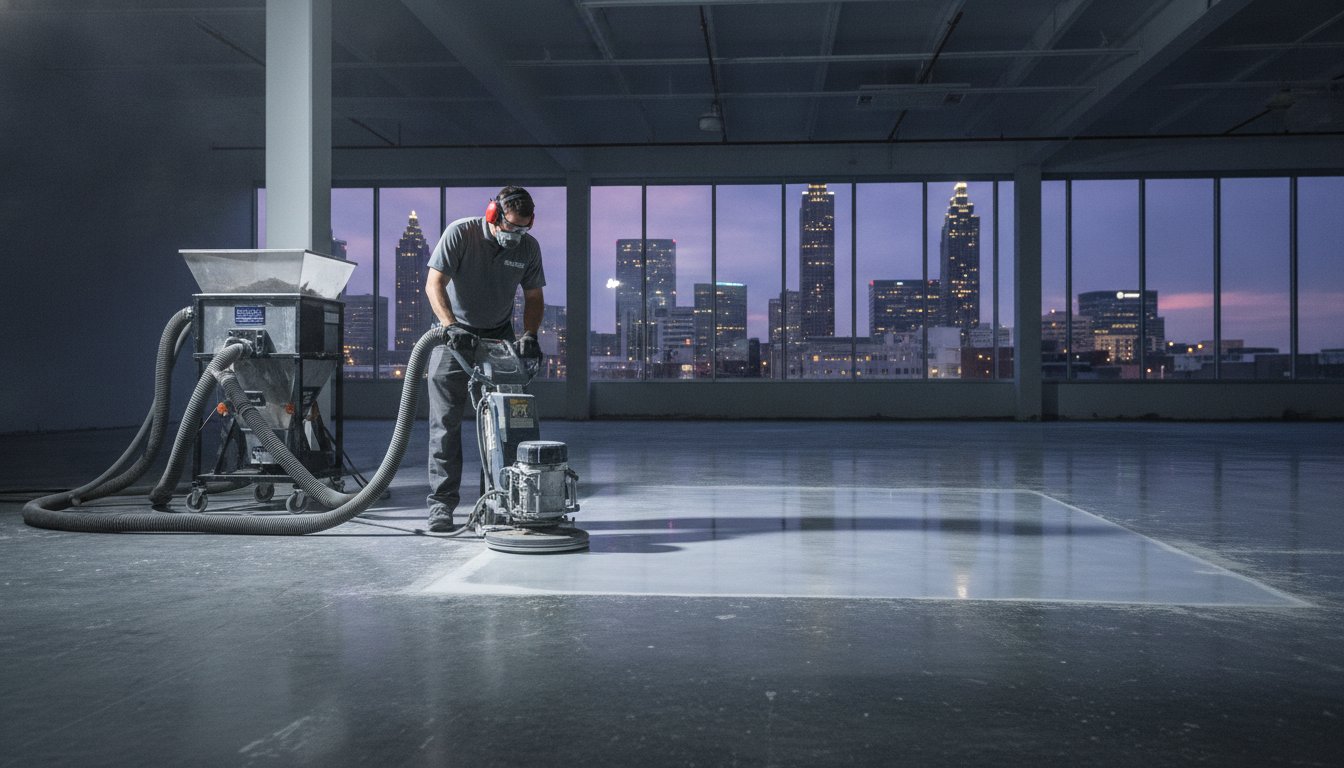
We exclusively use diamond-tooled planetary grinders for industrial preparation. These machines don't just scrape the surface. They shave away the top layer of contaminated concrete, taking the glue with it. Modern diamond tooling in 2026 allows us to remove thick mastics while simultaneously leveling the slab. This dual-action process creates a surface that is "thirsty" for new coatings. By opening the concrete's pores, we allow stains and epoxies to penetrate deep into the substrate. This ensures a permanent, mechanical lock that no chemical process can replicate. If you're ready to secure your investment, our industrial floor services provide the clean slate your project requires.
Engineering the Surface: Why Preparation is Non-Negotiable
Adhesion is not a suggestion. It is a requirement. Professional floor glue removal Atlanta transforms a slab from a demolition site into a high-performance substrate. While competitors might be satisfied with a surface that looks clear to the naked eye, we understand that true preparation happens at the microscopic level. If the concrete pores remain clogged with residual resins or silicates, your new flooring system is destined for early failure. We treat every square foot of your facility as an engineering challenge that requires a specific, documented solution.
Simply removing the old adhesive is only half the battle. Once the slab is exposed, we must evaluate its internal health. This includes rigorous porosity testing to ensure the concrete can actually accept a new bond. In the high-stakes world of industrial facility management, guessing is a liability you can't afford. Our approach ensures that every step of the preparation process aligns with the rigorous polished concrete floors Atlanta standards, providing a foundation that supports your operational goals for decades.
Achieving the Correct Concrete Surface Profile (CSP)
The texture of your concrete determines the strength of the mechanical bond. This texture is measured as the Concrete Surface Profile (CSP). For most industrial coatings and high-performance epoxies, a CSP 2 or 3 is the mandatory baseline. We don't rely on luck to reach these metrics. Our planetary grinding equipment allows us to "dial in" the exact profile needed for your specific finish. By precisely controlling the grit and weight of our diamond tooling, we create a uniform surface that maximizes surface area for adhesion. This level of precision is what separates a professional installation from a DIY-grade disaster.
Post-Removal Assessment: Moisture and Slab Integrity
Once the glue is gone, the slab's true character is revealed. We immediately move into a post-removal assessment to identify hidden structural issues. This includes testing for moisture vapor emission rates (MVER). Atlanta’s humidity can lead to "Sweating Slab Syndrome," a condition where moisture migrates through the concrete and destroys the bond of your new floor from underneath. We also look for:
- Micro-cracks and structural spalling hidden by old mastic.
- Evidence of previous chemical treatments that might act as bond-breakers.
- Variable density across the slab that requires specialized hardening treatments.
The Strategic Process: How We Execute Glue Removal in Atlanta
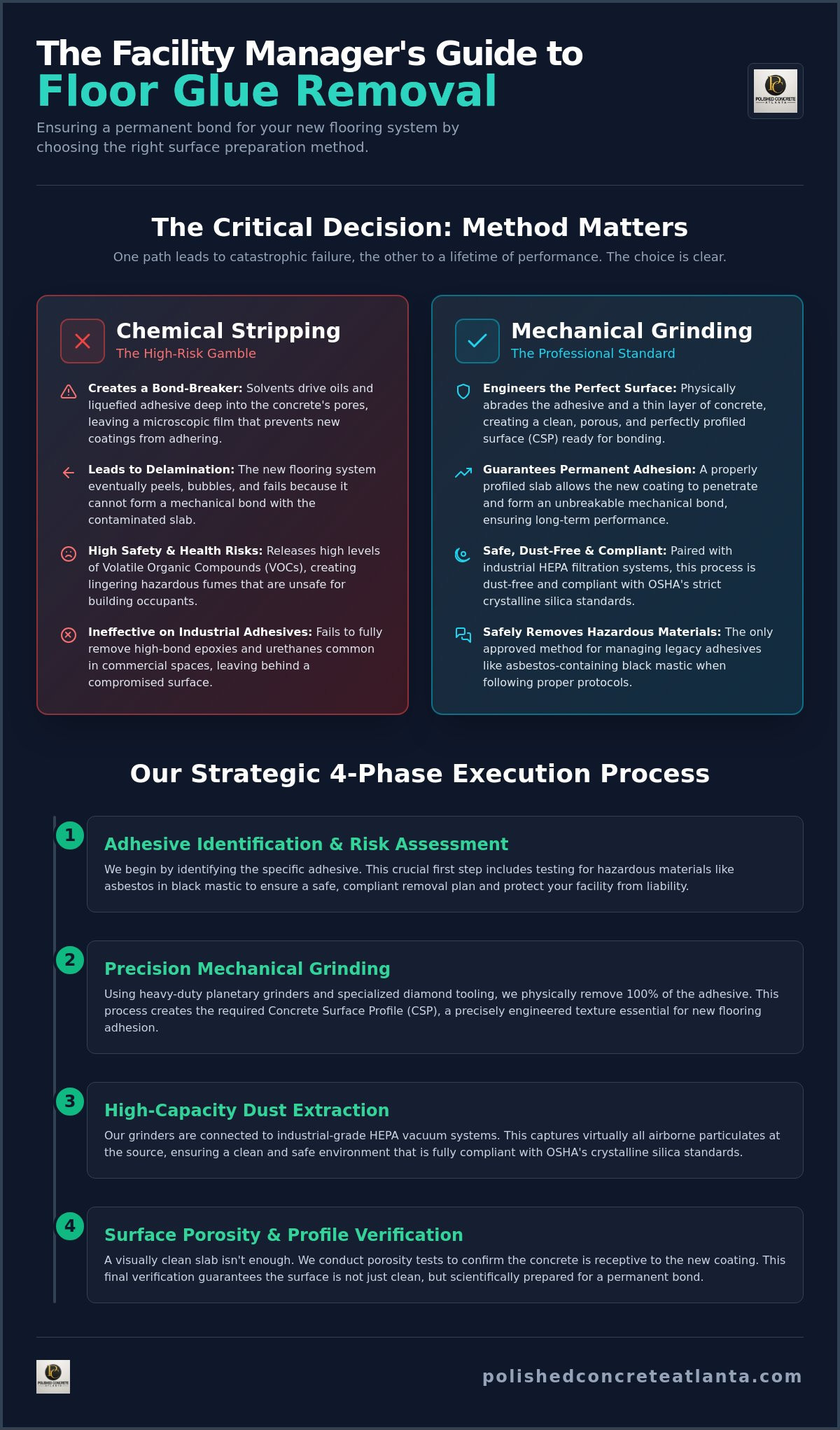
Execution is where the engineering plan meets the reality of the job site. A systematic approach to floor glue removal Atlanta ensures that no detail is overlooked and no deadline is missed. We don't just show up and start grinding. Our process is a four-phase strategic operation designed to eliminate variables and deliver a predictable, high-quality substrate. This methodical workflow is what allows us to maintain the integrity of your facility while preparing for a permanent flooring bond.
Phase 1 begins with a forensic site survey and adhesive identification. We determine exactly what we're fighting, whether it's legacy black mastic or high-performance urethanes. Phase 2 involves heavy-duty planetary grinding integrated with active dust extraction. This is the bulk of the work where we strip the slab to its clean, original state. Phase 3 focuses on the details. We utilize specialized hand grinders for edge work and tight corners to ensure a seamless finish across the entire footprint. Finally, Phase 4 includes a total surface vacuuming and rigorous pH testing. This ensures the concrete is chemically neutral and ready to receive its new finish without the risk of osmotic failure.
Industrial-Grade Equipment and Dust Containment
Occupied buildings require a higher standard of care. In 2026, "dustless" is the only acceptable baseline for Atlanta renovations. We utilize industrial-grade HEPA-filtered dust extractors that connect directly to our grinding equipment. This creates a closed-loop system that captures 99.97 percent of particulates at the source. This isn't just about cleanliness; it's about strict compliance with OSHA silica regulations. We protect your employees, your inventory, and our crew by maintaining pristine air quality throughout the duration of the project. You don't have to shut down your entire operation to get a clean slab.
Operational Impact: Minimizing Downtime
We understand that every hour your facility is offline represents a loss in revenue. Our crews are organized for maximum efficiency and speed. We offer flexible scheduling, including night and weekend shifts, to accommodate active Atlanta warehouses and commercial centers. A professional crew can move significantly faster than a general demolition team because we use the right tool for the specific adhesive. By preparing your space ahead of our arrival, we can maximize our square footage output and get your facility back into production. If you're ready to start your renovation with a clean slate, contact us for professional floor preparation that respects your timeline and your budget.
Investing in Preparation: Transitioning from Prep to Performance
Cheap preparation is a gamble you'll eventually lose. In the industrial sector, the cost of a flooring failure far exceeds the initial savings of a budget-tier contractor. When you prioritize professional floor glue removal Atlanta, you aren't just paying for the removal of old mastic. You're investing in the long-term structural integrity of your facility. A slab that hasn't been properly stripped and profiled is a ticking clock for delamination. We've seen countless projects where a high-end finish was applied over poorly prepared concrete, only to fail within months. Don't let your facility become a cautionary tale.
The transition from a raw, adhesive-covered slab to a precision concrete grinding and polishing masterpiece depends entirely on the quality of the initial grind. Every scratch pattern and residual chemical left behind during the prep phase will be magnified once the polishing or coating process begins. By treating glue removal as the first step of the finishing process rather than a separate demolition task, we ensure a seamless transition that maximizes both aesthetic and functional results.
The ROI of Professional Surface Preparation
The return on investment for elite surface prep is measured in years of maintenance-free performance. A properly engineered substrate can extend the life of your epoxy or polished finish by 2x. This is because the mechanical bond created during grinding allows the finish to become part of the concrete rather than just sitting on top of it. Avoiding the catastrophic costs of re-work and operational downtime is the smartest financial move a facility manager can make. Choosing a single-source contractor for both floor glue removal Atlanta and the final finish eliminates the "blame game" between prep crews and installers. We take absolute responsibility for the final product from the first diamond pass to the final sealer.
Next Steps: From Bare Concrete to Polished Excellence
Once the final inspection confirms a "ready-to-coat" slab, the path to a high-performance floor is clear. This criteria includes a uniform surface profile, zero residual adhesive, and moisture levels that fall within the manufacturer’s specifications. From here, we can pivot to the installation of industrial floor coatings Atlanta or continue the grinding process into a high-luster polish. Selecting the right sealer or densifier at this stage is critical to protecting your newly exposed slab from staining and wear. If you're ready to stop managing problems and start managing a high-performance asset, consult with an Atlanta expert on your floor prep today.
Securing Your Facility's Foundation for 2026
Your flooring investment is only as strong as the bond between the substrate and the finish. We've established that mechanical grinding is the only definitive way to achieve a clean slate. It avoids the catastrophic chemical residues that plague budget-tier projects. By focusing on Concrete Surface Profile standards and rigorous moisture testing, you eliminate the variables that lead to delamination. Precision preparation isn't just a service; it's an insurance policy for your facility's future.
As a veteran-owned industry leader since 2004, we've mastered the complexities of floor glue removal Atlanta for the city's most demanding industrial and commercial environments. Our crews utilize high-capacity HEPA dust extraction systems to ensure your facility remains clean and compliant throughout the renovation. Stop leaving your capital improvements to chance. It's time to transition from simple demolition to precision engineering. Request a Professional Surface Assessment today to guarantee the permanence of your next flooring masterpiece. You've worked hard to build your facility; we'll make sure the floor supports its future.
Frequently Asked Questions
How much does professional floor glue removal cost in Atlanta?
Professional costs are determined by the adhesive's chemical composition and the required Concrete Surface Profile (CSP) for your new finish. Industrial-grade removal is calculated based on square footage and the complexity of the mechanical bond. Factors like slab condition and the presence of hazardous materials will influence the final project scope. We focus on providing a definitive result that eliminates the need for expensive re-work.
Can I install new flooring directly over old adhesive residue?
No. Installing new flooring over old residue is a guaranteed path to project failure. Legacy adhesives act as a permanent bond-breaker, preventing new epoxies or sealers from penetrating the concrete pores. This leads to delamination, bubbling, and premature wear. You must achieve a clean, profiled substrate to ensure your flooring investment lasts for its intended lifespan.
How long does it take to remove glue from a 5,000 sq. ft. warehouse?
A professional crew can typically clear a 5,000 square foot warehouse in one to two business days. This specific timeline depends on the thickness of the mastic and the capacity of the planetary grinders deployed to the site. We utilize high-output equipment to maximize efficiency and minimize your facility's operational downtime. Speed never comes at the expense of surface integrity.
Is the dust from mechanical grinding dangerous for my employees?
Respirable crystalline silica dust is a significant health hazard if it's not managed with industrial-grade equipment. We use high-capacity HEPA-filtered dust extractors that capture 99.97 percent of particulates at the source. This ensures floor glue removal Atlanta remains safe for your employees and fully compliant with current OSHA standards. You don't have to compromise air quality for a clean floor.
What is the difference between scraping and diamond grinding?
Scraping only removes the bulk material while leaving a microscopic film of adhesive behind. Diamond grinding shaves away the top layer of contaminated concrete to physically open the pores. This process doesn't just clean the surface; it profiles the slab. This creates the necessary mechanical "tooth" required for high-performance industrial coatings and polished finishes to bond permanently.
Why did my previous floor coating fail after only a year?
Most floor failures are caused by improper surface preparation or unaddressed moisture vapor. If the previous contractor didn't remove every trace of old glue or failed to test for "Sweating Slab Syndrome," the new coating was destined to lift. We treat the slab as an engineered system to prevent these catastrophic failures. Proper preparation is the only way to avoid the cycle of constant repair.
Do you provide glue removal for residential homes in Atlanta?
Our services are strictly dedicated to commercial and industrial environments. We specialize in large-scale projects like warehouses, manufacturing plants, and high-traffic retail centers. We don't perform residential tile removal or small-scale home garage prep. This specialization allows us to maintain the heavy-duty equipment and expertise required for massive industrial footprints.
Can you remove black mastic adhesive safely?
Yes, we handle black mastic removal using specialized protocols that prioritize site safety and environmental compliance. Since many legacy asphaltic adhesives contain asbestos, we follow strict HEPA-contained grinding or wet-handling methods. We ensure all hazardous materials are managed according to 2026 regulatory requirements. We provide the documentation and peace of mind necessary for high-stakes facility renovations.


