
Your facility floor is either a precision-engineered asset or a mounting overhead expense. There is no middle ground. If you're still battling concrete dusting, moisture-related coating failures, or the relentless maintenance costs of traditional flooring, you're operating behind the curve. Professional concrete polishing services have evolved beyond simple aesthetics into a rigorous industrial standard for 2026. It's about hardening the slab at a molecular level. Results matter.
You know that a failing floor isn't just an eyesore; it's a safety hazard and a drain on your bottom line. We'll help you master the technical specifications and strategic selection process required to transform your floors into high-performance assets. This guide outlines the lifecycle benefits of mechanical polishing, from moisture mitigation standards like ASTM F2170 to the energy savings gained through improved reflectivity. We're breaking down exactly how to achieve a dust-free, high-luster finish that stands up to heavy machinery wear. Stop settling for mediocrity.
Key Takeaways
- Understand how professional concrete polishing services utilize chemical refinement and mechanical grinding to permanently eliminate concrete dusting in high-traffic warehouses.
- Discover the definitive criteria for choosing between breathable polished surfaces and non-porous industrial coatings based on your facility's specific moisture profile.
- Learn to specify the exact aggregate exposure and gloss levels required to balance operational durability with your desired aesthetic and reflectivity.
- Recognize why rigorous moisture vapor emission testing and substrate preparation are the non-negotiable foundations of a floor that lasts.
- Gain insight into the role of liquid densifiers in closing concrete pores to create a surface that resists heavy machinery wear and chemical penetration.
Beyond the Surface: Why Commercial Environments Require Professional Concrete Polishing Services
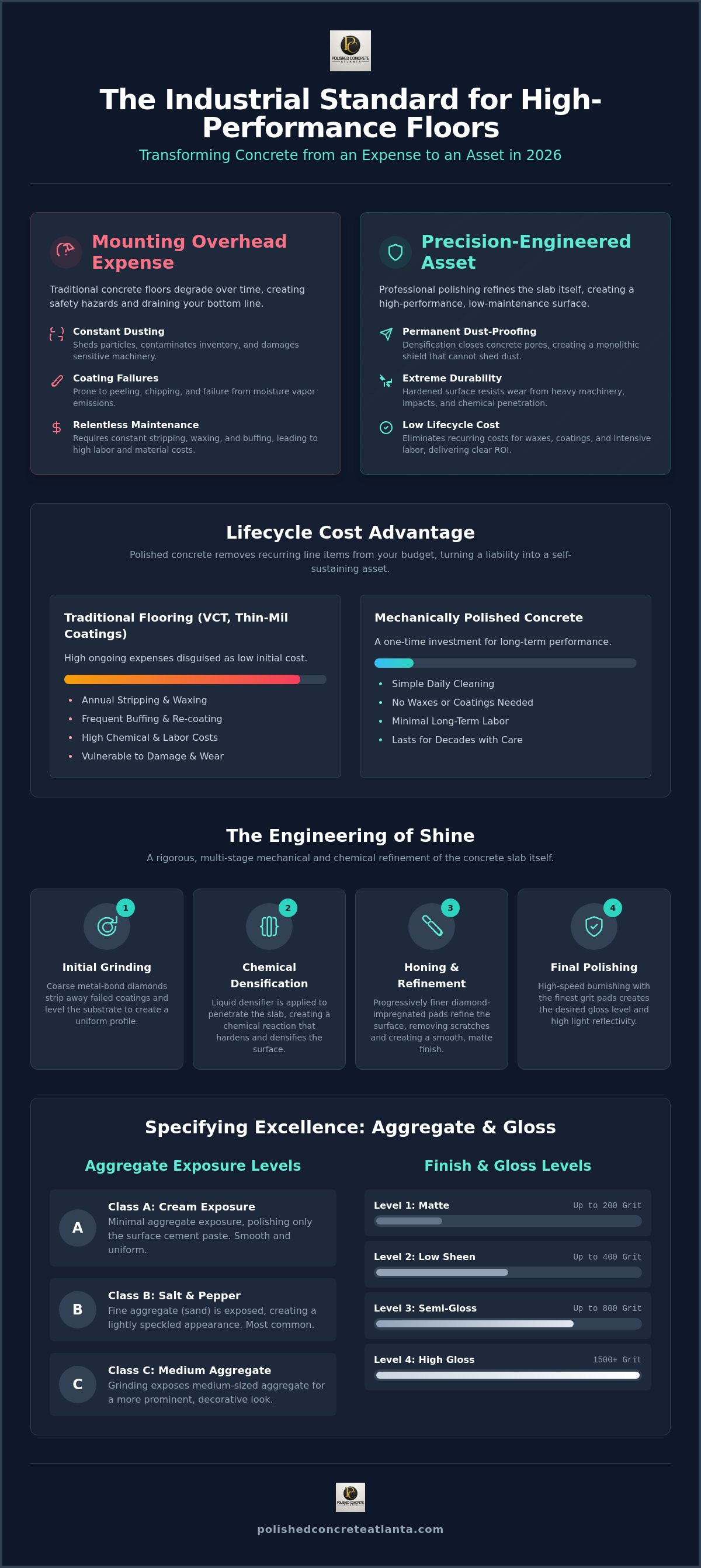
A floor is either a precision-engineered asset or a mounting overhead expense. Professional concrete polishing services are not a cosmetic application of wax or a temporary topical sealer. They represent a rigorous, multi-stage mechanical and chemical refinement of the concrete slab itself. By using progressively finer diamond-impregnated pads, the surface is physically ground down to achieve a specific level of smoothness and density. This is The Polished Concrete Process in its most disciplined form. Results matter.
One of the most persistent failures in unrefined slabs is concrete dusting. This isn't just a cleaning nuisance; it is the physical degradation of the concrete surface as it sheds microscopic particles of calcium hydroxide. In a warehouse or manufacturing environment, this dust infiltrates sensitive machinery, contaminates inventory, and compromises indoor air quality. Professional refinement eliminates this problem permanently. By densifying the slab, we transform a porous, fragile surface into a monolithic shield that cannot shed or erode.
Strategic facility management also requires a focus on operational visibility. High-luster polished floors significantly increase ambient light reflectivity, which can reduce the demand on artificial lighting systems. Improved visibility isn't just about utility bills. It's about safety. A brighter workspace allows for better hazard identification and reduces worker fatigue. Settling for a dull, absorbent floor is a choice to accept higher costs and lower safety standards. We don't settle.
The Lifecycle Cost Advantage for Facility Managers
Facility managers often get trapped in the cycle of low-bid flooring installations like VCT or thin-mil coatings that require constant attention. These traditional surfaces are liabilities disguised as savings. They demand annual stripping, waxing, and buffing to maintain even a basic level of functionality. Polished concrete removes these recurring line items from your budget. The ROI is undeniable. When you eliminate the need for expensive chemical waxes and the labor hours required to apply them, the floor becomes a self-sustaining asset. Low maintenance is a strategic advantage.
Industrial Durability and High-Traffic Performance
Industrial environments are unforgiving. Heavy machinery and forklifts exert massive point-load pressure that can crush inferior coatings and leave permanent tire marks. Polished concrete is engineered to resist this abuse. The densification process increases the surface's compressive strength, making it harder and more resistant to impact. It also provides a level of chemical resistance that prevents oils and contaminants from penetrating the slab. Understanding The Standard for Polished Concrete Floors in Atlanta is essential for any leader who prioritizes long-term durability over short-term fixes. We build for the long haul.
The Engineering of Shine: Understanding the Multi-Stage Concrete Polishing Process
Concrete polishing isn't a surface treatment. It's a fundamental restructuring of the slab's surface. High-quality concrete polishing services rely on a specific sequence of mechanical abrasion and chemical intervention. We follow the rigorous specifications outlined in The Engineering of Shine to ensure every square foot meets industrial performance standards. It starts with the heavy lifting. We don't guess. We execute.
Initial grinding uses coarse metal-bond diamonds to strip away failed coatings, adhesives, and surface laitance. This isn't just about cleaning. It's about leveling the substrate. We remove the peaks of the concrete to create a flat, uniform profile. This stage is messy, loud, and absolutely essential. Skipping or rushing the metal-bond stages leads to ghosting and uneven reflectivity later. We do it right the first time. The foundation determines the finish.
Step-by-Step Refinement: From Grinding to High-Luster
Once the floor is level, the refinement begins. We move from coarse metal bonds to transitional ceramics and finally to resin-bond diamonds. Each step is designed to remove the scratches left by the previous grit. It's a cumulative process. A typical progression might start at a 30-grit metal and finish at an 800 or 1500-grit resin, depending on your operational needs. The goal is a surface so smooth that light bounces off it rather than being absorbed. Precision is the only way to get there. There are no shortcuts to a true mechanical shine.
The Chemical Hardening Phase (Densification)
Between the grinding and honing stages, we introduce liquid densifiers. This is where the engineering happens. These chemicals, typically lithium or sodium silicates, penetrate the concrete and react with the free lime, also known as calcium hydroxide. This reaction creates calcium silicate hydrate, the same mineral that gives concrete its strength. While sodium densifiers are a legacy standard, we prioritize lithium-based solutions for their superior penetration and lack of caustic residue. This isn't just about making the floor look shiny. It's about making it hard. A densified floor is a permanent floor.
The final step is the application of a stain protector, or guard. Unlike a topical wax, this micro-film is burnished into the surface at high speeds. It provides a final line of defense against oil penetration and chemical etching without trapping moisture. The result is a monolithic surface that stands up to the most demanding industrial environments. No excuses. Only performance. Your facility deserves nothing less than an engineered solution.
Strategic Selection: Comparing Polished Concrete, Industrial Coatings, and Sealed Surfaces
Choosing a floor isn't about preference. It's about physics. Facility managers often fail because they treat flooring as a decorative choice rather than a functional specification. Professional concrete polishing services offer a breathable solution that industrial coatings simply cannot match. According to the ASCC Polished Concrete Technical Standards, the mechanical refinement of a slab maintains its vapor permeability. This is critical. If your slab can't breathe, your coating will fail. Period.
In the humid Atlanta climate, moisture vapor emission is a constant threat. Non-porous coatings like epoxy trap this moisture at the bond line. This leads to osmotic blistering, delamination, and eventual floor failure. Polished concrete allows moisture to pass through as a vapor without compromising the surface integrity. It effectively mitigates the risk of Sweating Slab Syndrome by preventing the accumulation of condensation on the floor's surface. Safety isn't optional. It's a requirement of professional engineering.
Polished Concrete vs. Epoxy Flooring
The Polished Concrete vs Epoxy Flooring: The Professional Verdict is clear: use epoxy for specific chemical containment and polishing for long-term lifecycle ROI. Epoxy creates a chemical bond, essentially a "skin" over the concrete. Polishing creates a mechanical refinement of the slab itself. One is a temporary layer; the other is a permanent transformation. While epoxy offers solid color flexibility, it eventually requires a full recoat. Polished concrete only needs periodic buffing to maintain its luster. It's the difference between a recurring expense and a one-time investment.
Sealed Concrete: The Budget-Friendly Industrial Alternative
Sometimes, a facility requires a tactical compromise for secondary spaces. The Definitive Guide to Sealed Concrete outlines the "Grind and Seal" process as a viable industrial alternative. This method involves a basic grind to clean the surface followed by the application of a high-performance topical sealer. It's a pragmatic choice for lower-traffic industrial zones where a multi-stage mechanical polish isn't necessary. You get:
- Immediate dust-proofing for warehouses
- Basic chemical resistance for storage areas
- A lower initial price point for massive square footage
Specifying Excellence: How to Define Aggregate Exposure and Gloss Levels for Your Facility
Precision in specification is the difference between a high-performing asset and an over-budget project. When selecting concrete polishing services, you must define exactly what you expect to see and how you expect the floor to perform. Vague requests lead to inconsistent results and wasted capital. We categorize these expectations into two primary metrics: aggregate exposure and gloss levels. We don't guess. We measure.
One of the most common mistakes in facility management is "specification creep." This occurs when a project is over-engineered, leading you to pay for a level of shine or aggregate exposure that your operational environment doesn't require. A mirror-like finish in a back-of-house distribution center is a liability, not an upgrade. We help you align your technical requirements with your budget to ensure every dollar spent contributes to the floor's longevity and safety. Efficiency is the goal.
Choosing Your Aggregate Exposure Level
Aggregate exposure is determined by the depth of the initial grinding stages. A Cream Finish (Class A) is the most delicate, removing only the surface "skin" to reveal the fine sand particles. This requires a near-perfect initial concrete pour with minimal surface defects. Most industrial facilities in Atlanta opt for a Salt and Pepper (Class B) finish. It provides a balanced, uniform look by revealing the fine aggregate without the labor-intensive deep grinding required for Large Aggregate (Class D) finishes. The age and quality of your slab dictate these possibilities. If your concrete was poorly finished or has significant wear, we may need to grind deeper to reach a structurally sound layer. We prioritize the integrity of the slab over superficial appearance.
Gloss Levels and Light Reflectivity Standards
Gloss is an objective measurement of light reflectivity, not a subjective opinion. We utilize gloss meters to ensure every project meets the specified level of reflection.
- Level 1 (Matte): A flat finish with no reflection. Ideal for heavy industrial zones where utility is the sole priority.
- Level 2 (Satin): A soft glow that improves lighting without the high maintenance of a mirror finish.
- Level 3 (High Gloss): The standard for retail and commercial showrooms where lighting efficiency and aesthetics are paramount.
- Level 4 (Mirror): The pinnacle of reflectivity, creating a nearly perfect mirror image on the floor.
The Polished Concrete Atlanta Standard: Precision Execution and Moisture Mitigation
Execution is everything. While many contractors view floor preparation as a hurdle to be cleared quickly, we recognize it as the single most important phase of any project. Our "No-Nonsense" approach to concrete polishing services begins with the absolute removal of all previous floor failures. This includes professional floor glue removal. We utilize heavy-duty mechanical grinding to strip away mastics and adhesives. Chemical stripping is a shortcut that leaves behind residues that compromise the slab's chemistry. We don't take shortcuts. We build on a clean, profiled substrate that is ready for transformation.
Understanding the substrate is the core of The Engineering of Adhesion: A Definitive Guide to Concrete Surface Preparation. If the preparation is flawed, the entire installation is a liability. We prioritize the removal of contaminants to ensure the liquid densifiers and guards mentioned in previous sections can penetrate the slab as intended. A superior finish requires a superior start. There is no alternative to a mechanically sound foundation.
Moisture Mitigation and Sweating Slab Syndrome Remediation
Moisture vapor emission is the silent killer of industrial floors. It's the primary cause of delamination and surface degradation in the Southeast. Before we touch your floor with a grinder, we perform technical moisture testing according to ASTM F2170 standards. This in-situ relative humidity probe testing provides an accurate profile of the moisture levels within your slab. We don't guess. We verify. If your facility lacks an intact vapor barrier, the risk of Sweating Slab Syndrome is high. This phenomenon occurs when moisture vapor migrates through the slab and condenses on the surface, creating a slip hazard and a breeding ground for floor failure.
Our remediation strategies are designed for industrial longevity. For slabs with high moisture vapor emission rates, we implement specialized moisture mitigation systems that stabilize the slab before the final polishing stages. This isn't an optional add-on. It's a non-negotiable step for any facility manager who values the integrity of their infrastructure. We provide permanent solutions, not temporary patches. Results matter, and reliability is built into every square foot we refine.
The Atlanta Advantage: Local Expertise, National Standards
Georgia's humidity is a variable that cannot be ignored. The local climate significantly impacts how concrete cures and how it breathes. Since 2004, we've mastered the nuances of Atlanta's concrete behavior. We combine this local expertise with national standards to deliver results that are both elite in skill and blue-collar in work ethic. Our concrete polishing services prioritize the elimination of uncertainty through transparent, data-driven processes.
Our commitment to transparency means you get an honest assessment of your slab's condition and a strategic roadmap for its transformation. You deserve a dedicated partner, not just a laborer. We carry the gravitas of veterans who have seen every possible scenario and mastered the craft. Let's discuss the future of your facility. A strategic consultation is the first step toward turning your floors into high-performance assets. Your facility deserves the standard of excellence that only an authoritative expert can provide.
Secure Your Industrial Infrastructure with Precision Engineering
Your facility floors are the foundation of your operational efficiency. Settling for subpar finishes is an invitation for dusting, degradation, and mounting maintenance costs. We've been serving Atlanta facilities since 2004, providing the uncompromising quality required to transform raw slabs into high-performance assets. By utilizing industrial-grade diamond grinding technology and serving as specialized moisture mitigation experts, we eliminate the uncertainty that plagues traditional flooring. Precision is non-negotiable. Results are the only metric that matters.
Choosing professional concrete polishing services is a strategic investment in your facility's lifecycle. You now understand the technical specifications and the rigorous preparation required to achieve a truly durable finish. Don't leave your infrastructure to chance. It's time to align your operational needs with a partner who prioritizes transparency and long-term value. Schedule your definitive floor assessment with Polished Concrete Atlanta. Let's build a floor that works as hard as you do.
Frequently Asked Questions
How much do concrete polishing services cost in Atlanta?
The total investment for your project depends on the square footage, the initial condition of the slab, and your specified gloss level. Larger industrial facilities often realize better economies of scale, while smaller projects with complex aggregate exposure requirements may see higher per-square-foot rates. We provide definitive assessments to eliminate pricing uncertainty. We don't guess; we calculate based on your facility's unique substrate needs.
Can any concrete floor be polished, regardless of age?
Almost any structurally sound concrete slab can be polished, no matter how old it is. Older floors often require more intensive preparation to address cracks, spalling, or surface degradation, but they frequently result in an exceptionally hard finish. We evaluate the slab's integrity first to ensure the mechanical refinement will deliver the high-performance results you expect. Age is rarely a barrier to excellence.
How long does a polished concrete floor typically last in a warehouse?
A professionally refined floor can last 20 years or more with a disciplined maintenance regimen. Unlike topical coatings that eventually peel, flake, or delaminate, the mechanical shine is a permanent structural change to the concrete. Its longevity is one of its greatest strategic advantages. Periodic high-speed burnishing and the use of correct cleaners will preserve the surface integrity for decades. Reliability is built-in.
Is polished concrete slippery when wet compared to other floors?
Polished concrete generally meets or exceeds ASTM standards for slip resistance when kept clean and dry. Despite the high-luster appearance, the mechanical grinding process maintains a high coefficient of friction that provides excellent traction. For environments prone to moisture, we specify grit levels and treatments that ensure safety compliance remains the priority. We prioritize your facility's safety without compromising on performance.
What is the difference between polished concrete and a 'grind and seal'?
Polished concrete is a multi-stage mechanical and chemical refinement of the slab itself, while a grind and seal is a topical application. Polishing is a permanent, breathable solution that hardens the concrete. A grind and seal is a tactical, budget-friendly alternative for secondary zones that will eventually require a recoat. One is a structural transformation; the other is a surface-level protection. We help you choose the right tool for the job.
How do I maintain my polished concrete floors to keep the shine?
Maintenance requires a simple but disciplined routine of daily dust mopping and damp mopping with pH-neutral cleaners. Avoid acidic chemicals or aggressive brushes that can etch the surface and dull the luster. High-traffic industrial zones may require periodic high-speed burnishing to refresh the gloss and ensure the stain-resistant guard remains intact. Proper care is the key to protecting your investment. It's that simple.
Can you polish concrete that has had tile or carpet glue on it?
Yes, we specialize in professional floor glue removal using heavy-duty mechanical grinding equipment. We strip away adhesives and mastics to reach the virgin concrete beneath, ensuring the concrete polishing services produce a monolithic, uniform finish. This process eliminates "ghosting" from previous flooring patterns. We don't just cover up the past; we erase it to create a superior future for your floor.
Does the polishing process create a lot of dust in the facility?
Our industrial-grade grinding equipment utilizes integrated HEPA vacuum systems to capture 99.9% of dust at the source. This ensures a near-dustless environment that protects your machinery, inventory, and personnel during the refinement process. We maintain a clean, organized workspace to minimize operational disruption. You don't have to choose between a better floor and a clean facility. We deliver both.


