
Your facility floor is either a high-performance asset or a recurring liability, and in Georgia’s unforgiving humidity, there is no middle ground. You’ve likely seen the failure of inferior coatings firsthand. Peeling, bubbling, and constant maintenance aren't just inconveniences; they're symptoms of a mismatched specification. Choosing between polished concrete vs epoxy flooring isn't merely an aesthetic preference. It's a strategic decision that dictates your operational downtime and long-term overhead for the next decade.
We don't settle for mediocrity, and your facility shouldn't either. This professional verdict provides the definitive engineering and economic breakdown you need to select a surface that reflects your brand’s quality. You'll discover how the 2026 International Building Code updates and new ASTM F3513 moisture standards impact your choice. We’ll compare the mechanical refinement of polished concrete against the chemical fortification of epoxy. By the end, you'll have the clarity to invest in a floor that withstands heavy-duty traffic without compromise. It's time to eliminate the uncertainty of floor failure.
Key Takeaways
- Identify the fundamental engineering distinctions between mechanical concrete refinement and high-performance chemical coatings.
- Evaluate the long-term economic impact of polished concrete vs epoxy flooring to determine the true lifecycle cost for your specific facility.
- Understand why professional moisture mitigation and rigorous floor preparation are non-negotiable for preventing delamination in Georgia’s humid climate.
- Learn to diagnose "Sweating Slab Syndrome" and specify the correct remediation strategies for unconditioned industrial environments.
- Gain a definitive decision-making framework to select a flooring system that meets 2026 building codes and elite performance standards.
Defining the Standard: Polished Concrete vs. Epoxy Flooring
Your facility's floor isn't just a surface; it's a foundation for operational success. In 2026, the distinction between polished concrete vs epoxy flooring has never been more critical for high-performance environments. We aren't talking about topical sealers or "industrial paint" that flakes off under the weight of a single pallet jack. We're talking about engineered systems designed for longevity. The fundamental choice lies between mechanical refinement and chemical application. One transforms the slab itself. The other builds a protective shield on top of it. Both require precision. Mediocrity isn't an option.
What is Polished Concrete?
Polished concrete is the result of a rigorous, multi-step mechanical grinding process. We use heavy-duty equipment fitted with diamond-segmented abrasives to progressively refine the surface. It’s not just about the shine. During this process, we apply chemical densifiers like the Ashford Formula. These penetrants react with the concrete's free lime to create a denser, harder surface. You aren't adding a layer that can fail. You're fundamentally changing the concrete's molecular structure. The results range from a functional matte finish to a high-luster, mirror-like surface. It's an elite finish for those who value permanent durability.
What is Epoxy Flooring?
Epoxy flooring is a resinous system that creates a seamless, non-porous barrier through a chemical bond. It consists of a resin and a hardener that, when mixed, undergo a cross-linking reaction to form a rigid material. This is where professional-grade industrial coatings separate themselves from mediocre DIY kits. A true industrial epoxy is engineered for impact resistance and chemical shielding. It's an additive solution. Whether you need decorative flakes for a commercial space or high-build quartz for a heavy-duty manufacturing zone, epoxy provides a customizable surface that is completely impervious to liquids. It’s a chemical fortification for slabs that need total protection.
2026 facility standards demand more than a quick fix. Modern logistics and manufacturing hubs require floors that can withstand 24/7 operations without delamination or dusting. Whether you choose the mechanical strength of polished concrete or the chemical resilience of epoxy, the goal remains the same. You need a floor that performs. We deliver that certainty through meticulous preparation and expert installation.
Engineering Durability: Performance and Lifecycle Comparison
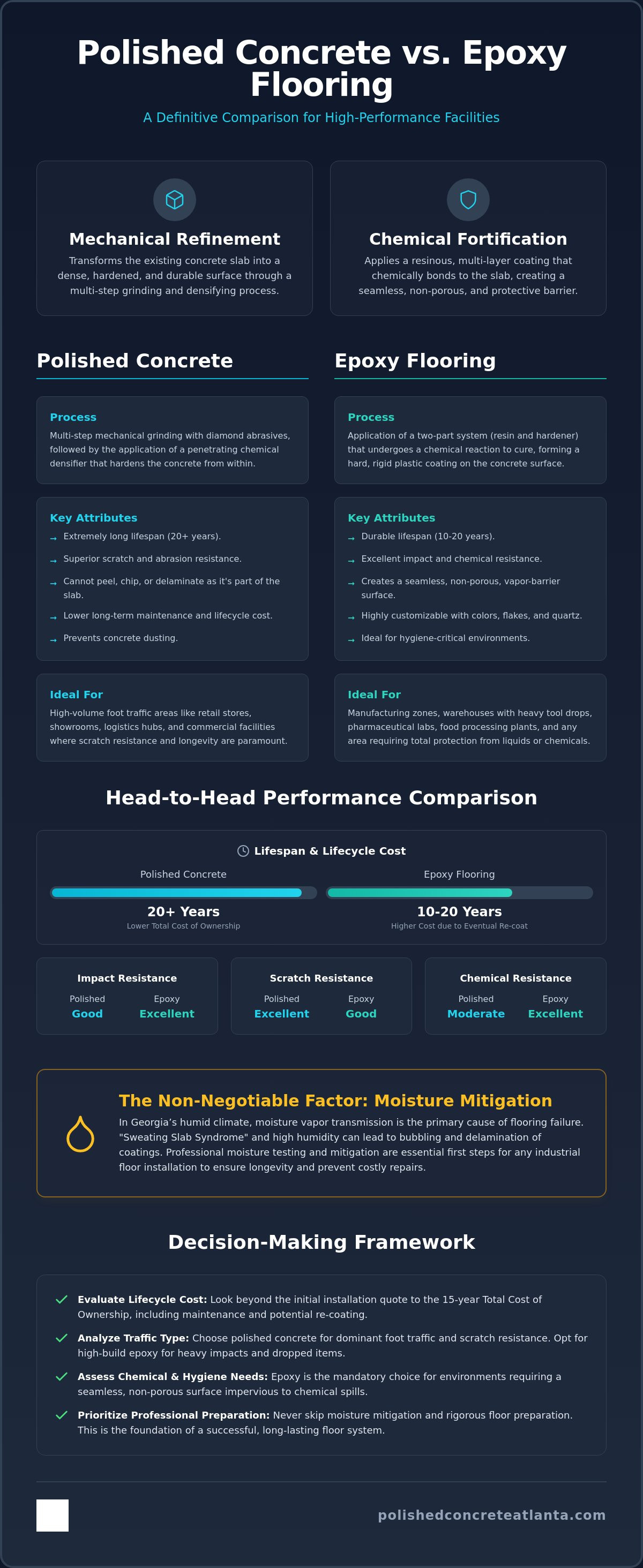
Engineering durability requires a 15-year perspective. Most facility managers look at the initial quote; professionals look at the Total Cost of Ownership. Polished concrete is a mechanical refinement of the slab that can last 20 years or more with basic maintenance. Epoxy is a high-performance chemical layer with a typical lifespan of 10 to 20 years. However, epoxy is a sacrificial surface. It will eventually require a full re-coat, whereas polished concrete simply requires occasional high-speed burnishing or a minor diamond refresh. This distinction is the pivot point for any polished concrete vs epoxy flooring evaluation.
Traffic and Impact Resistance
The choice between these systems often comes down to the type of abuse the floor will endure. Polished concrete excels in high-volume foot traffic environments. It remains the standard for Commercial Polished Concrete Atlanta installations because it resists the scratching and "traffic patterns" that plague topical coatings. It is virtually impossible to "peel" a polished floor because there is no film to delaminate. You are walking on the refined slab itself.
Epoxy serves a different master. In warehouses where heavy tools are dropped or pallet jacks create localized impact, a high-build epoxy provides a cushioning effect that protects the underlying concrete from chipping. It also prevents concrete dusting, a common issue in untreated facilities. But remember; epoxy is susceptible to gouging from dragged pallets. If your facility prioritizes scratch resistance over impact dampening, mechanical polishing is the superior engineering choice.
Maintenance and Hygiene Standards
Hygiene requirements often dictate the specification. Epoxy wins in FDA-regulated, pharmaceutical, or chemical-heavy environments. Its seamless, non-porous nature creates a literal vapor barrier that prevents hazardous liquids from penetrating the slab. Cleaning is straightforward. You can use aggressive sanitizers without compromising the surface integrity or worrying about liquid seepage into the substrate.
Polished concrete is the champion of air quality. It eliminates concrete dusting at the source by densifying the surface. While it has moderate chemical resistance, it is a breathable system. This breathability is a double-edged sword. It allows moisture vapor to pass through without causing failure, but it also means the floor is not entirely impervious to standing acids or oils. If you are unsure which system fits your workflow, our team can provide a professional flooring consultation to analyze your specific chemical exposure and traffic patterns.
The Invisible Factor: Moisture Mitigation and Atlanta's Climate
Atlanta’s geographic profile creates a brutal environment for industrial flooring. The region's dense red clay soil and high humidity levels generate significant hydrostatic pressure. This pressure forces moisture vapor upward through concrete slabs, a process known as Moisture Vapor Transmission (MVT). When evaluating polished concrete vs epoxy flooring, ignoring this invisible force is a recipe for catastrophic failure. In unconditioned warehouses across Georgia, this often manifests as Sweating Slab Syndrome, where moisture accumulates on the surface, creating extreme slip hazards and operational risks.
The choice of flooring system dictates how your facility handles this vapor. Epoxy acts as a non-porous vapor barrier. If the MVT rate is too high, the pressure builds until the coating blisters, bubbles, and eventually delaminates from the substrate. Polished concrete is a breathable system. It allows moisture to pass through the slab's capillary structure without compromising the surface integrity. For slabs with high relative humidity (RH) levels, mechanical refinement is often the only way to ensure long-term performance without the constant fear of coating failure.
Moisture Mitigation Strategies
Success begins with empirical data, not guesswork. 2026 standards require rigorous testing via ASTM F2170 (Relative Humidity probe) and ASTM F1869 (Calcium Chloride). If testing reveals RH levels above 75 to 80 percent, a dedicated moisture mitigation system is mandatory before any resinous application. This is where elite concrete surface preparation contractors prove their value. We utilize fluid-applied moisture barriers that meet the new ASTM F3513 standards to suppress vapor and ensure a permanent bond. Without this level of preparation, even the most expensive epoxy is destined to fail.
Chemical Resistance and Specialized Protection
While polished concrete handles moisture well, it has limitations in environments with heavy chemical exposure. Slabs contaminated with deep-seated oils or salts may not accept densifiers effectively. Facilities with battery charging stations, acid storage, or heavy oil use require the impermeable shield provided by industrial floor coatings Atlanta. Polished concrete remains vulnerable to acidic etching, which can dull the finish and expose the aggregate to staining. Many of our high-achieving clients now opt for a hybrid approach. We specify polished concrete for the high-traffic logistics zones to leverage its breathability and use high-performance epoxy in specialized chemical bays where a total barrier is non-negotiable.
Economics of the Floor: Installation Costs vs. Long-Term ROI
Smart facility management requires looking past the initial bid. When comparing polished concrete vs epoxy flooring, the quoted square-foot price is often a distraction from the true economic reality. A professional installation includes labor, high-grade materials, and, most importantly, the preparation phase. We see too many contractors treat surface prep as an optional line item. It isn't. For any facility undergoing a renovation, professional floor glue removal Atlanta is a mandatory investment. Leaving behind old mastic or adhesive residues ensures your new floor will fail, regardless of whether you choose a mechanical or chemical finish. We handle the difficult prep work that others skip because we refuse to attach our name to a floor that peels in six months.
Downtime is another hidden cost. Epoxy systems generally require a multi-day curing window before they can support heavy machinery or forklift traffic. Polished concrete offers a significant advantage here; the floor is usable the moment the last pass of the grinder is complete. In high-output environments, three days of lost production can easily exceed the cost of the floor itself. Choosing a mechanical finish means your facility stays online. It is a pragmatic choice for those who prioritize operational continuity.
Upfront Investment and Preparation
The condition of your slab dictates the complexity of the project. "Bad" concrete, characterized by deep spalling, uneven joints, or heavy pitting, requires more grinding steps to reach a uniform finish. This increases the labor hours for polished concrete. However, professional grinding also levels the slab. This reduces wear and tear on your forklift fleet over time. Skipping this preparation is the fastest way to lose your flooring investment. You cannot coat over structural mediocrity and expect a premium result. Precision grinding is the only way to ensure the integrity of the final surface.
Long-Term Value and Sustainability
Polished concrete is the definitive choice for sustainable facility management. It qualifies for LEED credits and carries a significantly lower carbon footprint because it utilizes the existing slab rather than importing large volumes of resin. The economic impact extends to your utility bills. Specifying high gloss concrete floors commercial standards can increase the lumen output of your facility by reflecting ambient light. This allows you to reduce artificial lighting levels without compromising safety. Over a 10-year outlook, polished concrete often wins on ROI because it eliminates the need for the periodic re-coating cycles that epoxy demands. It is a one-time investment in a permanent asset.
If you are ready to secure a floor that pays for itself through reduced overhead and elite durability, contact us for a definitive project estimate today.
The Professional Verdict: Selecting the Right System for Your Atlanta Facility
Selecting between polished concrete vs epoxy flooring is a high-stakes decision that dictates your facility’s operational efficiency for the next decade. We don't believe in one-size-fits-all solutions. The right choice depends on your slab’s specific moisture profile, your sanitation requirements, and the level of mechanical abuse the floor will face daily. It's about matching the engineering to the environment. Mediocrity in this phase leads to delamination, downtime, and wasted capital. We provide the clarity you need to choose an asset, not a liability.
When to Choose Polished Concrete
Polished concrete is the definitive choice when your facility requires a permanent, low-maintenance finish that leverages the existing slab as a high-performance architectural element. It's the standard for retail environments, corporate offices, and massive logistics hubs. If your primary concerns are recurring maintenance costs and the fear of coating failure due to Atlanta’s high humidity, mechanical refinement is your solution. It allows the slab to breathe. It eliminates the risk of delamination. It provides a high-luster appearance that reflects your brand’s commitment to quality without the need for sacrificial waxes or frequent re-coating cycles.
When to Choose Epoxy Flooring
Specify a high-performance epoxy system if your operations involve frequent chemical spills, heavy grease, or high-pressure sanitary washdowns. This is the non-negotiable standard for food processing plants, pharmaceutical labs, and automotive manufacturing bays. Epoxy is also the pragmatic choice if your existing concrete is too contaminated or structurally damaged to be polished effectively. It allows for the integration of high-visibility safety markings and specialized non-slip textures that are vital for industrial safety compliance. It creates a total chemical barrier where polished concrete cannot.
The Final Step: Partnering with an Atlanta Expert
Local experience isn't just a benefit; it's a requirement. Georgia’s dense red clay and extreme humidity create unique hydrostatic pressures that can destroy a floor installed by an inexperienced contractor. We understand the nuances of the 2026 International Building Code and the critical importance of rigorous moisture mitigation. Polished Concrete Atlanta brings a veteran’s perspective to every project, acting as a creative consultant to ensure your investment is worry-free. We handle the difficult prep work and the granular details that ensure a flawless execution. Don't leave your facility’s foundation to chance. Consult with an authoritative expert at Polished Concrete Atlanta today.
Secure Your Facility's Foundation for 2026 and Beyond
Your facility’s floor is a long-term asset that requires an expert specification. We've established that the definitive choice between polished concrete vs epoxy flooring isn't just about aesthetics; it's about engineering a surface that survives Georgia’s unique climate and your specific operational demands. Success hinges on one non-negotiable factor: precision preparation. Whether you require the breathable permanence of mechanical refinement or the impermeable shield of a chemical barrier, your floor must perform without compromise. Mediocrity is not an option for a high-output environment.
Since 2004, we’ve served the Atlanta region with uncompromising standards in surface preparation and industrial moisture mitigation. We don't guess; we utilize rigorous testing to eliminate variables. By prioritizing long-term ROI and slab integrity over mediocre topical solutions, you ensure a high-performance environment that reflects your brand's excellence. It’s time to eliminate the uncertainty of floor failure. Invest in a surface that is elite in skill and durable in practice. We are ready to help you execute that vision with total confidence.
Request a Professional Floor Evaluation from Polished Concrete Atlanta
Frequently Asked Questions
Is polished concrete better than epoxy for a high-traffic warehouse?
Polished concrete is the definitive choice for high-volume logistics hubs where forklifts and pallet jacks are in constant motion. It provides superior scratch resistance and eliminates the risk of delamination that can plague topical coatings under heavy mechanical stress. Unless your warehouse handles corrosive chemicals or requires a total liquid barrier, the mechanical durability of a refined slab is the superior engineering choice.
What is the most cost-effective flooring for a large commercial space in 2026?
Polished concrete offers the lowest Total Cost of Ownership (TCO) for large-scale facilities in 2026. When evaluating polished concrete vs epoxy flooring, you must look beyond the initial bid. Polished concrete eliminates the need for periodic re-coating cycles and reduces energy overhead through increased light reflectivity. It is a one-time investment in a permanent asset rather than a recurring maintenance expense.
Does epoxy flooring peel if the concrete wasn't prepared correctly?
Absolutely. Epoxy failure is almost always a direct result of mediocre surface preparation. If the concrete isn't ground to the correct Concrete Surface Profile (CSP) to open the pores of the slab, the resin cannot achieve a mechanical bond. Without this critical step, hydrostatic pressure or heavy traffic will cause the coating to blister, bubble, and eventually peel away from the substrate.
Can you polish concrete that previously had tile or carpet glue on it?
Yes, but it requires professional floor glue removal to be successful. We use specialized diamond grinding equipment to strip away old mastic, thin-set, and carpet adhesives that have penetrated the surface. Once we've cleared the contaminants and reached clean concrete, the mechanical polishing process can proceed to transform the slab into a high-performance, professional finish.
Is polished concrete too slippery for a commercial retail environment?
No. When kept clean and dry, polished concrete meets or exceeds national safety standards for slip resistance. Despite its high-luster appearance, the mechanical refinement process provides excellent traction for foot traffic. For environments prone to spills, we can integrate specialized anti-slip conditioners during the final treatment phase to ensure your facility remains safe for both employees and customers.
How long does a professional epoxy floor coating last compared to polished concrete?
A professionally installed epoxy floor typically has a service life of 10 to 20 years, depending on the volume of traffic and chemical exposure. Polished concrete is even more durable; it can last 20 years or more with basic maintenance. Because polished concrete hardens the slab itself rather than adding a sacrificial layer, it doesn't require the full re-application cycles that epoxy systems eventually demand.
When should I choose a grind and seal over true polished concrete?
You should only choose a grind and seal if you are working with a limited budget in a low-traffic environment where aesthetics are the primary goal. A grind and seal is a topical film that sits on the surface; it will eventually flake and wear out. True polished concrete is a mechanical refinement of the concrete’s internal structure. For industrial performance, true polishing is the only authoritative recommendation.
Does Georgia's humidity affect which flooring system I should choose?
Georgia’s high humidity and clay soil make moisture mitigation a non-negotiable factor in your decision. High moisture vapor transmission (MVT) can force non-porous epoxy coatings to delaminate if a professional moisture barrier isn't installed. Polished concrete is a breathable system that allows vapor to pass through the slab without causing surface failure. It is often the safest choice for unconditioned Georgia facilities.


