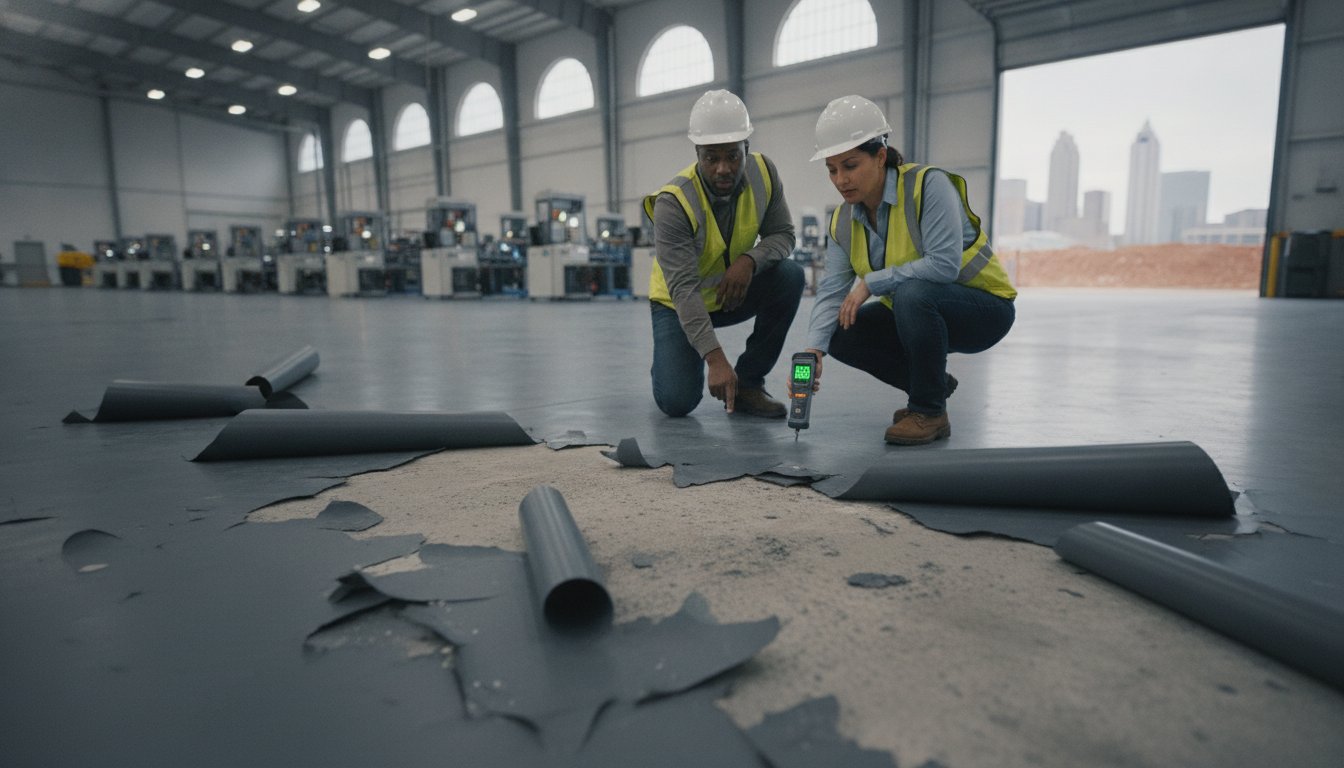
Eighty percent of floor coating failures have absolutely nothing to do with the quality of the resin itself. It's a staggering reality for facility managers who find their concrete floor failing after coating despite paying for what they were told was a premium system. You expected a durable, industrial-grade solution. Instead, you're facing delaminating flakes and bubbling surfaces that create safety hazards and force expensive production shutdowns. It's a waste of budget. It's a failure of professional standards.
We understand the frustration of a project that doesn't hold up to its promises. You deserve a workspace that reflects the high-end craftsmanship of your own operations. This article will identify exactly why your floor coating is peeling and reveal the professional standards required for permanent remediation. We'll debunk five persistent industry myths and explain why modern protocols, like the ASTM F2170 moisture test, are the only way to ensure a worry-free investment in 2026. Stop managing failures. Start demanding excellence.
Key Takeaways
- Recognize the critical signs of delamination to prevent production loss and safety hazards before they escalate into structural failures.
- Stop overpaying for "premium" resins; professional-grade surface preparation is the only factor that guarantees a permanent bond.
- Identify how hydrostatic pressure and unique regional soil conditions often result in a concrete floor failing after coating.
- Compare the long-term ROI of restorative polished concrete against the recurring costs and risks of failed topical coatings.
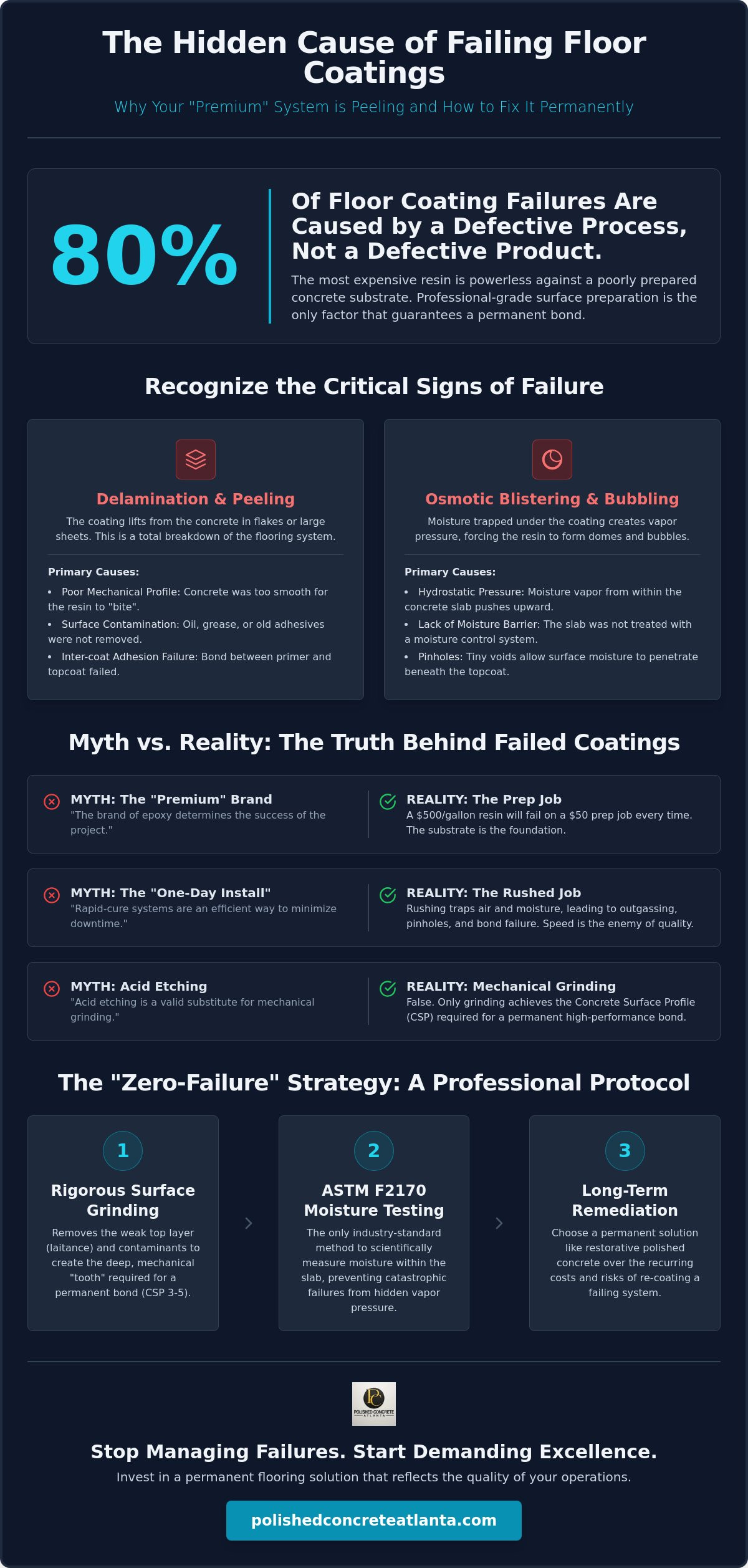
- Adopt a "zero-failure" strategy by utilizing ASTM F2170 moisture testing and rigorous grinding standards for every industrial project.
Recognizing the Symptoms: Is Your Floor Coating Actually Failing?
If you see your concrete floor failing after coating, you must determine if the issue is cosmetic or catastrophic. Delamination is the definitive point of failure; it occurs when the bond between the substrate and the coating snaps. This isn't just a surface scratch. It's a fundamental breakdown of the flooring system. While aesthetic wear like dullness or micro-abrasions is expected in high-traffic industrial environments, structural failure represents a total loss of protection. Many facility managers attempt to cut costs by "spot-fixing" visible damage. Don't fall for this trap. Patching a small peel is almost always a futile effort because it fails to address the underlying bond weakness that likely extends across the entire slab. Osmotic blistering is moisture trapped under an impermeable layer, creating internal pressure that eventually forces the resin to separate from the concrete.
Delamination and Peeling
When a coating lifts in large, continuous sheets, you're looking at a complete lack of mechanical profile. The concrete was likely too smooth for the resin to "bite" into the surface. Small flakes, by contrast, often point to localized contamination like oil or grease that wasn't properly neutralized during the floor preparation phase. We also see frequent failures in inter-coat adhesion. This happens in multi-layer systems when the bond between the primer and the topcoat fails, often because the contractor missed the critical re-coat window. High-traffic areas act as the ultimate stress test. Forklifts and heavy machinery apply shear forces that quickly expose poor bonding, turning a minor installation oversight into a massive safety hazard.
Osmotic Blistering and Bubbling
The science of bubbling is simple but relentless. Vapor pressure from within the slab pushes against the underside of the resinous layer. If the slab wasn't treated with Epoxy moisture control systems, that moisture has nowhere to go. It builds up until it creates a physical dome in the coating. Sometimes, these bubbles are caused by "pinholes"-tiny voids that allow moisture or chemicals to enter from the surface-but the most destructive bubbles come from below. These symptoms often appear months after a seemingly successful install. They wait for seasonal humidity changes to trigger a failure. Once these bubbles pop, they leave the concrete exposed to chemicals and oils, rendering the entire coating useless. It's a cycle of failure that only professional-grade remediation can break.
Myth vs. Reality: Why "Premium" Coatings Still Fail
Many property owners believe that the brand of epoxy printed on the bucket determines the success of the project. This is a dangerous misconception. In reality, the most expensive resin in the world is powerless against a poorly prepared substrate. A $500 per gallon coating will fail on a $50 prep job every single time. When you see a concrete floor failing after coating, the culprit is almost never a "defective" product. It's a defective process. High-end materials are simply the final layer of a much more complex engineering challenge. If the foundation isn't right, the finish won't last. We don't settle for "good enough" because we know that shortcuts lead to expensive re-work.
The "One-Day Install" Trap
Speed is the enemy of quality in industrial flooring. The "one-day install" trend, often utilizing rapid-cure polyaspartics, is a primary driver of a concrete floor failing after coating in Atlanta commercial spaces. These systems are marketed as a way to minimize downtime, but they often ignore the slab's need to breathe. Rapid curing can trap air escaping from the concrete. This leads to outgassing and pinhole defects. If the slab is too cold or carries high moisture levels, the bond never fully develops. Rushing the schedule to save 24 hours of production time frequently results in weeks of remediation later. It's a gamble that rarely pays off for the long-term integrity of your facility.
The Acid Etching Fallacy
Some contractors still insist that acid etching is a valid substitute for mechanical grinding. This is false. Chemicals cannot create the deep, mechanical "tooth" required for a high-performance bond. Acid only opens the surface pores; it doesn't remove the weak top layer of laitance or address deep-seated contaminants like oils and old adhesives. Even worse, acid etching introduces moisture and neutralizing salts into the concrete. If these salts aren't perfectly removed, they act as a bond-breaker for the new coating. Professional concrete floor grinding is the only industry standard for achieving the necessary Concrete Surface Profile (CSP). It's one of the most common reasons for coating failures in the industry today. We don't take shortcuts with chemicals because we know they don't work. For a floor that stands up to industrial abuse, you need the precision that only heavy-duty diamond grinding provides. If your current floor is showing signs of distress, it's time to evaluate the floor preparation standards used during the initial install.
The Invisible Killers: Moisture and Georgia Soil
Atlanta's geology is a silent adversary for industrial flooring. The infamous "Georgia Red Clay" is more than a landscape nuisance; it is a high-density soil that traps moisture directly against your concrete slab. While the surface might appear bone-dry to the naked eye, the reality is often a "slab saturated" condition where the concrete acts as a giant sponge. When you apply a non-breathable resin, you're essentially putting a lid on a boiling pot. This is why we so often see a concrete floor failing after coating in the Southeast. To avoid these disasters, 2026 standards require ASTM F1869 calcium chloride testing as a baseline for measuring moisture vapor emission rates.
Hydrostatic Pressure and Vapor Transmission
Concrete is a porous matrix. It is full of microscopic capillaries that allow water to move upward from the earth. Hydrostatic pressure is the physical force of this water pushing against your floor system. In many older Atlanta warehouses, vapor barriers were either never installed or have long since degraded into uselessness. Modern HVAC systems exacerbate this problem. By cooling the air above the floor, they create a pressure differential that literally "pulls" moisture through the slab. Without proper Floor Moisture Mitigation, no topical coating can withstand this relentless upward force. It is a battle against physics that the coating will always lose.
Testing Standards Every Manager Should Demand
Relying on a "plastic sheet test" is a recipe for commercial liability. It tells you nothing about the internal state of the slab. Professional managers must demand rigorous data before authorizing a project. We utilize the industry standard for concrete slab construction to ensure every variable is accounted for. This involves two primary tests: ASTM F2170, which measures the in-situ relative humidity (RH) inside the concrete, and ASTM F1869, which measures the emission rate at the surface. A concrete floor failing after coating is usually the result of a contractor who skipped these steps to save time. Reading a moisture report requires technical expertise. You should look for RH levels above 85% as a major red flag for most standard epoxies. If your report shows high moisture, you must pivot to specialized systems or mechanical refinement. We don't guess. We measure.
Remediation Strategy: Should You Re-Coat or Restore?
Facing a concrete floor failing after coating forces a critical financial decision. You must choose between a temporary fix and a permanent restoration. Settling for a re-coat is often a temporary stay of execution for an industrial floor. If the original failure was caused by moisture or poor preparation, applying another layer of resin simply adds more weight to a failing bond. It is throwing good money after bad. We analyze the lifecycle of industrial floors in high-traffic Atlanta hubs to help facility managers break the cycle of recurring repairs. In these demanding environments, the cost of a second coating failure includes lost production time and safety hazards. These costs far outweigh the initial investment in a total restoration.
The primary technical advantage of restoration is "breathability." While epoxy acts as a rigid, impermeable lid, polished concrete allows moisture vapor to pass through the slab without causing delamination. This is a strategic pivot. When slab saturation is high, we recommend a robust floor moisture mitigation protocol before considering any new topical system. However, for many facilities, removing the coating entirely is the only logical path forward. It eliminates the risk of future bond failure by removing the bond itself.
The Case for Polished Concrete
For those seeking a "no-fail" solution, polished concrete floors Atlanta represent the gold standard for 2026. This process eliminates the "peel" by removing the film-forming layer entirely. You are no longer relying on a chemical bond. Instead, we mechanically refine the concrete itself. By densifying the existing substrate, we create a surface that is harder and more resistant to abrasion. It is a premium, worry-free investment. Maintenance costs drop. Durability rises. The uncertainty of a topical layer disappears.
Professional Surface Preparation
Remediation begins with the total destruction of the failed system. This requires meticulous floor glue removal and the stripping of all old resins. We don't just scratch the surface. We grind deep enough to reach sound concrete and achieve the precise Concrete Surface Profile (CSP) required for the next phase. For retail spaces where a full polish might exceed the immediate vision, a "grind and seal" offers a middle-ground option. However, it still requires the same rigorous prep standards. If you are ready to stop the cycle of failure, contact us today for a professional evaluation of your industrial floors.
Engineering a Permanent Floor with Polished Concrete Atlanta
Engineering a permanent floor requires more than a bucket of resin and a prayer. It requires a "Zero-Failure" philosophy where preparation is 90% of the project. At Polished Concrete Atlanta, we don't settle for mediocrity. We understand that a concrete floor failing after coating is a symptom of a systemic lack of discipline during the installation phase. Our standards are designed to eliminate uncertainty for facility managers who cannot afford the pride-damaging reality of a peeling floor. With over 20 years of experience navigating the specific challenges of Georgia's dense soil and high humidity, we have mastered the art of slab stabilization. We are not just vendors. We are dedicated partners committed to the integrity of your facility's foundation.
The "Polished Concrete Atlanta Standard" is a rigorous framework that treats every square foot as a strategic asset. We know exactly how the local red clay interacts with slabs in older industrial zones and high-traffic commercial hubs. This localized intelligence allows us to anticipate failures that out-of-state contractors consistently miss. We don't just apply products. We engineer environments. Our commitment to high-end craftsmanship ensures that your investment is worry-free, durable, and aesthetically excellent. We prioritize tangible results over flowery descriptions. We deliver floors that work.
Our Mitigation and Prep Process
Our process begins with heavy-duty planetary grinders. These machines don't just scratch the surface; they aggressively open the concrete pores to ensure a mechanical bond that chemicals alone cannot achieve. When your project requirements dictate a resinous finish, we deploy high-performance moisture barriers that act as a definitive line of defense against vapor transmission. We perform a detailed site analysis for every contract. This exhaustive approach prevents the "One-Day" failure trap that plagues so many Atlanta commercial projects. We take the time to do it right. The result is a floor that stands as a testament to elite skill and industrial durability. Precision is our baseline.
A Strategic Partnership for Your Facility
We move beyond the typical vendor-client dynamic to offer a creative consulting partnership. This means transparent communication regarding your slab’s specific limitations and the expected outcomes of each remediation path. We don't hide behind technical jargon. We provide pragmatic, no-nonsense results that prioritize your long-term value over our short-term ease. If you are tired of the cycle of repair and want to prevent floor coating failure on your next project, it is time to consult with the authoritative experts. We bring the gravitas of veterans who have seen every possible scenario. Let's engineer a solution that lasts. Peace of mind is just one consultation away.
Demand a Permanent Foundation
A concrete floor failing after coating isn't a minor setback; it's a structural warning. We've established that premium resins cannot compensate for poor preparation or the relentless hydrostatic pressure of Georgia's unique soil. You now understand that the "one-day install" is a gamble and that mechanical diamond grinding is the only industry standard for a true bond. Don't waste another budget cycle on temporary fixes that are destined to peel. It's time to transition from managing failures to investing in high-end craftsmanship that stands the test of industrial abuse.
Polished Concrete Atlanta brings over 20 years of commercial experience to your facility. We are specialists in moisture mitigation and floor preparation, utilizing industrial-grade diamond grinding equipment to ensure every project meets our "zero-failure" philosophy. We don't settle for mediocrity, and neither should you. Take control of your facility's future and eliminate the uncertainty of delaminating coatings once and for all. Request a Professional Surface Evaluation from Polished Concrete Atlanta today. Your floor is the foundation of your production; let's make it permanent.
Frequently Asked Questions
Can I just paint over a peeling floor coating?
Painting over a peeling floor is a guaranteed way to waste your budget. The new coating is only as strong as the bond of the layer beneath it. If the original system is delaminating, the added weight and tension of a new coat will only accelerate the failure. You must remove the existing material completely through mechanical grinding to reach sound concrete before attempting a new application. Shortcuts here lead to total loss.
How long should I wait for concrete to dry before coating it?
While the industry standard for new concrete is a 28 day cure period, time alone is a poor indicator of readiness. You should never apply a coating based on a calendar. Environmental factors and slab thickness dictate the actual drying rate. Professional installers use moisture meters and relative humidity probes to confirm the slab is ready. Coating a slab that is still outgassing or holding moisture is a primary cause of failure.
What is the most common reason for epoxy floor failure in Atlanta?
The most frequent cause of a concrete floor failing after coating in the Atlanta region is a combination of poor surface preparation and high moisture vapor transmission. Georgia's dense red clay prevents water from draining away from the foundation. This creates immense hydrostatic pressure. If a contractor skips mechanical grinding or fails to perform moisture testing, the coating will inevitably bubble and peel away from the substrate.
Is polished concrete better than epoxy for high-moisture slabs?
Polished concrete is significantly more effective for high-moisture slabs because it is a breathable system. Unlike epoxy, which forms an impermeable barrier, polished concrete allows moisture vapor to escape through the slab's surface. This eliminates the risk of osmotic blistering and delamination. For facilities with known water table issues, mechanical refinement is often the only permanent solution that avoids the recurring costs of failed topical resins.
How do I test my concrete floor for moisture at home or in a warehouse?
For commercial and industrial facilities, you must use standardized testing methods like ASTM F2170 or ASTM F1869. The ASTM F2170 test involves drilling into the slab to measure internal relative humidity with specialized probes. The ASTM F1869 test uses calcium chloride to measure moisture vapor emission rates at the surface. Simple DIY methods like the plastic sheet test are insufficient for documenting the slab's condition and protecting your long-term investment.
What does CSP stand for in floor preparation?
CSP stands for Concrete Surface Profile, a standardized scale from 1 to 9 developed by the International Concrete Repair Institute. It measures the physical roughness or "tooth" of the concrete surface. Most thin-film coatings require a CSP 2, while heavy-duty industrial epoxies often demand a CSP 3 to 5. Achieving the correct profile through diamond grinding is the only way to ensure the coating has a permanent mechanical bond.
Can oil-saturated concrete ever be successfully coated?
Coating oil-saturated concrete is possible but requires rigorous decontamination protocols. Standard cleaning is rarely enough. You must use specialized degreasers and potentially heat-treating methods to draw oil out of the concrete capillaries. After cleaning, an oil-tolerant primer is mandatory to create a bridge between the contaminated substrate and the new topcoat. Failure to neutralize deep-seated oils will result in immediate delamination of the new flooring system.
Why does my floor coating have small bubbles (pinholes) after it dried?
Pinholes and small bubbles are typically caused by outgassing, which occurs when air in the concrete pores expands and pushes through the wet coating. This often happens if the coating is applied while the facility temperature is rising. To prevent this, professional installers apply coatings during the "cooling" phase of the day or use high-quality primers designed to seal the pores. These tiny defects are a sign that the slab was not properly sealed before the topcoat.


