Your commercial floor is not a cosmetic layer; it is a critical structural asset that either supports your operation or compromises your safety. You likely understand that a failing surface is more than an eyesore. It is a liability that triggers dust contamination and creates hazardous unevenness for your personnel. Achieving a high-durability finish requires more than a basic coating. It demands the specialized mastery of concrete grinding and polishing Atlanta facilities require to withstand the region's intense humidity and heavy-duty traffic. We don't settle for mediocrity. Neither should you.
We eliminate the uncertainty of floor failures by prioritizing technical precision and moisture mitigation from the first pass. This guide provides the definitive 2026 standards for professional concrete refinishing, covering everything from ANSI A326.3 slip resistance compliance to the specific challenges posed by Georgia's dense clay soil. You'll master the technical process necessary for a dust-free renovation and a predictable, high-end result. We've seen every scenario and mastered the craft. This is how you secure a floor that performs as well as it looks.
Key Takeaways
- Define the mechanical differences between structural grinding and refined polishing to ensure your project begins with a sound structural foundation.
- Master the moisture mitigation strategies necessary to combat Atlanta's humidity and prevent "Sweating Slab Syndrome" from ruining your floor investment.
- Implement a rigorous testing protocol, including Mohs scale and relative humidity checks. This removes all guesswork from the concrete grinding and polishing Atlanta process.
- Evaluate gloss levels and slip resistance against ANSI A326.3 standards to balance high-end aesthetics with uncompromising workplace safety.
- Identify the professional standards required to vet an industrial flooring contractor. High-performance results demand technical expertise.
The Fundamentals of Concrete Grinding and Polishing
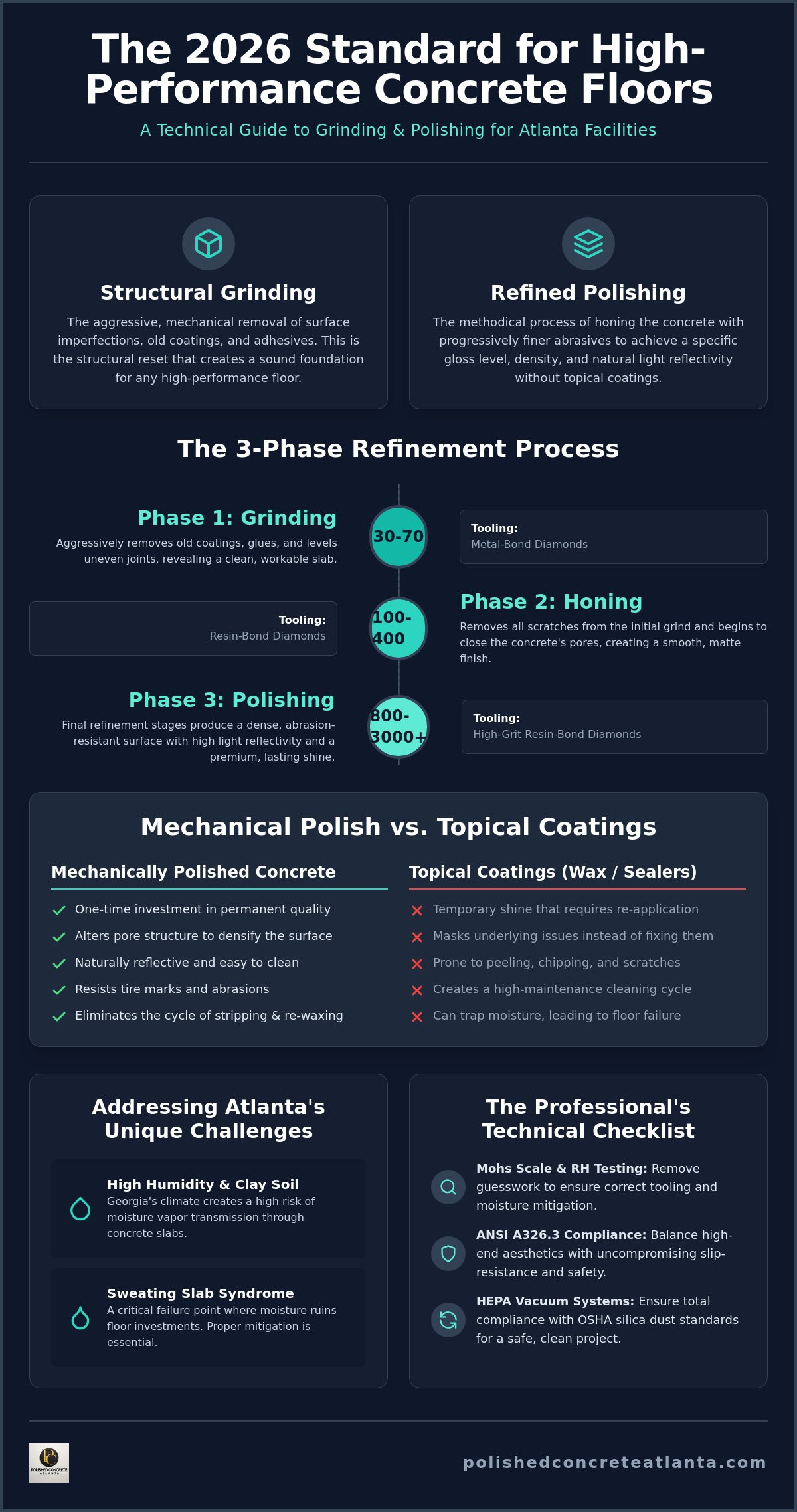
Precision in flooring begins with a fundamental understanding of mechanical refinement. Concrete grinding is the aggressive removal of surface imperfections, old glues, and failing epoxies through high-torque machinery. It is the structural reset your facility requires before any aesthetic work begins. In contrast, polishing is the methodical process of honing and refining that surface to reach a specific gloss level. The fundamentals of concrete polishing involve a series of sequential steps that transform a raw slab into a high-performance asset. For those seeking concrete grinding and polishing Atlanta services, understanding this distinction is the difference between a floor that lasts decades and one that fails in months. We don't settle for surface-level fixes. We engineer durability.
The success of the process depends on the equipment and the environment. We utilize industrial-grade HEPA vacuum systems to maintain a dust-free environment throughout the project. This isn't just about cleanliness; it's about safety. These systems ensure total compliance with OSHA's respirable crystalline silica standards, protecting both our crew and your personnel. A professional execution leaves no room for contamination. Results are measured in performance, not just appearance.
Mechanical Refinement vs. Topical Coatings
Topical coatings like wax or cheap sealers offer a temporary shine that masks underlying issues. They are short-term solutions for long-term problems. Mechanical polishing actually alters the concrete's pore structure, creating a surface that is naturally dense and reflective without the need for high-maintenance films. This level of refinement adheres to the Standard for Polished Concrete Floors in Atlanta, ensuring your facility meets modern industrial benchmarks. A refined slab is easier to clean, resists tire marks, and eliminates the cycle of stripping and re-waxing. It is a one-time investment in permanent quality.
The Role of Diamond Abrasives
The process relies on diamond-impregnated segments. Metal-bond diamonds are used during the initial coarse stages to cut through tough surfaces and level the slab. Resin-bond segments are utilized for the final honing and polishing phases to achieve clarity. The grit scale is precise and unforgiving:
- 30 to 70 Grit: Aggressive grinding to remove coatings and level uneven joints.
- 100 to 400 Grit: Honing the surface to remove scratches from the initial grind.
- 800 to 3000 Grit: High-level polishing for maximum light reflectivity and density.
Skipping a single step in this sequence leaves visible scratches that compromise the floor's integrity. To achieve this on an industrial scale, we utilize 480V high-torque planetary grinders. These machines provide the necessary head pressure to refine even the hardest 2026 concrete mixes. We prioritize tangible results over flowery descriptions. Every pass of the machine is a step toward a worry-free, premium investment.
A Step-by-Step Guide to the Grinding and Polishing Process
Execution is everything. A high-performance floor is the result of a rigorous, multi-stage protocol where every variable is controlled. We don't guess; we measure. Before a single diamond segment touches the slab, we conduct a comprehensive surface assessment. This includes Mohs scale hardness testing and relative humidity (RH) probes. Knowing the concrete's compressive strength and moisture content dictates our choice of bond and grit. Achieving a high-performance floor through concrete grinding and polishing Atlanta standards requires a disciplined transition from mechanical cutting to chemical refinement.
The transition from a raw, damaged slab to a refined surface is documented in A step-by-step guide to the grinding and polishing process, which highlights the structural necessity of each phase. This sequence is non-negotiable for facilities that demand longevity. We prioritize tangible results over surface-level promises.
Phase 1: Surface Preparation and Glue Removal
Old flooring materials often leave behind a legacy of failure. Stubborn mastic, thick industrial adhesives, and failing epoxies must be mechanically stripped to reveal the "virgin" concrete beneath. This requires Professional Floor Glue Removal Atlanta expertise to ensure the slab isn't gouged or damaged during the process. For any concrete grinding and polishing Atlanta project, we use PCD (Polycrystalline Diamond) scrapers to shear away thick coatings without compromising the substrate. Once clear, we address uneven slabs. Leveling these areas is critical for warehouse safety, removing the trip hazards that plague high-traffic facilities.
During this phase, we also perform structural repairs. Cracks and spalled joints are filled with high-performance polyurea. This material cures rapidly and supports joint edges under heavy forklift loads, preventing future edge breakdown.
Phase 2: Densifying and Strengthening the Slab
The secret to a maintenance-free floor lies in the chemistry. After the initial coarse grinding stages, we apply a liquid chemical densifier. This silicate-based solution reacts with the calcium hydroxide in the concrete to create calcium silicate hydrate (CSH). Essentially, it fills the microscopic pores of the slab from the inside out. Densification is the definitive solution for dust-proofing. It transforms a porous, "chalky" surface into a dense, abrasion-resistant barrier. This process significantly increases the floor's Mohs hardness rating, making it nearly impossible for traffic to wear down the finish. If you want a floor that stands up to 2026 industrial demands, consulting with a technical expert is the first step toward a permanent solution.
The final stages involve honing and polishing. We progress through resin-bond diamonds to achieve your specific reflectivity requirements:
- Level 1 (Matte): A clean, smooth surface with no light reflection.
- Level 2 (Satin): Low-luster with a slight overhead light blur.
- Level 3 (Semi-Polished): High reflectivity with clear light crispness.
- Level 4 (High-Gloss): Mirror-like finish for maximum aesthetic impact.
We deliver the exact level of refinement your vision requires. No excuses. Just results.
Addressing Atlanta’s Unique Environmental Challenges
Atlanta's environment is unforgiving. High humidity levels combined with dense clay soil create a unique set of variables that can compromise any flooring project. We don't gamble with moisture. Sweating Slab Syndrome (SSS) is a frequent failure point in Georgia facilities. When warm, humid air hits a cool concrete slab, moisture condenses on the surface. This isn't just a slip hazard; it's a structural threat that can ruin a finish before it even cures. Executing successful concrete grinding and polishing Atlanta projects requires a deep understanding of these local climate factors. We prioritize technical precision to eliminate these risks.
Our protocol begins with rigorous testing. We rely on ASTM F2170 in-situ relative humidity (RH) probes to measure the moisture deep within the slab. Surface-level tests are insufficient for the high-stakes environments we manage. By adhering to American Concrete Institute (ACI) standards, we ensure every stage of refinement is measured against industry-leading benchmarks for quality control and safety. We deliver peace of mind through data, not guesswork.
Moisture Mitigation and Remediation
In Georgia, Moisture Mitigation for Concrete Floors in Georgia is a non-negotiable step for any facility manager seeking long-term value. High Moisture Vapor Emission Rates (MVER) can lead to delamination of coatings or the appearance of unsightly "white spots" in a polished finish. Below-grade facilities or older slabs without functional vapor barriers are especially vulnerable. We utilize strategic alliances with high-performance material providers to install moisture barriers that stop upward vapor migration. It is a premium, worry-free investment in your facility's future.
Humidity Control During the Polishing Process
Ambient humidity directly affects how densifiers and sealers react with the concrete's chemistry. In non-conditioned warehouses, we monitor the dew point constantly to ensure a stable environment. Strategies for managing these conditions are critical during the peak humidity months of a Georgia summer. Seasonal timing matters for large-scale industrial floor projects. We plan our execution to align with optimal environmental windows, ensuring the chemical hardening process is never compromised. Our approach is methodical. We manage the details so you don't have to.
Finally, we address the unique challenge of Atlanta's red clay dust. This particulate matter is invasive and can easily contaminate a fresh finish during construction. Our industrial-grade HEPA vacuum systems are designed for total coverage. They capture both concrete dust and local contaminants, maintaining the integrity of the final product. We are elite in skill and blue-collar in work ethic. Results matter.
Evaluating Quality: Gloss Levels and Slip Resistance
Quality in 2026 is defined by objective metrics, not visual guesswork. We use standardized gloss meters and slip meters to verify that every square foot of your floor meets the exact specification promised. For commercial facilities, concrete grinding and polishing Atlanta projects must balance aesthetic brilliance with rigorous safety compliance. We don't settle for "good enough." We deliver precision. The final output is categorized by its level of refinement, moving from a functional matte to a high-end mirror finish.
- Level 1 (Matte): A clean and smooth surface with no light reflection. This is ideal for industrial back-of-house areas where durability is the only priority.
- Level 2 (Satin): A low-luster finish with a slight blur in overhead light reflection. It offers a clean, professional look without high-maintenance reflectivity.
- Level 3 (Semi-Gloss): High light reflectivity with clear side-view detail. This is the standard for modern retail and office environments.
- Level 4 (High-Gloss): A mirror-like finish with maximum light saturation. This level can significantly reduce the need for artificial lighting, lowering energy consumption.
Safety Standards and Slip Resistance
Safety is a structural requirement, not an afterthought. We measure the Dynamic Coefficient of Friction (DCOF) using the ANSI A326.3 standard to ensure total compliance. For interior, level spaces that may become wet, a minimum DCOF value of 0.42 is the professional benchmark. Contrary to common myths, polished concrete is often safer than traditional tile or wet-mop surfaces because it lacks grout lines that trap grease and contaminants. We prioritize your peace of mind by engineering surfaces that exceed these safety thresholds even in high-traffic restaurant or retail environments. Request a technical safety assessment for your facility.
The Aesthetic Impact of Aggregate Exposure
The depth of the initial grind determines the visual "texture" of the slab. This is a permanent decision that affects the floor's character for its entire lifespan. We categorize exposure into three distinct classes:
- Class A (Cream): Only the surface paste is polished. This requires a exceptionally flat initial pour and offers a sleek, monolithic look.
- Class B (Salt and Pepper): Fine aggregate is exposed. This is the most popular choice for commercial durability and hides minor imperfections well.
- Class C (Large Aggregate): Heavy grinding reveals the "stones" within the concrete mix. This creates a bold, terrazzo-like appearance that showcases the raw materials.
Your choice depends on your branding goals and the condition of your existing slab. We act as your creative consultant to ensure the final result aligns with your vision. Results are guaranteed. Uncertainty is eliminated.
If your facility's architectural design includes natural stone surfaces that require expert care, you can check out Stone Pros Polishing and Restoration to maintain a consistent high-end finish throughout your property.
Executing Your Project with Polished Concrete Atlanta
Choosing Industrial Flooring Contractors in Atlanta is not a simple procurement decision. It is a strategic alliance. The technical complexity of concrete grinding and polishing Atlanta projects requires a partner who understands the structural chemistry of the slab, not just the visual finish. We don't settle for mediocrity. Our commitment is rooted in no-nonsense pragmatism and high-end craftsmanship that stands up to the rigors of 2026 industrial demands. We eliminate uncertainty. We deliver results.
Minimizing disruption to your operation is a core pillar of our project management. We utilize advanced, remote-controlled grinding equipment that increases efficiency while maintaining surgical precision. Combined with our high-capacity HEPA filtration systems, we ensure your facility remains operational and dust-free. We manage the details so your production never misses a beat. Quality is non-negotiable. Reliability is guaranteed.
Our Collaborative Consultation Process
We start with the data. Our process begins with exhaustive slab testing, including Mohs scale hardness and relative humidity checks. We don't guess; we verify. During our consultation, we customize the grind depth and aggregate exposure based on your facility's specific use case. A heavy-duty distribution center requires a different refinement profile than a high-traffic retail showroom. We provide absolute transparency in timelines and project management expectations. You will have a clear vision of the execution from the initial assessment to the final walkthrough. We are your dedicated partner in every phase.
Investing in Durability
The long-term value of a mechanically refined floor far exceeds that of temporary coatings. While epoxy or VCT requires recurring maintenance and eventual replacement, polished concrete is a permanent asset. You effectively avoid the common pitfalls of a Concrete Floor Failing After Coating, a frequent issue when moisture vapor is trapped beneath non-breathable layers. Polished concrete allows the slab to breathe while providing a surface that is nearly impossible to wear down. This is the definitive ROI for any commercial facility. It is a premium, worry-free investment in your infrastructure.
Are you ready to transition from high-maintenance headaches to a low-maintenance asset? We have the gravitas of veterans who have mastered the craft. Contact us today for a professional site evaluation. Let's secure the future of your facility with a floor that performs as well as it looks. No excuses. Just excellence.
Secure Your Facility’s Future with Technical Excellence
Your floor is the foundation of your operational efficiency. We've established that high-performance surfaces require more than a topical shine. They demand a deep understanding of mechanical refinement and the specific moisture challenges of the Georgia climate. From the initial coarse grind to the final high-gloss pass, every step must be executed with precision to avoid the hazards of dust contamination and premature failure. We don't leave quality to chance. We engineer it.
Serving the region since 2004, we are recognized specialists in Sweating Slab Syndrome remediation and Red Dot-level design aesthetics for industrial environments. We don't settle for mediocrity; we deliver the concrete grinding and polishing Atlanta facilities need to remain safe, compliant, and durable for the long term. It’s time to move beyond temporary fixes and invest in a permanent asset that reflects your professional standards. Request a Professional Floor Evaluation from Polished Concrete Atlanta today. Let’s transform your facility into a high-end, worry-free environment that you can take pride in.
Frequently Asked Questions
Is concrete grinding and polishing a dusty process?
Professional concrete grinding is a virtually dust-free process when performed with industrial-grade HEPA vacuum systems. These systems connect directly to the grinders to capture particulate matter at the source. This ensures total compliance with OSHA silica standards and prevents contamination of your facility's inventory or HVAC systems. We prioritize a clean workspace. Safety is non-negotiable.
How long does the concrete polishing process take for a commercial space?
Timelines vary based on slab condition and aggregate exposure requirements. A typical 5,000 to 10,000 square foot project usually requires three to five business days for a complete multi-stage refinement. We provide definitive schedules during the consultation phase to ensure your operations experience minimal downtime. We value your time. Efficiency is a standard, not a goal.
Can any concrete floor be ground and polished?
Most structurally sound slabs can undergo the process, though results depend on the initial pour quality. Slabs with excessive spalling or low compressive strength may require a high-performance concrete leveling topping before polishing. We conduct a Mohs hardness test to determine if your specific slab is a candidate for mechanical refinement. We don't guess. We verify.
What is the difference between a grind and seal and true polished concrete?
A grind and seal involves a basic mechanical grind followed by a topical protective film. True polished concrete is a multi-step mechanical refinement process that utilizes densifiers to harden the slab internally. It offers superior longevity and breathability. Polished concrete is a permanent structural upgrade. A grind and seal is a shorter-term aesthetic solution.
How do you maintain a polished concrete floor in a high-traffic warehouse?
Maintenance is straightforward but requires discipline. Daily dust mopping removes abrasive particulates that can dull the finish over time. Use an automatic scrubber with a pH-neutral cleaner for weekly deep cleans. This process preserves the floor's density and slip resistance without the need for waxing or stripping. It is a low-maintenance asset. Results last for decades.
Is polished concrete too slippery for commercial kitchens or bathrooms?
Polished concrete is not inherently slippery. We engineer our concrete grinding and polishing Atlanta projects to meet or exceed ANSI A326.3 standards for a Dynamic Coefficient of Friction (DCOF) of 0.42 or higher. This provides excellent traction even in wet environments like commercial kitchens. It is often safer than traditional tile surfaces. Safety is our priority.
Can you polish concrete that has been previously covered in tile or carpet glue?
Yes, provided the slab beneath is structurally sound. We utilize specialized PCD scrapers to perform professional floor glue removal before the refinement stages begin. This process strips away stubborn mastic and industrial adhesives without gouging the concrete substrate. We reveal the virgin concrete hidden beneath old flooring. The transformation is definitive.
Will concrete polishing hide existing cracks or stains in the slab?
Polished concrete is a transparent process that highlights the natural character of the slab. While we use high-performance polyurea to fill cracks and stabilize joints, these repairs may remain visible as part of the floor’s industrial aesthetic. Significant deep-seated stains may persist depending on the depth of the grind. We provide a realistic assessment of the final look during our initial testing.


