
A concrete floor that peels or "dusts" within months isn't just a maintenance failure; it's a direct liability to your inventory and your professional reputation. In Georgia's high-humidity environment, a standard concrete sealer application Atlanta warehouses and factories often settle for simply won't suffice against the 2026 industrial standards. You need a surface that handles the relentless pressure of heavy traffic while resisting the moisture vapor emissions common to our local geography. It's time to stop viewing floor sealing as a janitorial task and start treating it as a critical engineering requirement.
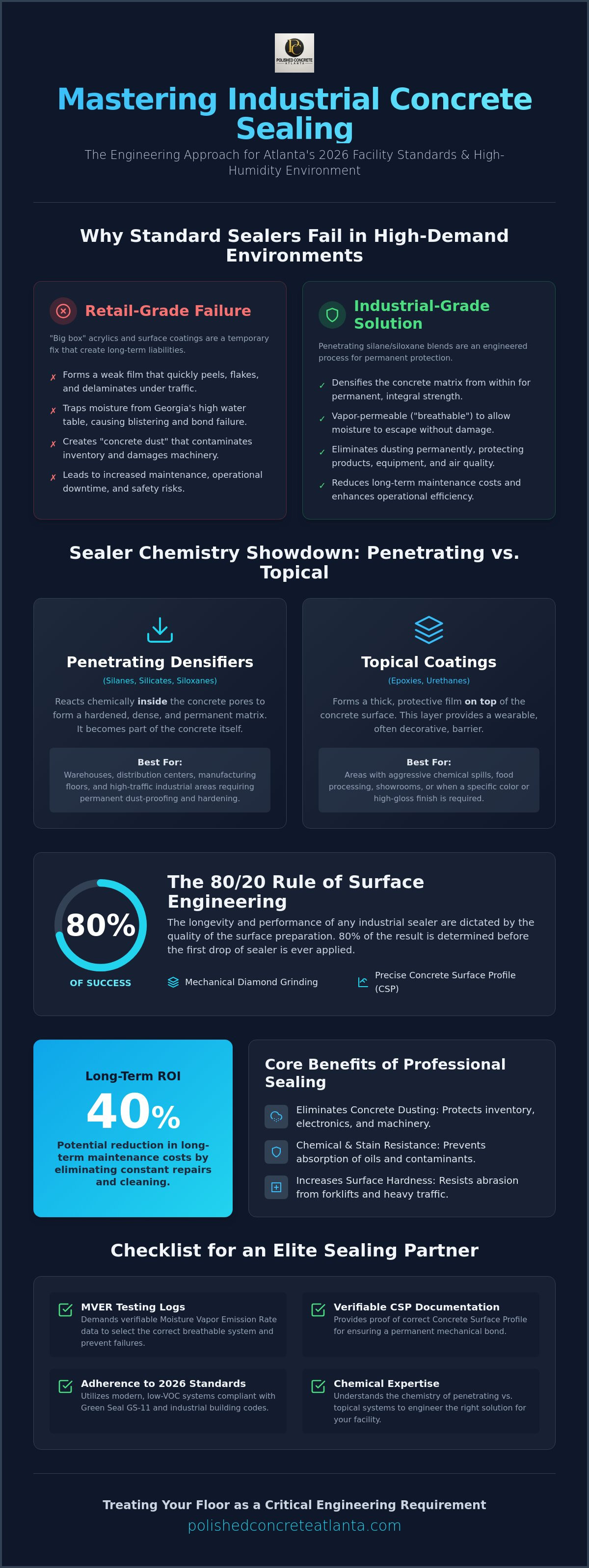
We recognize the frustration of seeing a premium investment delaminate because of poor preparation or incorrect chemical selection. This article outlines the exact protocols needed to master industrial-grade sealing, ensuring your facility remains dust-free and chemical-resistant. You'll learn how the newly adopted 2026 building codes impact your floor specifications and why proper moisture mitigation can reduce long-term maintenance costs by up to 40%. From rigorous grinding techniques to the selection of breathable, high-performance finishes, we provide the definitive roadmap to a floor that reflects your brand's commitment to quality.
Key Takeaways
- Distinguish between retail-grade coatings and industrial-grade silane blends that densify the concrete matrix from within for permanent protection.
- Master the "80/20 rule" of surface engineering, where mechanical diamond grinding and precise profiling dictate the longevity of the final bond.
- Navigate the specific technical requirements for a concrete sealer application Atlanta industrial environments demand to mitigate high water tables and humidity-related failures.
- Calculate the long-term ROI of professional sealing by comparing upfront engineering costs against a decade of reduced maintenance and inventory protection.
- Learn the vetting standards for elite partners, including the necessity of MVER testing logs and verifiable CSP documentation for every project.
Professional Concrete Sealer Application in Atlanta: Beyond the "Big Box" Solutions
Professional concrete sealing is an industrial engineering process, not a janitorial task. It requires a multi-stage chemical and mechanical bond that transforms a porous slab into a resilient asset. Many facility managers make the mistake of choosing "big box" retail-grade acrylics, which merely sit on the surface like a thin film. These products inevitably fail under industrial stress. A true concrete sealer application Atlanta warehouses require involves deep-penetrating silane or siloxane blends. These chemicals don't just coat the concrete; they react with the minerals inside to densify the matrix from within. This creates a surface that is both harder and more resistant to the daily abuse of a high-traffic environment.
Atlanta’s specific climate creates unique challenges for floor integrity. Our region's high humidity and significant water table mean that moisture vapor is constantly moving through the slab. If you apply a non-breathable sealer, that moisture gets trapped, leading to blistering, peeling, and eventual delamination. Professional-grade solutions are vapor-permeable, allowing the floor to breathe while remaining repellent to liquid spills. Is your current floor a simple "dust-proofer" or a true performance sealer? The difference is the gap between a temporary fix and a permanent solution.
The High Cost of Inadequate Sealing in Commercial Facilities
Concrete dusting is a silent killer for industrial operations. Unsealed floors shed microscopic particles that infiltrate sensitive electronics, gum up machinery, and settle on valuable inventory. This isn't just about aesthetics; it's about operational uptime. When a floor absorbs oils and chemicals, it becomes a permanent reservoir for contaminants that are impossible to clean. Beyond the hardware, the liability of slip-and-fall incidents on poorly maintained, oil-slicked surfaces can be catastrophic for a company's bottom line. A professional concrete sealer application Atlanta experts provide eliminates these risks by creating a non-porous, high-traction surface.
Industrial Standards vs. Residential Expectations
Forklift traffic and heavy machinery demand performance metrics that residential sealers simply can't meet. Industrial floors require a specific Concrete Surface Profile (CSP) and chemical resistance that exceeds standard domestic needs. We position sealed concrete as the baseline for facility hygiene and structural protection. Achieving low maintenance commercial floors starts with this professional foundation. It's the difference between a floor that needs constant repair and one that serves as a reliable, long-term investment for your brand.
Sealer Chemistry: Penetrating vs. Topical Systems for 2026 Facilities
Chemistry isn't a suggestion; it's the law of the slab. Choosing the wrong formulation for a concrete sealer application Atlanta project leads to catastrophic delamination and wasted capital. In 2026, the industrial standard has shifted toward high-solids, low-VOC systems that prioritize both structural integrity and environmental compliance. You must choose between penetrating chemistries that modify the internal matrix or topical coatings designed for aggressive surface protection. Each has a specific role in a high-performance facility.
Effective 2026 facility management requires strict adherence to the Green Seal GS-11 Standard. This ensures that your chosen sealer meets rigorous health and performance benchmarks. Beyond compliance, you must account for "breathability." Atlanta's high water table forces moisture vapor through concrete slabs. If your sealer traps this vapor, hydrostatic pressure will blow the coating off the surface. High-performance sealers remain vapor-permeable, allowing the slab to breathe while remaining impervious to liquid contaminants.
Penetrating Densifiers and the Ashford Formula
Penetrating sealers, specifically silicates and silanes, don't create a film. Instead, they trigger a chemical reaction within the concrete pores. This process converts weak calcium hydroxide into hard calcium silicate hydrate (CSH), the same mineral that gives concrete its strength. Densification is the permanent hardening of the concrete surface at a molecular level. By utilizing a system like the Ashford Formula, you achieve a permanent internal seal that never peels or flakes. It's a "one and done" engineering solution for facilities that cannot afford downtime for recoating.
Topical Coatings for Chemical and Abrasion Resistance
While penetrating systems strengthen the slab, topical coatings are necessary for extreme environments. Battery charging stations, chemical storage areas, and heavy manufacturing zones require the high-build protection of epoxies and urethanes. These systems provide a sacrificial layer that resists aggressive acids and mechanical gouging. UV stability is critical for Atlanta facilities with large skylights or open bay doors to prevent yellowing. For those managing heavy-duty operations, exploring the Definitive Guide to Industrial Floor Coatings Atlanta provides the technical depth needed for these specialized environments.
If you're unsure which chemistry fits your specific slab conditions, a professional consultation can prevent costly misapplications. You might consider scheduling a technical site assessment to determine your floor's moisture vapor emission rate before selecting a final system.
The Engineering of Application: A Step-by-Step Professional Protocol
Success in floor sealing isn't found in the bucket. It's found in the grinder. At this level of industrial service, we follow a "no-nonsense" 80/20 rule: 80% of the project is dedicated to mechanical preparation, while the actual application represents only the final 20%. A high-quality concrete sealer application Atlanta project fails every day because contractors skip the engineering phase to save time. We don't. We use diamond grinding to achieve a specific Concrete Surface Profile (CSP) that allows the chemistry to form a physical anchor within the slab.
Before any chemical touches the floor, diagnostic testing is mandatory. We utilize ASTM F1869 calcium chloride tests and ASTM F2170 relative humidity probes to map the slab's internal environment. These metrics dictate our application strategy. Whether we use high-volume, low-pressure (HVLP) sprayers for uniform coverage or microfiber pad agitation to ensure deep penetration, every move is calculated. It's a disciplined approach that eliminates the guesswork often found in budget-tier contracting.
Non-Negotiable Surface Preparation
Adhesion is impossible without a clean substrate. This is why we act as specialized concrete surface preparation contractors first and foremost. We focus on the total removal of bond-breakers like waxes, oils, and residual adhesives through professional floor glue removal Atlanta protocols. While some still use dangerous acid etching, we've retired that practice. It's obsolete, inconsistent, and introduces unnecessary moisture into the concrete matrix.
Managing Atlanta’s Humidity: Moisture Mitigation
Atlanta's geography presents a unique challenge known as Sweating Slab Syndrome, where moisture condenses on the surface and triggers delamination. We remediate this through a strategic concrete moisture barrier installation that blocks vapor drive. Moisture mitigation is the single most important factor in preventing floor coating failure in Georgia. Without it, even the most expensive sealer will eventually blister and peel under osmotic pressure.
Don't leave your facility's integrity to chance with unverified application methods. You should consult with an industrial flooring expert to ensure your slab is properly profiled and tested before your next project begins.
Selecting an Atlanta Concrete Sealing Partner: ROI and Maintenance
Vetting a contractor isn't a formality. It's a risk management strategy. For a high-stakes concrete sealer application Atlanta industrial leaders require, you must demand more than a quote. Ask for documented Moisture Vapor Emission Rate (MVER) testing logs and Concrete Surface Profile (CSP) verification. If a provider cannot produce these technical metrics, they aren't managing your project; they're guessing. A professional partner eliminates uncertainty by aligning every application with the specific mechanical needs of your slab.
Calculating the Total Cost of Ownership (TCO) reveals the true value of elite-level service. While a budget application might seem attractive initially, the cost of premature delamination and frequent recoating quickly erodes those savings. A professional application lasts significantly longer, typically extending the concrete's lifespan by 5 to 10 years. You also gain an "invisible ROI" through reduced cleaning labor, improved indoor air quality, and the protection of sensitive equipment from abrasive concrete dust. Establishing a 2026 maintenance schedule involving specialized cleaning and re-burnishing protocols ensures your floor remains a high-performance asset for a decade or more.
While interior slabs are the focus here, the exterior of your facility also requires professional attention from experts like Warrens Power Washing to maintain its integrity; to see how specialized pressure washing services can help, find out more.
The Local Advantage: Why Atlanta Expertise Matters
North Georgia's red clay and high water tables create a unique vapor drive that can destroy standard coatings. Hiring experienced industrial flooring contractors Atlanta facility managers trust ensures your project accounts for these local geological pressures. Furthermore, as of January 1, 2026, the state of Georgia has adopted new mandatory minimum standard codes for construction, including the 2024 International Building Code (IBC). We ensure every project remains compliant with these updated regulations, providing the peace of mind that comes from working with a partner who understands both the chemistry and the law.
Next Steps for Your Facility
Precision begins with data. We recommend requesting a professional core sample or moisture test to identify the specific requirements of your substrate. We prioritize minimizing downtime, coordinating our timeline to fit your operational needs without compromising the integrity of the cure. Our approach is disciplined, organized, and focused on the final product's durability. Don't settle for mediocrity when your brand's quality is on the line. Schedule a strategic consultation with Polished Concrete Atlanta for your next project.
Future-Proof Your Industrial Infrastructure for 2026
In the high-stakes world of Georgia logistics and manufacturing, a surface failure is an operational failure. We've established that a professional concrete sealer application Atlanta facilities require is a matter of molecular engineering, not just a surface coating. By prioritizing mechanical profiling and vapor-permeable chemistry, you eliminate the risks of dusting and delamination that plague inferior installations. Your floor should be a silent partner in your productivity, not a source of constant maintenance and inventory damage.
Don't let moisture issues or subpar prep compromise your bottom line. We bring over 20 years of Atlanta industrial experience to every project, specializing in complex challenges like Sweating Slab Syndrome remediation. Our team utilizes advanced MVER and RH moisture testing protocols to ensure your floor meets the uncompromising standards of 2026. It's time to invest in a surface that reflects the integrity of your brand. Take the uncertainty out of your facility management with a partner who understands the science of the slab.
Request a Professional Site Evaluation from Polished Concrete Atlanta
Build your facility on a foundation of reliability and elite craftsmanship. We look forward to engineering your success.
Frequently Asked Questions
How long does a professional concrete sealer application take in a large warehouse?
A standard industrial project typically requires two to four days to complete, depending on the square footage and required surface profile. This timeline accounts for rigorous mechanical grinding, moisture testing, and the necessary curing window for the chemistry to bond. We prioritize minimizing operational downtime by coordinating our logistics around your facility's peak hours. It's a disciplined process that ensures the substrate is perfectly prepared without rushing the critical engineering phase.
What is the difference between concrete sealing and concrete polishing?
Concrete sealing involves applying a protective chemical barrier to prevent liquid penetration and dusting, while concrete polishing is a mechanical refinement process using progressively finer diamonds. While sealed concrete provides excellent protection and chemical resistance at a lower initial cost, polished concrete offers superior longevity through physical densification of the slab. Both are high-performance solutions for commercial environments, but the choice depends on your specific traffic requirements and long-term aesthetic goals.
Can you apply a sealer over an existing old coating or oil-stained floor?
No, you cannot achieve a permanent bond by applying sealer over existing contaminants or failing coatings. Professional concrete sealer application Atlanta projects require the total removal of old resins, waxes, and deep-seated oils through mechanical diamond grinding. If these bond-breakers remain, the new sealer will eventually delaminate and peel. We utilize heavy-duty grinding equipment to ensure the substrate is physically open and ready to accept the new chemical treatment.
How often does an industrial concrete sealer need to be reapplied in Atlanta?
Reapplication frequency depends entirely on the chemistry used and the volume of forklift traffic within your facility. Penetrating densifiers like the Ashford Formula are permanent and never require reapplication. However, topical coatings typically need a refresh every three to seven years to maintain their protective properties and finish. A disciplined maintenance schedule can significantly extend these intervals and reduce your total cost of ownership over the life of the floor.
Will concrete sealing stop my floor from "sweating" in the Georgia summer?
Standard sealers won't stop Sweating Slab Syndrome, but a specialized moisture mitigation system will. This issue occurs when humid air hits a cool concrete slab, causing condensation that leads to slip hazards and inventory damage. To remediate this in our local climate, we install high-performance moisture barriers that manage vapor drive and prevent moisture from pooling. It's a technical solution that goes beyond basic sealing to protect your facility's structural integrity.
Is concrete sealer application environmentally friendly and LEED compliant?
Yes, modern industrial sealers are designed to be environmentally responsible and fully LEED compliant. The 2026 industrial standard emphasizes low-VOC, high-solids formulations that minimize off-gassing and improve indoor air quality for your workforce. By choosing these advanced systems, you ensure your facility meets rigorous health benchmarks like the Green Seal GS-11 Standard. We prioritize these sustainable chemistries to protect both the environment and the personnel working within your commercial space.


