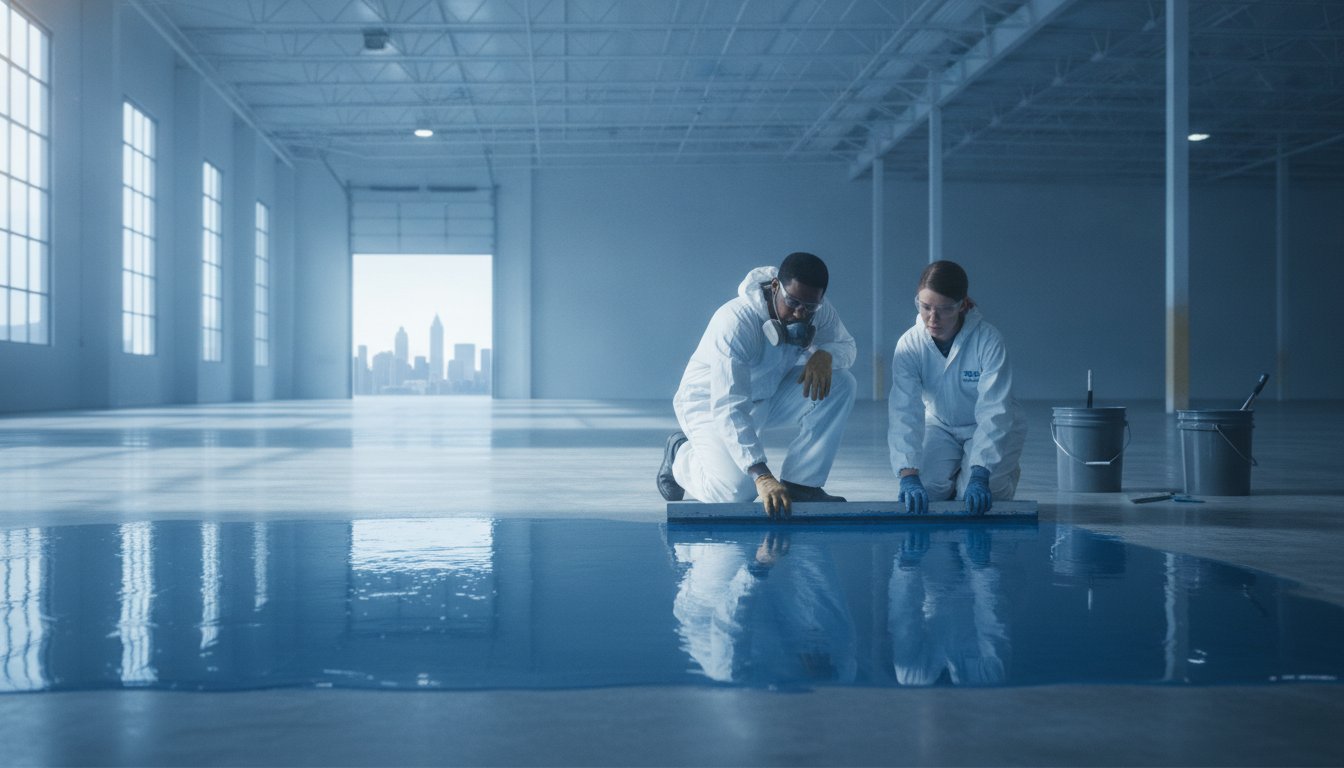
A floor coating is only as durable as the chemistry beneath it. Most commercial flooring failures are decided long before the first gallon of epoxy is poured. If you've ever dealt with the nightmare of bubbling, peeling, or mold growth, you know that moisture is the ultimate silent predator of industrial assets. Professional concrete moisture barrier installation isn't just a line item; it's a technical engineering requirement. Why risk unexpected downtime for remediation when you can eliminate the threat of hydrostatic pressure from the start?
You deserve a facility that performs without compromise. We understand that compliance with flooring manufacturer warranties is non-negotiable for your bottom line. This guide delivers the definitive standards for moisture mitigation, from the 2026 updates in the International Building Code to the new ASTM F3513 standards for fluid-applied systems. We'll break down the critical shift toward 10-mil Class A vapor retarders and the rigorous ASTM F2170 testing protocols required to secure your investment. It's time to move beyond guesswork and implement a permanent solution for high-traffic durability.
Key Takeaways
- Distinguish between basic vapor retarders and professional moisture mitigation systems designed to suppress high Moisture Vapor Emission Rates (MVER).
- Identify why liquid-applied epoxy barriers are the industry gold standard for existing commercial slabs compared to sub-slab sheet membranes.
- Master the technical phases of a professional concrete moisture barrier installation, including ASTM F2170 relative humidity testing and achieving a CSP 3+ surface profile.
- Understand the mechanics of hydrostatic pressure to prevent the upward force that causes high-end floor coatings to bubble and peel.
- Navigate regional environmental factors like Georgia’s high humidity and red clay drainage to ensure total compliance with flooring manufacturer warranties.
What is Concrete Moisture Barrier Installation and Why is it Critical?
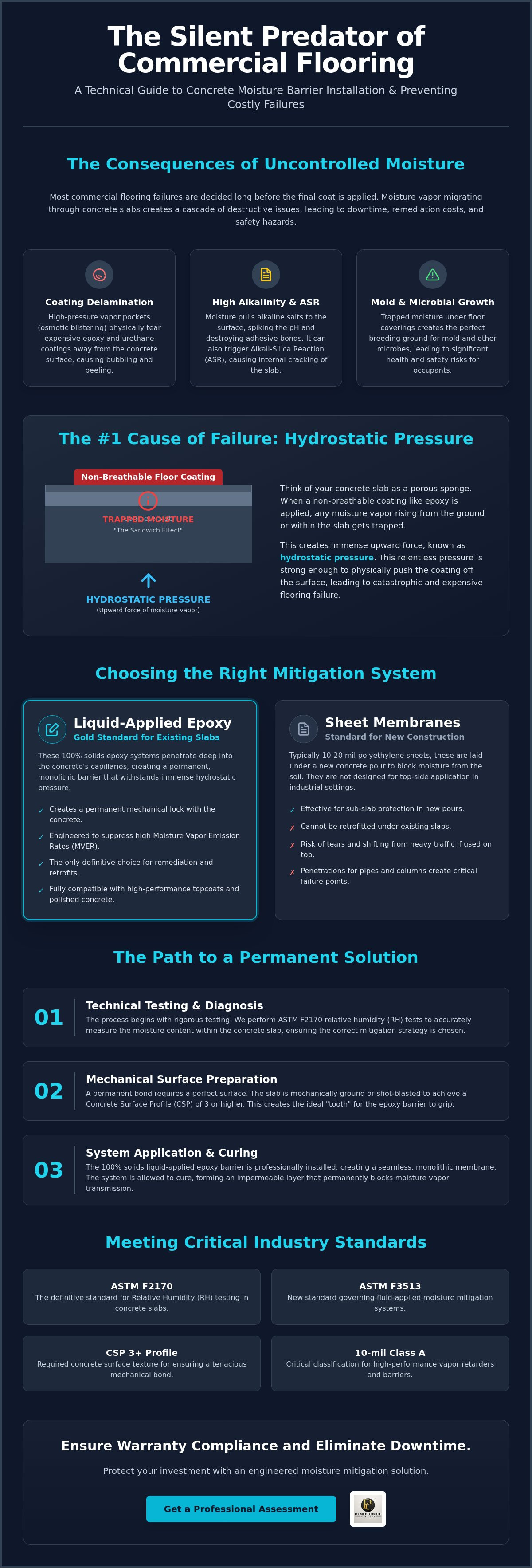
Professional concrete moisture barrier installation isn't just about laying down plastic. It's a technical engineering process designed to suppress Moisture Vapor Emission Rates (MVER). While a residential Vapor barrier focuses on blocking liquid water, industrial moisture mitigation systems are built to withstand the relentless upward pressure of vapor. Think of your concrete slab as a porous sponge. When you seal that sponge with a non-breathable industrial coating, you create a "sandwich effect." Moisture trapped between the slab and the finish has nowhere to go. This leads to osmotic blistering, where high-pressure vapor pockets physically tear the coating away from the surface. In commercial real estate, ignoring this reality is a liability. Floor failure doesn't just look bad; it creates massive financial losses through operational downtime and expensive remediation.
Vapor vs. Moisture Barriers: Understanding the Difference
The effectiveness of a barrier is measured in perms, or the rate of water vapor transmission. Lower perm ratings mean higher resistance. In humid environments like Georgia, liquid water is only half the problem. High ambient humidity keeps slabs saturated, making vapor drive a constant threat to your flooring. It's a matter of physics. Moisture Vapor Emission Rate (MVER) measures the amount of water vapor escaping from a concrete slab over a specific area and timeframe, serving as the primary metric for determining flooring compatibility.
The Consequences of Improper Moisture Control
When moisture control fails, the results are catastrophic. Beyond visible peeling and delamination, moisture alters the chemical composition of the concrete surface. It pulls alkaline salts to the top, spiking the pH level. This high alkalinity destroys the adhesive bond of epoxies and glues. You might also encounter Alkali-Silica Reaction (ASR), where moisture triggers a gel expansion that cracks the slab from within. Don't forget the health risks. Damp environments under floor coverings are breeding grounds for microbial growth and mold. To better understand these risks, discover Mold Pros Phoenix for detailed guides on identifying and remediating contamination. These aren't just aesthetic issues. They are structural and safety failures. They demand a permanent, engineered solution.
Choosing the Right Mitigation System: Liquid vs. Sheet Membranes
Choosing the wrong barrier is a recipe for failure. You can't treat a 50,000-square-foot warehouse the same way you treat a residential crawlspace. For new construction, sheet membranes are the industry standard for sub-slab protection. However, for existing facilities needing a retrofit, liquid-applied epoxy is the only definitive choice. The decision hinges on whether your flooring system is breathable or non-breathable. Polished concrete allows for some vapor transmission, whereas high-performance epoxy coatings trap everything. If you are prepping for a non-breathable finish, your concrete moisture barrier installation must be flawless.
Liquid-Applied Epoxy Moisture Barriers
Liquid-applied systems are the gold standard for commercial remediation. These 100% solids epoxy formulas don't just sit on top of the slab; they penetrate deep into the concrete's capillaries to create a permanent mechanical lock. This bond is strong enough to resist the massive upward force of hydrostatic pressure. These barriers are fully compatible with high-performance topcoats like industrial epoxy or urethane. If you're looking for a permanent solution, liquid barriers are the only choice for polished concrete preparation. They ensure the slab remains stable and dry, preventing the salt migration that ruins high-end finishes. Before moving forward, ensure your team follows ASTM concrete moisture testing methods to confirm the slab's current relative humidity.
Sheet Membranes and Underlayments
Sheet membranes serve a specific purpose. In new pours, reinforced polyethylene barriers, typically 10-mil to 20-mil, are laid over the subgrade before the concrete is placed. They are effective at blocking moisture from the soil. But they have limits. For an existing facility, you can't slide a sheet under the slab. Using them as a top-side underlayment is often risky in industrial settings. Heavy forklift traffic and machinery vibration can cause the sheets to shift or tear. Every utility pipe and column creates a penetration point. If these aren't sealed with surgical precision, the entire system fails. For high-traffic environments, a seamless liquid application is always superior to a taped-seam sheet.
Selecting the right system requires a deep understanding of your facility's specific needs. Factors like slab age, traffic volume, and the final finish type dictate the engineering requirements. Don't leave your investment to chance. If you're unsure which path to take, consulting with a specialist in floor moisture mitigation can save you thousands in future repairs.
The Professional Installation Process: From Testing to Bond
Precision defines every successful industrial project. A professional concrete moisture barrier installation follows a rigorous four-phase protocol that leaves no room for error. It isn't a matter of simply applying a product. It's about engineering a chemical bond that will withstand decades of hydrostatic pressure. When we step onto a job site, we aren't just installers; we're technicians executing a proven system. This methodical approach eliminates the uncertainty that leads to costly floor failures and operational downtime.
Testing and Diagnostics: Measuring the Invisible
You can't manage what you don't measure. Forget the "plastic sheet test" or other surface-level tricks used by amateurs. To secure a commercial warranty, we rely on empirical data. Phase 1 involves diagnostic moisture testing using ASTM F2170 in-situ relative humidity (RH) probes. These sensors measure the moisture profile deep within the slab, providing a true reading of the water vapor waiting to escape. We also utilize ASTM F1869 calcium chloride tests to calculate the specific Moisture Vapor Emission Rate (MVER).
Understanding these thresholds is critical. Most high-performance coatings require an RH level below 75% or 85% depending on the specific chemistry. By documenting these results, we create a permanent record for your facility maintenance files. This level of detail aligns with Department of Energy moisture control standards, ensuring the building envelope remains secure against environmental intrusion. Don't guess when you can know.
Mechanical Prep: The Key to Adhesion
Mechanical preparation is the foundation of every successful barrier. If the concrete isn't "open," the mitigation agent won't penetrate. This is why diamond grinding or shot blasting is non-negotiable. We aim for a Concrete Surface Profile (CSP) of 3 or higher. This process removes laitance, weak surface layers, and old curing compounds that block chemical absorption. During renovations, this phase often includes thorough Floor Glue Removal Atlanta to strip away residual adhesives that could contaminate the new system.
Once the slab is mechanically profiled, we move to precision application. The mitigation agent is applied at a specific mil thickness, calculated based on your slab's diagnostic data. We don't use a "one size fits all" approach. Every gallon is spread with the intent of creating a seamless, pinhole-free membrane. Finally, we verify the cured barrier's integrity. This ensures the surface is ready to receive the final finish, whether it's polished concrete or a heavy-duty epoxy system. The result is a floor that performs exactly as promised.
Addressing Hydrostatic Pressure: The #1 Cause of Floor Failure
Hydrostatic pressure is a physical force, not a suggestion. It is the primary reason high-end floor coatings fail within months of application. Many facility managers mistakenly believe that a standard top-side sealer is enough to waterproof a slab. This is a dangerous misconception. In reality, liquid water and vapor drive from the soil beneath the slab create a relentless upward force. Without a professional concrete moisture barrier installation, that pressure will eventually exceed the bond strength of your floor coating. It literally pops the finish off the surface. Think of it as a structural insurance policy. Professional mitigation secures your investment against the inevitable movement of groundwater.
What is Hydrostatic Pressure?
Concrete is essentially a hard sponge filled with microscopic capillaries. Hydrostatic pressure occurs when groundwater levels rise, forcing liquid water or vapor through these pores toward the surface. In many older Atlanta facilities, the lack of an original sub-slab vapor retarder makes this an active, daily threat. There is a critical difference between simple dampness and active pressure. While dampness might cause minor discoloration, active pressure is a structural force capable of delaminating even the toughest industrial epoxies. It is a constant battle between the earth and your facility's foundation. The red clay common in Georgia often traps moisture near the surface, exacerbating this upward drive.
Why Surface Sealers Fail Under Pressure
A surface sealer is designed to protect the top layer of concrete from spills and abrasion. It is not designed to act as a dam against rising vapor. When vapor pressure builds beneath a non-breathable sealer, it creates osmotic blisters. You will see these as localized peeling, fisheyes, or tiny pinholes in the finish. The physics are simple. If the vapor pressure exceeds the adhesive bond of the coating, the coating fails. Every time. This is why Polished Concrete Atlanta engineers systems that integrate deep-penetrating chemistry rather than just surface-level films.
Our concrete moisture barrier installation protocols ensure that the mitigation agent becomes part of the concrete matrix itself. We don't just coat the surface; we lock the pores. By addressing the root cause of moisture migration, you eliminate the risk of catastrophic floor failure and protect your capital investment for the long term. Don't wait for bubbles to appear before you take action. Secure your facility's future by scheduling a professional floor moisture mitigation assessment to identify hidden risks before they become liabilities.
Atlanta Standards for Commercial Moisture Mitigation
Atlanta's environment presents a unique set of challenges that can dismantle a standard flooring project. High humidity and dense red clay soil create a perfect storm for vapor drive. In this region, concrete moisture barrier installation is a mandatory engineering step for any facility manager who values longevity. You can't rely on national averages or standard cure times here. Compliance with the 2026 City of Atlanta Building Code updates requires a deeper understanding of how local conditions interact with the 2024 International Building Code (IBC) and Georgia Amendments. Doing it right the first time is the only way to avoid the "rip and replace" cycle that drains capital budgets.
Climate Considerations for Georgia Facilities
Georgia's humidity isn't just uncomfortable; it's a structural variable. Seasonal humidity swings in the Southeast directly affect cure times and moisture readings. If you're managing a warehouse or an unconditioned industrial space, your slab is at the mercy of the local water table. Atlanta's red clay acts as a dense basin, often trapping moisture directly against the sub-slab. This creates a constant state of saturation. Without a professional barrier, that moisture will eventually migrate upward, regardless of how old the concrete is. We've seen decades-old slabs fail because of a sudden shift in groundwater levels or a change in HVAC performance. Reliability comes from anticipating these swings before they happen.
Selecting an Atlanta Mitigation Expert
The success of your facility's floor depends on the integrity of your contractor. You need a partner who understands that moisture mitigation is a holistic project management task, not a quick fix. When evaluating a professional floor preparation contractor, look for single-source accountability. If one crew handles the grinding, another handles the mitigation, and a third applies the finish, the "blame game" is inevitable when a failure occurs. An expert contractor owns the entire process from initial ASTM F2170 testing to the final bond.
Ask about their mechanical preparation methods. Are they using planetary diamond grinders to achieve a verified CSP 3+ profile? Do they have the diagnostic equipment to provide documented RH and MVER reports? These aren't just technical details; they're the benchmarks of professional character and transparency. A veteran team knows that precision in the preparation phase is the only way to guarantee a premium, worry-free investment. Don't settle for mediocrity in a climate that punishes shortcuts. Protect your facility with professional moisture mitigation from Polished Concrete Atlanta.
Investing in a high-performance moisture system is about more than just following code. It's about the pride of craftsmanship and the peace of mind that comes from a permanent solution. By choosing a dedicated partner who respects the technical requirements of the Georgia climate, you ensure your high-traffic industrial floors remain durable, aesthetic, and fully compliant with all manufacturer warranties. That is the standard of excellence your facility deserves.
Secure Your Facility with Engineered Moisture Solutions
Your facility's floor is a massive capital asset. Don't let sub-slab vapor drive turn it into a liability. Success depends on more than just a surface sealer. It requires rigorous diagnostic testing, mechanical profiling, and a chemical bond that holds firm against relentless hydrostatic pressure. Professional concrete moisture barrier installation isn't an optional upgrade; it's the foundation of industrial durability. By mastering these technical standards, you eliminate the risk of osmotic blistering and secure your long-term ROI.
As veteran-owned and operated specialists since 2004, we've mastered the nuances of high-performance industrial prep. We understand exactly how Georgia's unique climate and red clay soil impact slab health. You don't have to navigate these complex engineering requirements alone. Secure your investment by partnering with experts who prioritize tangible results and uncompromising reliability. It's time to trade uncertainty for the peace of mind that comes from elite craftsmanship.
Request a Professional Moisture Assessment for Your Atlanta Facility to identify hidden risks before they lead to catastrophic floor failure. Build your operations on a foundation of certainty. Let's ensure your facility performs at the highest level for years to come.
Frequently Asked Questions
How do I know if my concrete floor needs a moisture barrier?
You determine the need through empirical diagnostic testing, specifically ASTM F2170. While visual cues like dark spots or white salt deposits suggest a problem, they don't quantify the threat. A professional concrete moisture barrier installation is necessary whenever the relative humidity (RH) within the slab exceeds the threshold specified by your flooring manufacturer. Don't rely on guesswork when a single failed test can save you thousands in future remediation costs.
Can I install a moisture barrier over old floor glue or paint?
No. A moisture barrier requires a direct chemical bond with the concrete capillaries to function properly. Any existing floor glue, paint, or curing compound acts as a bond breaker that will lead to catastrophic failure. We utilize mechanical surface preparation, such as diamond grinding, to achieve a Concrete Surface Profile (CSP) of 3 or higher. This ensures the mitigation chemistry can penetrate and lock into the slab matrix.
How long does concrete moisture barrier installation take?
The timeline for a professional concrete moisture barrier installation typically ranges from two to four days depending on the facility size and slab condition. The first phase involves rigorous mechanical preparation and cleaning to open the concrete pores. Once the surface is profiled, the application of the mitigation agent usually takes one day. Most high-performance systems require a 12 to 24 hour cure time before the final floor covering can be applied.
Is a vapor barrier the same as a moisture barrier?
These terms are often used interchangeably, but they serve different technical roles in commercial construction. A vapor barrier, or retarder, is typically a plastic sheet installed under the slab during a new pour to block moisture from the soil. A moisture barrier, or mitigation system, is a fluid-applied epoxy designed for existing slabs. It suppresses the moisture vapor emission rate (MVER) from within the concrete to protect top-side coatings.
What happens if I skip moisture mitigation for my epoxy floor?
Skipping mitigation leads to osmotic blistering and total delamination of your epoxy coating. When moisture vapor is trapped beneath a non-breathable finish, it creates high-pressure pockets that physically tear the resin away from the concrete. This results in bubbling, peeling, and potential microbial growth. If you encounter these issues, professional remediation specialists like floodsaferestoration.com can help address the damage and restore your facility's safety. The cost of ripping and replacing a failed floor far exceeds the initial investment in a proper mitigation system.
How much does commercial moisture mitigation cost per square foot?
Project pricing is determined by several technical variables, including the slab's current moisture vapor emission rate and the required surface preparation. Your specific project cost depends on the Concrete Surface Profile (CSP) needed and the mil thickness of the epoxy barrier required to suppress the vapor. We focus on providing a permanent, high-end solution that eliminates the financial risk of floor failure rather than competing on the lowest initial bid.
Does polished concrete require a moisture barrier?
Yes, polished concrete often requires mitigation if the slab exhibits high moisture vapor emission rates. While polished floors are more breathable than epoxy, excessive moisture can still transport alkaline salts to the surface. This leads to efflorescence, which creates a dull, hazy appearance and can cause the concrete to dust or spall. Mitigation ensures the aesthetic integrity and long-term durability of the polished finish in high-traffic environments.
Can a moisture barrier be installed on a new concrete slab?
You can and should install a moisture barrier on new slabs if construction timelines don't allow for a full natural dry-out. New concrete typically takes one month of drying time per inch of slab thickness to reach acceptable moisture levels. If you need to install flooring sooner, a fluid-applied concrete moisture barrier installation allows you to proceed without risking the integrity of the bond. It is a strategic move to keep fast-track projects on schedule.


