

Most industrial floor failures are entirely preventable. They aren't the result of heavy traffic, but rather a fundamental failure of the bond between the coating and the slab. If you've dealt with the headache of peeling or flaking epoxy, you understand that surface-level fixes don't cut it in a high-stakes environment. For those looking at acid stained concrete floors Georgia facilities require a solution that is chemically bonded, not just applied. You need a floor that works as hard as your team does.
This 2026 industrial buying guide will provide you with the technical and aesthetic standards necessary to ensure your facility achieves permanent, industrial-grade durability. We'll examine the latest 2026 Georgia building code updates and explain why rigorous moisture mitigation is now a mandatory standard for warrantable finishes. You'll learn how to move beyond boring gray slabs and implement a high-performance, low-maintenance system that stands the test of time. Results matter. Let's look at how to achieve them.
Key Takeaways
- Identify the chemical transformation that creates a permanent bond so your surface won't peel or flake under pressure.
- Master the 2026 industrial standards for acid stained concrete floors Georgia to guarantee maximum UV stability and heavy-duty durability.
- Discover why mechanical diamond grinding is the only acceptable standard for professional floor preparation and glue removal.
- Learn how slab age and cement composition directly influence your final color depth and aesthetic outcome.
- Evaluate the critical relationship between sealer selection and your facility's long-term performance requirements.
What is Acid Stained Concrete? The Science of Permanent Color
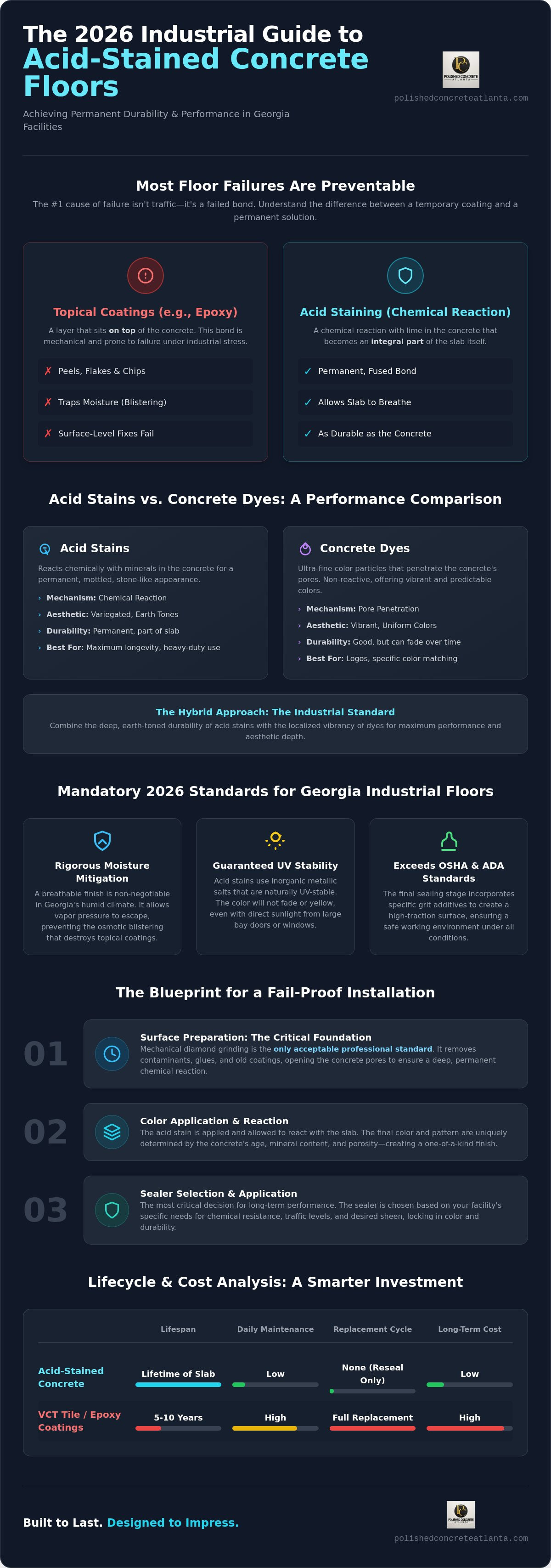
Acid staining isn't a coat of paint. It's a fundamental chemical reaction between metallic salts and the calcium hydroxide, or lime, already present in your slab. This process, often referred to as The Science of Permanent Color, creates a bond that becomes an integral part of the concrete itself. Because the color is etched into the matrix, it cannot flake, peel, or chip like topical coatings. When installing acid stained concrete floors Georgia facility managers gain a surface where the color is as durable as the structural slab. It's a permanent transformation.
The result is a variegated, mottled aesthetic. Every slab reacts differently based on its mineral composition, age, and cement content. This isn't a defect; it's the hallmark of a high-end, unique finish that mimics natural stone or aged leather. It provides a sophisticated look that standard gray slabs simply cannot match. You get a one-of-a-kind floor every single time. No two slabs are identical.
This unique, natural look is also highly sought after in residential settings for patios and walkways, where contractors like Concrete Impressions specialize in creating custom decorative finishes that elevate home curb appeal.
Acid Stains vs. Concrete Dyes: Which Does Your Facility Need?
Dyes and stains serve different purposes. Concrete dyes are non-reactive. They consist of ultra-fine color particles that penetrate the pores of the concrete. They offer vibrant, predictable colors but lack the chemical permanence of a reactive stain. Acid stains, by contrast, rely on that chemical etch for longevity. For many industrial projects, we utilize a hybrid approach. This combines the deep, earth-toned durability of an acid stain with the localized vibrancy of a dye for maximum aesthetic depth. It's about balancing performance with visual impact.
Why Permeability Matters for Georgia Slabs
Georgia's high humidity creates unique challenges for slab-on-grade facilities. Traditional coatings trap moisture, leading to osmotic blistering and delamination. Acid stains are different. They allow the concrete to breathe. This permeability ensures that vapor pressure doesn't build up beneath the surface. However, staining doesn't replace the need for moisture mitigation concrete floors require when vapor emission levels exceed industrial standards. The concrete matrix must be properly prepared to accept the stain while managing the moisture levels inherent in our local environment. This is why acid stained concrete floors Georgia businesses invest in remain a top-tier choice for 2026.
Industrial Standards for Stained Concrete Floors in Georgia
Industrial environments demand floor systems that do more than just look acceptable. They must perform under the duress of constant activity. Following the Industrial Standards for Stained Concrete ensures that your facility meets the rigorous demands of 2026 operations. For acid stained concrete floors Georgia facilities require a surface that integrates with the slab rather than sitting on top of it. This integration is why stained concrete withstands heavy foot traffic and light machinery without the risk of delamination.
UV stability is another critical factor. Many topical coatings yellow or become brittle when exposed to sunlight through large industrial windows or at outdoor-indoor transitions. Acid stains utilize inorganic metallic salts that are naturally UV-stable. The color won't fade. It remains vibrant for the life of the concrete. Additionally, when paired with high-performance sealers, these floors provide excellent resistance to common industrial spills. Safety is never an afterthought. By utilizing specific grit additives in the final sealing stage, we ensure your facility meets or exceeds OSHA and ADA slip-resistance requirements. Performance is the priority.
Maintenance Protocols for Commercial Stained Concrete
Daily maintenance is straightforward. Use a dust mop to remove abrasive grit. Avoid harsh acidic cleaners that can degrade the sealer over time. In high-traffic retail or professional office spaces, we often recommend a sacrificial wax layer. This acts as a renewable wear surface that protects the underlying stain. When you analyze the long-term cost, stained concrete consistently outperforms VCT or carpet. There is no replacement cycle. You simply maintain the existing surface. If you are looking to upgrade your facility, a consultation with an industrial flooring expert can help define the right maintenance schedule for your specific traffic patterns.
Aesthetic Versatility: From Warehouses to Office Lobbies
Function doesn't have to be boring. Using saw-cut scoring patterns, we can simulate the look of large-scale tile or incorporate custom branding directly into the floor. Natural color palettes like tans, deep browns, and terra cottas are strategic choices. They effectively hide dust and wear in busy environments. For more design inspiration, explore our guide on decorative concrete staining commercial applications. We move beyond the "gray slab" mentality to create professional environments that reflect the quality of your brand. Precision matters. Every cut and every color application is executed with meticulous detail to ensure your acid stained concrete floors Georgia project achieves an elite finish.
The Buying Guide: Selecting the Right System and Sealer
Success in industrial flooring depends on technical foresight. When planning for acid stained concrete floors Georgia, you must look beyond the color chart. The final aesthetic is a product of the slab’s chemical history. Concrete age, cement content, and previous topical treatments all influence the reaction. This is the Professional Installation Standard that experienced facility managers demand. We don't guess. We analyze the matrix to ensure the results are predictable and permanent.
Sealer selection is your floor's primary line of defense. Acrylic sealers are breathable and cost-effective, but they lack the abrasion resistance required for heavy machinery. High-solids polyurethanes or industrial epoxies offer superior protection for high-traffic environments. Your choice of gloss also impacts performance. High-gloss finishes maximize light reflectivity in professional showrooms. Conversely, matte or satin finishes are more forgiving in warehouses where dust and scratches are inevitable. Georgia's climate adds another layer of complexity. Outdoor slabs or slab-on-grade facilities require sealers with high moisture vapor transmission rates to prevent delamination.
Evaluating Your Existing Slab
The slab must be ready for the reaction. New concrete requires a minimum 28-day cure cycle before staining. Rushing this process leads to bond failure and inconsistent color depth. Existing slabs often hide contaminants like hydraulic oils or old waxes that prevent the acid from etching the surface. You cannot stain over a dirty canvas. This is why working with qualified concrete surface preparation contractors is a non-negotiable step. Mechanical grinding is the only way to ensure the slab is truly open and receptive.
Cost Drivers in Commercial Staining Projects
Budgeting for a commercial project involves more than a simple square-foot price. Floor complexity, the number of vertical transitions, and the presence of old carpet glue or epoxy coatings drive the total investment. Cheap bids usually indicate a lack of proper surface preparation. This leads to "ghosting" where old patterns reappear through the new finish. It's a waste of capital. For a result that reflects the integrity of your brand, get a professional project assessment from a team that understands industrial scale.
The Professional Installation Standard: Avoiding Failure
Industrial floor failure is rarely a mystery. It's almost always the result of cutting corners during the preparation phase. When installing acid stained concrete floors Georgia facilities require a level of precision that goes beyond the capabilities of a general contractor. Mechanical surface preparation is the only reliable method for achieving a permanent bond. We don't rely on acid washing. It's an outdated, unreliable technique that often leaves behind a residue that compromises the entire system. Diamond grinding is the professional standard. It's the only way to ensure the slab is truly open.
The "invisible" work defines the longevity of your floor. This includes ensuring that floor glue removal Atlanta is executed through rigorous mechanical grinding rather than chemical strippers. Chemical residues from old adhesives will ghost through your new stain, ruining the aesthetic and the bond. Once the slab is clean, application technique matters. We utilize a combination of sprayed and scrubbed methods. This ensures the metallic salts penetrate deep into the concrete matrix while maintaining the variegated depth that defines a high-end finish. Precision is everything.
Neutralization is the final, non-negotiable hurdle. Many low-cost contractors skip or rush this step. If the acid reaction isn't properly neutralized and the slab isn't returned to a pH-neutral state, the sealer will fail. It won't matter how expensive your sealer is if the chemistry beneath it is volatile. We verify the pH levels before a single drop of sealer touches the floor. We don't leave success to chance.
Why Prep is 90% of the Result
You can't hide a bad slab with a good stain. Sealed-in contaminants like oils, old paint, or moisture will eventually force the finish to delaminate. The concrete must be "open" enough to accept the metallic salts for the chemical reaction to take place. This level of detail is what separates an industrial-grade installation from a temporary fix. For those researching concrete floor staining near me, the standard must be uncompromising. If the prep isn't right, the floor won't last.
Choosing a Georgia Staining Expert
Vetting your partner is as important as choosing the system. Ask the hard questions. Do they use heavy-duty planetary grinders or just floor swingers? Can they provide proof of commercial insurance and a portfolio of industrial-scale projects? At Polished Concrete Atlanta, we provide a no-nonsense execution of the highest technical standards. We are dedicated partners who manage every granular detail to ensure your acid stained concrete floors Georgia project delivers a premium, worry-free investment. We don't settle for mediocrity. Neither should you.
Secure Industrial-Grade Performance for Your Slab
Achieving a permanent, high-performance finish isn't a matter of chance. It's a matter of precise chemistry and rigorous engineering. You've seen why mechanical diamond grinding is the only acceptable standard for a clean canvas and why the chemical bond of a reactive stain outlasts any topical coating. Navigating the 2026 standards for acid stained concrete floors Georgia requires a partner who understands the granular details of moisture mitigation and UV stability. We don't guess. We execute.
With over 20 years of industrial flooring expertise and specialized diamond grinding equipment, we eliminate the uncertainty of floor failure. Our team has built a proven track record with Georgia facility managers by prioritizing tangible results over surface-level aesthetics. Don't settle for a floor that might peel when you can have one that's chemically integrated into your facility's foundation. It's time to invest in a solution that works as hard as you do.
Request a Professional Consultation for Your Georgia Facility
Your facility deserves a foundation that reflects your commitment to excellence. Let's build it together.
Frequently Asked Questions
Is acid stained concrete slippery when wet?
Acid stained concrete is not inherently slippery, provided the correct sealer and anti-slip additives are used. The stain itself is a chemical reaction that lives within the slab, so the slip resistance is entirely dependent on the final protective topcoat. We integrate specific grit into the industrial sealer to ensure your facility meets all OSHA and ADA safety requirements. Safety is a non-negotiable standard for every project we manage.
How long does a professional acid staining project take for a 5,000 sq ft facility?
A typical 5,000 square foot project requires approximately five to seven days for a complete, professional execution. This timeline accounts for the critical mechanical preparation, the chemical reaction period, thorough neutralization, and the necessary cure times between sealer applications. We don't rush the process. A methodical approach is the only way to guarantee the permanent, high-performance results your environment demands.
Can you acid stain old concrete that has been covered by carpet or tile?
Yes, acid stained concrete floors Georgia projects involving old carpet or tile are common, but they require intensive mechanical preparation. Every trace of adhesive, thin-set, and wax must be removed through diamond grinding to open the concrete pores. If these contaminants remain, they'll block the chemical reaction and cause "ghosting" patterns. We engineer the surface to ensure a clean, uniform transformation of the existing slab.
Will the color of my acid-stained floor fade in the Georgia sun?
The color of an acid-stained floor will not fade because it's made from UV-stable inorganic metallic salts. Unlike topical dyes or paints that sit on the surface and break down under solar exposure, acid stains become an integral part of the concrete matrix. This makes them an ideal solution for facilities with large windows or high-traffic loading docks. The color is as permanent as the concrete itself.
What is the difference between acid staining and polished concrete?
Acid staining is a chemical coloring process, whereas polished concrete is a mechanical refinement of the slab. Staining relies on a reaction with the lime in the concrete to create variegated earthy tones. Polishing uses progressively finer diamond abrasives to grind the surface to a specific level of shine and smoothness. While they're different systems, they're often used together to create a durable, high-gloss aesthetic.
How do I know if my concrete slab is a candidate for acid staining?
Your slab is a candidate if it is structurally sound, porous, and free of deep chemical sealers. We perform a water drop test to verify that the concrete can absorb the stain. If the water beads up, a previous coating or wax is present and must be mechanically removed. A professional assessment is the only way to eliminate uncertainty and determine if your slab will accept the metallic salts correctly.


