Is your facility floor a high-performing asset or a liability waiting to happen? Most industrial floor failures aren't the result of heavy traffic; they're the result of poor chemistry. If you're struggling with concrete dusting that ruins your inventory or moisture vapor that causes coating failures, you're losing money every day. Implementing a professional sealed concrete strategy is the only way to lock down your slab. It's about reliability. It's about eliminating uncertainty. No more excuses.
Success in the industrial flooring sector is earned before the first drop of chemical hits the slab. We operate on a definitive principle: industrial durability is 90% preparation and 10% application. Many competitors suggest that a simple chemical wash is sufficient. They're wrong. Relying on cleaning agents alone to prepare a floor for sealed concrete is a shortcut that leads to delamination and surface failure. You can't wash away the structural weaknesses of a slab. You have to grind them away. Our no-nonsense approach is the only antidote to the floor failures that plague less disciplined contractors, a standard of excellence also practiced by Muddy Boots Concrete in their specialized concrete services.
We know you're tired of the confusion between sealing, polishing, and coating. You need a solution that works without the fluff. This guide will help you master the technical essentials required to protect your facility's most valuable asset. We'll break down the critical performance metrics of ASTM C1315 and C309 standards while navigating the latest 2026 VOC limits. You'll learn how to achieve a dust-free, easy-to-clean environment that stands up to chemical spills. This is your roadmap to a cost-effective, high-end industrial floor. No-nonsense results start here.
Key Takeaways
- Learn how to transform porous slabs into liquid-resistant barriers that eliminate concrete dusting and protect your inventory.
- Differentiate between penetrating and film-forming chemistries to select the exact level of protection your facility requires.
- Utilize a strategic framework to determine when sealed concrete is the most cost-effective alternative to full polishing or epoxy.
- Discover how to calibrate your flooring for high-humidity environments like Atlanta to avoid common failures like blushing and delamination.
- Understand why mechanical grinding is the non-negotiable standard for achieving true industrial-grade durability.
The Fundamentals of Sealed Concrete: Beyond the Surface Level
Sealed concrete isn't just a finish; it's a fundamental engineering requirement for any industrial environment. At its core, this process involves the application of specialized chemical barriers designed to penetrate or coat porous concrete slabs. The goal is simple: total protection. By transforming a raw slab into a high-performance surface, you achieve dust-proofing, liquid resistance, and a significantly extended lifespan for your floor. We don't settle for "good enough." Raw concrete is a liability that compromises your operations. It's a porous material that demands professional calibration to survive the rigors of industrial use.
The Problem with Unprotected Concrete
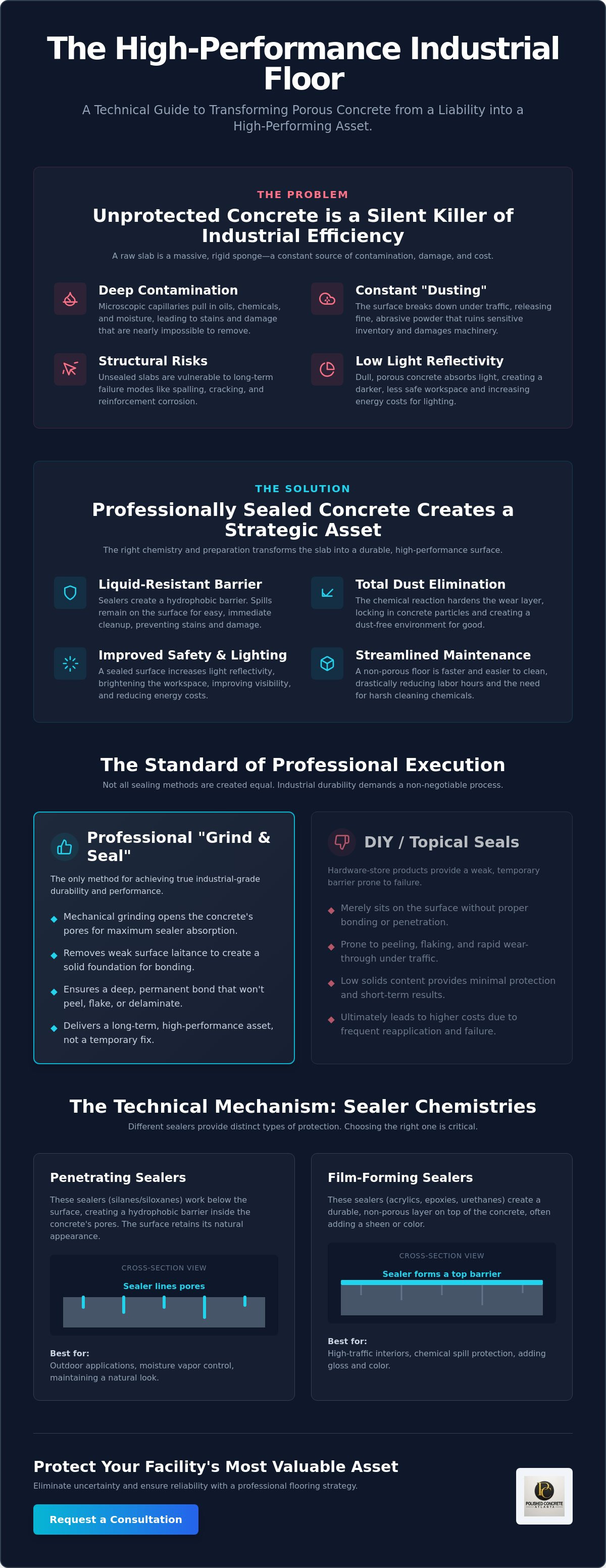
Unprotected concrete is essentially a massive, rigid sponge. It features microscopic capillaries that pull in oils, chemicals, and moisture, leading to deep-seated contamination that's nearly impossible to remove. This porosity is a silent killer of industrial efficiency. Perhaps more frustrating is the phenomenon known as "dusting." This occurs when the surface of the concrete breaks down under traffic, releasing a fine, abrasive powder into the air. This isn't just a cleaning nuisance; it's a hazard that ruins sensitive inventory and damages expensive machinery. Without a professional concrete sealer, your floor is actively deteriorating from the moment it's poured. Long-term structural risks like spalling and reinforcement corrosion aren't just possibilities; they're eventualities for unsealed slabs.
Sealed Concrete as a Strategic Facility Asset
Choosing sealed concrete is a calculated business decision that pays dividends in safety and efficiency. A properly sealed floor increases light reflectivity, which brightens the workspace and reduces the need for excessive overhead lighting. This creates a safer environment where hazards are clearly visible to employees and forklift operators. Maintenance also becomes a streamlined process rather than a constant battle. Since liquids can't penetrate the surface, spills remain on top where they can be easily wiped away. This reduction in cleaning labor and chemical costs makes sealed concrete the entry-level standard for any professional facility manager who prioritizes long-term value over temporary fixes.
The Distinction of Professional Execution
Don't confuse a hardware-store topical seal with a professional "grind and seal" system. A topical seal merely sits on top of the surface, prone to peeling and flaking within months. In contrast, our professional approach starts with mechanical grinding. We use diamond-toothed grinders to open the concrete's pores and remove surface laitance. This ensures the sealer bonds deeply with the substrate. The result is a unified, durable system that won't delaminate under pressure. It's the difference between a temporary fix and a permanent solution. We deliver floors that stand up to the toughest conditions without compromise.
The Technical Mechanism: How Sealers Transform Porous Concrete
Concrete is a hard sponge. It looks impenetrable, but at a microscopic level, it's riddled with capillaries and voids. This is where sealed concrete technology proves its worth. We don't just apply a topical layer; we change the surface's chemistry. Professional-grade densifiers react with the calcium hydroxide in the cement paste to produce calcium silicate hydrate. This fills the pores. It hardens the wear layer. It eliminates the dusting mentioned earlier. This isn't a cosmetic upgrade. It's a structural reinforcement of the slab's surface. We're locking down the matrix to ensure it stands up to industrial abuse.
The Sealer Selection & Application Guide provides a framework for choosing between penetrating and film-forming chemistries. Consumer-grade products sold at big-box retailers often have low solids content. They provide a thin, weak barrier that wears away in months. Industrial-grade chemicals are different. They're designed for high-traffic environments and specific chemical exposures. Reliability is the priority here. If you aren't sure which system fits your facility, a professional commercial floor preparation consultation can identify the specific needs of your slab.
Penetrating Sealers: Protecting from Within
Penetrating sealers, usually silanes or siloxanes, work below the surface. They create a hydrophobic barrier that lines the pores. Water and oils bead up. The concrete can still "breathe," allowing moisture vapor to escape without damaging the sealer. This is vital for exterior slabs or floors with high moisture levels. Because they don't form a film, they don't change the appearance or slip resistance of the floor. It's invisible, high-performance protection that won't flake or peel. You get the benefits of a sealed slab without the maintenance of a topical coating.
Film-Forming Sealers: Surface-Level Barriers
Film-formers like acrylics, polyurethanes, and epoxies create a protective skin over the concrete. They're the primary choice for aesthetic enhancement and maximum chemical resistance. These systems offer distinct advantages for specific facility needs:
- Acrylics: Cost-effective and easy to apply, offering a "wet look" finish that enhances color.
- Polyurethanes: Highly resistant to abrasion and chemicals, providing a barrier that's twice as thick as standard acrylics.
- Epoxies: Provide a hard, durable shield ideal for heavy-duty industrial settings where impact resistance is critical.
The trade-off is maintenance. These surfaces can scratch or peel if the bond is compromised by poor application. Professional mechanical grinding is the only way to ensure these barriers stay locked to the substrate. We don't take shortcuts with adhesion. A film is only as strong as the surface it's bonded to.
Strategic Comparisons: Sealed vs. Polished vs. High-Performance Epoxy
Selecting the right floor isn't a matter of preference; it's a matter of performance. You must match the flooring system to the specific operational demands of each zone. High-traffic loading docks require different engineering than climate-controlled retail spaces. A sealed concrete system offers an excellent balance of cost and durability for back-of-house areas, but it isn't a universal fix. We analyze your traffic volume, chemical exposure, and long-term budget to determine where to deploy each solution. Efficiency is the priority. We don't leave your facility's integrity to chance.
Sealed vs. Polished Concrete
The primary difference lies in the labor and the mechanical refinement of the slab. Polished concrete involves a progressive, multi-stage diamond-grinding process that achieves a high-gloss finish without a topical coating. It's the gold standard for high-end retail and public-facing areas where aesthetics and extreme durability are paramount. You can find more detail in The Standard for Polished Concrete Floors in Atlanta. In contrast, sealed concrete is a more streamlined approach. It's faster to install and provides excellent dust-proofing for massive warehouse footprints. While polished floors require periodic burnishing to maintain their shine, sealed floors will eventually need a fresh topical application to maintain their barrier. It's a strategic trade-off between upfront cost and long-term maintenance cycles.
Sealed vs. Epoxy and Industrial Coatings
There are limits to what a sealer can handle. Heavy manufacturing environments with constant chemical spills or extreme impact require the "build" of an epoxy system. Epoxies create a thick, opaque shield that can hide slab imperfections and provide superior slip resistance through specialized aggregates. A sealer is a clear, thin-film or penetrating treatment. It protects the slab but doesn't change its physical profile. If your facility deals with battery acid, harsh solvents, or heavy point-loading, an industrial coating is the only reliable choice. Sometimes, we combine systems. We might use floor moisture mitigation before applying a high-performance topcoat. We don't guess. We engineer the solution to the environment.
Consider the 10-year ROI. Sealed concrete has the lowest initial investment, making it ideal for large-scale industrial spaces where covering square footage is the goal. However, the re-application costs must be factored into your lifecycle planning. Polished concrete has a higher entry price but offers the lowest maintenance costs over a decade. Epoxy sits at the top of the price bracket but provides unmatched protection for high-liability zones. We help you allocate your capital where it matters most. No mediocrity. Just results.
Environmental Calibration: Selecting Sealers for Atlanta’s Climate
Atlanta's humid subtropical climate presents a unique set of challenges for industrial flooring. We don't just apply a product; we calibrate the solution to the local environment. High humidity and the moisture-retentive properties of Georgia's red clay mean your slab is under constant pressure from vapor drive. If you ignore these variables, your sealed concrete project is destined for failure. We prioritize precision. We eliminate the guesswork that leads to costly repairs and operational downtime. Reliability is the only standard we accept.
The Reality of Moisture Vapor Emission
Concrete isn't static. It's a dynamic material that constantly exchanges moisture with its environment. In Georgia, the dense clay soil beneath your slab often remains saturated. This creates a high Moisture Vapor Emission Rate (MVER), where vapor moves from the damp earth through the slab toward the drier air inside your facility. If you apply a non-breathable film-forming sealer over a slab with high MVER, that vapor gets trapped. The result is "blushing," a white, cloudy discoloration, or total delamination where the sealer physically peels away from the substrate. We prevent this by conducting rigorous moisture testing using ASTM F1869 or ASTM F2170 standards. If the levels exceed industrial tolerances, we move straight to a professional concrete moisture barrier installation to lock down the slab before sealing. We don't take chances with your investment.
Selecting the Right Chemistry for Georgia Facilities
A "one-size-fits-all" sealer from a national big-box store won't survive an Atlanta summer. These products often lack the chemical density or UV stability required for local conditions. We select chemistry based on the specific needs of your building. For facilities with large windows or outdoor exposure, UV stability is non-negotiable to prevent yellowing. In high-moisture zones, we may opt for breathable penetrating sealers that allow vapor to escape while still repelling liquids. For high-impact industrial zones, we might use a non-breathable urethane, but only after verifying the slab's internal humidity. This tailored approach ensures your floor remains a high-performing asset regardless of the weather outside.
Reliability comes from understanding the chemistry and the climate. Don't let a generic application ruin your facility's foundation. If you're dealing with moisture issues or need a professional assessment, contact us for a comprehensive floor moisture mitigation strategy today. We deliver results that last.
The Standards of Professional Execution: Ensuring Industrial Durability
Success in the industrial flooring sector is earned before the first drop of chemical hits the slab. We operate on a definitive principle: industrial durability is 90% preparation and 10% application. Many competitors suggest that a simple chemical wash is sufficient. They're wrong. Relying on cleaning agents alone to prepare a floor for sealed concrete is a shortcut that leads to delamination and surface failure. You can't wash away the structural weaknesses of a slab. You have to grind them away. Our no-nonsense approach is the only antidote to the floor failures that plague less disciplined contractors.
Mechanical Surface Preparation (CSP Standards)
Professional execution relies on achieving the correct Concrete Surface Profile (CSP). This isn't a suggestion; it's a technical requirement for sealer bonding. During the curing process, concrete develops "laitance," a fragile, powdery layer on the surface that lacks structural integrity. If you seal over it, the sealer bonds to the powder, not the slab. Our "Grind and Seal" process utilizes heavy-duty mechanical grinders equipped with industrial diamonds to strip away laitance and old contaminants. This mechanical profile creates the "teeth" necessary for the sealer to bite into the substrate. This is why our floors don't peel or flake like the DIY projects you've seen fail. We provide a surface that's engineered to last. We don't just cover up problems; we eliminate them.
Application Precision and Maintenance
Once the surface is prepared, precision becomes the priority. Amateurs often believe that a thicker layer of sealer provides better protection. In reality, over-application is a primary cause of bubbling and trapped moisture. We apply chemicals at strict manufacturer-specified coverage rates to ensure a uniform, high-performance barrier. This methodical process guarantees that the sealed concrete performs exactly as engineered under heavy industrial loads. Reliability doesn't end at installation. We help you establish a professional maintenance schedule that includes the use of pH-neutral cleaners and periodic inspections. This proactive approach extends the life of the seal and ensures your facility remains a high-end, worry-free investment.
A floor is only as good as the team that stands behind it. We bring the gravitas of seasoned experts to every project, ensuring that your facility's most valuable asset is protected by rigorous standards and elite craftsmanship. Don't settle for mediocrity when your foundation is at stake. Consult with Polished Concrete Atlanta today.
Transform Your Floor from a Liability into a High-Performance Asset
A raw concrete slab is an unfinished project. You now understand that professional protection requires more than a simple topical coating. It demands a synergy of mechanical surface preparation and advanced chemical engineering. By mastering the technical essentials of sealed concrete, you eliminate the risks of dusting and moisture failure that compromise so many industrial facilities. There is no room for uncertainty when it comes to your foundation. Precision is the only path forward.
We bring over 20 years of Atlanta-based industrial flooring expertise to every project. Our specialized moisture mitigation and surface preparation standards set the benchmark for commercial warehouses and retail environments. As authoritative consultants, we deliver a strategic alliance focused on the long-term integrity of your floor. It's time to stop managing floor failures and start investing in durability. Results matter. Reliability is non-negotiable.
Secure Your Industrial Asset with Professional Concrete Sealing
Take the first step toward a dust-free, high-performance environment today. We look forward to engineering a solution that exceeds your highest expectations.
Frequently Asked Questions
How long does sealed concrete last in a commercial warehouse?
High-performance epoxy sealers can last 5 to 15 years, while acrylic sealers typically require reapplication every 1 to 3 years. The specific lifespan depends on traffic volume and the chemical resistance required. We don't guess on durability; we engineer it. Frequent forklift traffic and abrasive debris will naturally accelerate wear on the top layer, necessitating a structured maintenance plan to preserve the slab's integrity.
Can I seal concrete that has already been stained or painted?
You can seal stained concrete, but sealing over existing paint requires the complete removal of the old coating first. A sealer must bond directly to the concrete's pores to be effective. If you apply it over paint, the sealer will only be as strong as the failing paint beneath it. We utilize mechanical grinding to strip away old coatings and open the pores, ensuring a definitive bond for the new system.
What is the difference between a concrete sealer and a concrete densifier?
A concrete densifier is a chemical treatment that hardens the surface from within, while a sealer creates a protective barrier against liquids and chemicals. Densifiers react with the concrete to fill voids and eliminate dusting. Sealers sit on top or just below the surface to repel contaminants. In many industrial projects, we use both. This combination ensures the floor is both structurally hardened and chemically protected against spills.
Is sealed concrete slippery when wet, and can traction be added?
Film-forming sealers can become slippery when wet, but we mitigate this by adding specialized anti-slip aggregates during the application. These micronized beads or fine sands increase the floor's coefficient of friction without compromising the aesthetic. Safety is a non-negotiable standard in industrial environments. We calibrate the level of traction to your specific operational needs, ensuring your team remains safe in wet or oily conditions.
How soon can I drive on my floor after the concrete has been sealed?
Most sealed concrete floors are ready for foot traffic within 24 hours and heavy vehicle traffic after 48 to 72 hours. These timelines depend on the specific chemistry used and the ambient humidity in your facility. Fast-curing polyaspartics can often handle traffic much sooner. We provide a definitive curing schedule for every project to eliminate uncertainty and prevent premature surface damage.
Will sealing my concrete floor prevent all cracks from forming?
Sealing won't prevent structural cracks caused by ground movement or settling, but it does prevent cracks caused by moisture expansion and chemical erosion. By locking out water and corrosive agents, you eliminate the internal pressures that lead to surface spalling. We don't claim to stop the earth from moving. We do, however, ensure your slab remains resistant to the environmental factors that cause premature deterioration.
What is a "Grind and Seal" and why is it better than just sealing?
A "Grind and Seal" involves mechanical surface preparation using diamond grinders to remove laitance and open the concrete pores before applying the sealer. This process is superior because it ensures a permanent bond between the chemical and the substrate. Simply pouring a sealer over an unprepared floor is a recipe for failure. Mechanical grinding eliminates surface contaminants and creates a uniform profile that maximizes the durability of the sealed concrete system.
How do I know if my existing concrete sealer is failing?
You can identify sealer failure by looking for "blushing," peeling, or areas where liquids no longer bead on the surface. If the concrete appears dark or damp when exposed to water, the barrier has been compromised. Dusting is another definitive sign that the sealer has worn away. We recommend a professional assessment if you notice these symptoms. Ignoring a failing seal leads to deep-seated slab contamination and higher repair costs.


