
The cheapest flooring installation is often the most expensive mistake a facility manager can make. Constant stripping and waxing cycles for VCT don't just drain your budget; they create unnecessary downtime that stalls your operations. You need low maintenance commercial floors that prioritize surface engineering over temporary coatings. It's about utilizing the structural integrity of your existing slab to create a high-performance environment that lasts. Professional results require a no-nonsense approach to durability.
We understand the frustration of floor failure caused by Georgia's high humidity and the pressure of meeting new 2026 OSHA slip resistance mandates. You're looking for a "set it and forget it" solution that doesn't sacrifice aesthetic excellence for utility. This guide identifies the most durable, cost-effective systems designed to slash cleaning labor and maintain a professional luster for over a decade. We'll examine how strategic floor preparation and moisture mitigation turn a high-traffic liability into a permanent, high-performance asset.
Key Takeaways
- Stop paying the "hidden tax" of recurring VCT maintenance and learn why true low maintenance commercial floors require zero waxing or chemical stripping to maintain their finish.
- Identify the specific high-performance systems, including polished concrete and industrial epoxy, that dominate the 2026 landscape for durability and cost-efficiency.
- Utilize a disciplined selection framework to accurately match your facility's foot traffic and chemical exposure to the correct surface engineering.
- Discover why elite craftsmanship starts with mechanical grinding and professional floor glue removal to ensure a permanent, failure-proof bond.
- Future-proof your facility against 2026 OSHA slip resistance standards while securing a high-end surface that maintains its luster for over a decade.
The True Cost of Commercial Flooring: Why 'Low Maintenance' is a Strategic Investment
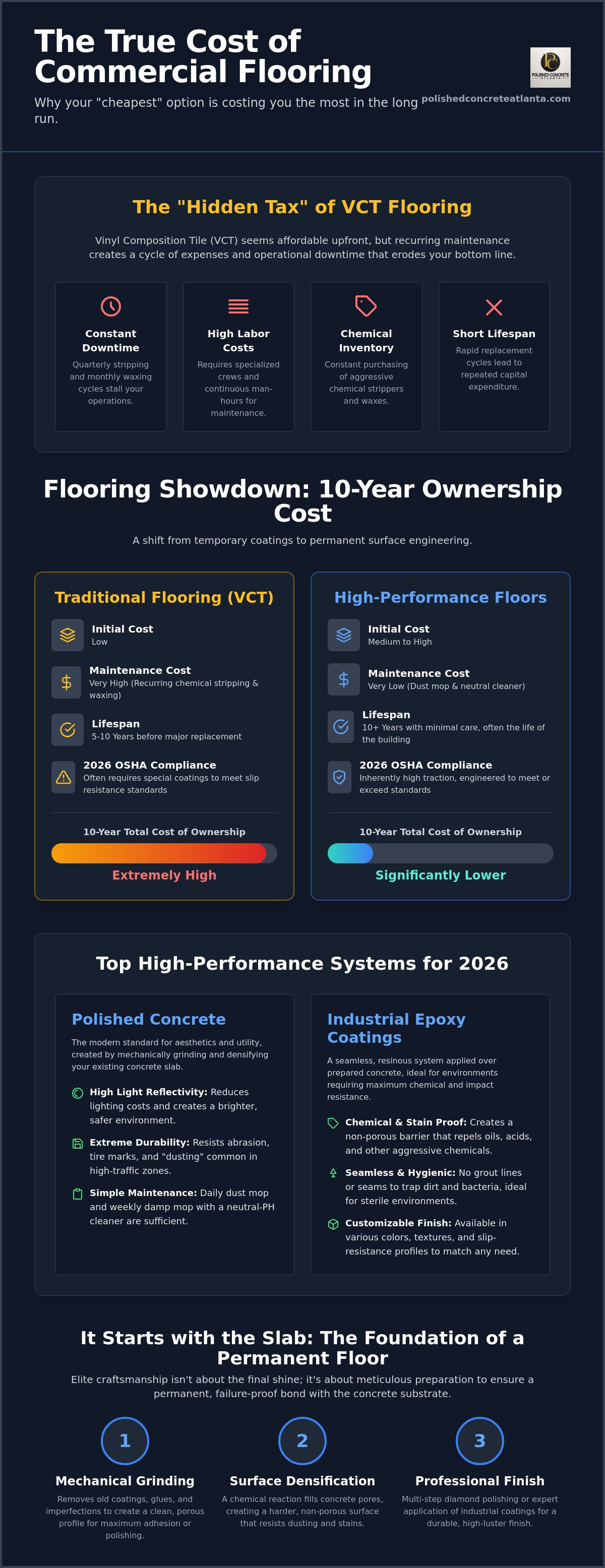
When evaluating an overview of flooring materials, the disparity in long-term value becomes clear. While VCT and carpet might offer lower initial installation costs, their rapid replacement cycles and high-maintenance demands make them a liability. By 2026 standards, sustainability isn't just a buzzword; it's a regulatory and financial necessity. Densified concrete has emerged as the commercial standard because it utilizes the existing slab, reducing the need for temporary, petroleum-based coverings that inevitably end up in a landfill. A dense surface doesn't just look better. It performs better by resisting the "dusting" and staining common in high-traffic industrial zones.
Understanding Concrete Densification
Standard concrete is naturally porous, acting like a hard sponge that absorbs oils, chemicals, and moisture. This porosity is why untreated floors "dust," creating a fine white powder that settles on inventory and machinery. We solve this through chemical densification. As authorized Ashford Formula installers, we use a specialized process that triggers a chemical reaction within the concrete, filling the pores with a crystalline structure. This turns a soft, porous slab into a non-porous, high-density surface. The result is a floor that is physically harder and significantly easier to maintain. You spend fewer man-hours on daily cleaning because the contaminants stay on the surface rather than sinking into the substrate.
The ROI of High-Performance Surfaces
The financial argument for high-performance flooring rests on the total cost of ownership over a ten-year period. While the upfront investment in polished concrete or epoxy might exceed the cost of cheap carpet, the operational savings are immediate. You eliminate the need for specialized waxing crews and expensive chemical inventories. High-quality floors also directly impact facility resale value and tenant retention; a clean, light-reflective surface projects a standard of excellence that cheap alternatives cannot match. Lifecycle cost is the only metric that matters for 2026 facility planning because it accounts for the inevitable expenses of labor, repairs, and replacement that short-term solutions ignore.
The High-Performance Roundup: Top 3 Low-Maintenance Flooring Systems
Selecting the right surface requires more than an aesthetic preference; it demands a cold-blooded analysis of your facility's operational reality. Low maintenance commercial floors are not a one-size-fits-all product. Each environment has unique stressors, from the abrasive grit of a loading dock to the sterile requirements of a pharmaceutical lab. When calculating the Life-cycle cost of flooring, three specific systems consistently outperform traditional materials by eliminating the need for aggressive chemical stripping and recurring waxes.
Polished Concrete: Aesthetics Meets Utility
There is a reason why polished concrete floors in Atlanta have become the preferred choice for modern retail and high-traffic corridors. This process uses heavy-duty grinding machines to refine the concrete surface to a mirror-like finish. Beyond the visual impact, high-gloss finishes significantly reduce lighting costs through increased light reflectivity. Maintenance is refreshingly simple. You don't need heavy detergents or specialized crews; a daily dust mop and a weekly damp mop with a neutral-PH cleaner are sufficient to keep the surface pristine for years.
High-Performance Epoxy and Industrial Coatings
While polished concrete is ideal for many spaces, some environments require the absolute chemical resistance of industrial floor coatings in Atlanta. Hospitals, commercial kitchens, and manufacturing plants demand a seamless, non-porous finish that stands up to harsh sanitizers and heavy impact. Resinous systems like epoxy create a monolithic barrier that protects the substrate from oils, acids, and bacteria. These floors are engineered for durability. They provide a sanitary, easy-to-clean environment that meets the most rigorous safety standards without the risk of peeling or delamination common in lower-grade DIY coatings.
Sealed Concrete: The Economical Workhorse
For utility spaces, back-of-house areas, and storage facilities, the definitive guide to sealed concrete highlights a cost-effective alternative. A professional "grind and seal" provides a durable topical barrier that prevents moisture penetration and concrete dusting. Unlike simple topical sealers that wear away in months, a mechanically ground and sealed floor offers superior longevity. It acts as a reliable topical barrier for areas where high-gloss aesthetics are less critical than functional protection. If you're looking to stabilize a large warehouse space quickly, our team at Polished Concrete Atlanta can help you determine if a sealed or polished finish provides the best long-term value for your slab.
- Polished Concrete: Daily dust mopping; weekly neutral-PH damp mop; no waxing or stripping required.
- Industrial Epoxy: Daily sweep; weekly mechanical scrub with mild detergent; zero-permeability for easy spill cleanup.
- Sealed Concrete: Daily sweep; damp mop as needed; topical re-application typically required every 3 to 5 years depending on traffic volume.
The Facility Manager’s Selection Framework: Matching Traffic to Surface
Selecting a floor based on a color swatch is a recipe for operational failure. You need a disciplined, engineering-first approach. High-performance low maintenance commercial floors must be matched to the specific stressors of your environment. This begins with quantifying your traffic. Are you moving light foot traffic or 10,000-pound forklifts? The sheer weight and frequency of movement dictate the necessary abrasion resistance standards your surface must adhere to. Next, identify your chemical profile. Acids, oils, and food-grade sanitizers all interact differently with resinous and densified surfaces. If you ignore the chemistry, the floor will fail. It's that simple.
The third step involves a cold, hard look at your existing slab. You must assess the Moisture Vapor Emission Rate (MVER) and overall structural integrity before a single drop of product is applied. Finally, align your aesthetic goals with your long-term durability requirements. A high-gloss finish looks elite, but it must be backed by a substrate that can handle the abuse. If you are unsure which system fits your facility's profile, consult with our experts at Polished Concrete Atlanta to secure a solution that lasts.
The Georgia Factor: Moisture and Humidity Control
In the Atlanta climate, humidity is your most persistent adversary. High ambient moisture often leads to Sweating Slab Syndrome, where condensation forms on the surface of the concrete. This creates an immediate slip-and-fall hazard and can cause topical coatings to bubble and peel. Professional concrete moisture barrier installation is the primary defense against these failures. We specialize in Sweating Slab Syndrome remediation, ensuring that moisture mitigation is integrated into the floor preparation process. This stabilizes the environment and ensures the long-term adhesion of your chosen system.
Safety Standards and Slip Resistance
Safety is a mandate, not a suggestion. New OSHA standards taking effect in Q4 2026 require a minimum coefficient of friction (COF) of 0.5 on level floors and 0.8 on ramps. Annual testing is now required, and you must keep records for five years. We achieve these rigorous standards by integrating specialized non-slip aggregates into our epoxy systems. These additives provide essential traction without creating the "dirt traps" that increase cleaning labor. ADA compliance and OSHA documentation are non-negotiable for modern facilities. Professional installation is the only way to guarantee that your high-performance floors remain both safe and legally compliant for years to come. To ensure your exterior surfaces meet similar safety and accessibility standards, check out Prime Mark Asphalt Maintenance and Striping Services LLC for expert parking lot striping and signage.
Beyond the Finish: Professional Restoration and Long-Term Value
A floor is only as durable as the bond it shares with the substrate. You can't achieve low maintenance commercial floors by simply pouring a product over a contaminated slab. True longevity is engineered from the bottom up. This is where many facility managers stumble; they prioritize the topical finish while ignoring the legacy adhesives, oils, and contaminants trapped within the concrete. If the foundation is compromised, the finish is temporary. We don't settle for temporary.
Professional concrete surface preparation contractors understand that mechanical grinding is the only way to ensure a permanent bond. By prioritizing thorough floor glue removal and grinding the surface to a precise profile, we eliminate the variables that lead to delamination and bubbling. This strategic approach often allows for restoration rather than replacement. We can revive an old, battered slab for a fraction of the cost of a new pour, turning a liability into a high-performance asset that maintains its luster for over a decade.
The Critical Role of Surface Preparation
Industry data confirms that 90% of floor failures are the result of inadequate preparation, not the quality of the flooring material itself. We reject shortcuts like acid etching. It provides an inconsistent profile and introduces unwanted moisture into the slab. Instead, we utilize heavy-duty diamond grinding to strip away legacy contaminants and open the concrete's capillary structure. This process creates the ideal surface for densifiers or high-performance coatings to penetrate deeply, ensuring your floor remains a "set it and forget it" solution that stands up to heavy traffic.
Partnering with Atlanta’s Industrial Flooring Experts
Since 2004, Polished Concrete Atlanta has operated with a single standard: uncompromising quality. We don't offer quick-fix coatings or "band-aid" solutions that fail within a year. Our team functions as a dedicated partner, providing the transparency and technical rigor required to manage large-scale commercial projects with absolute certainty. We solve complex facility challenges with a no-nonsense pragmatism that prioritizes your operational uptime and long-term ROI. Contact Polished Concrete Atlanta for a strategic facility consultation and secure a floor that reflects the elite standards of your business.
Secure Your Facility's Future with High-Performance Surface Engineering
Your facility's floor shouldn't be a recurring line item for repairs and refinishing; it should be a permanent asset that enhances productivity. We've established that the most effective low maintenance commercial floors are the result of rigorous surface engineering rather than temporary topical treatments. By addressing subfloor moisture and utilizing high-density finishes like the Ashford Formula, you secure a surface that maintains its luster for over a decade. Success in the 2026 landscape requires a partner who understands the technical nuances of the Georgia climate and the demands of heavy industrial traffic.
Polished Concrete Atlanta brings over 20 years of local expertise to every project. We combine elite industrial-grade equipment with specialized moisture mitigation solutions to solve complex facility challenges like Sweating Slab Syndrome once and for all. Our commitment to transparency and rigorous standards ensures your investment is protected from day one. Don't leave your facility's foundation to chance. Schedule a Professional Floor Evaluation with Polished Concrete Atlanta to secure a high-performance solution today. Your facility deserves a floor that reflects your standard of excellence.
Frequently Asked Questions
What is the easiest commercial floor to keep clean?
Polished concrete is the easiest commercial floor to maintain because it eliminates the need for waxes, strippers, and deep chemical scrubbing. Daily maintenance requires only a dust mop and an occasional damp mop with a neutral-PH cleaner. Unlike VCT or carpet, there are no grout lines or fibers to trap allergens or dirt. It's a dense, non-porous surface that stays clean with significantly less labor than traditional flooring materials.
How often do polished concrete floors need to be resealed?
True polished concrete never needs to be resealed because the densification process is a permanent chemical change within the slab. If you choose a "grind and seal" method instead, you may need a topical re-application every 3 to 5 years depending on traffic volume. High-performance low maintenance commercial floors utilizing the Ashford Formula are typically a one-time application that lasts the life of the concrete without ever needing a secondary coat.
Is epoxy flooring actually low maintenance in a warehouse environment?
Epoxy flooring is an exceptionally low-maintenance choice for warehouses, provided the substrate underwent professional floor preparation first. It creates a monolithic, seamless barrier that prevents oils and chemicals from penetrating the concrete substrate. While it requires regular sweeping to prevent abrasive grit from dulling the finish, it withstands the heavy impact of pallet jacks and forklifts far better than traditional paint or thin-set tile.
Can I turn my existing old concrete into a low-maintenance floor?
You can absolutely transform an old, contaminated slab into a high-performance surface through professional restoration. The process involves mechanical grinding to remove legacy adhesives and floor glue removal to reach clean, structural concrete. Once the slab is refined and densified, it functions exactly like a new installation. This is a cost-effective way to upgrade your facility's durability without the expense and downtime of a new concrete pour.
Do low-maintenance commercial floors have a high slip risk?
No, low-maintenance surfaces like polished concrete are not inherently slippery and often exceed OSHA’s 2026 coefficient of friction requirements of 0.5 on level surfaces. While they appear mirror-like, the mechanical refinement provides excellent traction under dry conditions. For environments prone to spills, we integrate specialized non-slip aggregates into our epoxy coatings. This ensures your facility remains ADA compliant and safe for employees without complicating your daily cleaning routine.
What is the best flooring for a high-traffic retail space in Atlanta?
Polished concrete is the superior choice for high-traffic retail in Atlanta due to its durability and light-reflective properties. It handles thousands of footsteps daily without showing the wear patterns common in carpet or luxury vinyl plank. Given the local humidity, we always recommend integrating floor moisture mitigation during the installation. This prevents Sweating Slab Syndrome and ensures your low maintenance commercial floors remain safe and aesthetically consistent throughout every season.


