
A failing floor isn't a product of the sealer. It's a symptom of a contractor who cut corners on the grind. Most facility managers dread the sight of peeling coatings and dusty slabs; they've seen the results of poor surface preparation firsthand. You've likely received three different quotes with three different explanations of why your concrete is or isn't suitable for sealing. It's frustrating. It's confusing. It stops today.
You want a floor that stands up to heavy traffic without the high-grit price tag of mechanical polishing. This guide eliminates the uncertainty by detailing the exact technical standards required for a high-performance grind and seal concrete floor in 2026. We'll master the engineering behind professional surface preparation and help you identify if your existing slab is ready for a long-term investment. From moisture mitigation to final performance standards, we're outlining the strategic process that ensures your commercial environment remains dust-proof and easy to clean for years to come. No fluff. Just results.
Key Takeaways
- Define the engineering difference between topical chemistry and mechanical friction to select a system that actually performs under pressure.
- Identify the non-negotiable standards for Concrete Surface Profile (CSP) and diamond tooling that prevent premature delamination and coating failure.
- Evaluate the superior chemical resistance of a grind and seal concrete floor in spill-prone environments where traditional polishing often falls short.
- Implement strategic moisture mitigation techniques to combat regional humidity and prevent "Sweating Slab Syndrome" in Georgia’s industrial facilities.
Understanding the Grind and Seal Concrete Floor System
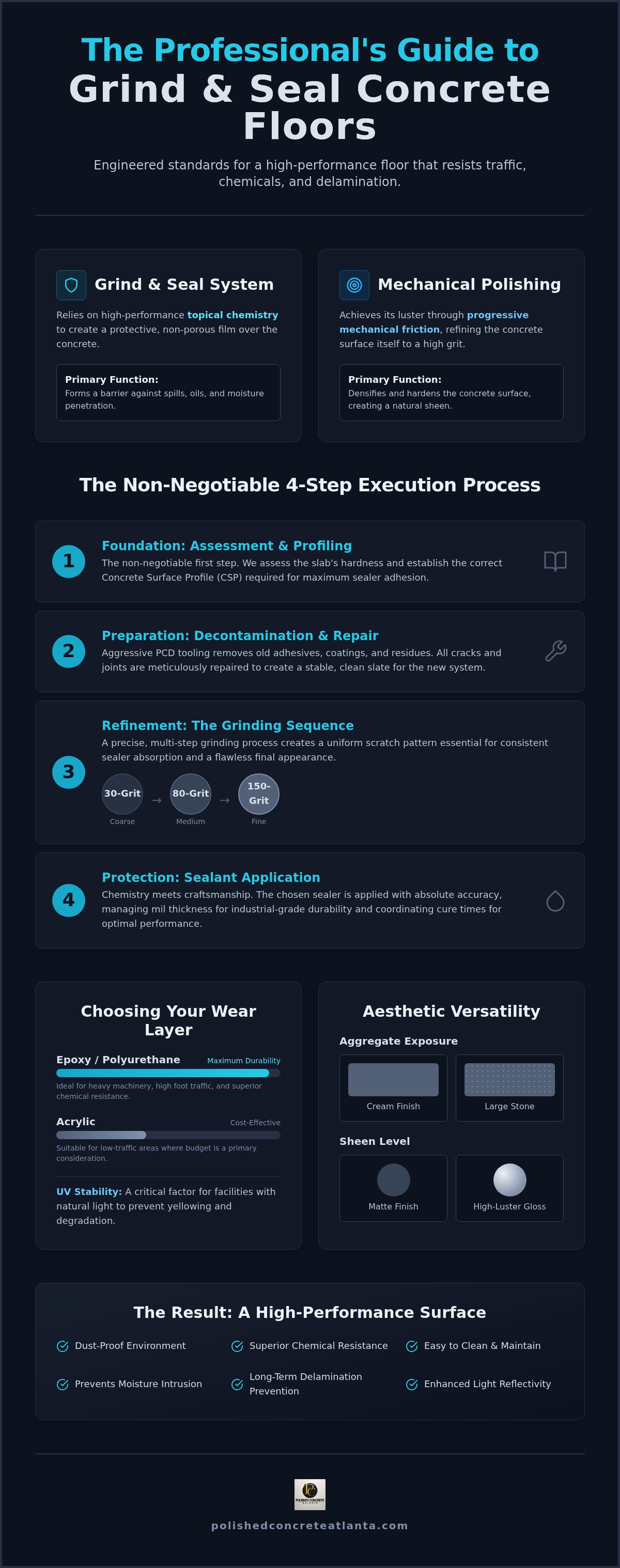
A grind and seal concrete floor is not a budget shortcut. It's a strategic, engineered system designed for high-traffic environments that require both aesthetic appeal and chemical resistance. This process involves mechanical grinding to open the concrete's surface, followed by the application of a high-performance topical sealant. While the Polished Concrete Process achieves luster through progressive friction and grit refinement, a sealed system relies on high-level chemistry to create a protective film. This film acts as a non-porous barrier, preventing oils, chemicals, and moisture from penetrating the slab. For facilities that prioritize spill protection and ease of maintenance, we specialize in sealed concrete that stands up to rigorous industrial standards.
The Mechanics of Topical Sealers
The choice of wear layer defines the floor's longevity. We don't use one-size-fits-all solutions. Choosing between acrylics, polyurethanes, and epoxies depends entirely on your facility's specific traffic patterns and chemical exposure. Acrylics provide a cost-effective option for low-traffic areas, but polyurethanes and epoxies offer the durability required for heavy machinery and constant foot traffic. These sealers penetrate the concrete pores to ensure maximum adhesion. Precision is non-negotiable here. In Atlanta facilities with significant natural light, UV stability is a critical factor. We select sealers that resist yellowing and degradation under intense sunlight, ensuring the floor's integrity remains intact for years. Reliability is the standard.
Aesthetic Versatility: Aggregates and Stains
Control is the hallmark of a professional grind and seal concrete floor. We allow you to customize the final appearance by controlling aggregate exposure. You can opt for a smooth cream finish that highlights the concrete's natural texture, or we can grind deeper to reveal large stone exposure for a more industrial, textured look. Adding decorative stains further elevates the professional aesthetic, allowing for branding or color-coding within a warehouse or showroom. Sheen levels are equally customizable. Whether your facility requires a subtle matte finish to hide scratches or a high-luster gloss to maximize light reflectivity, the result is a dust-proof surface that reflects the pride of high-end craftsmanship. We deliver tangible results without the fluff.
The Step-by-Step Professional Execution Process
The execution of a high-performance grind and seal concrete floor begins long before a sealer touches the slab. We prioritize the assessment of the Concrete Surface Profile (CSP) as the non-negotiable foundation of every project. Without the correct profile, even the most expensive sealer will eventually peel or delaminate. As seasoned concrete surface preparation contractors, we match our diamond tooling specifically to the slab's hardness and existing contamination levels. This isn't guesswork; it's engineering. We also utilize HEPA-filtered industrial vacuums to maintain a clean, dust-free environment throughout the process. Total containment. Zero compromise.
Surface Preparation and Glue Removal
Removing old adhesives, thin-set, and failed coatings is the first major hurdle. We utilize aggressive PCD tooling to strip away residues that would otherwise compromise the chemical bond. Every crack, divot, and joint must be stabilized and repaired before the final seal. Any remaining residue is a liability that leads to sealant delamination. If you're dealing with a failing slab, our specialized floor glue removal services ensure a clean slate for your new system.
The Grinding Sequence
Precision defines the grinding sequence. We transition from a coarse 30-grit metal bond to 80-grit and finally 150-grit refinements to achieve the desired clarity. This progression ensures a uniform scratch pattern, which is essential for consistent sealer absorption. A professional grind and seal concrete floor requires this meticulous preparation to prevent visual inconsistencies. We don't ignore the details. Hand-grinding the perimeters and edges ensures a seamless finish that matches the main field of the floor. Consistency is the goal.
Sealant Application and Curing
Application is where chemistry meets craftsmanship. We follow the standards outlined in the Concrete Floor Construction Guide to ensure industrial-grade durability. Whether using high-volume, low-pressure (HVLP) sprayers or microfiber pads, we manage mil thickness with absolute accuracy. This precision protects against industrial traffic and chemical spills. We also coordinate cure times strictly to minimize your facility's downtime. Efficient execution. Lasting performance.
Grind and Seal vs. Polished Concrete: The Professional Verdict
While mechanical polishing is often touted as the gold standard for aesthetics, it isn't the universal solution for every high-traffic facility. A grind and seal concrete floor offers a distinct advantage in environments where chemical resistance and spill protection are non-negotiable. Polished concrete relies on the slab's internal density, but sealed systems provide a sacrificial wear layer that physically blocks contaminants. This difference is critical for a 10-year Total Cost of Ownership (TCO). Facility managers looking for low maintenance commercial floors must weigh mechanical longevity against the superior chemical protection of topical sealants. Adhering to a professional Grind & Seal System Specification ensures the surface remains impermeable to oils and acids that would easily etch a standard polished floor.
Durability and Traffic Considerations
Forklifts don't forgive mistakes. While polished concrete is exceptionally hard, it remains porous at a microscopic level. In spill-prone industrial areas, sealers often outperform polishing because they create a total barrier. You must plan for a re-seal cycle every 3 to 5 years to maintain this integrity. It's a proactive maintenance strategy. This topical layer also provides excellent scratch resistance by absorbing the impact of heavy equipment before it reaches the underlying aggregate. We don't guess at durability; we engineer it. The result is a floor that handles the grind of daily operations without failing. Efficiency is the standard.
Cost-Effectiveness and ROI
The upfront savings of a sealed system are substantial. You don't always need the labor-intensive expense of 3000-grit mechanical polishing to achieve a high-end look. A professional grind and seal concrete floor provides comparable light reflectivity, which helps lower energy costs in large-scale warehouses and showrooms. Maintenance budgets become more predictable when you factor in routine deep cleaning instead of the specialized equipment needed for mechanical re-polishing. It's a pragmatic choice for the bottom line. If you're ready to optimize your facility's long-term ROI, our team provides expert commercial concrete floor assessments to determine the exact system your traffic patterns require. We deliver value through precision.
Strategic Implementation for Atlanta Commercial Environments
Atlanta’s climate presents a unique set of challenges that can compromise a grind and seal concrete floor if not addressed with technical precision. High humidity levels in Georgia often lead to "Sweating Slab Syndrome," where moisture accumulates on the surface and causes topical sealants to bubble or peel. We don't ignore these environmental variables. Every project we undertake follows the concrete sealer application Atlanta standard, ensuring that the chemistry of the sealant matches the atmospheric demands of the region. Local expertise isn't just a claim; it's a requirement for long-term slab integrity.
Moisture Mitigation and Slab Health
We begin every commercial project with rigorous Relative Humidity (RH) and Calcium Chloride testing. This isn't optional. If vapor emission rates exceed the sealant's tolerance, the result is catastrophic delamination. In these scenarios, we implement a professional concrete moisture barrier installation to lock out sub-slab moisture. This proactive approach eliminates the uncertainty that plagues amateur installations. We protect your investment by addressing the science of the slab first. Discipline matters.
Selecting the Right Industrial Sealant
Your industry dictates your floor's chemical profile. A food service facility requires different resistance levels than a heavy manufacturing plant. We match the sealer to your specific operational hazards, ensuring the wear layer remains resilient against acids, oils, or harsh cleaning agents. For occupied Atlanta offices, we prioritize VOC compliance to maintain air quality without sacrificing durability. Safety is also a primary concern. We integrate traction additives to ensure your floors meet slip-resistance standards, protecting both your staff and your liability. We deliver high-performance surfaces that don't compromise on safety, and for comprehensive facility care that includes exterior maintenance, you can visit Ehrman's Power Wash for professional power washing services.
Partnering with Atlanta’s Floor Experts
Cheap quotes are a red flag for poor surface preparation. When a contractor skips the essential grind stages or uses low-grade residential sealers, the floor will fail. Since 2004, Polished Concrete Atlanta has set the benchmark for commercial excellence through a no-nonsense commitment to quality. A successful grind and seal concrete floor is the result of meticulous attention to detail and decades of field experience. We aren't just looking for a quick finish; we are building a strategic alliance with your facility. Our process is methodical, transparent, and focused on tangible results. Don't settle for mediocrity. Contact us today for a professional site evaluation and secure a floor that reflects the elite standards of your business.
Secure Your Industrial Standard for 2026
Mastering your facility's flooring requires moving beyond surface-level aesthetics to embrace engineered durability. A professional grind and seal concrete floor isn't just about the final finish; it's about the discipline of the preparation. By prioritizing concrete surface profile (CSP) standards and aggressive moisture mitigation, you eliminate the fear of coating failure. You gain a dust-proof, resilient surface that handles the specific humidity challenges of the Atlanta climate. Discipline is the difference. Results are the priority.
Polished Concrete Atlanta has served the region since 2004. We are specialists in high-traffic commercial restoration and industrial-grade moisture mitigation. We don't guess at slab health. We test it. This commitment to technical excellence ensures your floor remains a high-performance asset rather than a maintenance liability. It's time to stop settling for confusing quotes and start investing in a proven system. Take the first step toward a worry-free industrial environment. Request an Expert Site Assessment from Polished Concrete Atlanta to verify your slab's suitability and establish your performance standards. Your facility deserves a floor that works as hard as you do.
Frequently Asked Questions
How long does a grind and seal concrete floor last in a commercial setting?
A professional grind and seal concrete floor typically delivers 3 to 5 years of peak performance before a re-seal is necessary. This timeline depends heavily on forklift volume and chemical exposure in your facility. Unlike mechanical polishing, the wear layer is sacrificial; it takes the abuse so your slab doesn't have to. Proactive maintenance and high-quality industrial sealants extend this window. We don't settle for average longevity. We engineer for maximum uptime.
Is a grind and seal floor the same as polished concrete?
No. They are fundamentally different systems. Polished concrete achieves its luster through mechanical friction and progressive grit refinement. In contrast, a sealed system relies on a high-performance topical coating to provide its shine and protection. Sealed systems often provide superior chemical resistance in spill-prone environments where polished slabs might etch or stain. It's about choosing the right tool for the environment. One is mechanical; the other is chemical.
Can you stain a grind and seal concrete floor?
Yes. We can integrate decorative stains during the grinding phase to achieve a specific professional aesthetic. This allows for branding or color-coding within commercial facilities without compromising the floor's integrity. The stain penetrates the opened pores of the concrete before we apply the final protective wear layer. It's a pragmatic way to combine high-end design with industrial-grade durability. We deliver the look you want with the performance you need.
Are grind and seal floors slippery when wet?
Any smooth surface can be slippery when wet, but we mitigate this through technical additives. We incorporate specialized traction media into the final sealant layer to ensure your facility meets safety compliance standards. This doesn't compromise the floor's easy-to-clean nature. It provides peace of mind for facility managers who prioritize both performance and worker safety. Reliability is non-negotiable. We ensure your floor is safe and functional.
How do you maintain a grind and seal floor in a warehouse?
Maintenance is straightforward but requires discipline. Use a neutral pH cleaner and an automatic scrubber with soft pads to remove debris that could abrade the sealer. Avoid harsh acidic or alkaline chemicals that can degrade the topical layer prematurely. Routine sweeping prevents the sandpaper effect of grit under heavy forklift traffic. A clean floor is a long-lasting floor. It's a simple process that protects your long-term investment. Efficiency is the standard.
What is the typical downtime for a professional grind and seal project?
Most commercial projects require 2 to 4 days of downtime, depending on the square footage and the specific sealant's cure time. We coordinate our execution to minimize impact on your operations. While the floor may be walk-on ready within 24 hours, heavy machinery typically requires a full 48 to 72-hour cure. We provide clear, definitive schedules so you can plan your facility's return to service with total confidence. We respect your timeline.


