
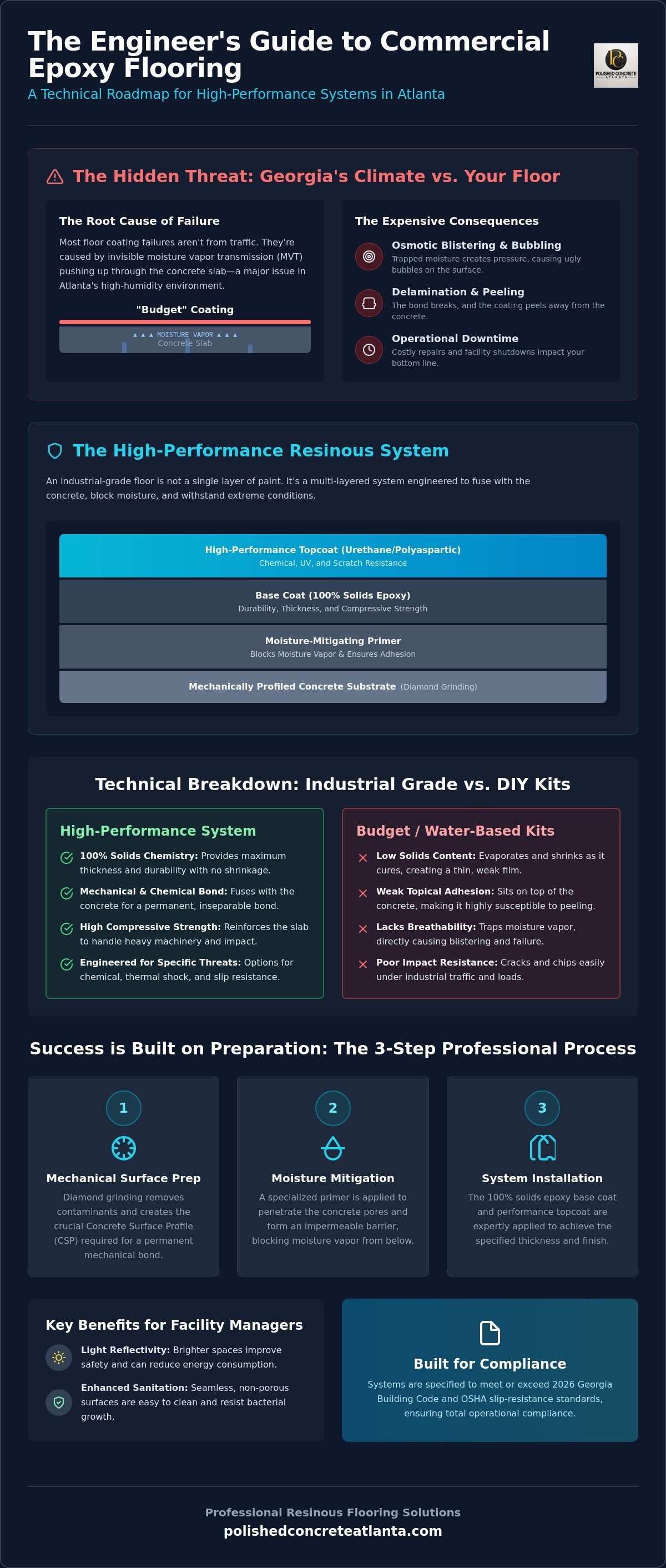
In Georgia’s climate, a floor coating is either a precision engineering project or a ticking time bomb. Most industrial failures don't stem from heavy forklift traffic or chemical spills. They happen because of invisible moisture vapor trapped beneath the surface. If you are sourcing commercial epoxy flooring Atlanta facilities require for 2026, you cannot afford to treat this as a simple cosmetic upgrade. It's a critical infrastructure investment that demands technical rigor. Success is found in the preparation, not just the topcoat.
You've likely seen the consequences of "budget" installations: bubbling, delamination, and the massive operational downtime that follows. It's a waste of capital. This guide provides the definitive roadmap to securing a high-performance system that survives the local environment. You'll learn how to navigate the 2024 International Building Code requirements and specify a surface engineered for Georgia's unique humidity profiles.
We'll break down the essential metrics for substrate preparation, moisture mitigation, and 2026 compliance standards. From understanding mandatory slip resistance to mastering the total cost of ownership, you'll gain the clarity needed to manage a professional, predictable installation. Let's eliminate the guesswork and build a floor that lasts.
Key Takeaways
- Identify the critical role of moisture mitigation in preventing osmotic blistering within Atlanta’s high-humidity environments.
- Navigate the technical specifications of commercial epoxy flooring Atlanta projects, focusing on 100% solids chemistry and high-performance topcoats.
- Align your facility with the 2026 Georgia Building Code and OSHA slip-resistance standards to ensure total operational compliance.
- Evaluate the necessity of mechanical concrete grinding and surface profiling to secure a permanent bond and eliminate coating failure.
- Apply a strategic selection framework to choose a resinous system that balances extreme durability with your specific aesthetic and maintenance goals.
Evaluating Commercial Epoxy Flooring for Atlanta’s Industrial Demands
High-performance commercial epoxy flooring Atlanta facilities require is not a simple topcoat. It is a sophisticated, multi-layered resinous system engineered to fuse with the concrete substrate. This isn't a cosmetic upgrade. It's a structural necessity. By understanding the chemical properties of epoxy resins, we design surfaces that resist extreme mechanical loads and aggressive chemical exposure. In 2026, the standard for Georgia industrial facilities has shifted decisively toward sustainability and strict VOC compliance. We don't just coat a floor; we install a functional industrial asset designed to last for decades.
Atlanta’s climate adds a layer of complexity that standard contractors often overlook. High humidity and fluctuating temperatures create a volatile environment for resinous coatings. Without technical precision, these environmental factors lead to premature failure. We treat every project as a unique engineering challenge, ensuring the system is optimized for the specific operational demands of your facility. It's about moving beyond "aesthetic" finishes to high-performance infrastructure that supports your bottom line.
Why Industrial Grade Matters in the Southeast
The Georgia climate presents specific challenges, most notably "Sweating Slab Syndrome." In many Atlanta warehouses, moisture vapor transmission through the concrete slab creates a layer of condensation that can destroy a weak bond. DIY kits and residential-grade products lack the solids content and breathability to survive these osmotic pressures. They peel. They bubble. They fail. A professional-grade resinous system achieves a mechanical and chemical bond that effectively makes the coating an inseparable extension of the concrete slab itself. We eliminate the uncertainty of delamination by using industrial-grade materials engineered for high-traffic environments.
Key Benefits for Facility Managers
Facility managers don't need flowery descriptions; they need tangible results. High-performance systems deliver operational efficiency through several key avenues:
- Light Reflectivity: Increased brightness improves safety and reduces energy consumption in large-scale facilities.
- Sanitation: Seamless, non-porous surfaces prevent bacterial growth and simplify rigorous cleaning protocols.
- Safety Standards: We integrate slip-resistance and safety markings directly into the floor design to meet 2026 OSHA requirements.
The long-term ROI is undeniable. When you compare the lifecycle cost of a high-performance epoxy system to the constant maintenance and frequent resealing of bare concrete, the resinous option is the superior investment. It provides peace of mind. It ensures compliance. It works.
Technical Specifications: Engineering Durability and Chemical Resistance
Specifying the right commercial epoxy flooring Atlanta systems requires a deep dive into technical data, not just a glance at a color chart. Superior durability starts with the chemistry of 100% solids epoxy. Unlike water-based alternatives that evaporate and shrink, 100% solids systems provide the density and thickness required for heavy industrial use. We often pair these with polyaspartic or urethane topcoats to achieve specific performance goals. Referencing NIST technical standards for resinous flooring ensures that every installation meets the rigorous benchmarks for adhesion and wear resistance that modern facilities demand.
Heavy manufacturing environments don't just need a "clean" floor; they need high compressive strength. Concrete alone can fail under intense point loads from heavy machinery or pallet jacks. A properly engineered resinous system reinforces the slab, distributing weight and providing the impact resistance necessary to prevent cracking. If your facility handles industrial solvents or aggressive cleaners, chemical resistant floor coatings are your primary line of defense. They prevent hazardous materials from penetrating the porous concrete, protecting your structural foundation from long-term degradation.
In food processing and cold storage, thermal shock resistance is the deciding factor between success and failure. Rapid temperature shifts during steam cleaning or hot-water washdowns can cause standard coatings to snap and delaminate. We engineer systems that expand and contract in harmony with the concrete substrate. It's about building a floor that survives the most brutal operational cycles without compromising integrity. If you're unsure which resin matches your specific chemical profile, you can consult with our technical team for a detailed substrate analysis.
High-Performance Coating Systems for 2026
Operational efficiency is a 2026 priority, which is why we've moved toward rapid-cure systems to minimize facility downtime. The installation is a methodical layering process: a moisture-mitigating primer, a high-build 100% solids base coat, optional broadcast media for texture, and a high-performance topcoat. This stacked approach creates a monolithic barrier that's far stronger than any single-layer paint. For a comprehensive look at these technical requirements, read our Definitive Guide to Industrial Floor Coatings Atlanta.
Aesthetics Meets Utility: Flake, Quartz, and Metallic Systems
High utility doesn't have to look industrial. Decorative flake systems are the standard for retail and high-traffic hallways, offering a balance of durability and visual appeal. For environments where safety is the top priority, quartz-reinforced floors provide extreme slip resistance and enhanced impact strength. While aesthetics matter in public-facing zones, heavy duty industrial flooring remains the uncompromising solution for back-of-house operations where performance is the only metric that counts.
The Selection Framework: Choosing the Right System for Your Facility
Selecting a flooring system is a strategic decision, not a design preference. A floor is a tool. You must use the right one for your specific operational environment. For many facilities, commercial epoxy flooring Atlanta businesses rely on serves as the backbone of their infrastructure, but the specific formulation must match the site's traffic, chemical exposure, and safety requirements. You shouldn't settle for a one-size-fits-all solution when your facility's productivity is on the line.
There is often a direct tradeoff between aesthetic appeal and technical performance. While a high-gloss metallic finish creates an immediate visual impact in a luxury showroom, it lacks the compressive strength required for a heavy manufacturing facility where industrial solvents are a daily reality. In low-traffic areas or back-of-house storage where high-build resin isn't necessary, a "Grind and Seal" approach using high-quality sealed concrete may be a more pragmatic, cost-effective alternative. Identifying these distinctions early prevents over-engineering low-impact zones and under-engineering mission-critical ones.
Mapping Floor Systems to Operational Use
Different environments demand different resinous chemistries. We categorize needs into three primary buckets:
- Warehouse and Distribution: These spaces require high-gloss, abrasion-resistant solid colors that maximize light reflectivity and withstand constant forklift traffic.
- Showrooms and Retail: Branding takes priority here. Utilizing stained concrete floors Atlanta designers prefer or metallic epoxy systems allows for a high-end look without sacrificing the ease of maintenance.
- Manufacturing and Food Processing: These facilities must prioritize chemical resistant floor coatings and aggressive safety textures to prevent slip-and-fall accidents in wet environments.
Total Cost of Ownership vs. Initial Bid
A lower bid is often a red flag. It typically indicates a lack of proper surface preparation or the use of thinned-out resins. When you factor in maintenance costs over a 10-year period, a premium installation that includes rigorous moisture mitigation and mechanical grinding is always the more economical choice. The true cost of a cheap floor is the delamination that occurs 18 months later, forcing a total facility shutdown for repairs. Don't risk your operational uptime on a "budget" contractor who cuts corners on the substrate. If you're ready to secure a floor engineered for long-term ROI, request a professional site consultation to review your facility's specific technical requirements.
When evaluating industrial flooring contractors in Atlanta, use this checklist to ensure they meet professional standards:
- Do they perform in-situ RH moisture testing before installation?
- Do they specify a Concrete Surface Profile (CSP) of 3 or higher?
- Can they provide a detailed project management plan for minimizing downtime?
- Are they using 100% solids industrial-grade resins?
The Engineering of Adhesion: Why Professional Installation Wins
The integrity of any commercial epoxy flooring Atlanta installation hinges on one factor: the mechanical bond. Without a properly profiled substrate, the most expensive resin in the world is just a temporary film. We achieve this bond through rigorous concrete grinding to reach a Concrete Surface Profile (CSP) of 3 to 5. This process removes the weak top layer of "laitance" and opens the pores of the slab, allowing the resin to penetrate deep into the concrete structure. It's a permanent fusion, not a surface-level attachment.
Renovations present additional hurdles that standard contractors often ignore. Existing residues from previous floor coverings act as bond breakers that guarantee future failure. Professional floor glue removal is a mandatory step in our process. We use heavy-duty planetary grinders to strip away old adhesives and contaminants, ensuring a clean, virgin surface for the new coating system. We don't cut corners on preparation because we don't accept mediocrity in the final product.
Moisture Mitigation and Slab Stabilization
Moisture vapor transmission (MVT) is the silent killer of industrial floors, accounting for nearly 90% of coating failures in the Southeast. In Atlanta’s humid climate, concrete slabs often act like sponges. If moisture isn't addressed, it builds osmotic pressure that results in blistering and total delamination. As leading concrete surface preparation contractors, we prioritize slab stabilization before the first drop of resin is mixed.
We utilize advanced testing methods to eliminate uncertainty. While some still rely on outdated Calcium Chloride tests, we favor in-situ RH probes to get a precise reading of the slab's internal humidity levels. If the data shows elevated moisture, we install a dedicated moisture mitigation barrier. This specialized layer suppresses vapor pressure and protects your investment from the ground up. It's about engineering out the risk of failure.
The Polished Concrete Atlanta Execution Standard
Our execution standard is rooted in technical data and a "no-nonsense" pragmatism. We adhere strictly to every manufacturer’s Technical Data Sheet (TDS), ensuring that mixing ratios, ambient temperatures, and cure times are managed with surgical precision. This disciplined approach eliminates the variables that lead to premature wear. We don't just provide a service; we act as a strategic partner for complex facility turnarounds where timing and durability are non-negotiable. If you need a floor that performs as hard as your team does, schedule a technical consultation for your Atlanta facility today. Let's build a foundation that lasts.
Future-Proof Your Facility with Industrial-Grade Infrastructure
A high-performance floor is the most critical tool in your operational arsenal. Success in 2026 requires moving beyond simple aesthetics to embrace rigorous engineering standards. You now understand that moisture mitigation isn't optional in Georgia; it's the baseline for survival. By prioritizing CSP-compliant surface preparation and selecting a resinous system tailored to your specific chemical and mechanical loads, you eliminate the volatility of future failure. It's about securing a maintenance-free surface that supports your bottom line for a decade or more.
Your choice of commercial epoxy flooring Atlanta partner will dictate the lifecycle of your facility. Don't settle for contractors who bypass technical data sheets or ignore the science of adhesion. Our seasoned consultants specialize in complex industrial and commercial projects, utilizing specialized moisture mitigation protocols to stabilize even the most problematic slabs. We bring the gravitas of industry leaders to every project, ensuring your installation is predictable, professional, and uncompromising in quality.
Ready to transform your space? Secure Your Facility's Foundation with Atlanta's Industrial Flooring Experts. Your facility deserves a floor that is as disciplined and high-achieving as your business itself.
Frequently Asked Questions
How long does a commercial epoxy floor last in a high-traffic Atlanta warehouse?
A professionally installed industrial system typically lasts 10 to 15 years in a high-traffic Atlanta warehouse. This lifespan depends on the specific resin chemistry and your adherence to routine maintenance protocols. We specify high-build systems that resist the abrasive force of constant forklift traffic and heavy point loads. If the substrate is properly prepared, the bond will often outlast the operational lifecycle of the facility itself.
What is the difference between shop-grade epoxy and industrial-grade resinous systems?
The primary difference lies in the volume of solids and the integrity of the chemical bond. Shop-grade kits are often water-based or solvent-thinned, leaving a thin, brittle film that peels under mechanical pressure. Industrial-grade resinous systems use 100% solids chemistry to create a thick, monolithic barrier. This system is chemically fused to the concrete substrate. It is the difference between a temporary paint job and a permanent structural upgrade.
Do I need moisture mitigation for my slab before applying epoxy coatings?
Moisture mitigation is mandatory for most Georgia facilities due to high vapor transmission rates in the local soil. Without a dedicated barrier, moisture trapped beneath the coating causes osmotic blistering and total delamination. We perform in-situ RH testing to determine the exact vapor pressure before specifying your commercial epoxy flooring Atlanta system. This technical step eliminates the uncertainty of floor failure in our humid climate.
How much downtime should I expect during a commercial epoxy installation?
Most installations require a window of 3 to 5 days for preparation, application, and a full chemical cure. While some systems allow for foot traffic within 24 hours, heavy machinery requires more time to prevent surface indentations. We utilize rapid-cure polyaspartic topcoats when possible to minimize this operational pause. Our goal is to get your facility back to full capacity without compromising the integrity of the cure.
Can epoxy flooring be applied over existing tile or old coatings?
We do not recommend applying new epoxy over existing tile or failing coatings. These layers represent a weak point that compromises the entire system. Our process involves professional floor glue removal and mechanical grinding to reach the bare concrete slab. This ensures the new resin fuses directly with the virgin concrete. It is the only way to guarantee a bond that won't peel or flake over time.
Is epoxy flooring slippery when wet, and how can that be prevented?
Smooth epoxy is slippery when wet, but we prevent this by integrating slip-resistant aggregates like quartz or aluminum oxide into the topcoat. We adjust the aggregate load based on your specific safety requirements and 2026 OSHA standards. This ensures your commercial epoxy flooring Atlanta project provides a safe, high-traction surface. You get the benefits of a seamless floor without the liability of a slip-and-fall hazard.


