
A floor failure isn't just a maintenance headache. It's a leadership failure. Most facility managers view their floors as a static surface, yet true longevity is a dynamic, engineered result of what happens beneath the finish. If you're currently battling peeling coatings or moisture-related bubbles in Georgia's humid climate, you know that traditional quick fixes are a waste of capital. Achieving durable concrete flooring for commercial buildings requires a shift from cosmetic thinking to structural strategy. It's about precision. It's about preparation. It's about refusing to settle for mediocrity.
We understand the frustration of constant repairs and the high maintenance costs that eat away at your budget. You deserve a floor with a 20 plus year lifespan that reflects the quality of your brand without the threat of constant downtime. This guide promises to reveal how true durability is engineered through meticulous substrate preparation and professional material selection. We'll provide a comprehensive look at moisture mitigation, 2026 market trends, and the ASTM E1155 standards required to turn your facility floor into a high-performance asset that lasts for decades.
Key Takeaways
- Learn why durable concrete flooring for commercial buildings is an engineered result of bond integrity and abrasion resistance rather than just a surface-level product choice.
- Discover how to select between high-luster polished concrete and seamless epoxy systems based on your facility's specific chemical exposure and foot traffic requirements.
- Understand the critical role of moisture mitigation and Sweating Slab Syndrome remediation in maintaining floor stability within Georgia's unique humid environment.
- Identify why professional floor preparation, including strategic glue removal and mechanical grinding, is the non-negotiable first step for achieving a 20-year floor life.
Defining True Durability in Commercial Flooring
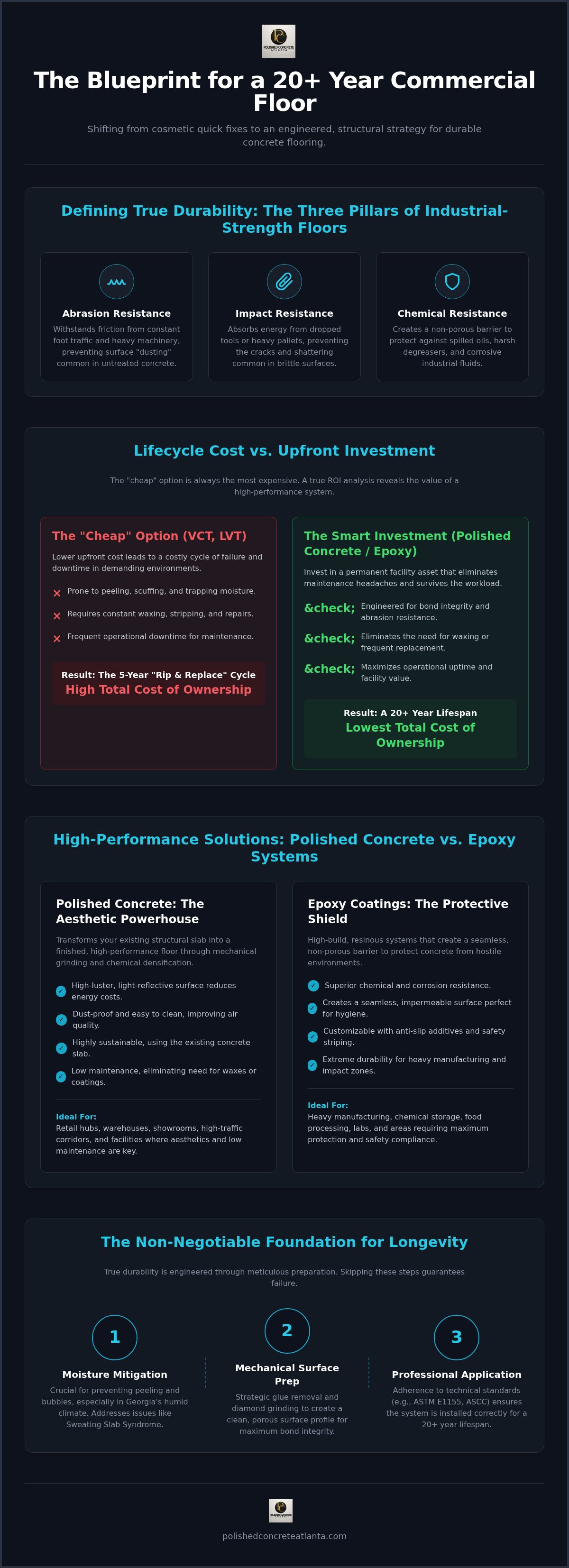
Durability isn't a marketing buzzword; it's a rigorous technical specification. For facility managers, commercial durability is the ability to withstand mechanical and chemical stress without structural failure. Don't be fooled by labels. A "commercial-grade" sticker doesn't mean the floor can handle 24/7 forklift traffic or the shearing force of pallet jacks. True durable concrete flooring for commercial buildings is an engineered outcome. It's the calculated intersection of abrasion resistance, impact strength, and bond integrity. If one of these pillars fails, the entire system is compromised.
The Three Pillars of Industrial-Strength Floors
Industrial environments are daily battlefields for your facility's foundation. To survive, a floor must excel in three distinct areas:
- Abrasion Resistance: This is about friction. Constant foot traffic and heavy machinery grind down surfaces. High-performance systems prevent the "dusting" common in untreated slabs.
- Impact Resistance: Dropped tools or heavy pallets shatter brittle surfaces. You need a floor that absorbs energy rather than cracking under pressure.
- Chemical Resistance: Spilled oils, harsh degreasers, and industrial fluids can eat through a standard sealer in hours. A professional system creates a non-porous barrier.
For a deep dive into the mechanical process behind these attributes, this polished concrete overview provides a solid foundation on how grinding transforms raw slabs into high-performance assets.
Lifecycle Cost vs. Upfront Investment
The "cheap" option is always the most expensive in the long run. Facility managers often fall into the trap of lower upfront costs, only to face a "rip and replace" cycle every five years. Materials like VCT or LVT might look good on day one, but they aren't designed for the rigors of heavy-duty industrial use. They peel, scuff, and trap moisture, leading to frequent failures and operational downtime.
Polished concrete and epoxy flooring offer the lowest Total Cost of Ownership (TCO) because they eliminate the need for constant waxing, stripping, and replacement. Over a 10 or 20-year ROI analysis, these systems outperform every alternative. You aren't just buying a floor; you're investing in a permanent facility asset that eliminates maintenance headaches. It's about choosing durable concrete flooring for commercial buildings that actually survives the workload without bleeding your budget dry. Stop paying for repairs and start investing in performance.
The Heavy Hitters: Polished Concrete and Epoxy Systems
Choosing between polished concrete and epoxy isn't about preference; it's about environmental demand. For massive commercial footprints, polished concrete floors Atlanta provide a sustainable, high-luster solution that utilizes your existing slab. The process involves rigorous mechanical grinding and chemical densification, transforming a porous surface into a dust-proof, light-reflective asset. This isn't just a surface treatment. It follows ASCC's polished concrete technical standards to ensure the final product meets specific gloss and clarity requirements. It’s the ultimate choice for durable concrete flooring for commercial buildings where low maintenance and high aesthetic value are required.
Polished Concrete: The Aesthetic Powerhouse
Polished concrete turns a structural slab into a finished floor. By grinding the concrete with progressively finer diamond-bonded abrasives, we close the surface pores and increase density. This results in a floor that won't "dust" or trap allergens. It's an ideal choice for retail hubs and high-traffic corridors. The high reflectivity can also reduce your energy costs by enhancing natural and artificial lighting. Because it uses the existing concrete, it's the most sustainable option available, eliminating the need for additional flooring materials that eventually end up in a landfill.
Epoxy and Industrial Coatings: The Protective Shield
When the environment is hostile, epoxy and industrial coatings take the lead. These high-build systems are engineered for heavy manufacturing, chemical storage, and food processing facilities. Unlike polished surfaces, epoxy creates a seamless, non-porous barrier that protects the concrete from corrosive agents. You can customize these systems with anti-slip additives and high-visibility safety striping to meet workplace safety standards. For technical specifications on resinous systems, consult our industrial floor coatings Atlanta guide. If you need a floor that can be hosed down with aggressive cleaners without losing its bond, epoxy is your answer.
The maintenance profiles differ significantly. Polished concrete is essentially dust-proof and requires simple microfiber mopping. Epoxy is scrubbable and resistant to standing liquids. Which system wins? If you're managing a retail showroom, polished concrete is the aesthetic powerhouse. If you're running a chemical plant, the epoxy shield is non-negotiable. Both represent the gold standard for durable concrete flooring for commercial buildings. If you're unsure which path fits your specific facility needs, you can consult with our project managers to evaluate your slab's condition and performance requirements.
Engineering the Selection: Matching Floors to Atlanta Industries
Atlanta's industrial landscape demands precision. Generic solutions fail here because they ignore regional variables like humidity and specific operational stresses. Selecting durable concrete flooring for commercial buildings means matching the material to the machine. A warehouse floor faces different physics than a retail showroom or a film soundstage. We don't believe in one-size-fits-all applications; we believe in engineered results that align with your specific industry requirements.
The Logistics Standard: Warehouse Durability
When planning a transition to a new facility or upgrading an existing industrial space, it is also a great time to explore Professional Moving and Relocation Services to ensure your valuable equipment is handled by experts during the move.
Warehousing is the backbone of the Georgia economy. E-commerce distribution hubs require floors that support high-speed forklift traffic without degrading or "dusting." In our region, "Sweating Slab Syndrome" is a constant threat. This occurs when warm, humid air hits a cool concrete slab, creating a dangerous moisture film that compromises safety and bond integrity. We remediate these issues through strategic moisture mitigation and mechanical densification. For existing structures, professional sealed concrete treatments are essential to eliminate the concrete dust that compromises air quality and inventory integrity. Properly filled joints and slab leveling are also critical to prevent expensive forklift tire wear.
High-Traffic Retail and Commercial Hubs
Aesthetics shouldn't come at the cost of strength. High-traffic retail hubs often make the mistake of installing tile or LVT, only to face grout failures and peeling within 3 to 5 years. Stained concrete floors Atlanta designers specify allow for deep, permanent color that won't scuff or peel under heavy foot traffic. These systems offer high-gloss light reflectivity, which significantly lowers energy costs in large commercial spaces. It’s a professional aesthetic that reflects brand quality while maintaining the core strength of the slab. You eliminate the trip hazards and maintenance costs associated with traditional flooring materials.
Manufacturing and automotive facilities prioritize chemical resistance and heavy load capacity. These floors must withstand oils and heavy machinery without cracking or delaminating. Similarly, the surging Atlanta film and studio sector requires specialized "Superflat" floors. Production crews need perfectly level, light-reflective surfaces for smooth camera dollies and consistent lighting. Whether it's a soundstage or a heavy manufacturing plant, the requirement remains the same: a floor that performs under pressure. If your facility is currently struggling with moisture issues or surface degradation, contact our team for a professional slab evaluation to determine the right system for your industry.
The Foundation of Longevity: Preparation and Execution
Ninety percent of commercial flooring failures are caused by improper surface preparation. This isn't an industry myth; it's a technical reality that facility managers ignore at their own peril. Achieving durable concrete flooring for commercial buildings requires a disciplined, multi-step execution that prioritizes the bond between the slab and the finish. If the foundation is flawed, the most expensive topcoat in the world will eventually delaminate. We follow a rigorous four-step protocol designed to eliminate uncertainty and ensure structural integrity.
- Step 1: Adhesive Remediation. We begin with strategic floor glue removal. Old mastic and adhesive residues are contaminants that prevent new systems from bonding correctly.
- Step 2: Mechanical Grinding. We utilize heavy-duty grinders to achieve the specific Concrete Surface Profile (CSP) required for your system. This creates the "tooth" necessary for mechanical adhesion.
- Step 3: Moisture Mitigation. We address the internal vapor pressure of the slab to prevent osmotic blistering.
- Step 4: Precision Application. Only after the slab is profiled and dry do we apply industrial densifiers or high-build resinous coatings.
Moisture Mitigation: The Georgia Essential
Georgia's climate is notoriously unforgiving for concrete slabs. High Moisture Vapor Emission Rates (MVER) are a "Georgia essential" consideration because local humidity levels often lead to trapped moisture within the concrete. Without intervention, this vapor pressure causes catastrophic coating failure. Professional moisture mitigation concrete floors rely on in-situ RH probes, which are the professional standard for measuring relative humidity deep within the slab. We don't guess; we test. This data-driven approach is the only way to prevent osmotic blistering and ensure your floor remains a permanent asset.
The Professional Advantage
Engineering always takes priority over aesthetics. Seasoned industrial flooring contractors Atlanta facilities trust understand that a "no-nonsense" handover starts with dust-contained grinding. This technology is critical for occupied or sensitive facilities where air quality cannot be compromised. We manage the entire project lifecycle with a blue-collar work ethic and elite technical skill. The final inspection isn't a formality; it's a verification that the floor meets our uncompromising standards for durability and performance. You aren't just getting a new surface; you're getting a floor engineered to survive the next two decades of industrial stress.
Secure the Future of Your Facility Floor
Durability isn't a passive quality; it's an engineered result. By now, it's clear that achieving durable concrete flooring for commercial buildings requires moving beyond superficial fixes and embracing rigorous substrate preparation. Whether you're managing a high-speed logistics hub or a high-end retail showroom, the integrity of your slab depends on professional moisture mitigation and mechanical profiling. You've seen how the "rip and replace" cycle of traditional flooring drains capital and creates unnecessary downtime. It's time to invest in a permanent asset that reflects the quality of your brand.
Since 2004, we've specialized in high-performance industrial surfaces. We are Atlanta's local experts in moisture mitigation and no-nonsense, results-driven execution. Don't leave your facility's foundation to chance or settle for contractors who skip the critical prep work. You can Request a Professional Consultation for Your Atlanta Facility today to ensure your next flooring project is your last. Let's build a floor that stands the test of time and heavy industry.
Frequently Asked Questions
What is the most durable flooring for a warehouse with heavy forklift traffic?
Heavy-duty polished concrete is the gold standard for high-traffic warehouse environments. It withstands the extreme shearing force of forklift tires without peeling or delaminating like traditional topical coatings. Unlike thin-film sealers that wear down, a densified polished slab becomes harder over time. If your facility handles corrosive chemicals, a high-build epoxy system is the superior choice to protect the structural slab from deep-seated damage and surface erosion.
How long does a professional polished concrete floor last in a commercial setting?
A professionally installed polished concrete floor can easily last 20 years or more in a commercial setting. This longevity depends entirely on the initial mechanical grinding and chemical densification process. Because the finish is part of the concrete itself, there is no topical layer to fail. It eliminates the expensive "rip and replace" cycles common with vinyl or tile, making it a permanent, high-performance asset for your facility.
Can epoxy flooring be installed over an old, damaged concrete slab?
Professional epoxy flooring is specifically designed to remediate and protect older slabs. We use mechanical concrete floor grinding to remove contaminants and open the pores of the concrete. Once we repair structural cracks and level the surface, the epoxy creates a high-strength bond that actually reinforces the damaged slab. It transforms a liability into a seamless, non-porous surface that meets modern industrial standards and safety requirements.
Why is moisture mitigation necessary for commercial floors in Atlanta?
Atlanta’s high humidity creates significant vapor pressure within concrete slabs, leading to osmotic blistering and coating failure. Moisture mitigation is a "Georgia essential" because it blocks this vapor from reaching the surface. Without proper moisture remediation and RH testing, even the best materials will eventually delaminate. It is the only way to ensure durable concrete flooring for commercial buildings remains bonded and stable in our unique local climate.
Is polished concrete or epoxy more cost-effective over a 10-year period?
Polished concrete is generally the most cost-effective solution over a 10-year period due to its minimal maintenance requirements. You don't have to worry about the recurring costs of stripping, waxing, or re-coating. However, in manufacturing zones exposed to harsh acids or oils, epoxy is more cost-effective because it prevents expensive structural slab repairs. Both systems offer a significantly higher ROI compared to traditional materials like VCT or laminate. To ensure these floors stay in top condition, you can learn more about the professional cleaning services offered by ProScrub Cleaning Solutions.
We utilize mechanical floor glue removal to strip old adhesives and reach the clean, virgin concrete underneath. Chemical strippers often leave residues that compromise the bond of your new system. By using diamond-bonded abrasives, we ensure the slab is perfectly profiled and ready for a professional finish. This step is non-negotiable if you want to avoid the bond failures that plague amateur installations and achieve durable concrete flooring for commercial buildings.


