
A beautiful topcoat is worthless if the concrete beneath it is exhaling moisture that will inevitably blow the floor apart. It is a harsh reality for facility managers who trust the wrong epoxy floor coating contractors Atlanta and prioritize aesthetics over rigorous substrate engineering. You already know that your floor is the literal foundation of your operations. It must endure punishing forklift traffic, chemical exposure, and the relentless humidity of the South without peeling or bubbling. Settling for a subpar installation isn't just a mistake. It is a liability that leads to expensive operational downtime and wasted capital.
This guide provides the technical roadmap you need to secure a high-performance system that lasts ten years or more. We'll show you how to eliminate the uncertainty of moisture-related failures and residual glue issues through precision prep. We will examine the critical 2026 Georgia building code updates, the necessity of mechanical floor grinding, and the moisture testing protocols required for a permanent bond. This is about more than just a high-luster finish. It is about engineering a surface that performs as hard as your team does every single day.
Key Takeaways
- Understand the engineering distinction between high-performance resinous systems and standard floor paint to ensure long-term industrial durability.
- Learn to match specific resin formulations, such as 100% solids epoxy, to the unique operational stressors and chemical exposures of your facility.
- Master the technical requirements of surface preparation, including why mechanical grinding is the only reliable method for achieving a permanent bond.
- Evaluate epoxy floor coating contractors Atlanta by scrutinizing their moisture mitigation strategies and equipment standards rather than just their installation speed.
- Navigate the 2026 Georgia building code updates to ensure your flooring project remains compliant with the latest fire and safety regulations.
Performance Standards for Commercial Epoxy Flooring
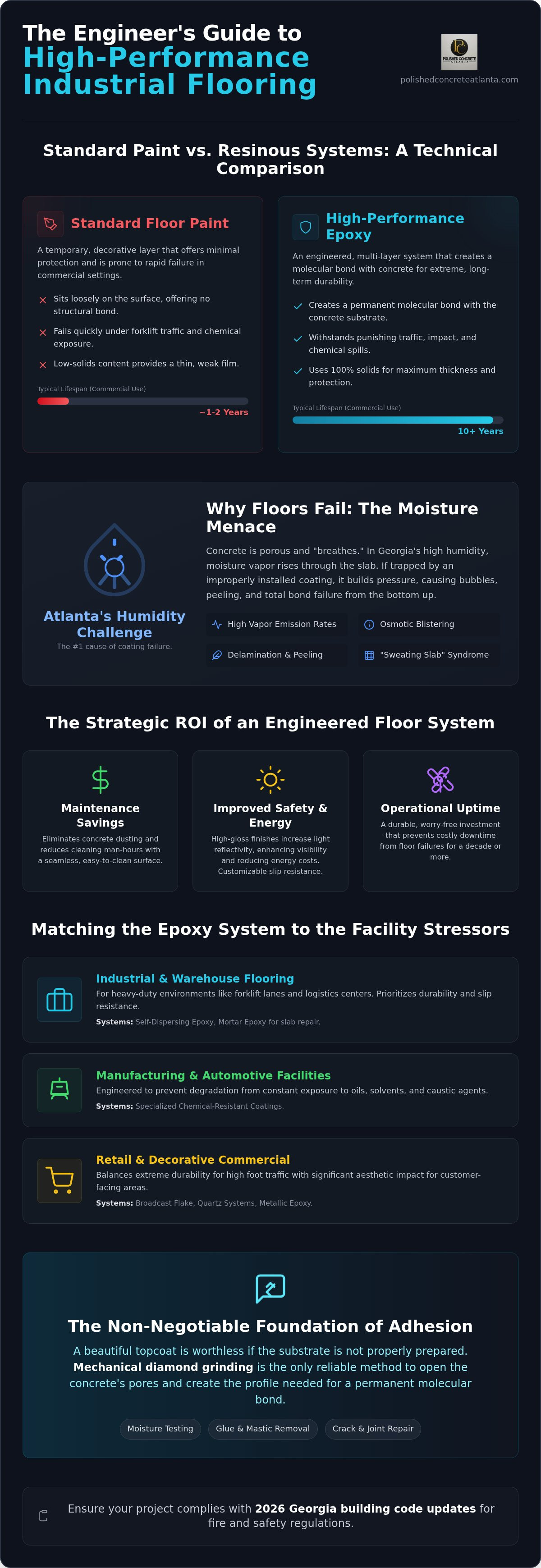
Commercial epoxy is not a decorative afterthought. It is a high-performance resinous flooring system designed to withstand the brutal realities of industrial use. Many property owners confuse these systems with simple floor paint, but the technical gap is vast. While paint sits loosely on the surface, professional-grade epoxy resins create a molecular bond with the concrete substrate. Resinous flooring is an engineered multi-layer system for industrial protection. It provides critical impact, chemical, and abrasion resistance that standard coatings cannot match. When vetting epoxy floor coating contractors Atlanta, facility managers must prioritize partners who understand that substrate integrity is the non-negotiable foundation of coating longevity.
Why Adhesion Fails in Georgia Facilities
Atlanta’s high humidity creates a unique set of challenges for industrial floors. Concrete is porous; it breathes. High relative humidity often leads to elevated concrete vapor emission rates, which can delaminate a floor from the bottom up. This is particularly dangerous in unconditioned warehouse or manufacturing spaces prone to Sweating Slab Syndrome. Without professional intervention, moisture trapped beneath the coating will cause osmotic blistering and total bond failure. Partnering with expert concrete surface preparation contractors is the mandatory first step to prevent these avoidable disasters.
The ROI of High-Performance Industrial Coatings
Investing in high-performance coatings is a strategic financial decision. Low-solids "garage" kits might look appealing on a balance sheet today, but they fail rapidly under heavy commercial traffic. True industrial systems utilize 100% solids formulations that offer superior longevity. You'll see immediate maintenance savings by eliminating concrete dusting and reducing cleaning man-hours. Beyond durability, these systems improve safety standards by increasing light reflectivity in dark zones and providing customizable slip resistance. High-end craftsmanship isn't just about looks. It's about a worry-free investment that yields tangible results for over a decade. Experienced epoxy floor coating contractors Atlanta will always focus on these performance metrics over mere aesthetics.
Selecting the Right Epoxy System for Your Atlanta Facility
Success starts with a technical audit of your facility's operational stressors. You don't just need a floor; you need a system engineered for your specific traffic patterns and chemical exposures. Elite epoxy floor coating contractors Atlanta will always insist on 100% solids epoxy for high-traffic industrial zones. Why? Because it provides the compressive strength required to handle heavy machinery without fracturing. This isn't a "one size fits all" commodity. It's a strategic investment in your infrastructure.
Light reflectivity is a frequently overlooked benefit that impacts both your bottom line and employee safety. High-gloss, high-performance systems can significantly reduce energy costs by maximizing your existing lighting. They also enhance visibility, which is critical for compliance with OSHA Regulation 1910.22 regarding clean and safe walking-working surfaces. Working with a creative consultant who understands these granular details ensures you get a result that serves your operations. You need a strategic partner, not just a crew with a roller.
Industrial and Warehouse Flooring Systems
Retail and Decorative Commercial Finishes
High-end environments demand a balance of durability and aesthetic impact. Broadcast flake and quartz systems are the workhorses of the retail sector, offering immense durability for high-foot-traffic areas. For Atlanta office lobbies or luxury showrooms, metallic epoxy provides a high-luster, three-dimensional depth that projects prestige. If you require a different look altogether, consider stained concrete floors Atlanta as a high-performance alternative. Achieving this level of craftsmanship requires a partner who manages every detail with blue-collar work ethic. You can consult with our team to determine which high-performance system aligns with your vision.
The Engineering Process: From Floor Prep to Final Cure
Surface preparation is ninety percent of the project. This is the Polished Concrete Atlanta standard. We don't settle for shortcuts because we know that the bond is only as strong as the substrate. Mechanical grinding to a Concrete Surface Profile (CSP) of 2-3 is the only reliable way to ensure commercial adhesion. Acid etching is a relic of the past. It introduces moisture and chemical inconsistency into your slab. Professional epoxy floor coating contractors Atlanta must utilize planetary diamond grinders to open the concrete pores and create a receptive profile. Executing thorough floor glue removal prevents chemical delamination by eliminating latent contaminants that block resin penetration.
Substrate Preparation: The Non-Negotiable Phase
Renovated commercial spaces and retail conversions often hide layers of old mastic and adhesive. We specialize in heavy-duty floor glue removal to clear the path for a permanent bond. Before a single drop of resin is mixed, we conduct rigorous moisture testing according to ASTM F2170 standards. This step is critical in the humid Georgia climate. If the slab exceeds safe vapor emission levels, we implement moisture mitigation strategies immediately. We also address structural integrity through crack injection and joint filling. This creates a seamless, monolithic surface that prevents future point-of-failure issues. Precision matters here.
The Installation Sequence
The application process is a disciplined progression of layers. We begin with a high-penetration primer designed for deep substrate anchoring and vapor suppression. This layer meets the rigorous performance benchmarks outlined in ASTM C722 for resinous flooring. Next, we install the body coat, which provides the system's core strength and can include aggregate broadcast for essential slip resistance. The final step is a high-performance urethane topcoat. This layer provides the necessary UV stability and scratch resistance to maintain a high-luster finish in demanding environments. Managing environmental controls during this phase is vital, as Atlanta’s fluctuating dew points can impact curing times. You can schedule a technical site assessment with our team to start your facility's transformation.
Evaluating Epoxy Floor Coating Contractors in Atlanta
The market is flooded with "one-day" installation claims that are a massive red flag for any commercial facility manager. These rapid-fire services are designed for residential garages, not high-traffic industrial environments. Professional epoxy floor coating contractors Atlanta know that a 100% solids system requires a disciplined sequence of prep, testing, and curing that cannot be compressed into twenty-four hours. Rushing the process leads to bond failure and operational nightmares. You need a partner who prioritizes substrate engineering over marketing gimmicks. Always verify their history with industrial-scale projects and demand proof of comprehensive insurance and bonding before signing a contract. Your facility’s foundation is too valuable for amateur risks.
Technical competence is revealed through the equipment a contractor brings to the site. Ask direct questions about their surface preparation methods. Do they use planetary diamond grinders to achieve a CSP 2-3 profile, or are they relying on outdated acid etching? Demand to see their ASTM F2170 moisture testing protocol. If a contractor cannot provide a detailed report on your slab's vapor emission levels, they aren't equipped to guarantee a ten-year floor. For a deeper dive into professional selection standards, consult our guide on industrial flooring contractors Atlanta.
Total Project Management vs. Simple Installation
Elite contractors act as creative consultants rather than simple laborers. This means they take ownership of complex issues like Sweating Slab Syndrome remediation and floor glue removal. You deserve a partner who provides transparent technical reporting and shares moisture data throughout the project lifecycle. We focus on building strategic alliances with facility managers to coordinate installation phases around your production schedule. This minimizes downtime and ensures the final product meets your exact performance specifications. Reliability is built on this level of meticulous detail.
Maintenance and Long-Term Care
A high-performance resinous floor is a long-term asset that requires proper stewardship. Maintaining that high-luster finish starts with pH-neutral cleaning protocols. Don't use harsh chemicals or abrasive pads that can degrade the epoxy matrix and compromise slip resistance. It's a simple process, but it requires discipline. We recommend scheduling a professional topcoat refresh approximately every ten years to maintain the integrity of the system. This proactive approach extends the floor's life indefinitely and ensures your facility remains a safe, high-end environment. Precision in maintenance reflects the same elite skill used during the initial installation.
Securing the Future of Your Facility’s Infrastructure
A high-performance floor is a strategic asset that requires an uncompromising approach to engineering. You now understand that the difference between a ten-year success and a rapid failure lies in the technical rigor of substrate preparation and moisture mitigation. Selecting the right resinous system isn't just about aesthetics. It's about matching 100% solids formulations to your facility's specific operational stressors. When you vet epoxy floor coating contractors Atlanta, you must demand transparency in moisture testing and a history of industrial-scale mastery. Settling for mediocrity is an invitation for expensive operational downtime.
Polished Concrete Atlanta brings over 20 years of industrial flooring expertise to every project. We are specialists in heavy-duty floor prep and moisture mitigation, providing the no-nonsense, authoritative project management your facility requires. We eliminate the uncertainty that leads to coating failure. It's time to invest in a surface that reflects the excellence of your brand. You can Request a Professional Consultation for Your Atlanta Facility to ensure your next project is a permanent success. Let's build a foundation that performs as hard as your team does.
Frequently Asked Questions
How long does a commercial epoxy floor installation take in Atlanta?
A professional commercial installation typically requires three to five days to complete correctly. The timeline is dictated by the complexity of surface preparation and the specific cure rates of high-solids resins. Rushing this process is a recipe for failure. Elite epoxy floor coating contractors Atlanta will account for mechanical grinding, moisture testing, and multi-layer applications. Attempting to compress this into a single day compromises the chemical bond and long-term durability. Quality takes time.
Can epoxy be installed over concrete with high moisture levels or vapor issues?
Yes, but only after implementing a dedicated moisture mitigation system. High vapor emission rates will blow a standard coating off the slab. We utilize specialized epoxy primers designed to suppress moisture vapor and withstand high alkalinity. Every project must begin with ASTM F2170 moisture testing to determine the specific mitigation requirements. Without this data, any installation is a gamble. We prioritize substrate engineering to ensure your investment remains permanent and worry-free.
What is the difference between residential garage epoxy and commercial grade systems?
The primary difference lies in the resin's solids content and compressive strength. Residential kits are often water-based or low-solids products that lack the thickness to withstand industrial forklift traffic. Commercial systems utilize 100% solids epoxy to create a high-build, impact-resistant barrier. These industrial-grade formulations offer superior chemical resistance and abrasion durability. They are engineered for the punishing realities of a 24/7 manufacturing environment, not just a light-duty home garage. Don't settle for mediocrity.
How do you handle old floor glue or mastic before applying a new epoxy coating?
We utilize heavy-duty mechanical grinding to remove every trace of old floor glue or mastic. Using chemical strippers is a mistake. They leave behind residues that contaminate the concrete pores and prevent the epoxy from anchoring properly. Our team uses planetary diamond grinders to strip the surface down to clean, sound concrete. This process simultaneously creates the necessary Concrete Surface Profile for a mechanical bond. Thorough floor glue removal is a non-negotiable step for any renovation.
Is epoxy flooring more durable than polished concrete for heavy-duty warehouses?
Durability depends on your specific operational environment. Polished concrete excels in high-impact zones with heavy traffic due to its extreme hardness. However, epoxy flooring is the superior choice for facilities exposed to aggressive chemicals, oils, or frequent washdowns. Epoxy provides a seamless, non-porous barrier that protects the underlying slab from liquid penetration. Professional epoxy floor coating contractors Atlanta can help you determine which system aligns with your facility's unique stressors and maintenance capabilities. We provide pragmatic solutions.
What is Sweating Slab Syndrome and how do you fix it in unconditioned spaces?
Sweating Slab Syndrome occurs when moisture collects on the surface of a concrete slab, often due to temperature differentials in unconditioned spaces. This creates a dangerous slip hazard and can lead to coating failure. We remediate this issue through technical moisture mitigation and the application of high-performance resinous systems. Identifying the root cause through environmental monitoring is essential. Our holistic approach ensures your floor remains dry, safe, and structurally sound regardless of the relentless Atlanta humidity.


