
Your premium epoxy floor isn't failing because of a poor coating; it's failing because you ignored the volatile chemistry trapped beneath the surface. For industrial facilities in Georgia, high humidity isn't just an inconvenience. It's a calculated risk that leads to costly delamination and ruined investments. Professional moisture mitigation concrete floors are not an optional add-on or a luxury upgrade. They're the engineering foundation that dictates whether your floor succeeds or fails. You shouldn't have to guess if your slab is ready for a finish. Results require precision.
We understand the frustration of receiving conflicting advice from general contractors who prioritize speed over science. You want a fail-proof floor that adheres correctly the first time. This guide provides the technical roadmap to master moisture control, ensuring a lifetime of industrial durability. We'll examine the rigorous testing required for scientific proof of slab readiness and offer long-term solutions for Sweating Slab Syndrome. From strategic consultation to precise execution, you'll learn how to transform a vulnerable slab into a high-performing asset. It's time to eliminate uncertainty and demand results that last.
Key Takeaways
- Understand the mechanics of osmotic pressure and how trapped moisture vapor transmission can lead to catastrophic coating failure.
- Transition from guesswork to science by implementing in-situ Relative Humidity (RH) monitoring according to the latest ASTM F2170 standards.
- Evaluate different strategic systems for moisture mitigation concrete floors to select the right barrier or membrane for your specific slab conditions.
- Learn how to navigate the environmental challenges of Georgia's high humidity and soil composition to prevent Sweating Slab Syndrome.
- Gain the professional insight needed to integrate moisture remediation into your broader industrial floor preparation strategy for lifetime durability.
The High Stakes of Concrete Moisture and Floor Failure
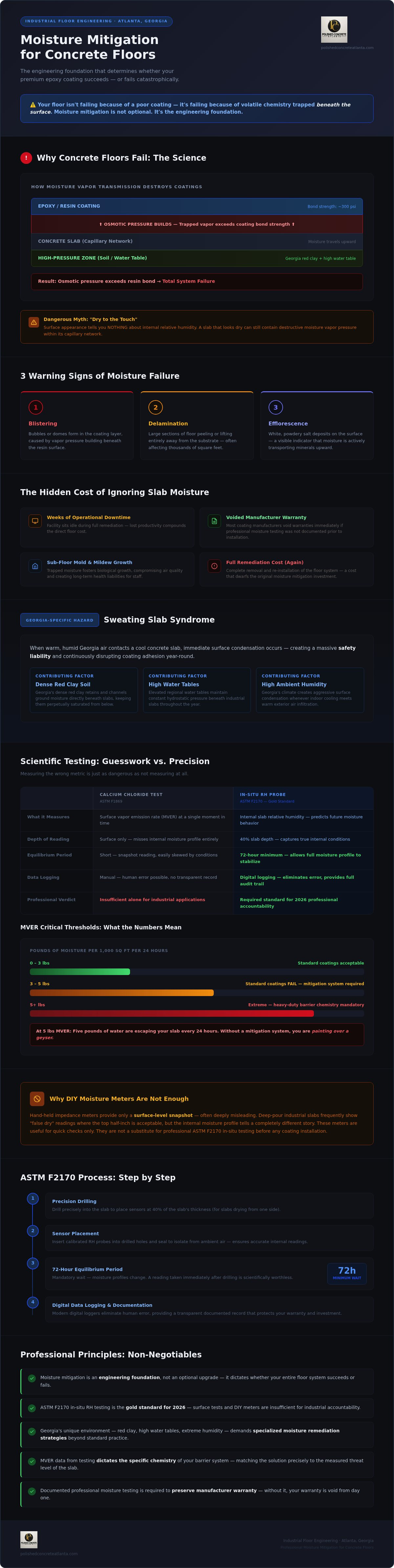
Concrete is essentially a hard sponge. Moisture vapor transmission (MVT) is the relentless movement of water molecules through the slab's capillary network, migrating from high-pressure areas below the ground to low-pressure areas above. When you install high-performance coatings without addressing this flow, you create a pressure cooker. Osmotic pressure builds as trapped water attempts to escape, eventually exceeding the bond strength of your resin. The result is a total system failure. Don't be fooled by a slab that looks ready. Surface appearance tells you nothing about the internal relative humidity. The "dry to the touch" metric is a dangerous myth that leads to catastrophic project delays.
Identifying the symptoms of moisture issues before they escalate is critical for facility management. You must watch for three specific warning signs:
- Blistering: Bubbles or domes in the coating caused by vapor pressure.
- Delamination: Large sections of the floor peeling or lifting away from the substrate.
- Efflorescence: White, powdery salt deposits that indicate moisture is transporting minerals to the surface.
The Hidden Costs of Ignoring Slab Moisture
Ignoring these risks leads to staggering financial consequences. Remediation isn't just about the cost of a new floor; it's about the weeks of operational downtime while your facility sits idle. Most coating manufacturers will void their warranties immediately if professional moisture testing wasn't documented. Beyond the budget, trapped moisture fosters sub-floor mold and mildew growth, which compromises your air quality; for those managing these specific environmental hazards, Dryrite Restoration provides an excellent example of the professional standards required for effective remediation. Reliability isn't a luxury. It's a requirement.
Sweating Slab Syndrome: An Atlanta Industrial Epidemic
In Georgia, our environmental conditions are particularly aggressive. Sweating Slab Syndrome occurs when warm, humid air contacts a cool concrete slab, leading to immediate surface condensation. This isn't just a nuisance; it's a massive safety liability. Georgia's dense red clay and high water tables keep slabs perpetually saturated from below. Professional moisture mitigation concrete floors are the only way to break this cycle. We treat moisture control as a non-negotiable engineering foundation, ensuring your warehouse or industrial space remains safe, dry, and productive year-round.
These environmental challenges aren't limited to industrial settings; homeowners also benefit from expert moisture management in wet-space projects, and you can visit Remarkable Installations to see how professional standards are applied to residential bathroom remodeling in North Georgia.
Scientific Testing: Quantifying Relative Humidity and Vapor Emission
Precision is the only defense against floor failure. You can't manage what you don't measure, and in the industrial sector, measuring the wrong metric is just as dangerous as not measuring at all. The industry has moved decisively away from superficial surface tests toward in-situ Relative Humidity (RH) monitoring. While Calcium Chloride testing (ASTM F1869) measures the Moisture Vapor Emission Rate (MVER) in pounds per 1,000 square feet, it only captures what's leaving the surface at a single moment. RH probes (ASTM F2170) tell us what's coming next. Standardizing your approach to moisture mitigation concrete floors starts with these probes. Results demand science. Not guesses.
Interpreting MVER data is critical for system selection. When a report cites 5 pounds per 1,000 square feet, it's warning you that five pounds of water are escaping every 24 hours. Most standard coatings fail at 3 pounds. Without a mitigation system, you're essentially painting over a geyser. We use this data to dictate the specific chemistry of your barrier, ensuring the solution matches the actual threat level of the slab.
ASTM F2170: The Gold Standard for 2026
ASTM F2170 isn't a suggestion; it's the benchmark for professional accountability. The process involves drilling precisely into the slab and placing sensors at specific depths, typically 40% of the slab's thickness for slabs drying from one side. We require a 72-hour equilibrium period because moisture profiles change. A reading taken immediately after drilling is worthless. Modern digital data logging eliminates human error, providing a transparent record that protects your investment. If you're looking for a partner who prioritizes this level of technical rigor, consult with a floor preparation specialist before your next project begins.
The Failure of DIY Moisture Meters
Hand-held impedance meters are useful for quick checks, but they aren't a substitute for professional testing. They provide a surface-level snapshot that is often misleading. Deep-pour industrial slabs frequently exhibit "false dry" readings where the top half-inch is acceptable, but the core remains saturated. Relying on these tools for final approval is a recipe for delamination. Professional calibration ensures your data stands up to insurance scrutiny and manufacturer warranty requirements. We don't settle for "close enough." We demand proof.
Strategic Mitigation Systems: Barriers, Membranes, and Sealers
Selecting a mitigation strategy is a high-stakes engineering decision. You can't apply a one-size-fits-all sealer and expect industrial-grade performance. If your RH readings exceed 85%, a simple densifier won't suffice. You need a robust system designed to withstand the hydrostatic pressure typical of Georgia's high water table. Strategic moisture mitigation concrete floors involve matching the specific chemistry of a barrier to the quantitative data gathered during testing. Whether you're opting for penetrating silicates to densify the slab from within or a heavy-duty cementitious overlay, the goal remains the same: total vapor control. Precision dictates the outcome.
High-Performance Epoxy Moisture Barriers
When dealing with high-emission slabs, 100% solids epoxy barriers are the definitive solution. These systems create an impermeable vapor-blocking layer that effectively isolates the slab from the final finish. However, the barrier is only as good as its bond. We demand rigorous mechanical profiling, typically through diamond grinding, to achieve the necessary concrete surface profile (CSP). This is the "Engineering of Adhesion." Without it, even the best epoxy will eventually peel. These systems are fully compatible with elite finishes like polished concrete or decorative industrial coatings, providing a stable foundation for a lifetime of use.
Vapor Retarders vs. Surface Membranes
Many general contractors confuse below-slab vapor retarders with topical mitigation membranes. A retarder is a plastic sheet installed before the pour; it's a first line of defense, not a cure for a wet slab. Topical membranes are post-pour solutions applied directly to the surface to manage moisture that is already present. This distinction is critical when you're utilizing moisture-insensitive adhesives for secondary flooring. Additionally, mitigation systems provide essential alkalinity control. High pH levels caused by migrating moisture can re-emulsify adhesives and destroy floor coverings from the bottom up. We eliminate this risk through strategic chemistry. If you need a fail-proof foundation for your facility, secure your investment with a professional moisture assessment.
The Professional Standard for Moisture Remediation in Atlanta
Atlanta’s geological profile presents a specific set of challenges that most national contractors fail to grasp. Our dense red clay and high water tables create a subterranean environment where moisture is constantly pushed into your slab. This makes moisture mitigation concrete floors a mandatory engineering requirement rather than a line-item option. We don't just treat the surface; we address the environmental reality of the Southeast. By integrating rigorous moisture control into our industrial floor coatings, we ensure that your facility’s foundation is as durable as the machinery on top of it. Our approach is characterized by a no-nonsense pragmatism that prioritizes tangible, long-term results over aesthetic shortcuts.
Total Surface Preparation
A mitigation system is only as effective as the preparation that precedes it. You can't achieve a permanent bond over old carpet glue, oil residues, or previous failed coatings. We utilize heavy-duty mechanical diamond grinding to open the concrete’s pore structure, allowing our barriers to penetrate deep into the substrate. This process isn't just about cleaning; it’s about creating the ideal profile for chemical fusion. For a deeper look at this critical phase, consult The Engineering of Adhesion: A Definitive Guide to Concrete Surface Preparation. We don't settle for "good enough" when your operational uptime is at stake. Results require precision.
Your Next Steps: Assessment and Execution
Your path to a fail-proof floor begins with a professional moisture assessment. We don't rely on visual inspections or surface-level guesses. We provide the scientific proof needed to move forward with confidence. Developing a strategic alliance with an expert flooring partner means you're no longer navigating the complexities of slab chemistry alone. Once the moisture threat is neutralized, we transition your vision from a mitigated slab to a high-luster finish that reflects the quality of your brand. Don't leave your investment to chance. Secure your facility's future with a plan that prioritizes engineering over guesswork.
Secure Your Industrial Foundation Through Engineering
Don't leave the integrity of your facility to chance. We've established that moisture isn't just a surface issue; it's a structural threat that requires scientific quantification and strategic remediation. By prioritizing in-situ Relative Humidity testing and selecting high-performance epoxy barriers, you eliminate the risk of delamination and costly downtime. In the aggressive humidity of the Georgia market, moisture mitigation concrete floors are the difference between a failing coating and a lifetime investment. Results require precision. Guesses lead to failure.
We bring over 20 years of Atlanta industrial flooring expertise to every project. Our team consists of specialists in Sweating Slab Syndrome remediation who adhere to no-nonsense professional standards. You deserve a floor that performs as well as it looks. The path to a fail-proof surface starts with a commitment to technical rigor and a dedicated partner who understands the high stakes of your operation. It's time to build on a foundation of certainty.
Contact Polished Concrete Atlanta for a Professional Moisture Assessment
Frequently Asked Questions
How do I know if my concrete floor needs moisture mitigation?
Visual cues like white salt deposits or peeling coatings are clear warning signs; however; only scientific testing provides absolute certainty. You must use ASTM F2170 relative humidity probes to measure the internal moisture levels of the slab. If these readings exceed the specific limits set by your finish manufacturer; mitigation is a mandatory requirement. Never rely on surface appearance to judge a slab's internal health. Precision is your only protection.
Can I install epoxy over a wet concrete slab if I use a primer?
No, a standard primer isn't engineered to withstand the relentless force of hydrostatic pressure. Using a basic primer over a high-moisture slab is a recipe for catastrophic delamination. You require a specialized 100% solids epoxy moisture barrier designed specifically to manage vapor emission rates. These systems are technically superior to primers and create a permanent bond that won't blow off the slab when pressure builds. Don't settle for shortcuts.
What is the difference between a vapor barrier and a vapor retarder?
A vapor retarder merely slows the rate of moisture movement; while a true vapor barrier is designed to stop it almost entirely. For professional moisture mitigation concrete floors; we focus on surface-applied barriers that create an impermeable seal against vapor transmission. Retarders are typically the thin plastic sheets placed under the slab during the initial pour. They're a first line of defense; but they aren't a cure for a wet slab.
How long does moisture testing take before I can start my flooring project?
Professional moisture testing requires a minimum of 72 hours to achieve valid results. This window is dictated by ASTM F2170 standards to allow the in-situ probes to reach equilibrium with the slab's internal environment. Rushing this timeframe results in inaccurate data and voids manufacturer warranties. You should plan for this three-day window during your project’s preparation phase to ensure the data stands up to professional and insurance scrutiny.
Does polished concrete help with Sweating Slab Syndrome?
Polished concrete doesn't stop Sweating Slab Syndrome on its own because the issue is driven by dew point and humidity. However; the use of high-quality densifiers during the polishing process significantly reduces the slab's porosity. This makes the surface easier to manage when condensation occurs. For a total solution; you must combine technical floor preparation with proper HVAC management to break the condensation cycle that plagues many Georgia warehouses and industrial facilities.
Is moisture mitigation worth the extra cost for an industrial warehouse?
Yes, it's a vital investment that protects your facility from operational downtime and total floor failure. The expense of stripping and replacing a delaminated epoxy floor is exponentially higher than the cost of installing a moisture barrier correctly the first time. Think of it as a non-negotiable insurance policy for your infrastructure. We prioritize long-term durability over low initial bids because a failed floor is the most expensive floor you'll ever buy.


