Most commercial flooring failures in Georgia aren't caused by heavy foot traffic; they're caused by a fundamental misunderstanding of the slab's internal chemistry. In our humid climate, a high-performance floor is a precisely engineered system, not just a topical decoration. You want a surface that reflects your brand's excellence without the constant threat of peeling or fading. Results matter. It's a common frustration to see a significant investment compromised by Georgia’s vapor levels or outdated installation methods. This guide provides the definitive technical roadmap to achieving the stained concrete floors Atlanta businesses need for long-term durability. We'll bridge the gap between high-end aesthetics and the rigorous engineering required by the 2026 Georgia State Building Code updates. You'll learn how to navigate moisture mitigation standards like ASTM F2170 and choose the correct chemical integration to ensure a permanent, vibrant finish that resists wear and eliminates the uncertainty of slab failure. No excuses. Just performance.
Key Takeaways
- Understand the distinction between molecular infusion and topical coatings to ensure your flooring remains a permanent, high-performance asset for your facility.
- Learn how to navigate the 2026 Georgia Building Code updates by implementing rigorous moisture mitigation and ASTM testing protocols.
- Identify the chemical differences between reactive acid stains and water-based dyes to select the optimal system for your specific slab chemistry.
- Discover why high-performance stained concrete floors Atlanta installations require integrated breathability to survive the unique challenges of Georgia’s humidity.
- Master the vetting process for selecting a professional partner who prioritizes industrial-grade preparation and long-term value over low-bid shortcuts.
Understanding Stained Concrete Floors in the Atlanta Commercial Landscape
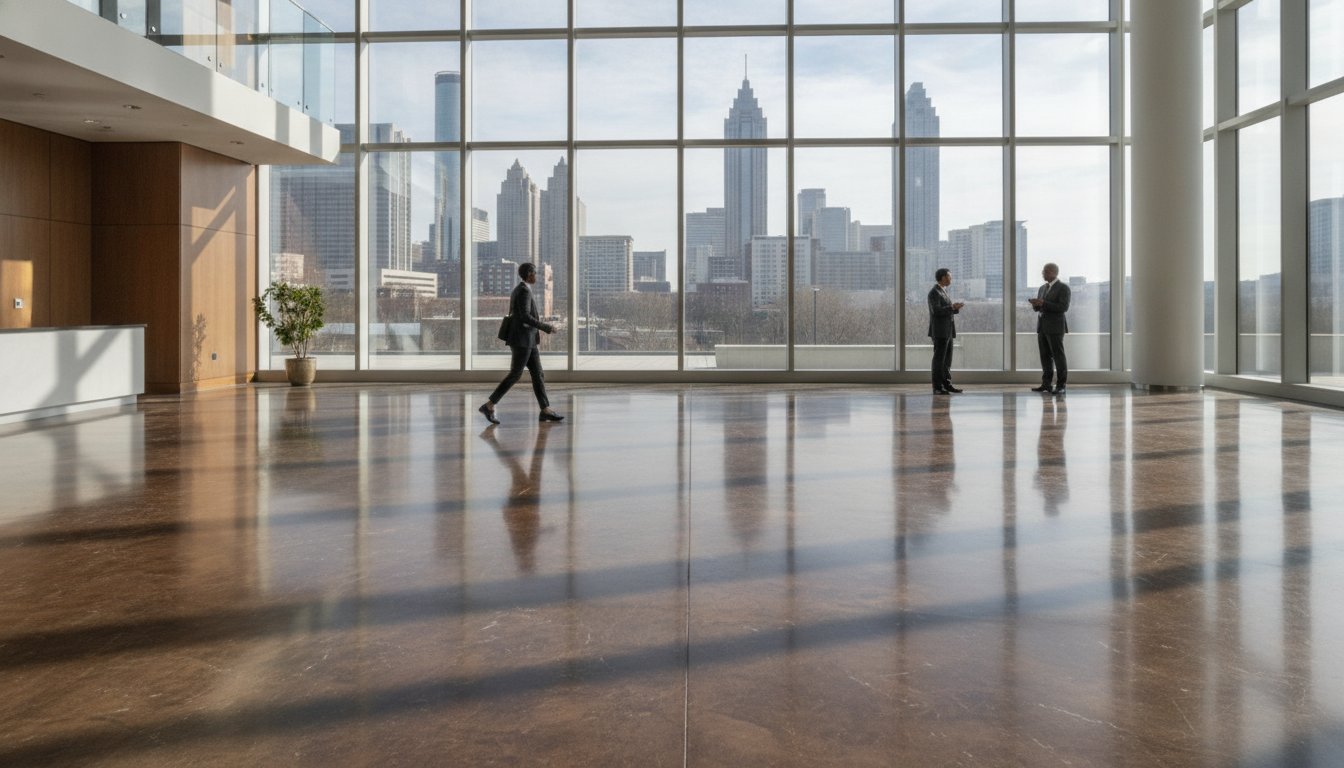
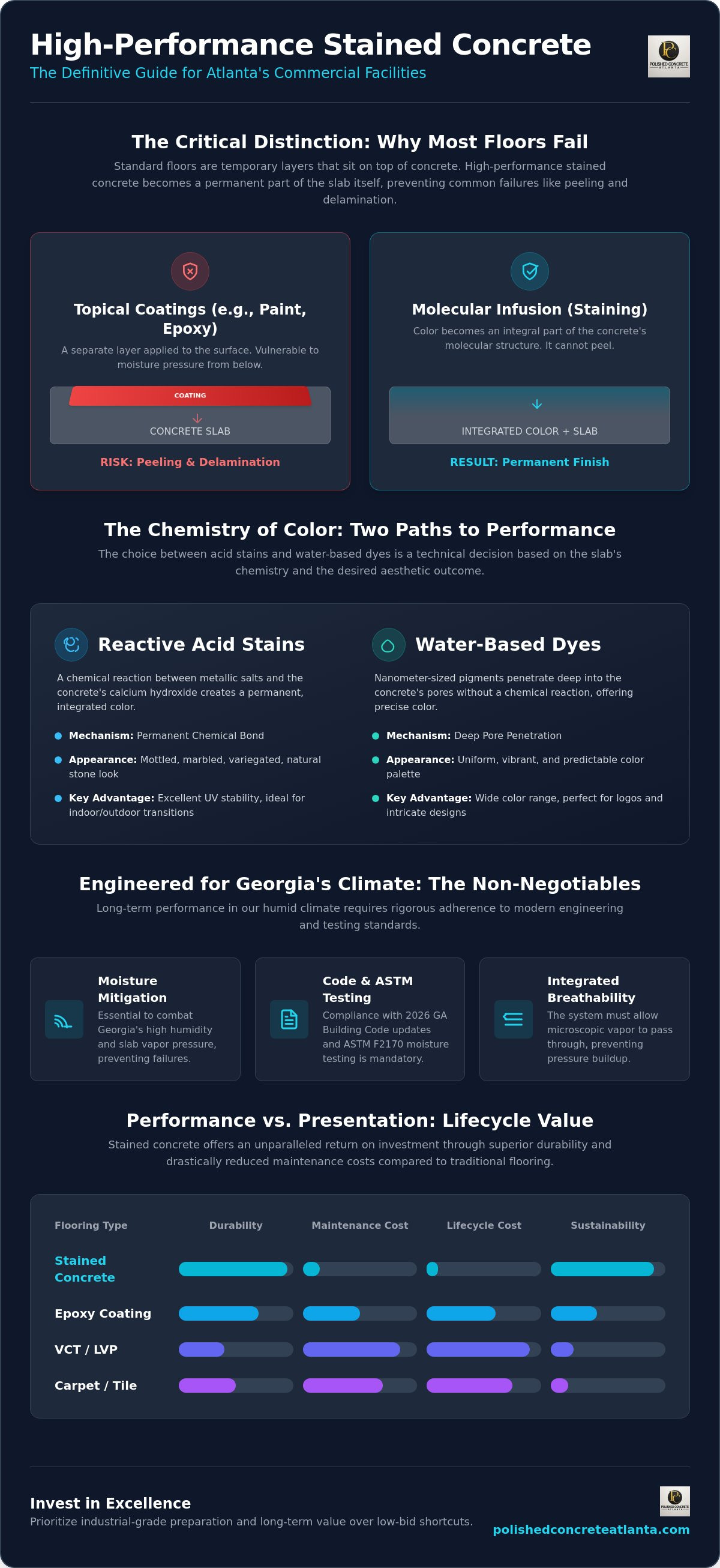
Surface-level thinking leads to surface-level failures. For high-traffic Atlanta facilities, stained concrete is not a topical paint or a fragile coating that sits on the surface. It is a permanent molecular infusion of color into the concrete matrix. Unlike paint that peels or epoxy that can delaminate under vapor pressure, staining creates a finish that is physically part of the floor. Stained concrete is a chemical reaction that alters the slab’s wear layer permanently. This distinction is critical for facility managers who prioritize longevity over temporary aesthetics. While residential applications often focus on simple "decorative" looks, commercial standards demand a high-performance surface capable of withstanding the rigors of industrial use and constant foot traffic.
Professional Decorative Concrete Techniques have evolved far beyond simple coloring. In 2026, the push for sustainable, LEED-certified building materials has made staining the primary choice for forward-thinking developers. By utilizing the existing slab, you eliminate the need for secondary materials like carpet or tile, which eventually end up in Georgia landfills. This is a strategic alliance between aesthetic excellence and environmental responsibility.
The Evolution of Concrete Staining for 2026 Facilities
Modern staining techniques have effectively rendered traditional, high-maintenance flooring obsolete in high-profile Atlanta developments. In Midtown and Buckhead, the "industrial-chic" aesthetic has become the baseline for premium office spaces and retail hubs. This shift isn't just about style; it's about air quality. Because stained concrete floors Atlanta installations meet strict low-VOC requirements, they contribute to a healthier indoor environment. We don't settle for mediocrity in design or air quality. The result is a sophisticated, mottled appearance that mimics natural stone while maintaining the structural integrity of industrial concrete, often serving as the ideal backdrop for custom timber elements sourced from Bourbon Bigfoot Woodworking.
Economic Advantages for High-Traffic Environments
Pragmatism dictates that the best floor is the one with the lowest lifecycle cost. When you compare stained concrete to VCT or luxury vinyl plank, the long-term ROI is undeniable. Stained surfaces don't require the stripping, waxing, or replacement cycles that plague traditional materials. Maintenance overhead is slashed because these floors require fewer man-hours and less specialized equipment to clean. Additionally, the thermal mass of a concrete slab provides inherent energy efficiency benefits. By absorbing and slowly releasing heat, your floor helps regulate the internal climate of large facilities, directly impacting your bottom line. It's a premium, worry-free investment that pays for itself through durability and reduced operational costs.
The Chemistry of Color: Acid-Stained vs. Water-Based Systems
Chemistry dictates performance. When specifying stained concrete floors Atlanta, the decision between acid-reactive stains and water-based dyes isn't merely aesthetic; it's a technical choice based on slab composition and intended use. Selecting the wrong system for a high-traffic environment leads to premature wear and aesthetic degradation. We don't guess. We engineer. Understanding how these substances interact with the concrete matrix is the only way to guarantee a result that lasts for the life of the facility.
Acid stains rely on a chemical reaction between metallic salts and the calcium hydroxide present in cured concrete. This process creates a permanent, variegated appearance often described as "mottled" or "marbled." Conversely, water-based dyes consist of nanometer-sized pigments designed to penetrate deep into the pore structure without a chemical reaction. Dyes offer a more uniform, predictable color palette. While acid stains are the gold standard for depth and UV stability in indoor-outdoor transitions, dyes provide the vibrancy and precision required for intricate brand elements. For long-term maintenance, refer to the CMHA guide to concrete stain prevention to protect your investment from environmental contaminants.
Acid Staining: The Permanent Chemical Bond
Acid isn't just a colorant; it's a catalyst. The etching process involves a mild phosphoric or hydrochloric acid solution that opens the concrete surface, allowing metallic salts to reach the reactive minerals within the slab. This creates an inorganic bond that won't chip or peel. Every Atlanta slab reacts differently. Factors like cement content, age, and previous finishing techniques influence the final hue. This "unpredictability" is exactly why acid staining is prized in high-end restaurants and hotel lobbies where a unique, organic character is the primary design goal. It’s a sophisticated look that rewards those who value authenticity.
Water-Based Dyes: Precision and Vibrancy
Precision is the priority here. Because dyes don't rely on a chemical reaction, the color you see in the container is the color that ends up in your floor. This makes dyes the superior choice for 2026 "live-work" renovations where brand consistency across a large commercial footprint is non-negotiable. The installation is fast-paced. Dyes dry quickly, allowing for rapid sealing and a shorter project timeline. If your facility requires complex logos or multi-colored patterns, dyes provide the control necessary for a professional-grade finish. If you're unsure which chemical system fits your current slab condition, it's time to consult with a technical specialist for a comprehensive site evaluation.
Georgia’s solar load is relentless. For areas with heavy sunlight exposure, such as glass-walled showrooms or outdoor entryways, UV stability is a critical metric. Acid stains are inherently UV-stable because the color is derived from earth-based minerals. While modern dyes have improved significantly, they can still be susceptible to fading if not protected by high-performance, UV-resistant sealers. We prioritize durability. We ensure the chemistry matches the environment.
Performance vs. Presentation: Stained Concrete vs. Other Finishes
Performance is non-negotiable. While aesthetics capture the initial interest, the structural integrity of the finish determines the long-term value of your asset. When evaluating stained concrete floors Atlanta, facility managers must look beyond the surface. The primary advantage of a stained system is its resistance to "wear-through." Unlike thin-film coatings or paints that sit on top of the concrete, staining involves deep mineral penetration. Color is integrated into the slab. Even under the weight of heavy equipment or constant pallet jack traffic, there is no topical layer to delaminate or flake away. This creates a surface that handles industrial abuse without losing its professional appearance.
A common objection regarding stained concrete is its perceived slip resistance. Is it "slippery" when wet compared to sealed concrete? The answer lies in the topcoat, not the stain itself. While a high-gloss finish may look glass-like, professional installations utilize specific anti-slip additives to meet or exceed OSHA and ADA standards. In contrast to polished concrete floors Atlanta standards, which rely on mechanical refinement for shine, stained floors use sealers that can be customized for specific traction requirements. You get the visual impact without compromising safety. No compromises.
Staining vs. Polishing: The Hybrid Approach
The choice isn't always between one or the other. Many 2026 commercial projects utilize concrete floor staining near me as a precursor to high-grit polishing. This hybrid method provides the deep, variegated color of a stain with the high-durability mechanical finish of a polish. For warehouse-scale projects, a pure stain and seal is often more cost-effective and less labor-intensive than a 1500-grit polish. However, the "grind and stain" approach offers a level of color depth that pure polishing cannot replicate. It’s about matching the process to the project's specific traffic load and budget.
Utility Comparison: Staining vs. Industrial Epoxy
Breathability is the deciding factor in the Georgia climate. While industrial floor coatings Atlanta facilities use for chemical labs provide unmatched spill resistance, they are non-breathable. In slabs with high vapor emission rates, epoxy can trap moisture, leading to osmotic blistering and total floor failure. Stained concrete remains breathable. It allows moisture vapor to pass through the slab without forcing the finish to delaminate. This makes staining the superior choice for ground-level showrooms and retail spaces where hydrostatic pressure is a known variable. Furthermore, high-gloss stained finishes improve facility safety by increasing light reflectivity, reducing the need for additional overhead lighting. Results-driven engineering wins every time.
Engineering for Longevity: Moisture Mitigation and Atlanta Slab Standards
Georgia’s geography is the primary adversary of a stable floor. The dense red clay and high water tables across the state create a pressurized environment beneath your facility. This leads to high vapor emission rates that can compromise even the most precise stained concrete floors Atlanta installations. We don't gamble with slabs. Ignoring the subterranean reality of your project is a recipe for delamination and aesthetic failure. Results are earned through engineering, not luck.
Testing is the only path to certainty. We utilize both calcium chloride testing and in-situ Relative Humidity (RH) probes to map the moisture profile of the concrete. Per 2026 standards, moisture mitigation is mandatory if vapor emission exceeds 3 lbs per 1,000 sq ft. This isn't a suggestion; it's a technical requirement for a warrantable finish. Without these data points, you're just guessing. We prioritize data because your investment deserves a permanent solution.
Unconditioned spaces face an additional threat known as "Sweating Slab Syndrome." This occurs when warm, humid air hits a cold concrete surface, causing condensation that can saturate the stain and lead to sealer failure. Proper engineering accounts for these dew point fluctuations to ensure the floor remains dry and vibrant throughout the year. It's about total environmental control.
The Non-Negotiable Step: Surface Preparation
Preparation is the foundation of excellence. Our professional concrete staining services always begin with mechanical grinding. We don't just "clean" the surface. We remove curing compounds, old adhesives, and deep-seated contaminants that would otherwise block stain absorption. We also perform rigorous pH testing. If the slab is too alkaline or too acidic, the chemical reaction will fail. We correct the chemistry before the first drop of stain hits the floor. Precision matters.
Sealing the Deal: Protecting the Color
The sealer is your floor's first line of defense. In the high-humidity environment of Atlanta, choosing between solvent-based and water-based sealers is a strategic decision. Solvent-based options often provide superior color enhancement, while water-based versions offer better breathability for slabs with moderate vapor issues. For high-traffic zones, we recommend a sacrificial wax coat. This layer takes the brunt of the friction, preserving the sealer and the stain beneath it. We also integrate UV inhibitors to prevent fading in sun-drenched entryways. If you're ready to secure your facility's future, schedule a comprehensive moisture assessment today.
Investing in Excellence: Selecting an Atlanta Staining Partner for 2026
Low bids often hide high liabilities. In the competitive world of commercial construction, "cheap" staining is the most expensive mistake a facility manager can make. When a cut-rate contractor skips essential moisture testing or uses inferior topical sealers, the resulting floor failure requires costly rework, grinding, and downtime. We don't settle for mediocrity. Our approach to stained concrete floors Atlanta projects is built on the elimination of uncertainty. You aren't just buying a floor; you're investing in a high-performance asset that reflects your brand’s commitment to quality. Precision is mandatory. Results are the only metric that matters.
Vetting a contractor requires more than a cursory glance at a portfolio. You must ask definitive questions about their technical protocols. Do they own industrial-grade planetary grinders, or are they using handheld equipment that leaves uneven profiles? What specific moisture testing equipment do they use to comply with the 2026 Georgia Building Code? A professional partner should provide a detailed breakdown of their surface preparation and vapor mitigation strategy before a single gallon of stain arrives on site. At Polished Concrete Atlanta, our process moves from a strategic consultation to rigorous slab analysis and final sealer application. We manage the details so you can manage your business.
The Professional Standard for Commercial Projects
Experience is the ultimate stabilizer. Having navigated complex industrial slab conditions since 2004, we've seen every possible scenario in the Georgia landscape. This longevity allows us to provide a "no-nonsense" approach to project management that prioritizes tangible results and strict adherence to deadlines. We don't make excuses. We deliver. Our team functions as a creative consultant and a meticulous manager, forming strategic alliances with Atlanta general contractors to ensure every phase of the installation remains on schedule. We respect the tradition of craftsmanship while remaining at the forefront of chemical innovation.
Next Steps for Facility Managers
Success starts with a mock-up. Because every concrete slab has a unique chemical signature, you should always see the stain on your specific surface before proceeding with the full footprint. This eliminates surprises and ensures the final aesthetic aligns with your vision. We also prioritize minimal-impact installation schedules. We understand that active businesses cannot afford prolonged closures, so we coordinate our workflow to reduce downtime and maintain facility productivity. It’s time to move from concept to execution. View our commercial project gallery and get your estimate today to begin your facility’s transformation. Peace of mind is the ultimate return on investment.
Securing Your Facility’s Future
Your commercial floor is a direct reflection of your brand's operational standards. Settling for a mediocre installation is a liability you don't need when the structural integrity of your facility is at stake. We've established that high-performance stained concrete floors Atlanta installations require a rigorous, engineering-first approach. This means prioritizing moisture mitigation and precise chemical selection over superficial aesthetics. You now possess the technical roadmap to differentiate between fragile topical coatings and permanent molecular infusion. Success is found in the details. No excuses.
Since 2004, we've provided the regional market with uncompromising results through specialized commercial grinding equipment and exhaustive expertise in industrial moisture mitigation. We eliminate the guesswork that leads to peeling or delamination. It's time to transform your space into a durable, high-end asset that resists wear and slashes maintenance overhead. Get a Professional Quote for Stained Concrete in Atlanta to begin your project evaluation. We look forward to partnering with you to create a floor that stands the test of time.
Frequently Asked Questions
How long do stained concrete floors last in a commercial setting?
Stained concrete floors are designed to last the lifetime of the slab because the color is a permanent molecular infusion, not a topical layer. In a high-traffic commercial environment, the finish will remain vibrant for 20 years or more with proper maintenance and periodic re-sealing. It won't chip, flake, or peel like paint. Durability is built into the chemistry of the floor.
Can you stain old concrete floors that have been previously covered with carpet or tile?
You can absolutely stain older slabs, provided the surface is properly prepared through mechanical grinding and glue removal. Previous coverings like carpet or tile often leave behind mastic and adhesives that must be entirely removed to ensure the stain penetrates the concrete pores. Our process involves rigorous floor preparation to uncover a clean, reactive surface. We don't settle for compromised adhesion.
How do I maintain stained concrete floors in a high-traffic Atlanta office?
Maintaining stained concrete floors Atlanta offices depend on requires a simple but disciplined regimen of daily dust mopping and weekly wet mopping with a pH-neutral cleaner. High-traffic zones benefit significantly from a sacrificial wax coat. This sacrificial layer absorbs the friction from foot traffic, protecting the underlying sealer and preserving the high-end aesthetic without the need for aggressive chemicals. It is a pragmatist's approach to long-term value. For those managing mixed-use facilities that still utilize soft surfaces or tile, professional cleaning specialists like andersoncarpetcleaninginc.com provide the necessary expertise to maintain a consistent standard of cleanliness across all flooring types.
Is stained concrete cheaper than epoxy flooring for industrial use?
Staining is typically more cost-effective than high-build epoxy systems because it utilizes the existing slab rather than adding thick layers of resin. While industrial epoxy is necessary for extreme chemical resistance, staining provides a superior lifecycle value for showrooms and retail spaces. It offers a permanent finish with lower long-term maintenance costs compared to traditional industrial coatings. Efficiency meets excellence.
Does stained concrete make the floor slippery?
Stained concrete is no more slippery than other hard surfaces when dry, but slip resistance depends entirely on the sealer used. We integrate specialized anti-slip aggregates into the final sealer coat to meet ADA and OSHA traction standards. This ensures your facility remains safe for employees and clients even in wet conditions. Safety is never compromised for style. We eliminate the uncertainty of slip hazards.
What is the difference between acid stain and concrete dye?
Acid stains create a permanent chemical bond through a reaction with concrete minerals, resulting in an organic, mottled appearance. Concrete dyes are nanometer-sized pigments that penetrate the surface without a chemical reaction, offering more vibrant and predictable color options. We often recommend acid stains for UV stability and dyes for precise branding or intricate patterns. Both systems require professional-grade sealing to ensure longevity.
How long does the staining process take for a 5,000 sq ft space?
A 5,000 square foot commercial project typically requires five to seven days from initial grinding to final sealer curing. This timeline accounts for the necessary reaction time for acid stains and the meticulous cleaning required between phases. We prioritize an efficient workflow to minimize facility downtime while ensuring every technical standard is met without shortcuts. We respect your schedule.
Can stained concrete be used for outdoor commercial walkways in Georgia?
Stained concrete is an excellent choice for outdoor commercial walkways in Georgia due to its durability and UV resistance. We specifically recommend acid-reactive stains for exterior applications because the earth-based minerals won't fade under the intense Southern sun. When paired with a breathable, UV-stable sealer, these floors provide a permanent, high-performance solution for entryways and patios. It is a worry-free investment in curb appeal.


