
An uneven floor isn't just a nuisance; it's a liability that actively devalues your facility every single day. If your forklifts are rattling over joints or your high-performance coatings are peeling at the edges, your substrate is failing you. We understand the frustration of dealing with tripping hazards and the fear of floor coating failure due to poor preparation. Precision isn't optional. It's a requirement. In Georgia's humid climate, red clay soil and moisture vapor transmission create unique challenges that demand a sophisticated, technical response rather than a superficial patch.
This guide is your definitive roadmap to mastering concrete floor leveling Atlanta requirements. You'll learn how to achieve a perfectly flat substrate that complies with the latest 2024 International Building Code standards while minimizing operational downtime. We'll break down the technical selection criteria for remediation and explain how to prepare your floor for high-luster polishing or heavy-duty epoxy. This isn't about a quick fix. It's about engineering a high-performance asset that stands the test of time. Results matter. We'll show you how to get them.
Key Takeaways
- Identify the critical distinctions between structural slab lifting and surface-leveling to choose the most cost-effective remediation for your facility.
- Evaluate high-speed polyurethane injection methods designed to eliminate tripping hazards with minimal disruption to your active daily operations.
- Understand how regional environmental factors like red clay and humidity dictate the specific requirements for concrete floor leveling Atlanta commercial projects.
- Learn to integrate advanced moisture mitigation strategies with substrate leveling to ensure the long-term integrity of high-performance floor coatings.
- Master the technical selection framework used to achieve industrial-grade flatness compliant with the latest 2024 International Building Code standards.
Understanding Concrete Floor Leveling for Atlanta Commercial Facilities
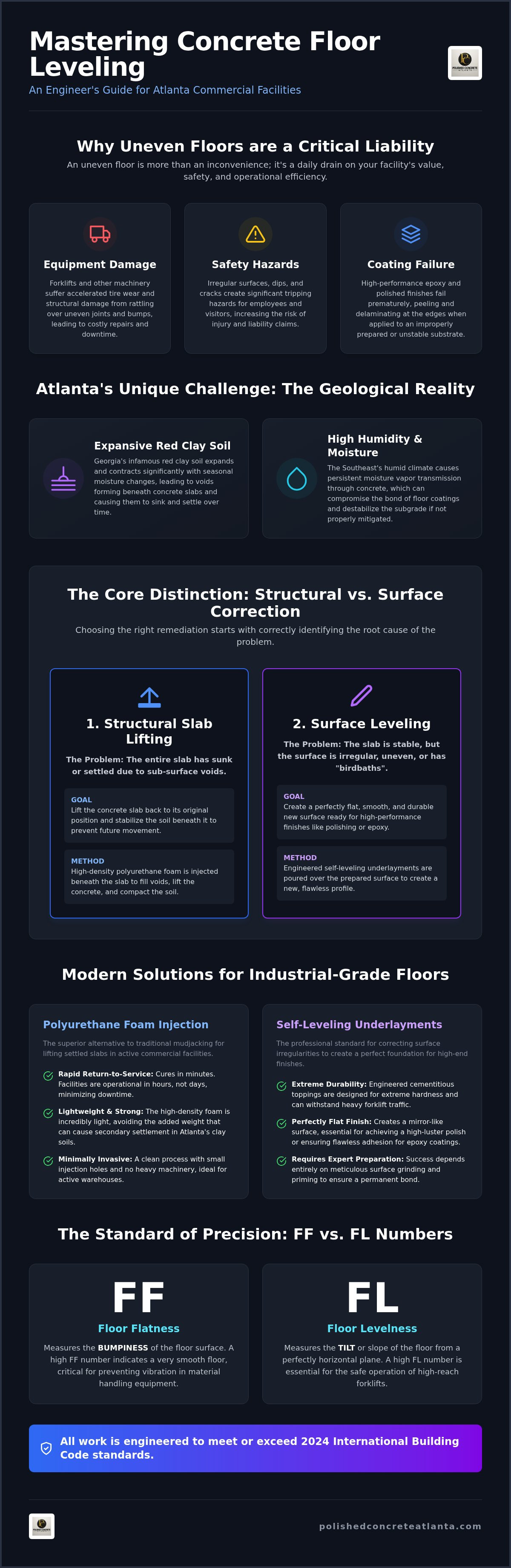
Don't confuse residential slab lifting with industrial floor leveling. They aren't the same. While homeowners worry about a sinking patio, facility managers face structural and operational crises. In an industrial setting, unlevel floors destroy equipment. Forklifts suffer accelerated tire wear. Safety risks skyrocket. When we discuss concrete floor leveling Atlanta projects, we're talking about precision engineering. We address the substrate to ensure it's ready for high-performance finishes. Identifying the signs early is critical. Look for joint spalling, birdbaths where water pools, or coating delamination. These aren't just aesthetic flaws. They're symptoms of a failing foundation. Different concrete leveling methods exist, but the right choice depends on whether you have a structural failure or a surface irregularity.
The Science of Slab Settlement in Georgia
Atlanta's geography presents a unique challenge. The region's infamous red clay expands and contracts with the seasons. Fluctuating water tables in the Southeast lead to voids beneath industrial subgrades. Often, poor initial compaction during rapid warehouse construction leaves slabs unsupported. Subsidence in Atlanta commercial real estate refers to the gradual caving in or sinking of an area of land or a building's foundation due to these shifting sub-surface conditions. It's a geological reality that demands a professional response, and if the damage is covered by your policy, you may want to check out Public Adjusters Atlanta to ensure your claim is handled correctly.
Floor Flatness (FF) vs. Floor Levelness (FL) Standards
Precision matters in high-volume logistics. We utilize the Face Floor Profile Numbering System to define industrial standards. FF measures the bumpiness of the floor, while FL measures the tilt. If you operate high-reach forklifts, standard residential tolerances won't work. Even a tiny deviation at the floor level translates to a dangerous swing at the top of a rack. Achieving these standards is the only way to guarantee the success of polished concrete floors Atlanta facilities require for long-term durability. We don't guess. We measure. We deliver.
Commercial Leveling Methods: Mudjacking, Poly-Lifting, and Underlayments
Methods matter. Precision dictates performance. Don't settle for a one-size-fits-all approach when your facility's operational integrity is on the line. Your specific floor failure determines the remediation strategy. If the entire slab has settled, you need geotechnical lifting. If the slab is stable but surface irregularities persist, you need surface correction. Selecting the wrong method is an expensive mistake. For concrete floor leveling Atlanta professionals, the goal is total stabilization and a perfect profile. We analyze substrate chemistry and adherence to concrete admixture standards to ensure every material used meets industrial thresholds. No room for error.
Polyurethane Foam Injection for Industrial Slabs
Traditional mudjacking is often too heavy for Atlanta's clay soils. It adds thousands of pounds of slurry that can actually trigger secondary settlement. High-density polyurethane injection is the superior alternative for active warehouses. It's fast. It's clean. The foam expands to fill voids and stabilizes the soil without the need for heavy machinery. Most facilities return to service in hours, not days. That's the efficiency your schedule demands. The lightweight nature of the foam ensures you aren't adding unnecessary stress to an already compromised subgrade.
Self-Leveling Underlayments and Toppings
When the slab is structurally sound but the surface is irregular, cementitious underlayments are the professional standard. These aren't basic patches. They are engineered toppings designed for extreme durability and high-performance finishes. The success of these systems depends entirely on the expertise of concrete surface preparation contractors who understand the engineering of adhesion. Without surgical grinding and specialized priming, any underlayment will eventually delaminate. We ensure the bond is permanent. This approach creates a mirror-like finish for high-end retail or a robust, flat base for heavy-duty epoxy.
Sometimes, you don't need to add material; you need to remove it. Mechanical grinding shaves down high spots and joint ridges that cause forklift vibration. It's a surgical approach to floor flatness. If you're unsure which path fits your project, consulting with a technical specialist can clarify your requirements before you commit to a strategy. We provide the clarity you need to make an informed investment.
The Selection Framework: Choosing the Right Leveling Strategy
Strategy precedes execution. You cannot fix a structural failure with a surface solution. Successful concrete floor leveling Atlanta projects begin with a surgical diagnosis of the substrate. Is the slab sinking due to soil subsidence, or is the surface simply out of spec from a poor initial pour? Choosing the wrong path leads to wasted capital and recurring maintenance. We prioritize a "no-nonsense" assessment that identifies the root cause before a single tool touches the floor. If your slab is structurally sound but lacks the flatness required for high-speed logistics, we focus on surface correction. If the foundation is compromised, we pivot to geotechnical stabilization. Precision is the only acceptable outcome.
Environmental factors in the Southeast dictate your material choices. Atlanta's high humidity and porous red clay subgrades mean moisture is always a threat. Ignoring this leads to delamination. We often integrate sealed concrete protocols into our leveling framework to ensure the substrate remains stable and resistant to vapor drive. Budgeting for longevity means looking past the initial quote. The cheapest leveling fix often omits critical surface prep, leading to catastrophic coating failure within months. We build for the long term. We value reliability over shortcuts.
Moisture Mitigation: The Hidden Leveling Requirement
Unlevel floors frequently mask underlying moisture vapor transmission issues. Trapped water under a slab can cause the very instability that leads to settlement. We utilize rigorous testing protocols, including Relative Humidity (RH) and Calcium Chloride tests, to quantify the risk. Integrating moisture barriers into the leveling process is non-negotiable for successful industrial floor coatings Atlanta installations. We don't just fill holes; we engineer a dry, stable environment for your finish.
Evaluating Contractor Expertise
Residential "mudjackers" lack the equipment to meet commercial FF/FL specifications. They don't speak the language of industrial bids. When vetting a partner, demand to see their laser-leveling technology and high-production grinding equipment. A comprehensive strategy must go beyond "filling gaps." It requires a holistic project management approach that considers downtime and logistics. We minimize disruption while maximizing accuracy. If you need a partner who understands the high stakes of commercial operations, contact our technical team for a facility audit. We provide the certainty you need to move forward.
Polished Concrete Atlanta: Engineering Your Perfect Foundation
A high-performance floor is only as good as the substrate beneath it. At Polished Concrete Atlanta, we don't just "patch" uneven surfaces. We engineer foundations. Working with multiple vendors for leveling, preparation, and finishing creates gaps in accountability and technical execution. We eliminate that risk. As a single-source contractor, we manage the entire lifecycle of your floor, from the initial concrete floor leveling Atlanta requirements to the final architectural finish. This integrated approach ensures that every step of the process supports the next. We provide the reliability and scale that Atlanta's industrial sector demands. Results matter. We deliver them without compromise.
Precision leveling is the prerequisite for aesthetic excellence. If you are investing in stained concrete floors Atlanta, the uniformity of the substrate dictates the depth and clarity of the final color. An unlevel floor leads to inconsistent dye penetration and "hot spots" where the finish fails to bond. We align our leveling strategies with your desired outcome, ensuring the floor is perfectly flat and chemically receptive to high-luster polishing or heavy-duty epoxy. We don't just meet standards. We set them.
Total Surface Mastery
Our capabilities extend beyond simple leveling. We provide a holistic suite of services including industrial glue removal, precision grinding, and moisture mitigation. Sweating slab syndrome is a common plague in Georgia's humid climate, but we solve it by integrating moisture-blocking technology directly into the leveling process. For example, we recently remediated a Midtown Atlanta retail space where a severely out-of-spec slab threatened the project's high-gloss polishing goals. Through surgical grinding and high-performance underlayments, we achieved a level of flatness that allowed for a mirror-like finish. We turn problematic slabs into premier assets.
Your Strategic Partner in Atlanta
We operate as more than a service provider. We are your creative consultants and meticulous managers of detail. Our consultative approach focuses on long-term asset protection and facility efficiency. High-achieving businesses in the Southeast trust us because we prioritize "no-nonsense" pragmatism and tangible results over vague promises. We understand the high stakes of commercial real estate and industrial logistics. Don't leave your facility's foundation to chance. Take the next step toward a perfectly level, high-performance floor. Contact our team today to schedule a comprehensive site evaluation for your commercial facility. For facility managers looking to discover Liberty Door Repair and their professional entryway services, securing your doors is a vital step in complete property maintenance. Let's build something that lasts.
Master Your Facility's Foundation
Precision is the mandatory bridge between a failing substrate and a high-performance industrial asset. We've established that addressing the root cause of instability is the only way to avoid recurring maintenance costs and operational hazards. Whether you're battling soil subsidence or surface irregularities, your choice of strategy dictates the longevity of your floor. Integrating moisture mitigation with technical concrete floor leveling Atlanta protocols ensures your facility remains compliant with the latest building standards. You need a partner who understands these high stakes. With 20+ years of Atlanta industrial experience, we provide the specialized commercial-grade grinding and leveling equipment required for surgical accuracy. Our comprehensive moisture mitigation and prep services eliminate the uncertainty that leads to coating failure. Don't settle for mediocrity when you can have an engineered foundation. Secure Your Industrial Floor Integrity; Contact Polished Concrete Atlanta Today. Your facility deserves a substrate built for excellence. We're ready to deliver it.
Frequently Asked Questions
How much does commercial concrete floor leveling cost in Atlanta?
Commercial pricing is determined by the specific scope of the substrate correction and your required floor flatness (FF) tolerances. Factors like total square footage, the severity of the slab dip, and the chosen material system all influence the final investment. We provide project specific quotes after a technical site evaluation to ensure accuracy and eliminate hidden costs. We don't offer generic estimates because industrial requirements demand a tailored engineering approach.
Can you level a floor that already has an existing epoxy coating or glue?
You cannot successfully level over existing epoxy or glue without compromising the bond. Adhesion is a non-negotiable engineering requirement. We perform mechanical floor glue removal or grinding to reach a clean, porous concrete surface before applying any leveling agents. This ensures the new substrate is a permanent part of the floor structure rather than a superficial patch that will eventually delaminate under traffic.
What is the difference between concrete leveling and concrete lifting?
Concrete lifting involves injecting materials beneath a sunken slab to raise it back to its original position. In contrast, concrete floor leveling Atlanta projects typically focus on the surface. We use precision grinding or cementitious underlayments to achieve the exact flatness required for industrial finishes. While lifting addresses subgrade voids, surface leveling creates the architectural profile needed for high performance operations and equipment stability.
How long does it take for a leveled floor to be ready for polished concrete?
Cure times vary based on the specific system used for your facility. High density polyurethane foam allows for almost immediate foot traffic, while cementitious self leveling underlayments usually require 24 to 48 hours before they're ready for industrial grinding and polishing. We coordinate these timelines to ensure minimal operational downtime while respecting the chemical requirements of the materials. We don't rush the process at the expense of the finish.
Do I need moisture mitigation if I am leveling an old warehouse floor?
Yes, moisture mitigation is a critical requirement for older warehouse slabs in Georgia's humid climate. High water tables and porous concrete lead to vapor transmission that can easily delaminate new coatings or leveling underlayments. We conduct Relative Humidity testing to determine if a moisture barrier is necessary to protect your investment. Ignoring moisture is the most common cause of floor failure in the Southeast.
Will concrete leveling fix cracks in my industrial floor?
Leveling provides a flat surface, but it doesn't heal structural cracks. We treat cracks as separate engineering challenges, often using epoxy injection or specialized joint fillers to stabilize the slab before the leveling process begins. This prevents the cracks from reflecting through your new finish. It's a comprehensive approach that ensures the structural integrity of the entire floor system rather than just covering up a problem.


