
Why did your "premium" floor coating just become an expensive liability? It is a question that echoes through empty warehouses and stalled production lines every day. You likely invested heavily in a high-performance system, only to find your concrete floor failing after coating with blisters, peels, and safety-compromising flakes. This isn't just an aesthetic annoyance; it is a direct hit to your bottom line and your facility's operational integrity.
We understand the frustration of watching a "guaranteed" solution crumble under standard use. You expected a permanent asset, but you received a maintenance nightmare. The reality is that most failures have nothing to do with the chemical quality of the epoxy or resin itself. Instead, they stem from a failure to respect the concrete's biology and a lack of rigorous professional standards during the preparation phase.
This focus on technical integrity is universal; specialized firms like The Solution provide expert damage repair and restoration services that emphasize the same rigorous standards required to prevent structural failures and ensure long-term durability.
This guide will dismantle five pervasive industry myths and reveal the technical reality of Moisture Vapor Transmission and surface profiling. You'll learn the exact remediation steps required to achieve a permanent, high-end finish that stands up to 2026 industrial demands. It is time to move past temporary fixes and embrace a strategy rooted in long-term value and engineering excellence.
Key Takeaways
- Learn to distinguish between superficial aesthetic wear and structural delamination to assess the true health of your facility's slab.
- Understand why even the most expensive resins cannot compensate for poor surface preparation, which remains the leading cause of a concrete floor failing after coating.
- Discover how Georgia's unique soil density and hydrostatic pressure create "invisible killers" that compromise non-breathable floor systems.
- Compare the long-term ROI of traditional re-coating against the superior breathability and durability of professional polished concrete restoration.
- Explore the "Zero-Failure" engineering approach that prioritizes rigorous moisture mitigation and mechanical profiling to ensure a permanent, high-performance finish.
Recognizing the Symptoms: Is Your Floor Coating Actually Failing?
Identifying the difference between a minor scuff and a total system collapse is the first step toward reclaiming your facility. Many owners mistake surface scratches for structural issues, while others ignore the early warning signs of a concrete floor failing after coating until the damage is irreversible. True failure is rarely about the top layer wearing down. It's about the loss of integrity at the bond line.
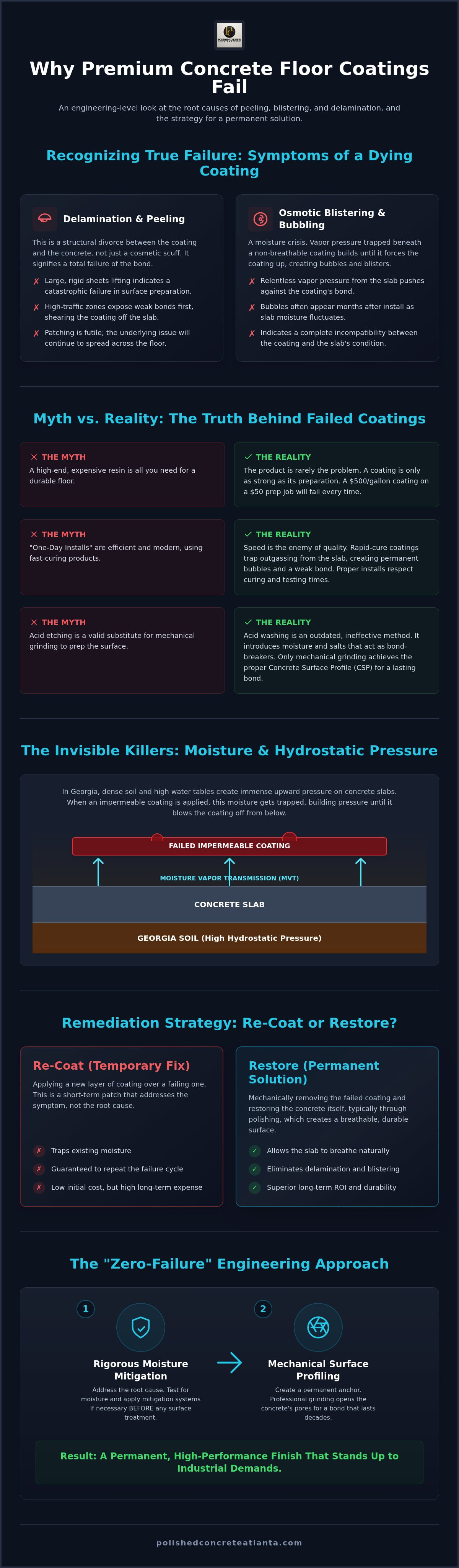
Delamination occurs when the bond between the substrate and the coating snaps. This is a structural divorce, not a cosmetic blemish. When you see material lifting away from the concrete, the system has already failed. Patching a localized peel is a futile effort; it addresses the symptom while the underlying pathology continues to spread. This instability is often rooted in the chemical and physical degradation of concrete, which prevents the resin from anchoring properly. Osmotic blistering is moisture trapped under an impermeable layer, creating pressure that the coating simply cannot withstand.
Delamination and Peeling
When coatings lift in large, rigid sheets, it points to a fundamental failure in surface preparation. The primer never bit into the concrete. In contrast, small flakes often indicate "inter-coat adhesion" issues, where the layers of the system didn't fuse together. High-traffic zones act as the ultimate stress test. Forklifts and heavy machinery will quickly expose poor bonding by shearing the coating away from the slab. The bond is dead. You can't fix this with a roller and a bucket of "premium" epoxy.
Osmotic Blistering and Bubbling
Myth vs. Reality: Why "Premium" Coatings Still Fail
Many facility managers believe that sourcing a high-end resin is the silver bullet for durability. This is a costly misconception. You can spend $500 per gallon on a top-tier coating, but if it's applied to a $50 preparation job, it will result in a concrete floor failing after coating every single time. The product is rarely the problem. The bond is the problem. A coating is only as strong as the surface it anchors to. Without a mechanical profile, the resin simply sits on top of the concrete like a sheet of plastic rather than becoming part of the slab.
The "One-Day Install" Trap
Speed is the enemy of quality. The trend of "one-day installs" using rapid-cure polyaspartics has led to a surge in premature failures across Atlanta commercial projects. These systems are often applied before the slab has finished outgassing or without respecting industry standards for moisture testing. Outgassing occurs when air inside the concrete expands due to temperature changes and pushes through the wet coating. If the resin cures too quickly, those air pockets become permanent bubbles. It's a fundamental physics problem that marketing promises can't solve.
The Acid Etching Fallacy
Some contractors still claim that acid etching is a valid substitute for mechanical grinding. It isn't. Chemicals can't create the deep, mechanical "tooth" required for a high-performance bond. Worse, acid etching introduces liquid into the slab and leaves behind neutralizing salts. If these aren't perfectly removed, they act as a bond-breaker. To achieve the correct Concrete Surface Profile (CSP), professional concrete floor grinding is the only non-negotiable standard. Mechanical grinding opens the pores of the concrete, allowing the primer to penetrate deep into the substrate. It's the difference between a floor that lasts decades and one that peels in months.
If you're tired of seeing your concrete floor failing after coating, you need a partner who prioritizes preparation over speed. It's time to consider a more resilient approach through professional floor preparation that guarantees results.
The Invisible Killers: Moisture and Georgia Soil
Georgia’s geography dictates your floor’s destiny. The dense, non-porous nature of Georgia red clay creates a subterranean reservoir that traps water directly beneath your slab. While the top of your concrete might appear "surface dry," the core is often "slab saturated." This moisture doesn't just sit there. It moves. Without a breathable exit path, this moisture creates a concrete floor failing after coating by exerting relentless upward force. Applying these rigorous metrics is the only proven method for preventing premature coating failures in high-humidity environments like the Southeast. Current 2026 standards mandate the use of ASTM F1869 calcium chloride testing to establish a baseline for moisture vapor emission before any coating application begins.
Hydrostatic Pressure and Vapor Transmission
Concrete is a sponge. Moisture moves from the earth through the porous concrete matrix via capillary action. Modern HVAC systems often exacerbate this. By dehumidifying the air, these systems create a pressure differential that "pulls" moisture through the slab. In older Atlanta warehouses, vapor barriers have often degraded or were never installed. When an impermeable epoxy is placed on top, the trapped vapor turns into liquid water, generating enough hydrostatic pressure to pop the coating right off the surface. It's a mechanical battle your coating will never win.
Testing Standards Every Manager Should Demand
Don't settle for a "plastic sheet test." Taping a piece of poly to the floor for 24 hours is insufficient for commercial liability. You need data, not guesswork. ASTM F2170 (In-situ Relative Humidity) and ASTM F1869 (Calcium Chloride) are the only two metrics that matter. A concrete floor failing after coating is often the result of a contractor who skipped these steps to save time. Before you sign any contract, demand a comprehensive moisture report. If the readings are high, you don't need a different brand of epoxy; you need a moisture mitigation strategy or a breathable floor system. True professional character is shown in the testing phase, not the sales pitch.
Remediation Strategy: Should You Re-Coat or Restore?
Facing a concrete floor failing after coating presents a critical fork in the road. You can chase a failing system with more resin, or you can pivot to a permanent engineering solution. In Atlanta’s high-traffic logistics and commercial hubs, the lifecycle of a second coating failure is often shorter than the first. The cost of lost production time and repeat mobilization usually exceeds the investment in a superior restoration. It is a matter of professional pragmatism. Do you want a floor, or do you want a project?
The primary differentiator is breathability. While epoxy creates an impermeable seal that traps vapor, polished concrete allows the slab to breathe. This eliminates the osmotic pressure that caused your initial failure. If testing reveals high vapor emissions, you must choose floor moisture mitigation over a simple re-coat to break the cycle of delamination. It's the only way to ensure the substrate remains stable for the long term.
The Case for Polished Concrete
Choosing polished concrete floors Atlanta facilities rely on is the ultimate "no-fail" decision. By removing the film-forming layer entirely, you eliminate the possibility of peeling or flaking. We densify the existing substrate, turning the concrete itself into a hard, wear-resistant surface. Maintenance costs plummet. Reliability skyrockets. It is a permanent asset, not a temporary covering. No film. No failure. Just performance.
Professional Surface Preparation
Success requires a clean slate. This means total floor glue removal and the complete stripping of old, failed coatings. You cannot bond a new system to the remnants of a failed one. We focus on achieving the precise Concrete Surface Profile (CSP) necessary for the specific environment. While a "grind and seal" offers a middle ground for retail, industrial environments demand the mechanical integrity of a full polish. The preparation is 90% of the value.
End the cycle of repairs by investing in a system designed for your specific slab conditions. Reach out to our team for a comprehensive industrial floor evaluation and secure your facility's future.
Engineering a Permanent Floor with Polished Concrete Atlanta
At Polished Concrete Atlanta, we don't just apply finishes. We engineer substrates. Our "Zero-Failure" philosophy is built on a single, uncompromising truth: preparation is 90% of the project. If the foundation is flawed, the result will inevitably be a concrete floor failing after coating. We leverage over 20 years of experience managing the specific geological challenges of the Georgia market to ensure your facility avoids the cycle of remediation. We aren't interested in temporary fixes. We are interested in permanent assets. Results matter; certainty is our standard.
Our approach is grounded in a "no-nonsense" pragmatism that prioritizes the long-term integrity of your facility. We understand that a concrete floor failing after coating represents more than just a repair bill. It represents lost production time and a compromise in safety. By applying rigorous professional standards and advanced moisture mitigation techniques, we eliminate the uncertainty that plagues standard epoxy installations. We provide the peace of mind that comes from high-end craftsmanship and industrial-grade reliability.
Our Mitigation and Prep Process
We utilize heavy-duty planetary grinders to mechanically open the concrete pores, ensuring a surface profile that allows for absolute adhesion. When a resinous system is required, we deploy high-performance moisture barriers that act as a chemical shield against hydrostatic pressure. We reject the "One-Day" install culture. Instead, we perform a detailed site analysis to synchronize our application with the slab's actual behavior. This methodical approach ensures that outgassing and moisture transmission are neutralized before they can threaten the bond.
A Strategic Partnership for Your Facility
Professionalism requires transparency. We move beyond the traditional vendor relationship to act as a creative consultant for your project. This means providing honest assessments of slab limitations and defining realistic outcomes before the first grinder touches the floor. You deserve a partner who values your budget as much as their own reputation. We provide clear, data-driven communication throughout the project lifecycle to ensure the final product meets your operational requirements. Don't wait for the next blister to appear. Contact us today to prevent floor coating failure on your next industrial or commercial project.
Secure Your Facility’s Future with Permanent Floor Solutions
Accepting a concrete floor failing after coating as a cost of doing business is a mistake you don't have to make. True reliability is engineered through meticulous preparation and a deep understanding of Georgia’s unique geological challenges. We have spent over 20 years mastering the nuances of moisture mitigation and mechanical floor preparation to ensure our clients never have to settle for mediocrity. By prioritizing industrial-grade diamond grinding over superficial chemical etching, we create a bond that lasts a lifetime.
Whether you need a high-performance breathable system or a total restoration via polished concrete, the path to a worry-free investment starts with a technical assessment. We bring the gravitas of two decades in the Atlanta market and the precision of elite equipment to every slab we touch. Stop managing failures and start investing in durability. Request a Professional Surface Evaluation from Polished Concrete Atlanta today. It's time to build a foundation that supports your ambition without compromise.
Frequently Asked Questions
Can I just paint over a peeling floor coating?
No. Applying a new layer over a failing substrate is a waste of budget. The new coating will only adhere to the loose material beneath it, leading to a secondary collapse. You must mechanically remove the failed system and return to bare concrete to establish a proper bond. Anything less is a temporary cosmetic mask, not a solution.
How long should I wait for concrete to dry before coating it?
Time is a poor metric for readiness. While the standard curing window is 28 days, moisture content is the only data point that matters. You must perform ASTM-certified testing to verify that the slab’s internal relative humidity is within the manufacturer's specifications. High-performance projects require data, not a calendar, to succeed.
What is the most common reason for epoxy floor failure in Atlanta?
Hydrostatic pressure driven by Georgia’s dense red clay is the primary culprit. This soil traps moisture beneath the slab, creating a relentless upward force. When an impermeable epoxy is applied, this trapped vapor creates the exact conditions for a concrete floor failing after coating. Without professional moisture mitigation, the physics of the site will eventually win.
Is polished concrete better than epoxy for high-moisture slabs?
Yes. Polished concrete is a breathable system that allows moisture vapor to pass through the slab without building pressure. It eliminates the risk of delamination because there is no film-forming layer to snap. It is the most reliable choice for facilities where high vapor emissions make traditional resinous coatings a high-risk gamble.
How do I test my concrete floor for moisture at home or in a warehouse?
Utilize ASTM F2170 in-situ relative humidity probes for the most accurate industrial assessment. While a DIY plastic sheet test can show surface moisture, it fails to measure the moisture deep within the concrete matrix. Professional-grade sensors provide the granular data necessary to protect your investment and meet warranty requirements.
What does CSP stand for in floor preparation?
CSP stands for Concrete Surface Profile. This is a standardized scale ranging from 1 to 9 that measures the roughness of the concrete. Achieving the correct CSP through mechanical grinding is vital for the primer to "bite" into the substrate. Without the right profile, even the most expensive coating will eventually peel.
Can oil-saturated concrete ever be successfully coated?
Yes, but it requires a rigorous decontamination process. You must use industrial degreasers and deep mechanical grinding to remove surface-level hydrocarbons. If the saturation is deep, specialized oil-tolerant primers are required to prevent a concrete floor failing after coating. Success depends entirely on the intensity of the preparation phase.
Why does my floor coating have small bubbles (pinholes) after it dried?
This is caused by outgassing. As the facility warms up, air inside the concrete pores expands and pushes through the wet resin. We prevent this by timing our applications during the cooling phase of the day and using high-quality primers that seal the pores. It is a technical timing issue that requires seasoned field experience to manage.


