
A box fan is not a piece of industrial engineering, yet it's often the only thing standing between your facility and a massive OSHA slip-and-fall liability. When the humidity climbs and your concrete floor begins to "sweat," the risk to your inventory and your team becomes an immediate crisis. You've likely tried the standard stopgap measures only to find that the moisture returns the moment the weather shifts. It's time to move beyond guesswork. Implementing professional sweating slab syndrome solutions isn't just about surface appearances; it's about protecting your capital investment and maintaining a safe, productive environment that meets strict federal standards for floor dryness.
We understand the pressure of managing a high-traffic industrial space where downtime isn't an option. This guide eliminates the confusion between simple condensation and deep-seated ground moisture issues. You'll learn how to leverage advanced moisture mitigation techniques and industry-leading treatments to secure a bone-dry finish. We'll explore everything from mechanical air management to the chemical densification of the slab itself. By the end of this article, you'll have a clear, actionable roadmap to eliminate hazardous moisture and safeguard your floor assets for the long term.
Key Takeaways
- Recognize that intermittent moisture accumulation is a serious engineering failure and a major OSHA slip-and-fall liability for your facility.
- Identify the two primary drivers of moisture: the intersection of surface dew points and the presence of hygroscopic contaminants.
- Discover why effective sweating slab syndrome solutions require a shift from temporary air circulation to permanent surface remediation.
- Learn how professional densifiers like the Ashford Formula penetrate the concrete to create a durable, moisture-resistant barrier.
- Implement a long-term strategy that reduces maintenance costs while protecting your inventory and personnel from moisture damage.
The Engineering Reality of Sweating Slab Syndrome (SSS)
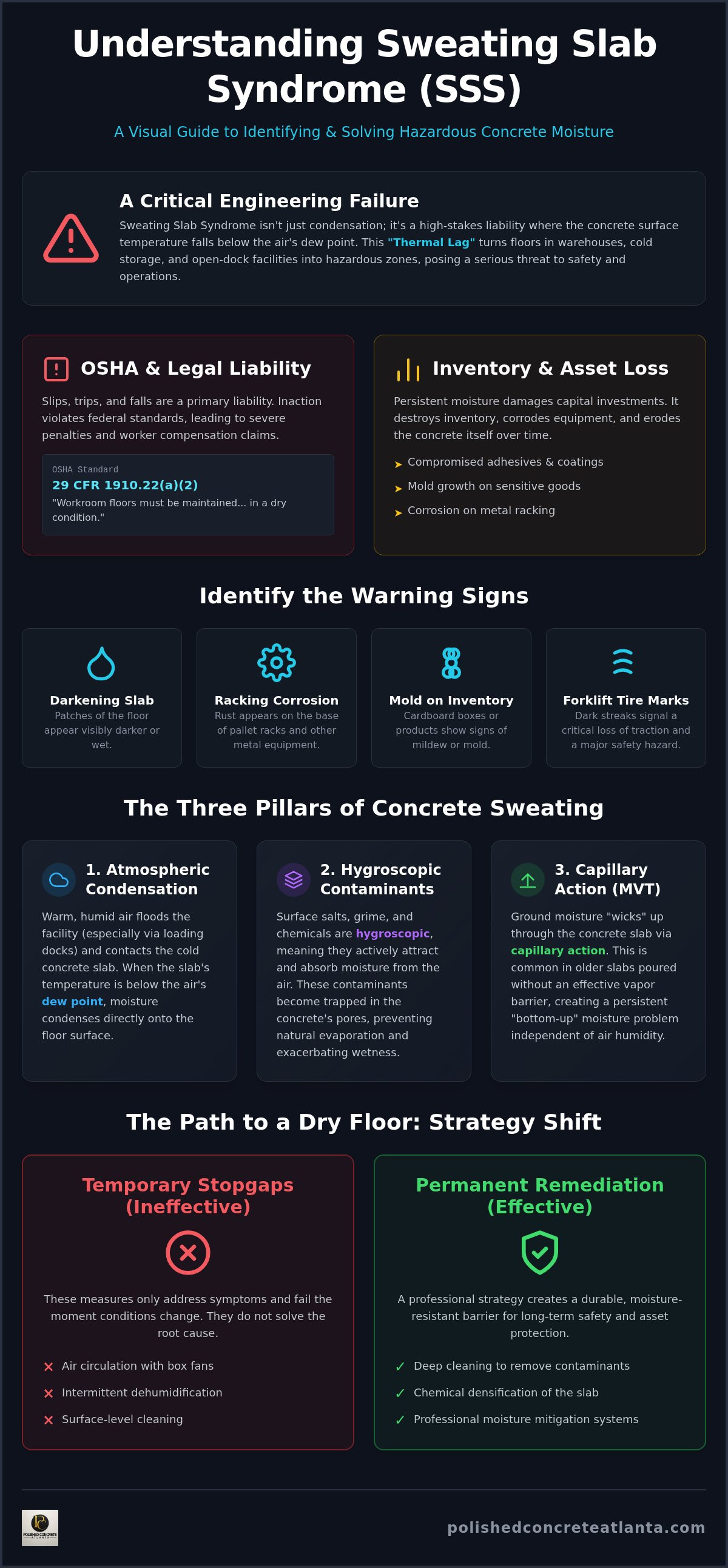
Sweating Slab Syndrome (SSS) is a multi-dimensional failure of air management and surface chemistry. It isn't a minor nuisance. It's a high-stakes liability. In industrial environments, this moisture appears when the surface temperature of the concrete falls below the dew point of the surrounding air. This phenomenon, known as 'Thermal Lag,' occurs because concrete slabs act as massive heat sinks. They retain the lower temperatures of the night long after the morning air has turned warm and humid. Facilities such as cold storage units, expansive warehouses, and open-dock operations are the most frequent victims of this atmospheric clash. Without effective sweating slab syndrome solutions, these facilities remain in a constant state of risk.
Identifying the Symptoms in Industrial Facilities
Look for the distress signals. You'll first notice a distinct darkening of the slab or fine beading across the surface. These aren't just damp spots; they're indicators of a compromised environment. Secondary signs include corrosion on pallet racking and mold growth on sensitive inventory. One of the most dangerous symptoms is the 'Tire Mark' trap. Forklifts lose traction on the moisture film, leaving behind dark streaks that signal a critical safety hazard. These visual cues demand immediate attention to prevent operational failure; keeping your fleet in top condition with services from TIPS Automotive can further enhance the safety and efficiency of your facility's operations.
The High Cost of Inaction: Liability and Asset Loss
The financial impact of inaction is staggering. Slips, trips, and falls remain the primary liability for facility managers. OSHA standard 29 CFR 1910.22(a)(2) mandates that workroom floors remain dry to the extent feasible. Beyond the risk of worker compensation claims, persistent moisture destroys your assets. It compromises the bond of existing adhesives and erodes the concrete matrix over time. While Damp proofing in construction provides a baseline, industrial-scale sweating requires specialized sweating slab syndrome solutions to prevent permanent asset loss. Proper remediation is an investment in the longevity of your floor and the safety of your workforce.
The Three Pillars of Concrete Slab Sweating
SSS is rarely the result of a single, isolated factor. It is a convergence of atmospheric physics, surface chemistry, and subterranean moisture. In regions like Atlanta, the humid transition seasons of spring and fall create a "perfect storm" where these variables align to compromise your facility. Understanding these pillars is the first step toward implementing effective sweating slab syndrome solutions. Without a holistic view of why moisture is accumulating, any fix will be temporary at best.
Atmospheric Condensation and the Dew Point Gap
Georgia's high relative humidity interacts aggressively with the significant thermal mass of an industrial concrete slab. Large open loading docks act as conduits, allowing warm, moisture-heavy air to flood the building. When this air contacts a slab that has retained overnight cooling, condensation forms instantly. The dew point is the temperature at which air can no longer hold water vapor. If your slab temperature stays below this threshold, it will remain wet regardless of how many portable fans you deploy across the workroom floor.
Hygroscopic Contaminants: The Role of Surface Salts
Surface chemistry often dictates how much moisture a floor attracts. De-icing salts, industrial chemicals, and even simple grime are hygroscopic; they have a chemical "thirst" that pulls water directly out of the air. Over time, forklift tire marks and debris clog the concrete's pores, trapping this moisture and preventing natural evaporation. Neutralizing these elements requires the expertise of concrete surface preparation contractors who understand how to deep-clean and open the slab's profile to remove these thirsty contaminants.
Capillary Action and Ground-Level Moisture Migration
You must distinguish between "top-down" condensation and "bottom-up" moisture vapor transmission (MVT). Many older industrial slabs were poured without an effective vapor barrier, allowing ground moisture to "wick" through the concrete via capillary action. A simple diagnostic is the plastic sheet test. Tape a square of clear plastic to the floor for 24 hours to see if moisture accumulates underneath. If it does, you aren't just dealing with humidity; you need professional moisture mitigation for concrete floors to block this subterranean pressure. If you're unsure which pillar is failing your facility, consult with a specialist to diagnose the root cause accurately.
Immediate and Long-Term Solutions for Sweating Slabs
Effective sweating slab syndrome solutions require a strategic hierarchy. Immediate relief comes from air management, but permanent security requires surface remediation. Relying on HVAC adjustments alone is a losing battle in high-traffic industrial zones. The constant movement of freight through open docks introduces more humidity than most standard systems can extract. You need a tiered strategy that moves from immediate stabilization to long-term asset protection. Stabilization addresses the air, but remediation addresses the concrete itself.
Optimizing Airflow with HVLS Fans and HVAC Adjustment
High-Volume Low-Speed (HVLS) fans are the frontline of air management. They work by destratifying the air, effectively equalizing the temperature between the ceiling and the floor to keep the slab above the dew point. Properly installed HVLS fans can also lead to year-round energy savings of up to 33%, making them a dual-purpose investment for your facility. Don't waste capital on portable box fans. They lack the power to dry a massive thermal mass and often just circulate humid air without achieving evaporation.
Surface Remediation: Scrubbing and Salt Neutralization
Surface remediation begins with aggressive cleaning. Automated scrubbers using alkaline cleaners are necessary to strip away the hygroscopic salts and industrial grime that attract moisture. Routine scrubbing isn't just maintenance; it's a prerequisite for any permanent coating or sealer. Neutralization is the chemical process of removing reactive contaminants to restore the slab's pH balance and open its pores for treatment. To achieve a permanent fix, you must address the slab's porosity through densification. This process, which often utilizes the Ashford Formula, chemically closes the concrete's pores. It makes it significantly harder for moisture to dwell or penetrate. If you are ready to implement these high-performance sweating slab syndrome solutions, our team provides the engineering expertise required for a bone-dry facility.
Professional Moisture Mitigation and Permanent Remediation
While mechanical solutions address the air, permanent remediation addresses the slab's physical profile. High-performance industrial floor coatings Atlanta provide a robust barrier against moisture vapor transmission, but the foundation of any long-term fix is chemical densification. This isn't a superficial treatment. It's a fundamental change to the concrete's internal structure. By transitioning from reactive maintenance to engineering-grade sweating slab syndrome solutions, you eliminate the cycle of moisture accumulation and floor failure. It's an investment in your facility's safety and the long-term integrity of your floor assets.
Moisture Mitigation Systems and Ashford Formula
Reactive chemical densifiers, specifically the Ashford Formula, work by penetrating deep into the concrete matrix. This chemical reaction fills the microscopic voids and pores that otherwise facilitate capillary action. Once treated, the slab becomes a hardened, dust-proof surface that resists the "wicking" of subterranean moisture. Permanent sealers are far more cost-effective than the endless energy consumption of industrial dehumidifiers or high-velocity fans. You aren't just drying the floor; you're making it impossible for the floor to hold moisture in the first place.
Polished Concrete as a Preventive Strategy
Mechanical refinement through the installation of polished concrete floors Atlanta creates a surface with significantly less available surface area for condensation to cling to. A dense, polished finish works in perfect synergy with high-performance sealed concrete protocols. There's a common misconception that polished floors are more slippery when they sweat. In reality, their lack of surface texture makes them much easier to dry and maintain during peak humidity. A smooth, dense surface allows moisture to evaporate faster than the rough, porous profile of untreated concrete.
Partnering with Atlanta’s Concrete Remediation Experts
Facility managers shouldn't rely on guesswork when worker safety is on the line. A professional moisture test and slab analysis are the only ways to identify whether your issues are atmospheric or subterranean. Polished Concrete Atlanta takes a no-nonsense approach to industrial floor failure, providing definitive sweating slab syndrome solutions that last for decades. We don't offer temporary patches; we provide engineered results. Consult with our experts for a permanent SSS solution and secure your facility today.
Secure Your Industrial Infrastructure Against Moisture
Sweating Slab Syndrome is more than a seasonal nuisance. It's a structural and safety failure that demands an engineering-grade response. You've seen how thermal lag, atmospheric dew points, and hygroscopic contaminants create a persistent hazard. Temporary fixes only mask the symptoms. True resolution requires a holistic approach that combines rigorous surface preparation with advanced chemical densification. By closing the concrete's pores and neutralizing surface salts, you transform a liability into a high-performance asset.
Polished Concrete Atlanta brings over 20 years of industrial expertise to every project. We are specialists in Ashford Formula installation and high-performance coatings, using the industry's most comprehensive surface preparation standards. Don't settle for mediocre results that fail when the Georgia humidity rises. Our definitive sweating slab syndrome solutions provide the peace of mind that comes from elite craftsmanship. Secure Your Facility with Professional Moisture Mitigation Today. Your team deserves a safe environment, and your inventory deserves total protection. We are ready to secure your floor for the long term.
Frequently Asked Questions
What is the fastest way to stop a concrete floor from sweating?
The fastest immediate way to stop condensation is to increase airflow using High-Volume Low-Speed (HVLS) fans to equalize surface and air temperatures. However, for a permanent fix, you need sweating slab syndrome solutions that address the slab's chemistry. Professional densification with the Ashford Formula closes the concrete's pores to prevent moisture from dwelling. This dual approach ensures your Atlanta facility stays dry during the most humid transition seasons.
Is Sweating Slab Syndrome an OSHA violation?
Yes, Sweating Slab Syndrome often leads to a violation of OSHA standard 29 CFR 1910.22(a)(2), which requires workroom floors to be maintained in a clean and dry condition. Moisture on a concrete surface creates a significant slip-and-fall liability that facility managers cannot ignore. Failing to address these hazards puts your personnel at risk and exposes your business to costly worker compensation claims and federal fines.
Can I use a regular sealer to stop my floor from sweating?
Regular film-forming sealers are generally ineffective and can actually worsen the problem by trapping moisture beneath the coating, leading to delamination. You need a penetrating chemical densifier that reacts with the concrete to fill its internal voids. These professional sweating slab syndrome solutions create a moisture-resistant barrier from within the slab rather than just sitting on top. This method ensures durability and prevents the peeling common with generic topical sealers.
How do I know if my floor is sweating or if there is a leak?
You can differentiate between atmospheric condensation and a subterranean leak by performing a simple plastic sheet test. Tape a square of clear plastic to the floor for twenty-four hours; if moisture appears on top, it's condensation from the air. If the moisture is underneath the plastic, you have ground-level moisture vapor transmission. For a definitive diagnosis in Atlanta warehouses, we recommend professional ASTM F2170 relative humidity testing.
Does polishing concrete make Sweating Slab Syndrome worse?
Polished concrete does not make sweating worse; in fact, it often makes the moisture easier to manage. The mechanical polishing process creates a dense, refined surface with less total surface area for water vapor to cling to. While the floor may look slicker, the lack of surface pores allows for faster evaporation and much easier cleaning with an automated scrubber. A polished finish combined with a densifier is a superior preventative strategy.
How much does professional moisture mitigation cost for a warehouse?
The cost of professional moisture mitigation depends on several variables including the total square footage of the warehouse and the severity of the moisture vapor transmission. Other factors like existing floor contamination and the specific type of industrial floor coatings required also influence the final investment. Because every slab in the Atlanta region has unique thermal properties, a detailed site analysis and moisture test are required to provide an accurate estimate.


