
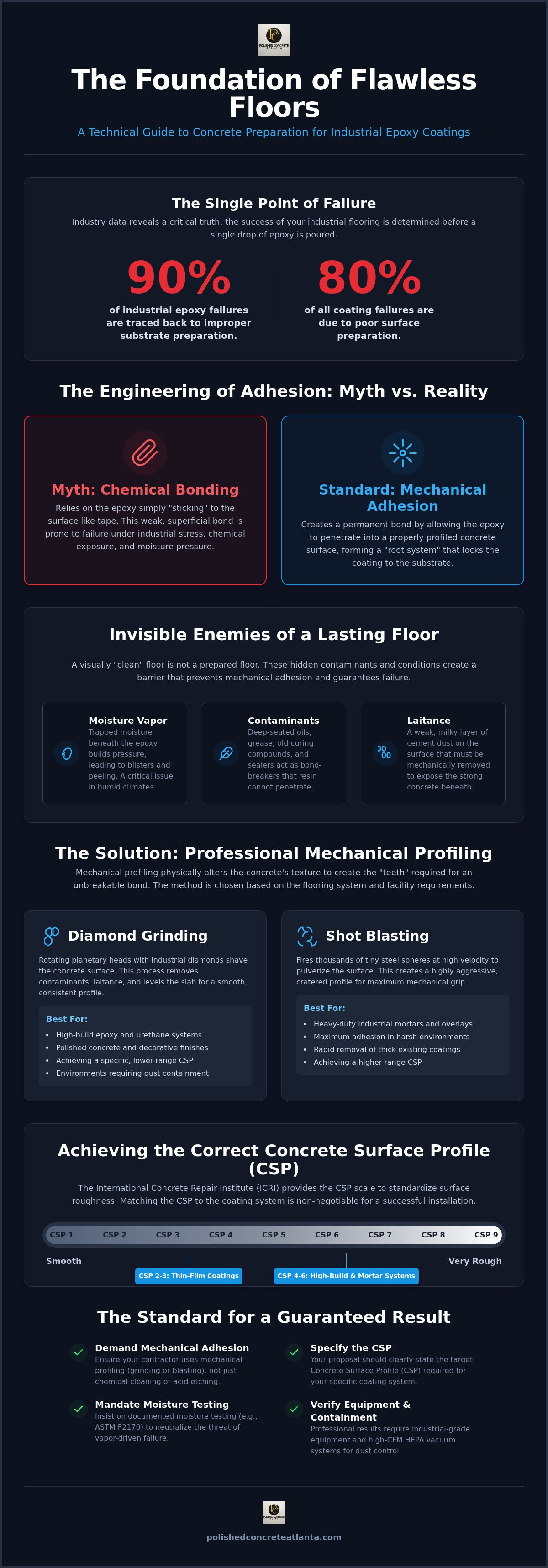
Did you know that 90% of industrial epoxy failures are traced back to a single phase of the project? It isn't the quality of the resin or the skill of the applicator during the pour. It's the substrate. You expect your facility's floor to withstand heavy traffic and chemical exposure without flinching. Seeing a premium investment peel, blister, or delaminate is a failure no stakeholder should tolerate. We agree that mediocrity has no place in industrial infrastructure. That is why mastering concrete prep for epoxy flooring is the only way to guarantee a permanent result.
Adhesion is not accidental; it's an engineered mechanical bond that requires precise profiling and moisture management. In this guide, we'll provide the technical requirements to ensure your floor meets the 2026 standards for durability and safety. We'll examine the critical shift toward mechanical diamond grinding, the necessity of ASTM F2170 moisture testing, and how to achieve the exact Concrete Surface Profile (CSP) your specific environment demands. Your floor shouldn't just look elite. It should be indestructible.
Key Takeaways
- Learn why mechanical adhesion is the only acceptable standard for industrial environments where chemical bonds inevitably fail.
- Discover how to utilize the ICRI CSP scale to specify the correct concrete prep for epoxy flooring for high-traffic facilities.
- Gain clarity on the ASTM testing protocols required to neutralize the threat of Georgia's high humidity and vapor drive.
- Compare diamond grinding and shot blasting to determine which method eliminates substrate uncertainty for your specific slab.
- Recognize why professional floor preparation is a strategic investment that secures your facility's long-term operational integrity.
Why Concrete Surface Preparation is the Single Point of Failure
Industrial flooring isn't about aesthetics; it's about performance. Most contractors rely on chemical bonding, hoping the resin sticks to the surface like tape. Professional standards demand mechanical adhesion. This occurs when the epoxy penetrates the open pores of the concrete, creating a root system that cannot be pulled apart. Without rigorous concrete prep for epoxy flooring, you're merely painting a floor. Industry data confirms that 80% of all epoxy floor failures are traced back to poor surface preparation.
Invisible enemies often sabotage the bond. Deep-seated oils, old curing compounds, and laitance create a barrier that resin cannot penetrate. If these aren't removed through mechanical means, the floor will fail. We view this as the "Engineering of Adhesion." It's a strategic asset protection plan, not a janitorial task. When you eliminate substrate uncertainty, you eliminate the risk of a total loss.
The Cost of Failure: Blistering, Peeling, and Delamination
Trapped moisture and contaminants are the primary catalysts for delamination. When vapor pressure builds beneath an unsealed or poorly prepped slab, it forces the epoxy off the substrate. The result is blistering and unsightly peeling. For an active facility, the financial impact of downtime is often triple the cost of the original installation. Laitance is the weak, milky layer of cement dust and sand that rises to the concrete surface during pouring and must be removed to expose the solid aggregate beneath. Properly installed Epoxy moisture control systems are essential to mitigate these risks and protect your investment.
Why 'Clean' Concrete Isn't Prepared Concrete
A floor can be spotless and still be completely unprepared for a coating. Surface cleanliness is not the same as a proper Concrete Surface Profile (CSP). Methods like pressure washing or chemical acid etching are relics of the past that often introduce more moisture or leave behind reactive salts. True concrete prep for epoxy flooring requires mechanical profiling to create the "teeth" the resin needs. For a deeper look at these technical requirements, read The Engineering of Adhesion: A Definitive Guide to Concrete Surface Preparation. We don't settle for "clean" when the standard is "profiled."
Mechanical Profiling: Diamond Grinding vs. Shot Blasting
Surface "cleaning" is for residential garages. In an industrial environment, the only acceptable standard for concrete prep for epoxy flooring is mechanical profiling. This process moves beyond the surface to physically alter the concrete's texture. We utilize the International Concrete Repair Institute (ICRI) Concrete Surface Profile (CSP) scale to define the exact topography required for your specific coating system. Adhesion is a science, not a guess.
Diamond grinding is the preferred method for high-build epoxy and aesthetic finishes. It uses rotating planetary heads equipped with industrial diamonds to shave the concrete, removing laitance and leveling the slab. For heavy-duty industrial adhesion, shot blasting remains the gold standard. It fires thousands of steel metallic spheres at the substrate, creating a cratered, high-grip surface that heavy mortars require for a permanent bond. Choosing the wrong method is the fastest way to ensure a premature floor failure.
Achieving the Right CSP (Concrete Surface Profile)
The ICRI scale ranges from CSP 1 (nearly smooth) to CSP 9 (extremely aggressive). Thin-film systems typically demand a CSP 2, while high-performance industrial mortars require a CSP 4 or higher. Visualizing this as a specific "sandpaper" texture helps stakeholders understand the mechanical "teeth" required for the resin to bite. If your contractor cannot specify the CSP they're targeting, they aren't preparing your floor; they're just scuffing it. Following ASTM moisture testing standards during this phase ensures the profiled substrate is actually ready for the coating.
The Equipment Advantage: Industrial vs. Rental Grade
Flatness and consistency are only achievable with industrial-grade planetary grinders. Rental-grade single-head units lack the head pressure and weight needed to remove deep-seated contaminants or correct slab irregularities. Our process prioritizes dust containment through high-CFM vacuum systems with HEPA filtration. This maintains air quality in food-safe or sensitive environments where contamination isn't an option. For a deeper look at system specifications, see The Definitive Guide to Industrial Floor Coatings Atlanta.
Clearing the slate also requires expert floor glue removal. Old mastic, carpet adhesives, and thin-set prevent epoxy penetration. We use specialized PCD (Polycrystalline Diamond) tooling to strip these residues without compromising the slab's integrity. Consulting with experts in industrial floor preparation ensures your profiling strategy matches your facility's long-term operational needs. We don't just prep floors; we engineer them for life.
Managing Moisture and Substrate Integrity in Atlanta
Atlanta's climate presents a unique set of challenges for industrial flooring. High humidity and hilly terrain aren't just environmental factors; they're direct threats to your floor's longevity. In Georgia, concrete slabs often act like sponges, absorbing moisture from the red clay soil and releasing it through the surface. This process, known as vapor drive, creates hydrostatic pressure that can easily exceed the bond strength of standard resins. Without specialized concrete prep for epoxy flooring that accounts for these local conditions, your floor is on a collision course with failure.
Sweating Slab Syndrome is a frequent issue in Atlanta warehouses. It occurs when warm, humid air enters a facility and condenses on a cooler concrete slab. This moisture doesn't just sit on top; it penetrates the pores. Identifying and remediating this syndrome is critical before any coating application. We install high-performance moisture mitigation systems that act as a permanent barrier, neutralizing vapor drive and ensuring your investment remains bonded for its entire lifecycle.
Professional Moisture Testing Protocols
Reliability starts with data, not guesswork. We reject the "plastic sheet test" as an insufficient relic that offers zero protection against commercial liability. True substrate integrity is verified through ASTM F2170 (Relative Humidity probe) and ASTM F1869 (Calcium Chloride) tests. These protocols measure the internal relative humidity and the Moisture Vapor Emission Rate (MVER) of the slab. If your internal RH exceeds 80-85%, a high-moisture tolerant primer is a non-negotiable requirement. We eliminate uncertainty by quantifying exactly what's happening inside your concrete.
Repairing the Foundation: Cracks, Joints, and Spalls
A perfectly profiled floor is useless if the foundation is fractured. Every joint, crack, and spall must be addressed before the first drop of epoxy touches the ground. Moving cracks are particularly dangerous; without proper stabilization, they will telegraph through your new floor, causing visible fractures in the coating. We use semi-rigid joint fillers and industrial-grade epoxy mortars to restore the slab to a perfectly flat, monolithic plane. This level of detail is what separates a premium installation from a temporary fix. For facilities dealing with high humidity or slab sweating, our team provides expert floor moisture mitigation services to secure your substrate before installation begins.
The Polished Concrete Atlanta Standard: Choosing Your Partner
Cutting corners on substrate preparation is the most expensive mistake a facility manager can make. While a lower bid might seem attractive, the hidden costs of delamination and operational downtime far outweigh the initial savings of a "quick clean." We believe in a no-nonsense approach to concrete prep for epoxy flooring because we understand that your floor is a critical piece of industrial infrastructure. A partner who prioritizes rigorous standards over speed ensures that your investment remains an asset rather than a recurring liability. Adhesion is a permanent commitment, not a temporary fix.
Atlanta's geological landscape, defined by high-clay content and extreme seasonal humidity, demands a contractor with local mastery. National firms often apply a one-size-fits-all solution that fails to account for the vapor drive unique to Georgia slabs. We don't just see a concrete floor; we see a complex substrate that requires a specific engineering strategy to survive in our local climate. This regional expertise is the difference between a floor that lasts five years and one that lasts twenty. We bring the gravitas of veterans who have mastered the craft in the most challenging environments.
The Value of an Authoritative Expert
Transparency in the preparation phase is the hallmark of professional character. When vetting a contractor, ask about their specific CSP targets and the CFM capacity of their dust containment systems. Do they perform in-situ relative humidity testing, or are they relying on visual inspections? An expert partner will provide data-driven answers and clear documentation of every test performed. For a deeper dive into selecting the right team, consult our Industrial Flooring Contractors in Atlanta: A Strategic Guide. We don't hide behind vague descriptions; we lead with technical precision.
Ready to Engineer Your Floor?
The transition from a raw, profiled slab to a high-performance industrial finish is where vision meets execution. We eliminate uncertainty by managing every granular detail of the process, from initial glue removal to the final application of high-luster resins. Our commitment to high-end craftsmanship means we never settle for mediocrity in our concrete prep for epoxy flooring protocols. If you are ready to secure your high-traffic commercial space with a floor engineered for durability, contact us for a professional consultation. We build floors that reflect the integrity of your business.
Securing Your Industrial Infrastructure for 2026 and Beyond
A high-performance floor is only as reliable as the substrate beneath it. We have established that mechanical profiling and rigorous moisture testing are the non-negotiable pillars of a successful installation. By adhering to the ICRI CSP standards and neutralizing vapor drive through professional concrete prep for epoxy flooring, you eliminate the uncertainty of delamination and premature failure. Your facility deserves a foundation built on technical precision, not optimistic guesswork.
As Atlanta's leader in industrial moisture mitigation, we bring two decades of high-end craftsmanship to every project. Our specialized expertise in Sweating Slab Syndrome remediation ensures your floor remains resilient despite Georgia's challenging climate. We don't settle for mediocrity; we deliver tangible results that protect your operational integrity. It is time to move from a vision of quality to the execution of excellence.
Secure Your Facility's Foundation with Professional Prep – Contact Polished Concrete Atlanta. Let us engineer a surface that stands the test of time and heavy traffic.
Frequently Asked Questions
How much does professional concrete prep for epoxy flooring cost per square foot?
Professional costs depend on the current state of your substrate and the required Concrete Surface Profile (CSP). Factors like deep-seated oil contamination, heavy mastic removal, or the necessity of moisture mitigation in Atlanta's humid environment will influence the total investment. We view this phase as a non-negotiable stage of the engineering process. Attempting to cut costs here leads to the vast majority of industrial floor failures. Quality concrete prep for epoxy flooring secures your long-term ROI.
Can I just use acid etching instead of diamond grinding for an industrial floor?
No. Acid etching is an outdated residential technique that has no place in a modern industrial facility. It fails to create the aggressive mechanical bond required for heavy machinery and high-traffic loads. Etching often introduces excess moisture and reactive salts into the slab, which can sabotage your resin's adhesion. We utilize mechanical diamond grinding to ensure a consistent, predictable profile that meets 2026 industrial safety and durability standards. We don't settle for "clean" when the standard is "profiled."
What is the difference between shot blasting and diamond grinding for concrete prep?
Diamond grinding uses rotating planetary heads equipped with industrial diamonds to shave and level the slab. It's the preferred method for high-build aesthetic systems. Shot blasting fires steel metallic spheres at the concrete to create a deeper, cratered texture. This is the gold standard for heavy-duty industrial mortars that require maximum mechanical "teeth." Both methods outperform manual cleaning by physically altering the substrate to guarantee a permanent, worry-free bond that chemical adhesion alone cannot provide.
How long does the concrete preparation process take for a large warehouse?
Timing for a large warehouse depends on the square footage and the complexity of the existing floor. A standard industrial prep phase might take two to four days using high-performance planetary grinders and shot blasters. We prioritize efficiency without compromising on the meticulous management of details. Our high-CFM dust containment systems allow us to work in sensitive environments without halting your entire operation. Precision takes time, but a floor failure takes significantly longer to remediate.
What happens if I apply epoxy to a concrete slab with high moisture levels?
Applying epoxy to a high-moisture slab is a recipe for total delamination. Atlanta's red clay and high humidity often cause vapor drive, where moisture moves through the concrete and creates hydrostatic pressure. This pressure will eventually force the coating to blister and peel off the substrate. We neutralize this threat through professional moisture mitigation and ASTM-standard testing. Protecting your foundation is the only way to avoid a catastrophic floor failure and the massive costs of facility downtime.
Do I need to remove old floor glue and paint before applying new epoxy?
Yes. Any existing paint, sealer, or mastic acts as a bond-breaker that prevents the epoxy from penetrating the concrete pores. Professional concrete prep for epoxy flooring must involve thorough floor glue removal using specialized PCD tooling. We clear the slate to expose the virgin aggregate beneath. This ensures the resin forms a monolithic bond with the slab itself rather than clinging to a failing layer of old material. If the previous coating is still there, your new floor isn't actually attached to the building.


