
Most commercial flooring is a temporary layer waiting to fail. Whether it's paint that chips or carpet that traps contaminants, the cycle of replacement is a constant drain on your bottom line. You need a solution that's permanent. This is where decorative concrete staining commercial applications redefine the industry standard. Unlike topical paints that merely sit on the surface, professional stains create a permanent chemical bond deep within the concrete matrix. This results in a floor that can't peel, flake, or delaminate under heavy foot traffic. It's not just a finish. It's an architectural integration.
It's natural to feel uncertain about maintenance costs or the technical differences between stains, dyes, and paints. You deserve absolute clarity and a high-luster finish that doesn't sacrifice industrial-grade resistance. This guide explores how precision engineering transforms raw slabs into high-end assets with a superior long-term ROI. We'll examine the critical role of surface preparation and moisture mitigation in ensuring your investment remains flawless for decades. Your floor should be a definitive statement of excellence. We ensure it stays that way.
Key Takeaways
- Master the science of chemical penetration to ensure your decorative concrete staining commercial application never peels or delaminates under pressure.
- Distinguish between reactive acid stains and non-reactive dyes to achieve the precise architectural aesthetic your high-end facility demands.
- Recognize why mechanical grinding and meticulous floor preparation are the only ways to guarantee a permanent bond for your finish.
- Evaluate high-performance sealers like polyaspartic and polyurethane to shield your floors from heavy traffic and industrial wear.
- Implement a strategic maintenance plan using sacrificial wax layers to preserve your floor's luster and extend its life for decades.
The Science of Commercial Decorative Concrete Staining
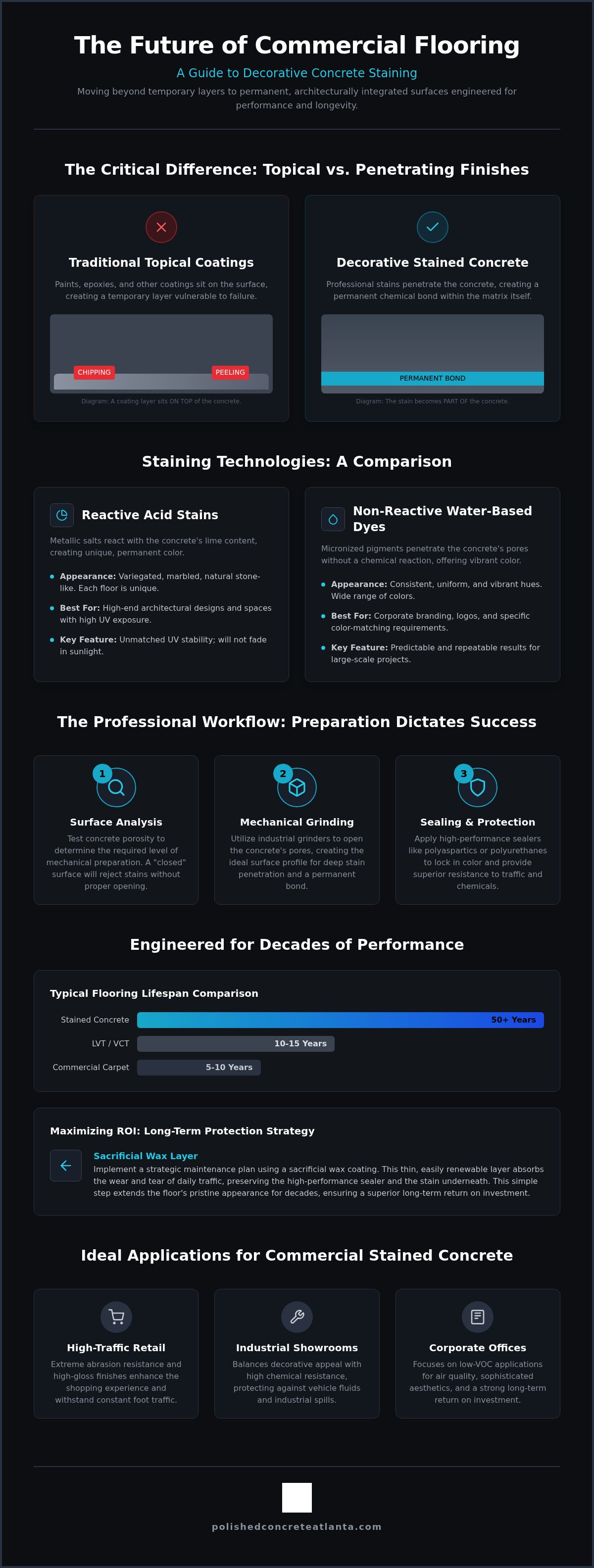
Commercial flooring is often misunderstood as a purely aesthetic choice. It isn't. High-end facilities require a substrate that performs under duress. Professional decorative concrete staining commercial projects succeed because they rely on chemical penetration rather than topical adhesion. While paint sits on the surface, waiting to chip, a professional stain becomes part of the concrete matrix itself. This distinction is the foundation of The Science of Commercial Decorative Concrete Staining. The final look isn't just applied. It's a result of the unique mineral composition of your specific slab. This results in a floor that can't peel, flake, or delaminate under heavy foot traffic. It's not just a finish. It's an architectural integration.
Acid Stains vs. Water-Based Dyes
Reactive acid stains work by introducing metallic salts that react with the calcium hydroxide in the concrete. This creates a permanent, variegated appearance that mimics natural stone or aged leather. It's unpredictable in the hands of an amateur but sophisticated when executed by experts. Water-based dyes offer a different advantage. These non-reactive systems provide consistent, vibrant hues that are perfect for specific branding requirements. For facilities with large windows or skylights, UV stability is a critical factor. We select systems that resist fading, ensuring the architectural intent remains intact for years. We don't settle for mediocrity.
The Role of Concrete Porosity in Commercial Applications
Most modern commercial slabs are hard-troweled for density. This creates a "closed" surface that rejects stains. We don't guess; we test. If the surface is too tight, we utilize mechanical grinding to open the pores and create the necessary surface profile for optimal absorption. Surface porosity determines the depth of the chemical bond and the ultimate richness of the pigment saturation. Without this professional mechanical opening, the stain remains shallow and vulnerable. We prioritize the engineering of the substrate to ensure the finish survives the rigors of industrial use. Quality is non-negotiable. Our process eliminates uncertainty.
Performance Metrics for Decorative Concrete in High-Traffic Zones
Aesthetics mean nothing if the floor fails under the pressure of daily operations. In high-traffic zones, decorative concrete staining commercial solutions must withstand thousands of footfalls and heavy equipment cycles without degrading. We don't just apply color. We engineer a surface that resists abrasion and chemical intrusion. Unlike epoxy, which can delaminate if the bond is compromised, stained concrete becomes a permanent part of the slab. This chemical integration is why stained concrete has a lifespan of over 50 years with proper maintenance. It outlasts carpet and LVT by decades. It's a definitive investment in your facility's future.
Safety is a non-negotiable metric. We integrate traction additives into high-performance sealers to meet rigorous slip resistance standards. This is especially critical in retail and restaurant environments where spills are inevitable. When we discuss a Professional Workflow: Why Surface Preparation Dictates Success, we're highlighting the foundation of this performance. A properly prepared floor ensures that the sealer and stain bond perfectly, creating a barrier against oils, chemicals, and moisture. We eliminate the uncertainty of floor failure through disciplined execution.
Strategic Selection Framework
Different environments demand specific performance profiles. High-traffic retail spaces prioritize extreme abrasion resistance and high-gloss aesthetics to reflect light and enhance the shopping experience. Industrial showrooms require a balance of chemical resistance and decorative appeal to showcase products without fear of staining from vehicle fluids. In corporate office environments, the focus shifts to low-VOC applications and long-term ROI. We help you identify the specific needs of your space to ensure the final product is both beautiful and functional. If you're looking for a partner to handle your commercial concrete floors, we provide the expertise needed for these high-stakes environments.
Stain vs. Dye Performance Comparison
Choosing the right medium is critical for long-term durability. While acid stains offer unmatched UV stability for facilities with high natural light, dyes provide the vibrant branding colors many modern facilities demand. You can compare these performance metrics against The Standard for Polished Concrete Floors in Atlanta to determine which system aligns with your facility's gloss and maintenance requirements.
| Metric | Acid Stain | Solvent Dye | Water-based Dye |
|---|---|---|---|
| Longevity | Permanent (Chemical) | High (Penetrating) | High (Penetrating) |
| Color Range | Earthy/Natural | Vibrant/Wide | Vibrant/Wide |
| Installation Speed | Slow (Reaction/Wash) | Very Fast | Moderate |
| UV Resistance | Excellent | Variable | Good |
Professional Workflow: Why Surface Preparation Dictates Success
Surface preparation is not a suggestion. It is the law of the slab. Many contractors rush to the aesthetic phase because it's the easiest to sell. We don't. A high-end decorative concrete staining commercial project lives or dies by the mechanical profile of the concrete. If the pores aren't open, the stain has nowhere to go. It sits on the surface. It fails. We utilize industrial-grade planetary grinders to remove the "laitance" and create a consistent surface profile that accepts chemical integration. DIY methods and rental equipment simply lack the weight and diamond tooling necessary to achieve this standard. We eliminate the guesswork.
Floor Glue Removal and Surface Leveling
Renovating an existing facility often reveals a history of failure. Layers of old mastic, carpet glue, or failing epoxy residues act as barriers to a successful stain. We perform rigorous floor glue removal to expose the "virgin" concrete. This step is critical to prevent "ghosting," a phenomenon where the pattern of previous floor coverings telegraphs through the new finish. We don't just scrape; we grind until the substrate is pristine. For an exhaustive look at our technical standards, consult The Engineering of Adhesion. Our process ensures a flawless canvas for your architectural vision.
Moisture Remediation in Georgia Facilities
In Atlanta, the climate is your greatest adversary. High ambient humidity combined with poorly shielded slabs leads to "sweating slab syndrome." This isn't just a nuisance. It's a catalyst for floor failure. We conduct MVER (Moisture Vapor Emission Rate) testing as an absolute 2026 industry standard before any stain is applied. If the relative humidity exceeds 75%, we implement advanced moisture mitigation systems to block vapor drive. This prevents osmotic blistering and ensures your decorative finish remains bonded for the life of the building. We prioritize the integrity of the final product over a fast turnaround. Peace of mind is part of the package.
Don't risk your facility's reputation on a contractor who skips the prep. We are the authoritative experts in floor preparation and moisture mitigation, ensuring your high-end finish is built on a foundation of excellence.
Maximizing ROI: Maintenance and Long-Term Protection
High-end floors are significant capital investments. They require a definitive strategy to maintain their value over time. Professional decorative concrete staining commercial applications achieve their full potential only when protected by the correct chemical barrier. A floor that looks elite on day one must remain elite on year ten. This is about lifecycle costs. By eliminating the frequent removals and replacements common with carpet or tile, you secure a superior long-term ROI. We don't just finish floors. We preserve assets.
The Sealing Standard for 2026
The choice of sealer is a technical decision based on your specific facility hazards. Acrylic sealers provide a cost-effective dust-proofing layer, but they lack the industrial-grade resistance of high-solids systems. Polyurethane offers exceptional resistance to oils and acids. It's the standard for retail or food service. Polyaspartic sealers are the elite choice for rapid return-to-service, curing in hours rather than days. Your choice between a high-luster gloss or a sophisticated matte finish also impacts how your commercial lighting interacts with the space. For a deeper dive into these specifications, see The Definitive Guide to Sealed Concrete.
We recommend a 2026 maintenance schedule that prioritizes a sacrificial wax layer. This thin, renewable coating takes the brunt of daily foot traffic. It preserves the permanent sealer underneath. It's a pragmatic approach. When the shine dulls, you simply buff and re-apply the wax, not the entire sealer system. This reduces downtime. It cuts labor costs. It works. We prioritize results over flowery descriptions.
Partnering with Atlanta Flooring Specialists
Local expertise is non-negotiable in the Southeast. Our team understands how Georgia's humidity affects chemical cure times and bond strength. We manage the project from initial color sampling to final execution, ensuring every detail aligns with your architectural vision. For those seeking high-performance results in the metro area, our guide to Stained Concrete Floors Atlanta provides the roadmap for success. We eliminate the uncertainty of the process.
Stop settling for mediocre flooring solutions that require constant repair. You need a partner who understands the science of the slab and the rigors of industrial use. Schedule a professional consultation for your Atlanta commercial facility. We deliver results that endure. No excuses. Just excellence.
Securing Your Facility’s Architectural Future
Your commercial floor is a high-stakes asset. Don't leave its performance to chance or amateur application. We've established that success depends on rigorous mechanical preparation and the precise chemical integration of decorative concrete staining commercial systems. By prioritizing moisture mitigation and strategic maintenance, you ensure a finish that resists the heaviest industrial demands while maintaining an elite aesthetic.
Polished Concrete Atlanta brings over 20 years of industrial experience to every project. We utilize specialized moisture mitigation equipment to eliminate the risk of floor failure in Georgia’s humid climate. Our proven track record with high-traffic retail and corporate office spaces speaks for itself. We don't just provide a service; we deliver peace of mind through disciplined engineering and uncompromising quality.
Ready to transform your facility with a floor built to last decades? Request a Professional Quote for Commercial Concrete Staining today. Let's build a foundation that reflects your standard of excellence.
Frequently Asked Questions
Is decorative concrete staining permanent for commercial use?
Decorative concrete staining commercial applications are permanent because they rely on chemical penetration rather than topical adhesion. The stain reacts with the concrete's minerals to create a deep color that won't peel or flake under industrial foot traffic. While the protective sealer may require eventual maintenance, the color itself is integrated into the slab. This makes it a superior long-term investment compared to temporary surface coatings or paints.
How long does the commercial concrete staining process take?
Most commercial projects require three to five days for completion, though specific timelines depend on the substrate's condition. The process involves mechanical grinding, stain application, neutralization, and sealing. Large Atlanta facilities may require phased execution to minimize operational disruption. We prioritize thorough surface preparation over speed because rushing the cure or prep phases leads to premature floor failure. Quality takes a disciplined amount of time.
What is the difference between concrete stain and concrete paint?
Concrete paint is a topical film that sits on the surface and eventually delaminates under stress. In contrast, decorative concrete staining commercial systems penetrate the pores to create a permanent bond. Paint hides the concrete's character with an opaque layer that chips. Stains provide a translucent, variegated finish that highlights the material's natural beauty while ensuring industrial-grade durability. We don't recommend paints for high-traffic environments.
Can you stain old concrete floors that had carpet or tile?
You can absolutely stain older slabs, provided they undergo professional floor glue removal and mechanical grinding. Residual adhesives from carpet or tile will block stain penetration and must be completely remediated. We specialize in removing legacy mastics to expose a clean, porous surface. Be aware that ghosting patterns from previous flooring may remain visible, adding to the floor's unique industrial character. We engineer the surface for success.
How much maintenance does a commercial stained concrete floor require?
Maintenance is minimal but essential for preserving the floor's luster. Daily dust mopping and occasional damp mopping with a pH-neutral cleaner are usually sufficient. For high-traffic Atlanta retail spaces, we recommend a sacrificial wax layer that protects the permanent sealer from abrasion. This wax can be easily buffed or reapplied without stripping the entire floor. This strategic approach reduces lifecycle costs and keeps the facility looking elite for decades.
Is stained concrete slippery when wet in a commercial setting?
Stained concrete can be slippery when wet if it's finished with a high-gloss sealer, but we eliminate this risk through engineering. We integrate specialized anti-slip additives into the final sealer coat to increase traction without compromising the aesthetic. This ensures your facility meets all safety standards while maintaining a high-end architectural finish. We prioritize safety and performance in every installation. Your peace of mind is our standard.


