
A cheap floor coating is the most expensive mistake a facility manager can make. While a quick topical seal might look acceptable on day one, the inevitable peeling and dusting soon transform a budget-friendly choice into a maintenance nightmare. Deciding between sealed vs polished concrete is not merely an aesthetic preference. It is a strategic decision regarding the structural integrity and long-term viability of your facility. You deserve a surface that reflects your standards of excellence. No more guesswork. Just performance.
You are likely tired of conflicting contractor advice and the high costs of traditional floor upkeep. We understand the need for a definitive, high-performance solution that eliminates uncertainty and protects your investment. This 2026 comparison guide delivers the critical structural and financial data you need to choose the definitive surface for your specific traffic requirements. We will analyze total cost of ownership, maintenance cycles, and the mechanical refinement processes that separate a temporary film from a permanent, dust-free asset. It is time to move from the abstract concept of quality to the concrete reality of a superior floor.
Key Takeaways
- Define the technical engineering gap between sealed vs polished concrete to ensure you aren't mistaking a temporary topical film for permanent structural refinement.
- Compare lifecycle costs and maintenance cycles to see how polished surfaces eliminate the recurring expense of re-sealing and frequent topical repairs.
- Assess your facility's specific traffic patterns and slab condition to select a surface that withstands industrial-grade wear without dusting or peeling.
- Learn why professional surface preparation and glue removal are the only ways to guarantee long-term adhesion and performance for any concrete finish.
Understanding the Technical Divide: Sealed vs. Polished Concrete
The divide between sealed vs polished concrete isn't just about how the light hits the floor. It's a question of where the protection lives. One system places a barrier on the surface, while the other re-engineers the slab's internal structure. Both methods aim to solve the problem of concrete dusting, but the underlying engineering determines whether your floor is a temporary finish or a permanent asset. You must decide if you want a layer of protection or a slab that is inherently protected.
The Mechanics of Sealed Concrete
Sealed concrete, often called a "grind and seal" in professional circles, relies on chemistry to do the heavy lifting. We use industrial-grade equipment to remove surface contaminants and open the pores before applying topical agents like acrylics, epoxies, or polyurethanes. These products create a sacrificial wear layer that shields the concrete from stains and abrasion. Alternatively, penetrating sealers move into the pores to create an internal moisture barrier. Regardless of the specific product, the protection remains a separate entity from the concrete itself. It's a coating that will eventually wear thin under heavy use.
The Science of Polished Concrete Refinement
Polished concrete represents a different level of commitment. This is a mechanical refinement process that closes the surface pores to a molecular level. The Polished concrete process utilizes a sequence of diamond-grit abrasives to grind and hone the slab. We introduce chemical densifiers during these stages to trigger a reaction with the concrete's natural compounds. This creates a harder, denser crystalline structure. The result is a floor that doesn't need a topical film to shine or resist wear. The slab becomes the finish. It's a permanent, high-performance surface that stands up to the most rigorous industrial environments. It doesn't peel because there is nothing to peel. It is the definitive choice for those who prioritize long-term structural integrity over short-term fixes.
Performance Metrics: Durability, Maintenance, and Lifecycle Costs
The true cost of a floor is rarely found in the initial quote. It surfaces over years of forklift traffic, chemical exposure, and maintenance cycles. When evaluating sealed vs polished concrete, you must look beyond the first day of installation. A floor that fails under pressure isn't a bargain. It's a bottleneck. You need a surface that works as hard as your crew does.
Traffic Resistance and Industrial Longevity
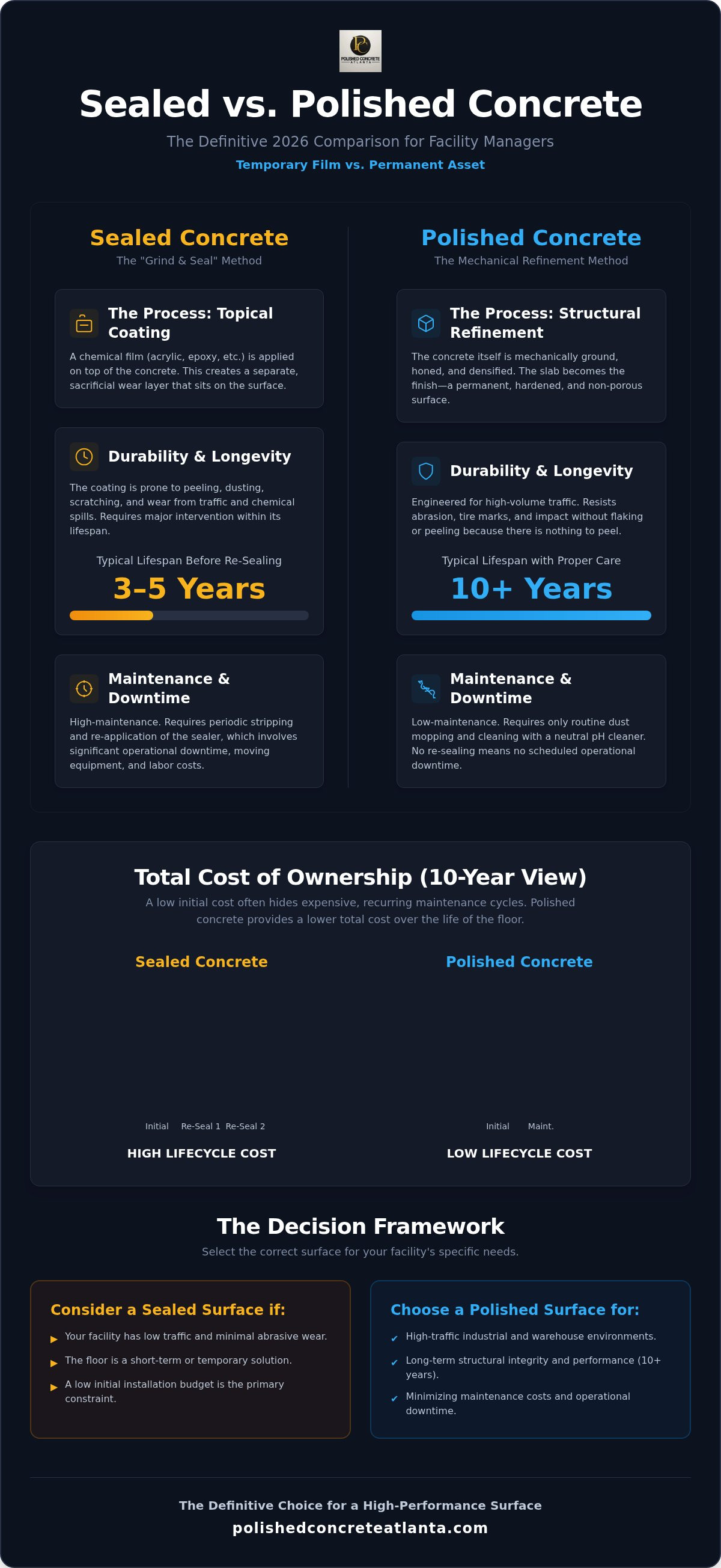
Polished concrete is engineered for high-volume environments. It resists the black tire marks and abrasions that plague warehouse settings. Because the surface is mechanically densified, it withstands the constant friction of pallet jacks and heavy machinery without flaking. Sealed floors simply cannot compete at this level. A topical sealer acts as a sacrificial layer; it takes the hit so the concrete doesn't. However, once that film is breached by impact or chemical spills, the protection vanishes. You can expect a polished surface to last 10 years or more with proper care. A sealed floor typically requires intervention within 3 to 5 years. The difference in longevity is a matter of structural engineering versus temporary coating.
Maintenance Requirements and Operational Downtime
Maintenance cost is the silent killer of facility budgets. Polished floors simplify the process. They require nothing more than routine dust mopping and the use of neutral pH cleaners to maintain their clarity. There is no wax to strip and no film to buff back into existence. Conversely, the hidden costs of sealed floors include periodic re-application. Every re-seal requires a facility shutdown. That means moving racks, stopping production, and paying for labor. It's a cycle of disruption that high-performance facilities cannot afford. Adhering to rigorous Polished Concrete Finishing Specifications ensures your slab remains a low-maintenance asset rather than a recurring liability. If you're managing an industrial space, you can't afford the downtime of a failing floor. Our team at Polished Concrete Atlanta ensures your surface meets the highest performance standards from day one.
The Decision Framework: Selecting the Correct Surface for Your Facility
Choosing between sealed vs polished concrete requires a cold, hard look at your facility's operational reality. You can't pick a finish based on a catalog photo. Your existing slab's condition dictates the roadmap. If the concrete is soft, porous, or heavily contaminated, the preparation requirements will shift your budget immediately. Local climate conditions also demand your attention. Atlanta's high humidity levels often trigger Sweating Slab Syndrome, where moisture collects on the surface of non-breathable coatings. We solve this through strategic moisture mitigation and mechanical refinement. A misapplied finish is a liability you'll pay for every day.
When to Choose Sealed Concrete
Sealed concrete remains a tactical choice for specific scenarios. It's the ideal solution for large-scale industrial shells or storage areas where foot traffic is minimal. If your primary goal is dust-proofing a massive warehouse on a tight timeline, a professional sealed concrete application provides the necessary protection without the intensive labor of full mechanical polishing. It's about pragmatic resource allocation. Use it for temporary leases or back-of-house areas where basic surface protection is the only immediate priority.
When Polished Concrete is the Non-Negotiable Standard
Polished concrete is the gold standard for facilities that demand both performance and prestige. Modern offices, high-end retail spaces, and heavy manufacturing plants benefit from the mirror-like luster and extreme durability of a refined slab. It's also the superior choice for organizations pursuing LEED certification or sustainability goals because it utilizes the existing thermal mass of the building. For long-term assets, polished concrete floors in Atlanta represent the peak of flooring technology. They deliver a level of light reflectivity and impact resistance that topical coatings simply cannot match. If your facility defines your brand, don't settle for a film.
Deciding on the right finish is a high-stakes choice for your infrastructure. Contact Polished Concrete Atlanta today for a professional slab evaluation to ensure your investment stands the test of time.
The Foundation of Success: Professional Surface Preparation
A high-performance floor is only as reliable as the slab beneath it. Whether you are weighing the benefits of sealed vs polished concrete, the technical reality remains the same: the finish will fail if the preparation is flawed. You cannot shortcut the engineering of a floor. At Polished Concrete Atlanta, we treat surface preparation as a non-negotiable discipline. We don't build on top of uncertainty. We eliminate it through rigorous concrete surface preparation that ensures every square inch of your facility is ready for its final refinement.
Remediating Failed Floors and Glue Removal
Legacy adhesives, mastic, and failed coatings are the primary enemies of a successful concrete finish. We utilize advanced planetary grinders to execute total floor glue removal, stripping away contaminants that would otherwise compromise the bond of a sealer or the clarity of a polish. If you leave old adhesive residue behind, topical sealers will inevitably delaminate. In a polished system, these "ghosts" of previous flooring ruin the mechanical clarity of the slab. We provide the clean slate required for high-performance industrial coatings to perform as designed. It's a methodical process that separates professional-grade assets from amateur mistakes.
Moisture Mitigation and Georgia Environments
Georgia's environment presents unique challenges for concrete slabs. High humidity and hydrostatic pressure often lead to "sweating slab syndrome," where moisture collects on the surface and creates a hazardous, slippery environment. This is why professional moisture testing is a mandatory step in our industrial floor coatings process. We don't guess about moisture levels; we measure them. If we identify high emission rates, we implement strategic moisture mitigation solutions to stabilize the slab. This proactive approach prevents the dreaded peeling and osmotic blistering that destroy commercial investments. We manage the environmental variables so you can focus on your operations. Our standards aren't just high. They're definitive.
Secure Your Facility’s Future with a Definitive Floor
Your flooring choice is a strategic investment in your facility’s operational efficiency. The debate of sealed vs polished concrete ultimately comes down to your specific traffic demands and long-term financial goals. While a topical seal provides immediate dust-proofing for low-impact shells, mechanical polishing offers a permanent, high-performance solution that eliminates the cycle of coating failure. Success isn't found in the finish alone. It's built on a foundation of rigorous surface preparation and expert moisture mitigation.
Since 2004, Polished Concrete Atlanta has delivered results-driven project management for industrial and commercial leaders. We don't settle for mediocrity. Our team specializes in complex floor restoration and moisture remediation, ensuring your slab remains a durable asset rather than a recurring liability. You deserve a partner who prioritizes tangible results and professional character. Let's eliminate the uncertainty of your next project and build a surface that reflects your standards.
Get a Professional Consultation for Your Atlanta Facility and define the performance standards of your workspace. Your floor is ready for its final refinement.
Frequently Asked Questions
Is polished concrete more expensive than sealed concrete?
The upfront investment for polished concrete is higher due to the intensive labor and mechanical refinement required. However, the lifecycle costs are significantly lower because you eliminate the need for recurring sealer applications. You pay for the engineering once rather than paying for maintenance forever. It's a strategic trade-off between initial capital and long-term operational expenditure.
Can any concrete floor be polished, or is sealing the only option for old slabs?
Most existing slabs can be polished, provided the concrete has sufficient structural integrity and a minimum compressive strength. If the slab is excessively soft or damaged, a grind and seal approach might be the more pragmatic path. We evaluate the slab's density and aggregate distribution to determine if mechanical refinement will yield a professional-grade finish. Old age doesn't disqualify a slab; poor quality does.
How long does the installation process take for sealed vs. polished concrete?
Sealed concrete typically has a faster turnaround because it requires fewer grinding passes and no chemical densification stages. Polished concrete is a multi-step mechanical process that can take twice as long depending on the desired grit level and sheen. For a high-performance facility, the extra time spent on the front end prevents weeks of maintenance-related downtime over the life of the floor.
Which floor is more slip-resistant: sealed or polished?
Polished concrete generally offers superior slip resistance when dry because the mechanical process increases the surface's coefficient of friction. Topical sealers can become slick when wet unless we introduce anti-slip additives into the film. When comparing sealed vs polished concrete for safety, a properly refined polished floor often meets or exceeds 2026 industry standards for traction in commercial environments.
What happens if my concrete slab has high moisture levels?
High moisture levels require a dedicated remediation strategy to prevent osmotic blistering or sweating slab syndrome. We implement moisture mitigation systems that stabilize the slab before any finish is applied. Ignoring hydrostatic pressure is a recipe for total floor failure. Whether you choose sealed vs polished concrete, professional moisture testing is a mandatory step in our project management process.
Do I need to re-polish my floors every few years like I would with a sealer?
No, you don't need to re-polish your floors on a frequent cycle. Unlike topical sealers that wear away and require full re-application every few years, polished concrete is a permanent structural change to the slab. Routine maintenance with neutral pH cleaners and occasional high-speed burnishing keeps the luster intact. It's a definitive solution for high-traffic facilities that cannot afford recurring shutdowns.


