

The most sophisticated architectural surface in your facility is only as durable as the substrate beneath it. While many pursue the minimalist aesthetic of micro cement floors Atlanta designers demand, few account for the technical precision required to sustain that beauty in Georgia's humid climate. A high-end finish shouldn't be a gamble. It should be a predictable, high-performance asset. we understand the frustration of seeing a premium investment ruined by visible expansion joints, grout lines, or the inevitable cracking of inferior overlays. You expect a seamless, waterproof surface that remains bonded for a decade or more. That level of integrity is non-negotiable.
This 2026 guide outlines exactly how professional-grade engineering and moisture mitigation transform a standard slab into a seamless masterpiece. With the 2024 International Building Code and Georgia Amendments now in full effect, technical precision is no longer optional for commercial spaces. We'll explore the critical role of substrate preparation, the remediation of Sweating Slab Syndrome, and the specific installation standards required to ensure your floor delivers both aesthetic excellence and long-term durability. Quality is not a luxury. It is a standard of practice.
Key Takeaways
- Distinguish between industrial-grade cementitious-resin composites and inferior microtoppings to ensure your architectural surface survives high-traffic commercial use.
- Understand why aggressive diamond grinding and mechanical profiling are the non-negotiable prerequisites for the long-term bond integrity of micro cement floors Atlanta installations.
- Learn to mitigate the risks of delamination and blistering by implementing professional-grade moisture barriers tailored for the humid Georgia climate.
- Explore how seamless transitions from floors to feature walls can elevate the minimalist aesthetic of luxury retail showrooms and modern office lobbies.
- Master the strategic phases of a flawless installation, prioritizing exhaustive substrate repair and technical surface preparation over superficial aesthetics.
What are Micro Cement Floors? Understanding the Architectural Overlay
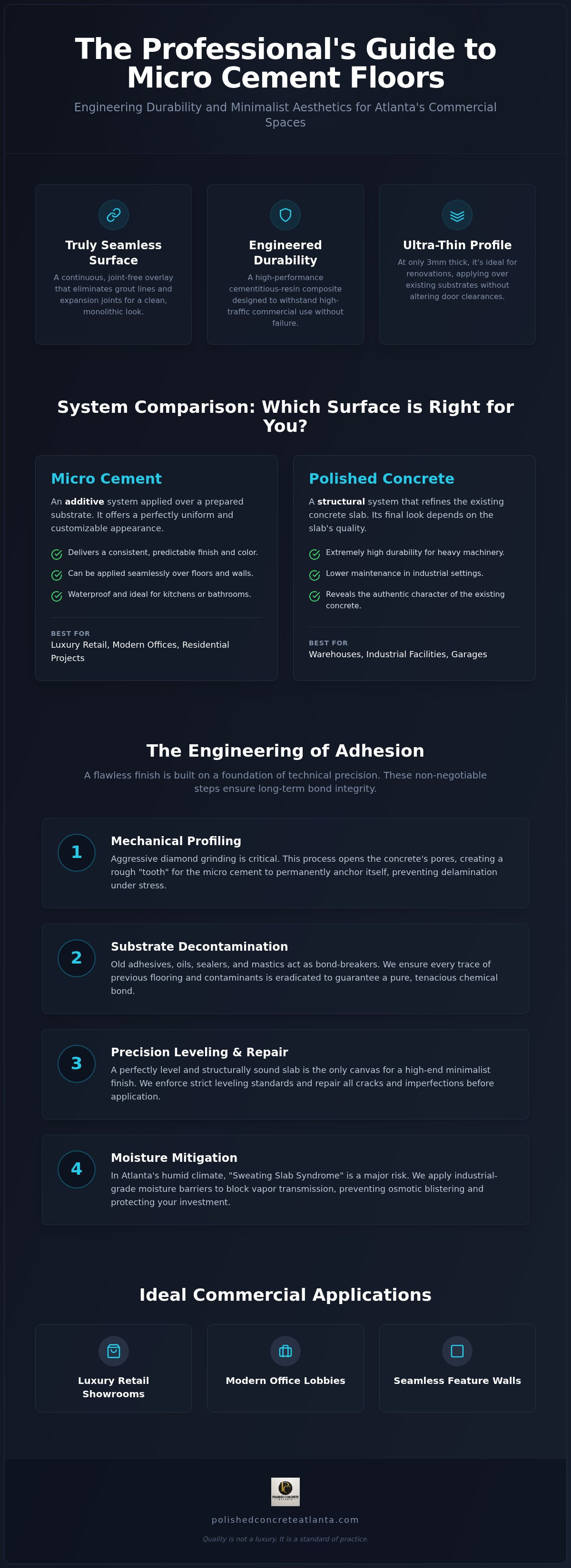
Micro cement is a high-performance cementitious-resin composite. It's an engineered architectural system, not a simple paint or coating. Unlike standard "microtoppings" that often fail under commercial stress, industrial-grade micro cement uses advanced polymers to create a tenacious chemical bond with the substrate. This technical category, often called Decorative Concrete Overlays, allows for a continuous, joint-free surface. It removes the need for expansion joints across large spans. That's the "seamless" advantage. It's a definitive solution for facilities that demand a clean, uninterrupted visual plane.
With a slim 3mm profile, these systems are ideal for renovations where door clearances are tight. You won't have to reconstruct your entryways or shave down doors to accommodate a new floor. It's a high-impact solution that respects the existing architecture of your facility.
Micro Cement vs. Polished Concrete: Which is Right for You?
Choosing between these systems requires understanding their DNA. The polished concrete floors Atlanta professionals install are structural; we refine the existing slab. Micro cement is additive. In high-end retail, the consistent finish of an overlay provides a premium look that raw concrete often lacks. However, for industrial warehouses with heavy machinery, a "grind and seal" is often a better functional choice. We help you determine which system aligns with your facility's specific load requirements. Don't settle for a guess when engineering can provide the answer.
The Aesthetic Appeal: Minimalist Design in Atlanta Facilities
The "raw concrete" look is trending across Buckhead and West Midtown. It's a hallmark of modern minimalist design. While many associate micro cement floors Atlanta installations with standard industrial gray, the system allows for deep color customization. You aren't limited by the natural color of your existing slab. Whether you require a muted matte, a soft satin, or a high-gloss finish, the result is always intentional and precise. It's the ultimate tool for brands seeking a neutral, high-end backdrop for their products; once complete, many local businesses rely on Drew Shirley Photography to capture the sophisticated results for their marketing needs. You get the rugged soul of concrete with the precision of a luxury finish.
The Engineering of Adhesion: Why Preparation is the Priority
An architectural surface lives or dies by its bond to the substrate. This is the no-nonsense reality of micro cement floors Atlanta installations. If the bond fails, the aesthetic fails. We don't settle for "clean enough." Mechanical profiling via aggressive diamond grinding is non-negotiable. This process opens the concrete pores, creating the necessary surface profile for the resin-cement composite to anchor itself permanently. Without this mechanical tooth, the overlay is merely sitting on top of the slab, waiting to delaminate under the first sign of stress.
Ignoring old adhesives or chemical residues is a guaranteed path to failure. Contaminants like oils, sealers, and old mastics act as bond-breakers. We ensure every trace of previous flooring is eradicated. Our team handles the entire lifecycle of the project, from the initial heavy grinding to the final architectural finish, ensuring total control over the bond integrity. Precision is the only path to a worry-free investment.
Critical Floor Preparation Services
Successful professional floor glue removal Atlanta is the first technical step in our engineering process. Residual mastic or thin-set will eventually "ghost" through the overlay or cause localized bond failure. Beyond cleanliness, we enforce strict standards for concrete floor leveling. A perfectly level slab is the only way to achieve the high-end, minimalist look seen in premier Interior Design Projects across the globe. We eliminate the variables before the first layer of micro cement is ever mixed.
Moisture Mitigation: Protecting Your Investment
Atlanta's humidity is a constant threat to floor integrity. Sub-slab moisture vapor often builds up, leading to "Sweating Slab Syndrome." This phenomenon causes osmotic blistering, where moisture pressure forces the overlay to detach from the concrete. We utilize industrial-grade, epoxy-based moisture barriers to seal the slab and neutralize this vapor pressure. The Calcium Chloride test is the industry standard for measuring vapor emission. This data-driven approach allows us to determine exactly when a moisture barrier is required. Don't leave your project to chance; verify your slab's condition with expert substrate analysis to ensure long-term success.
Commercial Applications for Micro Cement in Atlanta
Micro cement floors Atlanta businesses select aren't just about surface-level beauty. They're about performance. High-end retail showrooms in Buckhead utilize these surfaces to create a neutral, sophisticated backdrop. This allows luxury products to remain the focal point. In modern office lobbies, the material's versatility shines through seamless transitions. We can extend the same architectural finish from the floor directly onto feature walls. It creates a cohesive, monolithic environment that traditional materials can't replicate.
The hospitality sector demands surfaces that are both resilient and hygienic. Restaurants and boutique hotels benefit from a non-porous finish that resists staining and is easy to sanitize. For residential high-rises, micro cement offers a solution to a common engineering hurdle. It provides the sought-after industrial concrete aesthetic without the structural weight of a full-depth pour. It's the smart choice for vertical developments where every pound of dead load matters. Key advantages for these spaces include:
- Zero Grout Lines: Eliminates the primary collection point for dirt and bacteria.
- Stain Resistance: Protects against food and chemical spills common in food service.
- Thermal Stability: Handles the temperature fluctuations of commercial kitchens.
Durability Standards for High-Traffic Zones
Commercial environments require high compressive strength. Modern micro cement systems are engineered to withstand the constant foot traffic of a busy Atlanta terminal or retail center. Scratch resistance is achieved through the application of high-performance topcoats. These aren't standard sealers. They're industrial-grade protectors. Maintenance protocols are straightforward. A simple cleaning regimen keeps the finish looking new for years. Reliability is built into the chemistry of the system.
Waterproofing and Wet Area Performance
Micro cement is the premier choice for commercial restrooms, locker rooms, and spas. Its waterproof nature prevents moisture from penetrating the substrate. We achieve a slip-resistant finish that meets safety standards without compromising the minimalist aesthetic. In hygienic environments, seamless coving is essential. We eliminate the corners where bacteria typically hide. If your facility requires an uncompromising architectural finish, consult with our industrial floor specialists to review your project specifications. We don't just apply coatings. We engineer surfaces that last.
Executing a Flawless Installation: What to Expect
Executing a micro cement floors Atlanta project requires a disciplined, four-phase approach. We don't skip steps. Phase one involves aggressive diamond grinding to create a mechanical profile. This is followed by substrate repair and the application of a moisture barrier if vapor emission rates exceed current 2026 ASTM standards. The third phase is where the vision comes to life through multi-layer application and artisanal troweling. This isn't a DIY kit; it's a skilled craft. Finally, we apply specialized sealers that cure to maximum hardness, ensuring the surface withstands the rigors of commercial use. Precision is the only path to a permanent bond.
Timeline and Logistics for Atlanta Businesses
Efficiency is a hallmark of professional management. A typical 2,000 sq. ft. commercial installation requires a five to seven-day window. Site conditions must be strictly controlled. We manage temperature and utilize HEPA-filtered dust extraction to maintain a clean environment. You can typically resume light foot traffic within 24 to 48 hours, though full chemical curing requires seven days. We provide a clear schedule. No surprises. Your business needs to return to operational status, and we respect that timeline through rigorous project management.
Choosing an Atlanta Industrial Flooring Contractor
Don't trust an architectural finish to a general painter. You need a commercial concrete floor contractor who understands the physics of the slab. Ask about equipment. If they aren't using industrial-grade HEPA-filtered dust extraction, they aren't prepared for a commercial environment. The value lies in a partner who masters both industrial floor coatings Atlanta and the nuances of high-end aesthetics. We bring the discipline of industrial engineering to the art of seamless surfaces. That's the difference between a floor that lasts and one that fails. We don't settle for mediocrity, and neither should you.
Elevate Your Facility with Architectural Precision
A seamless, high-performance floor is more than an aesthetic choice; it's a strategic investment in your brand's physical environment. Achieving the minimalist look of micro cement floors Atlanta designers prioritize requires a commitment to technical excellence from the initial grind to the final seal. You don't have to settle for visible joints or the risk of moisture failure. By prioritizing industrial-grade substrate preparation and specialized moisture mitigation technology, you ensure a surface that remains bonded and beautiful for years to come.
We bring over 20 years of Atlanta flooring expertise and premium industrial-grade materials to every project. We eliminate the uncertainty that often accompanies architectural overlays. It's time to transform your facility into a monolithic masterpiece that stands up to the rigors of commercial traffic. Request a Professional Consultation for Your Atlanta Micro Cement Project today and secure the peace of mind that comes with elite craftsmanship. Your vision deserves a foundation that won't fail.
Common Questions Regarding Architectural Surfaces
How long do micro cement floors last in a commercial setting?
A professionally installed micro cement floor in a commercial setting typically has a lifespan of 10 to 15 years. This durability depends entirely on the quality of the initial substrate preparation and the application of high-performance topcoats. Because the system is non-porous and chemically bonded to the slab, it resists the delamination common in thinner overlays. Regular maintenance and re-sealing at recommended intervals will extend this functional life even further.
Can micro cement be applied over existing tile or wood?
Micro cement can be applied over existing tile provided the surface is structurally sound and free of loose components. Wood substrates are more complex due to natural expansion and contraction. We require a rigid, non-flexing base to prevent reflective cracking. In most commercial renovations, we mechanically profile the existing surface to ensure a tenacious bond. If the underlying material is unstable, we recommend full removal to protect the integrity of the new finish.
Is micro cement prone to cracking like traditional concrete?
Industrial-grade micro cement is significantly more resistant to cracking than traditional concrete because of its polymer-resin composition. These resins provide a level of tensile strength and flexibility that standard cement lacks. While it won't crack under its own tension, it can still be affected by structural movement in the underlying slab. This is why we emphasize comprehensive substrate repair and the use of reinforcement meshes in high-risk zones before application.
How do you clean and maintain seamless micro cement floors?
Maintaining micro cement floors Atlanta facilities is straightforward and requires only pH-neutral cleaners and water. You should avoid harsh acidic chemicals or abrasive scrubbing pads that can degrade the protective topcoat. Because the surface is seamless and non-porous, dirt has no grout lines to penetrate. Regular sweeping and damp mopping are usually sufficient to maintain the architectural finish. For high-traffic commercial zones, we recommend a periodic professional deep clean to preserve the original luster.
What is the price difference between micro cement and polished concrete?
Micro cement is a premium architectural finish that typically carries a higher installation cost than standard polished concrete. This reflects the multi-layer application process and the artisanal labor required to achieve a flawless, hand-troweled result. While polished concrete refines the existing slab, micro cement adds a high-performance composite layer. For brands seeking a specific minimalist aesthetic or color consistency that raw concrete cannot provide, the investment in micro cement offers superior design value.
Does micro cement require expansion joints in large Atlanta warehouses?
One of the primary advantages of micro cement floors Atlanta installations is the elimination of visible expansion joints across large areas. The material is engineered to be applied as a continuous, monolithic surface. While we must respect existing structural movement joints in the building's slab, the micro cement itself does not require the grid-like joint patterns seen in traditional concrete pours. This creates the uninterrupted, high-end visual plane that modern commercial architecture demands.


