
Industrial flooring is an engineering challenge, not a janitorial task. If you treat your facility’s surface like a simple aesthetic upgrade, you're likely setting yourself up for an expensive failure. In a climate as humid as Georgia's, choosing the right industrial flooring contractors Atlanta depends on requires a partner who prioritizes technical surface preparation over superficial finishes. It's about more than just a clean look. It's about structural integrity and operational survival.
You already know that frequent coating failures and the high maintenance costs of untreated concrete are more than just an eyesore; they're a drain on your bottom line. This guide identifies the critical criteria for selecting contractors who respect your operational schedule while delivering high-performance systems with the highest ROI. We'll break down the technical requirements for moisture mitigation, industrial-grade grinding, and the specific coatings that withstand heavy machinery and chemical spills. Discover how to eliminate uncertainty and secure a floor that serves as a durable foundation for your facility’s future.
Key Takeaways
- Master the critical criteria for selecting industrial flooring contractors Atlanta facility managers trust to handle high-humidity environments and technical moisture mitigation.
- Compare the long-term ROI of polished concrete versus epoxy coatings to determine the optimal high-performance system for your facility’s mechanical and chemical exposure.
- Realize why technical surface preparation, specifically industrial-grade grinding, is the non-negotiable foundation for preventing costly coating failures and delamination.
- Streamline your facility’s upgrades by adopting a strategic project management approach that prioritizes long-term durability while respecting strict operational schedules.
Why Industrial Flooring Contractors in Atlanta Are Pivotal to Facility Longevity
Industrial flooring isn't just a surface. It's the literal foundation of your facility's operational efficiency. Every pallet moved and every machine anchored depends on the integrity of that slab. In the high-stakes environment of 2026, facility managers can't afford a "wait and see" approach to maintenance. You need a floor that performs from day one. This level of reliability requires a strategic flooring partner rather than a mere service provider. True industrial flooring contractors Atlanta facilities rely on don't just apply coatings; they engineer solutions that respect the massive scale of your operations. We focus on results that eliminate uncertainty and protect your investment.
The Impact of the Georgia Climate on Industrial Slabs
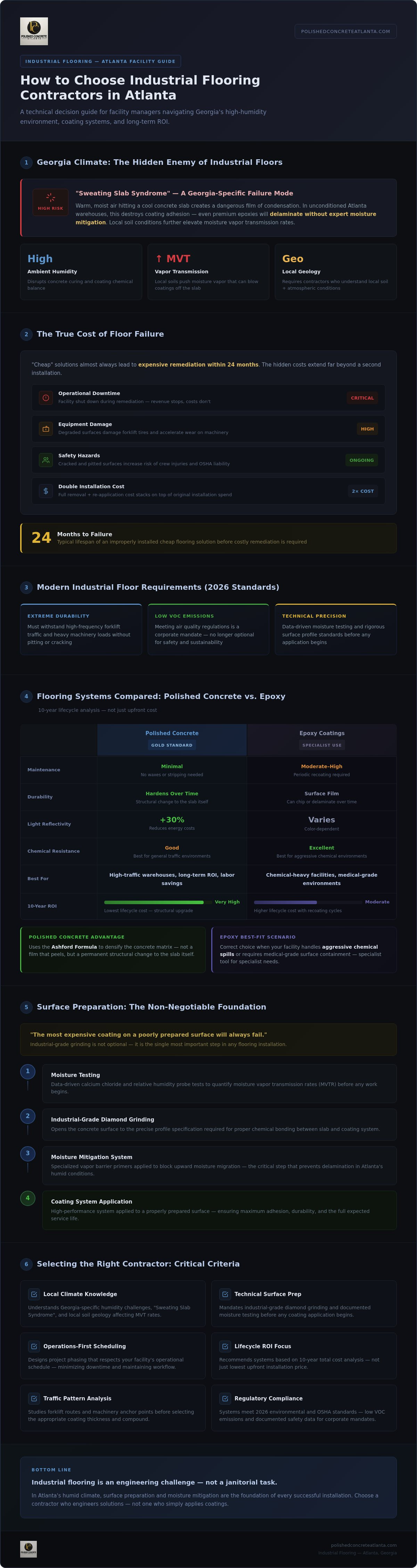
Atlanta's climate presents a specific set of technical hurdles that punish the unprepared. High ambient humidity often disrupts the delicate chemical balance required for proper concrete curing and coating adhesion. We frequently see the devastating effects of "Sweating Slab Syndrome" in unconditioned warehouses across the metro area. This occurs when warm, moist air hits a cool concrete slab, creating a dangerous film of condensation. Without expert moisture mitigation, even the most expensive epoxy will delaminate. Local soil conditions also play a role; they often increase moisture vapor transmission rates that can blow a coating right off the surface. You need a partner who understands local geology and atmospheric pressure.
Operational Risks of Substandard Flooring
The hidden costs of floor failure are staggering. It isn't just the price of a second installation. It's the operational downtime, the damaged forklift tires, and the increased safety hazards for your crew. "Cheap" flooring solutions are a trap. They almost always lead to expensive remediation within 24 months. The industrial flooring contractors Atlanta managers trust must understand traffic patterns and chemical exposure before the first grinder touches the floor. Modern 2026 standards demand higher durability and lower VOC emissions to meet both environmental regulations and corporate safety goals. We prioritize these outcomes because mediocrity has no place in a high-performance facility. Key requirements for modern floors include:
- Extreme Durability: Surfaces must withstand high-frequency forklift traffic and heavy machinery loads without pitting or cracking.
- Low VOC Emissions: Meeting air quality regulations is no longer optional; it's a corporate mandate for safety and sustainability.
- Technical Precision: Every application must be backed by data-driven moisture testing and rigorous surface profile standards.
Evaluating Industrial Flooring Systems: Polished Concrete vs. Epoxy Coatings
Selecting a floor isn't about finding a surface that looks good on day one. It's about identifying which system survives the next decade of abuse. As veteran industrial flooring contractors Atlanta, we see too many managers choose based on upfront cost rather than total lifecycle ROI. You need a solution that aligns with your specific chemical and mechanical demands. Mediocrity in this choice leads to delamination and operational failure. A ten year lifecycle analysis usually reveals that the "cheapest" option is the most expensive mistake you'll ever make.
Polished Concrete for High-Traffic Warehouses
Polished concrete is the gold standard for high-traffic environments. These systems transform a porous slab into a dense, wear-resistant surface that actually hardens over time. When we install polished concrete floors in Atlanta, we utilize the Ashford Formula to dustproof and densify the concrete matrix. This isn't a film that can peel; it's a structural change to the slab itself. The result is a high-performance surface that improves light reflectivity by up to 30%, significantly reducing energy costs. Maintenance is minimal. No waxes. No stripping. Just a clean, durable floor that stands up to constant forklift traffic. It's the ultimate choice for warehouses prioritizing long-term labor savings.
High-Performance Epoxy and Industrial Coatings
There are scenarios where polished concrete isn't enough. If your facility handles aggressive chemicals or requires medical-grade hygiene, you need the protection of industrial floor coatings in Atlanta. Heavy-duty resinous systems provide a seamless barrier against battery acid, oils, and impact. We don't deal in thin, decorative epoxies that flake off under pressure. Our industrial grade systems are engineered for adhesion. We integrate anti-slip textures and safety markings directly into the floor design to ensure your facility meets 2026 safety standards. Whether you need a high-build slurry or a chemical-resistant urethane, the goal is total surface protection. If you are unsure which system fits your specific traffic patterns, a consultation with an expert partner can eliminate the guesswork.
- Polished Concrete: Best for dry storage, logistics, and retail where low maintenance is the priority.
- Epoxy Coatings: Essential for food processing, pharmaceutical labs, and heavy manufacturing.
- ROI Factor: Polished concrete typically offers the lowest 10-year cost per square foot.
The Non-Negotiable Standard: Surface Preparation and Moisture Mitigation
Surface preparation is the single most important factor in preventing floor failure. Period. While many industrial flooring contractors Atlanta has to offer might focus on the final aesthetic, a high-performance system is only as good as the bond beneath it. We don't settle for chemical etching. It's an outdated, unreliable method that fails to create a consistent mechanical profile. Instead, we prioritize the engineering of adhesion through diamond grinding. This process opens the concrete pores and creates the necessary surface profile for coatings to anchor permanently. Without this step, your investment is on borrowed time.
Solving Sweating Slab Syndrome and Moisture Issues
In the humid Atlanta environment, moisture mitigation is a technical requirement, not a suggestion. We've seen countless facilities rely on the primitive "plastic sheet" test, which provides no actionable data. We utilize internal RH probe testing to measure the relative humidity within the slab itself. This precision allows us to install advanced moisture barriers that prevent osmotic blistering and delamination. As expert concrete surface preparation contractors, we ensure that vapor transmission is neutralized before any finish is applied. It's the only way to guarantee a long-term bond in unconditioned warehouse spaces.
Professional Floor Glue and Adhesive Removal
Old mastic and adhesive residues are dangerous bond-breakers. Leaving even microscopic traces of legacy glue under a new flooring system will lead to failure. DIY removal methods or chemical strippers often fail to reach the required industrial bond standards and can contaminate the concrete further. We utilize heavy-duty mechanical grinding to strip away contaminants and expose clean, porous concrete. This ensures your new floor system integrates perfectly with the base slab. Don't risk your facility's operational uptime on a compromised foundation. If you need a surface that meets the highest engineering standards, consult with our technical preparation team today.
Partnering with Polished Concrete Atlanta: Your Strategic Flooring Alliance
Choosing the right partner is a strategic decision that dictates your facility's long-term operational health. Since 2004, Polished Concrete Atlanta has delivered uncompromising industrial expertise to the metro area. We're not generalists who happen to do floors. We are the industrial flooring contractors Atlanta facilities trust for high-stakes environments. This distinction matters. While other providers might offer a quote based on square footage alone, we provide a solution based on over two decades of technical data. We prioritize tangible results over vague promises. Our team doesn't settle for mediocrity. We define the standard.
A strategic alliance with a specialized contractor beats a generalist approach every time. General contractors often lack the specific machinery and technical depth required to handle Atlanta's unique slab challenges. We bring a "no-nonsense" pragmatism to every project, ensuring your floor is engineered for your specific mechanical demands. It's about reliability. It's about the elimination of uncertainty. We manage the details so you can focus on your operations.
Our Meticulous Project Management Process
A successful project is built on discipline and technical rigor. Our approach eliminates guesswork from the first site visit to the final walkthrough. We respect your operational schedule and work to minimize downtime. Our process includes:
- Step 1: Comprehensive Site Audit. we perform exhaustive moisture testing and identify potential fail points in your slab before any work begins.
- Step 2: Custom System Specification. Your floor is engineered based on your facility’s specific traffic patterns, chemical exposure, and mechanical load requirements.
- Step 3: Precision Execution. We utilize state-of-the-art grinding and application equipment to ensure a flawless finish that meets 2026 durability standards.
Securing Your Facility’s Future
Our floors are designed to outlast standard commercial applications. We focus on high-end craftsmanship that stands up to the most demanding industrial environments. This commitment to quality is rooted in our values of transparency and professional character. We don't cut corners. We build foundations. A partnership with us ensures your facility remains a productive, safe, and efficient environment for years to come. It's a premium, worry-free investment in your infrastructure. Contact us today to schedule a technical consultation for your Atlanta facility and secure the high-performance surface your operations deserve.
Build a Foundation for Operational Excellence
Your facility’s floor is a high-stakes asset that dictates operational speed and safety. We've seen how technical surface preparation and precise moisture mitigation are the only ways to prevent expensive failures in Georgia’s humid climate. Choosing the right industrial flooring contractors Atlanta has to offer means prioritizing a partner who values engineering over aesthetics. Since 2004, we've specialized in high-performance industrial coatings and technical moisture mitigation services that eliminate uncertainty for facility managers. We don't just apply products; we solve structural challenges.
Success in 2026 requires infrastructure that withstands heavy traffic and rigorous chemical exposure without flinching. Mediocrity in flooring leads to delamination and dangerous downtime. It’s time to move beyond temporary fixes and invest in craftsmanship that lasts for decades. Secure your facility’s foundation with an expert consultation from Polished Concrete Atlanta. Let’s transform your slab into a durable foundation that powers your productivity and protects your bottom line. We look forward to engineering your next success.
Frequently Asked Questions
What is the typical lifespan of an industrial polished concrete floor in a warehouse?
A properly executed polished concrete floor can last 20 years or more before requiring significant re-polishing. It is a permanent structural modification of the slab rather than a topical film. Unlike coatings that peel or flake, this system hardens the concrete matrix itself. Routine cleaning with neutral cleaners is the only requirement for maintaining its integrity. It's the most durable long-term investment for high-traffic warehouse environments.
How do industrial flooring contractors in Atlanta handle moisture issues in old slabs?
Expert industrial flooring contractors Atlanta relies on handle moisture through rigorous RH probe testing and the installation of specialized mitigation barriers. We don't guess with surface tests. We measure the internal humidity of the slab. If levels exceed safe thresholds, we apply technical moisture mitigation systems that neutralize vapor transmission. This prevents the osmotic blistering that typically destroys standard floor finishes in the humid Georgia climate.
Is epoxy or polished concrete better for a heavy-manufacturing environment?
Heavy-manufacturing environments typically require high-performance epoxy or resinous coatings due to their superior chemical resistance and impact protection. While polished concrete excels in logistics, it cannot withstand the aggressive oils or acids common in manufacturing. A thick-build industrial coating provides a seamless barrier that protects the structural slab from deep contamination. We specify the system based on your facility's exact mechanical load and chemical exposure profile.
How long does a typical industrial flooring project take to complete?
A typical industrial project covering 10,000 square feet usually requires five to seven days for completion. This timeline includes intensive surface preparation, which is the most critical phase of the installation. Larger or more complex facilities with significant moisture issues or extensive floor glue removal will require additional time. We provide a definitive schedule during the site evaluation to ensure your operational downtime remains within strictly managed limits.
Can you install industrial coatings over existing tile or glue residue?
No, you should never install industrial coatings over existing tile or legacy glue residue. These materials act as bond-breakers that will inevitably lead to system failure. We utilize heavy-duty mechanical grinding to strip the slab back to clean, porous concrete. This ensures the new system achieves a permanent mechanical bond. Shortcuts in adhesive removal are the primary cause of premature floor delamination in industrial settings.
What is Sweating Slab Syndrome and how can it be fixed?
Sweating Slab Syndrome is the accumulation of moisture on a concrete surface caused by warm, humid air contacting a cool slab. It creates a dangerous slip hazard and promotes mold growth. We resolve this through technical densification and moisture mitigation treatments that stabilize the slab's surface. In unconditioned Atlanta facilities, this remediation is essential for maintaining safe operational conditions and protecting the structural integrity of the concrete.


