

Improper surface preparation causes 90% of industrial floor failures. That's a staggering reality for Atlanta facility managers who settle for superficial coatings that eventually peel, flake, and trap grime. You need a solution that isn't just a layer on top, but a permanent chemical transformation of the slab itself. Our professional concrete staining services utilize engineered systems designed to withstand the rigors of heavy commercial traffic while delivering high-end aesthetics. It's time to stop treating your floor as an afterthought and start viewing it as a strategic asset.
We understand the frustration of moisture-related failures and the costly downtime associated with inferior installations. You want a floor that remains impenetrable to dirt and moisture without disrupting your operations every few months. This guide explores how the 2026 industrial standard for concrete staining provides the durability your facility demands and the sophisticated finish your brand deserves. We'll break down the technical shift toward matte finishes, the necessity of mechanical diamond grinding, and how to achieve a permanent surface that never flakes. Quality isn't an accident; it's the result of rigorous standards and uncompromising execution.
Key Takeaways
- Understand why industrial-grade staining is a permanent chemical reaction within the slab rather than a topical coating that inevitably peels.
- Compare the technical performance of acid-reactive stains and UV-stable water-based systems to select the optimal solution for your facility environment.
- Learn why mechanical diamond grinding is the non-negotiable standard for preventing floor failure and remediating the "Sweating Slab Syndrome" common in Georgia facilities.
- Identify the specific equipment and 20-year expertise requirements necessary when vetting professional concrete staining services for high-traffic Atlanta commercial spaces.
- Discover how engineered staining systems eliminate porous surfaces to provide a low-maintenance, industrial-strength floor that upholds high-end commercial aesthetics.
Beyond Aesthetics: Why Professional Concrete Staining is a Strategic Asset
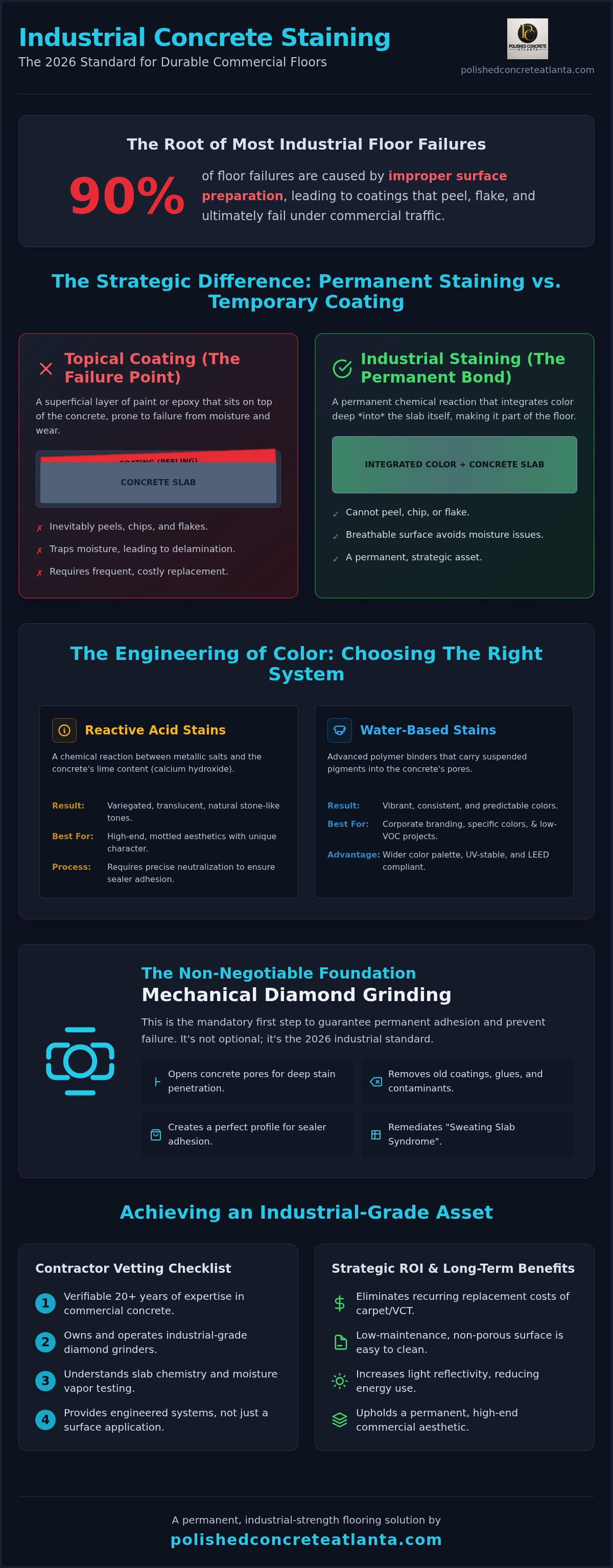
Professional concrete staining is not a cosmetic mask. It is a fundamental chemical alteration of the slab's surface. While DIY kits and residential "painting" projects focus on temporary visual appeal, professional concrete staining services provide a permanent, industrial-grade solution. This process involves a deep reaction between the stain's metallic salts and the calcium hydroxide within the concrete. The result is a color that cannot peel, chip, or flake. It becomes part of the floor. This is a strategic asset for any high-traffic facility in Georgia.
When integrated with polished concrete floors Atlanta, staining adds a layer of sophisticated branding without compromising the structural integrity of the "Grind and Seal" method. We don't just apply color; we engineer a surface that performs under pressure. This holistic approach ensures that your flooring investment contributes to the overall value of the property.
The ROI of Stained Concrete in Commercial Spaces
Long-term facility management requires a focus on lifecycle costs. Stained concrete eliminates the recurring expenses associated with replacing worn carpet or cracked VCT. The durability is unmatched. In large-scale warehouses and retail environments, the increased light reflectivity of a stained and sealed surface can even reduce energy consumption. It’s about efficiency. You get a floor that withstands heavy foot traffic and light machinery while maintaining its professional appearance for years, not months. Peace of mind comes from knowing your flooring won't require a total overhaul in three years. For a truly comprehensive facility upgrade, addressing air quality is just as important as the floors; Best Odor Removal can help eliminate any lingering industrial smells to match your new high-end aesthetic.
Topical paints and cheap coatings often fail in the high-humidity climate of Atlanta. Moisture vapor transmission from the soil pushes against the underside of non-breathable coatings, leading to inevitable delamination. Staining is different. Because it relies on penetration rather than surface adhesion, the color remains locked within the concrete matrix. Various decorative concrete techniques utilize this chemical bond to ensure longevity. A penetrating stain is a permanent pigment integration that lives inside the concrete rather than sitting on top of it. This makes the floor essentially wear-proof. It doesn't just look better; it lasts longer. That is the standard we deliver.
The Engineering of Color: Acid Staining vs. Water-Based Systems
The engineering of color requires more than a bucket and a brush. It demands a deep understanding of slab chemistry. When you invest in professional concrete staining services, you're choosing between two distinct chemical pathways: reactive acid stains or pigment-suspension water-based systems. Each serves a specific industrial purpose. Choosing the wrong one for your facility's environment leads to premature wear and aesthetic failure. We don't guess. We analyze the slab to ensure the bond is absolute.
Acid Staining: The Industrial Standard for Depth
Acid stains aren't coatings. They're reactive solutions of water, hydrochloric acid, and acid-soluble metallic salts. When applied, they react with the calcium hydroxide in the concrete to create variegated, translucent tones that mimic natural stone. This is why acid staining remains the preferred choice for stained concrete floors Atlanta facilities rely on for high-end, mottled aesthetics. The process is rigorous. We must neutralize the slab post-application to stop the chemical reaction and ensure the pH level is perfect for sealer adhesion. Skip this step, and your topcoat will fail. We don't cut corners.
Water-Based Stains: Precision and Sustainability
For corporate offices or retail spaces requiring vibrant, consistent branding colors, water-based stains are the modern solution. These systems use advanced chemistry to suspend pigments in a specialized polymer binder. They don't rely on a chemical reaction, which allows for a broader, more predictable color palette. In 2026, low-VOC requirements and LEED certification are non-negotiable for many Atlanta commercial projects. Water-based systems meet these standards without sacrificing durability. Modern pigment bonding has evolved to provide excellent UV stability, ensuring your corporate colors don't fade under high-intensity lighting.
A stain is only as durable as the shield protecting it. We follow the industry standards for concrete by pairing these stains with high-performance topcoats. Whether it's the Ashford Formula for densification or a fast-curing polyaspartic for rapid return-to-service, the sealer is what handles the abuse of heavy machinery and foot traffic. If you're unsure which system fits your specific warehouse or retail layout, consult with our technical team to evaluate your slab's profile. Quality isn't an accident. It's a calculated chemical result.
Surface Preparation: The Non-Negotiable Foundation for Stained Floors
Surface preparation is the invisible variable that dictates the lifespan of your floor. Most contractors claim they "clean" the slab. Cleaning is insufficient. To achieve the industrial-grade results expected from professional concrete staining services, the concrete must be mechanically opened. Without this, the stain cannot penetrate the surface to create that permanent chemical bond. It simply sits on top, waiting to fail. This is why the role of concrete surface preparation contractors is so critical; they bridge the gap between a porous slab and a high-performance finish.
Residual contaminants like oils, curing compounds, and old mastic are the enemies of clarity. If your facility has recently undergone a renovation, professional floor glue removal is mandatory. Even microscopic traces of adhesive will block stain absorption, resulting in unsightly blotches and inconsistent color. We don't accept these imperfections. Our process ensures the slab is a clean slate before a single drop of pigment is applied. We prioritize the integrity of the bond above all else.
Mechanical Grinding vs. Acid Etching
Acid etching is an unpredictable, messy, and often ineffective method for commercial slabs. It doesn't remove deep-seated contaminants and often leaves the surface pH unbalanced. We utilize industrial-scale mechanical grinding. This method provides a precise Concrete Surface Profile (CSP) that allows for maximum chemical bonding. It also levels minor slab imperfections, ensuring a uniform finish for high-gloss topcoats. High-end results require precision, not shortcuts. We provide the profile your floor needs to succeed.
Moisture Mitigation and Slab Health
Georgia's humidity creates a unique challenge known as Sweating Slab Syndrome. Moisture vapor trapped beneath the concrete can force its way up, causing "white blush" or complete delamination of sealers. This is why testing for the Moisture Vapor Emission Rate (MVER) is a non-negotiable part of our protocol. Proper moisture mitigation is vital for industrial floor coatings Atlanta facilities need to remain operational. We address hydrostatic pressure before it becomes a liability to your operations.
Don't risk your facility's integrity on a contractor who skips the grinding phase. Schedule a technical slab evaluation to secure a foundation that lasts.
Selecting an Atlanta Staining Contractor for Commercial Facilities
Selecting the right partner for your facility's flooring is a high-stakes decision. You aren't just buying a service; you're investing in a strategic asset. Many residential painters offer professional concrete staining services as a side business, but they lack the industrial-scale equipment and technical depth required for commercial environments. Hand tools and shop vacs aren't enough. You need a contractor who brings heavy-duty planetary grinders and a veteran's understanding of slab chemistry to the site. The slab doesn't lie. Experience matters.
Transparency is the hallmark of a professional. A qualified contractor won't guess about moisture levels or surface profile; they'll test and document every variable. This no-nonsense approach to project management ensures site safety and eliminates the "white blush" failures that plague amateur installations. We prioritize reliability over shortcuts. It's about protecting your investment through rigorous standards and disciplined execution.
Critical Questions for Your Flooring Partner
Vetting a contractor requires looking past the portfolio. Ask about their specific protocol for floor glue removal and mechanical preparation. If they don't mention diamond grinding, they aren't prepared for commercial traffic. Request case studies from industrial projects that mirror your facility's scale and environmental demands. It's also vital to verify their adherence to industrial flooring contractors Atlanta standards. A true partner provides transparency in moisture testing and refuses to move forward if the slab's MVER poses a risk. Integrity comes before the sale.
The Polished Concrete Atlanta Difference
We've been navigating the complexities of the Atlanta market since 2004. We've seen every slab failure imaginable and mastered the techniques to prevent them. Our approach is purely pragmatic. We don't offer flowery promises; we deliver tangible results through a disciplined, no-nonsense project management style. From the initial technical consultation to the final application of high-performance sealers, we manage every detail. We are elite in skill and blue-collar in work ethic. That's the standard. That's the Polished Concrete Atlanta difference.
Secure Your Facility's Future with Industrial-Grade Precision
Your flooring is the foundation of your facility's operational efficiency. Settling for topical solutions that peel or flake is a liability you can't afford. By prioritizing the chemical engineering of reactive stains and the non-negotiable standard of mechanical diamond grinding, you ensure a surface that withstands the 2026 industrial environment. We have been serving the Atlanta market since 2004, refining our approach to provide the most reliable professional concrete staining services available today.
We understand the unique challenges of Georgia's climate. As specialists in industrial surface preparation and expert moisture mitigation services, we eliminate the uncertainty that leads to floor failure. Our no-nonsense methodology focuses on tangible durability and high-end commercial aesthetics that last for the long term. It's time to transition from temporary fixes to permanent strategic assets. Quality is a choice, not an accident.
Request a Professional Consultation for Your Atlanta Facility to evaluate your slab's potential. We look forward to partnering with you to create a high-performance environment that reflects the integrity of your brand.
Frequently Asked Questions
What is the difference between concrete staining and concrete painting?
Staining is a chemical reaction that penetrates the slab; painting is a topical film that sits on the surface. Stains create a permanent bond with the concrete minerals that cannot flake or peel. Paint inevitably delaminates under traffic and moisture pressure. Our professional concrete staining services ensure the pigment is locked into the concrete matrix. This eliminates the expensive maintenance cycle of repainting your facility every few years.
How long does a professionally stained concrete floor last in a warehouse?
A professionally stained and sealed warehouse floor typically lasts 10 to 20 years before the topcoat requires a refresh. The stain itself is permanent because it lives inside the slab. Total durability depends on the choice of sealer, such as the Ashford Formula for densification. Regular cleaning with pH-neutral solutions prevents abrasive grit from wearing down the protective shield. It's a long-term industrial investment that outlasts traditional floor coverings.
Can you stain old concrete that has existing glue or oil stains?
Yes, but only after rigorous mechanical preparation. We use industrial-scale planetary grinders to remove old mastic, carpet glue, and oil-saturated top layers. This process opens the slab's pores to allow the stain to react with the minerals. Without professional floor glue removal, the stain will blotch or fail to bond. We evaluate the slab's profile to ensure the final color is consistent and clear across your entire facility.
Is stained concrete slippery when wet in commercial settings?
Stained concrete is no more slippery than other hard surfaces when properly finished. In commercial settings, we incorporate anti-slip aggregates into the final sealer to meet OSHA standards for slip resistance. This is vital for facilities prone to spills or the Sweating Slab Syndrome common in Georgia's humidity. We prioritize safety without sacrificing the high-end aesthetic. You get a floor that looks sophisticated but remains functionally safe for your workforce.
How do I maintain a stained concrete floor in a high-traffic office?
Maintenance is remarkably simple compared to carpet or VCT. Daily dust mopping removes abrasive dirt; a weekly damp mop with a pH-neutral cleaner keeps the surface pristine. You don't need to strip or wax these floors. For those managing multi-surface facilities, partnering with experts like Athena Team Cleaning for specialized tile and grout care ensures that every corner of your space matches the high standard of your stained concrete. High-traffic areas benefit from sacrificial floor finishes that take the brunt of the wear. Our professional concrete staining services provide a low-maintenance solution that keeps your corporate office looking sharp with minimal operational disruption.
Most facilities resume light foot traffic within 24 hours of the final sealer application. Heavy machinery and forklifts typically require 48 to 72 hours for a full chemical cure, depending on the specific topcoat used. Fast-curing polyaspartics can often handle traffic much sooner. We coordinate our schedule to minimize your downtime. We provide clear, definitive timelines so your operations aren't left in a state of uncertainty during the installation process.


