
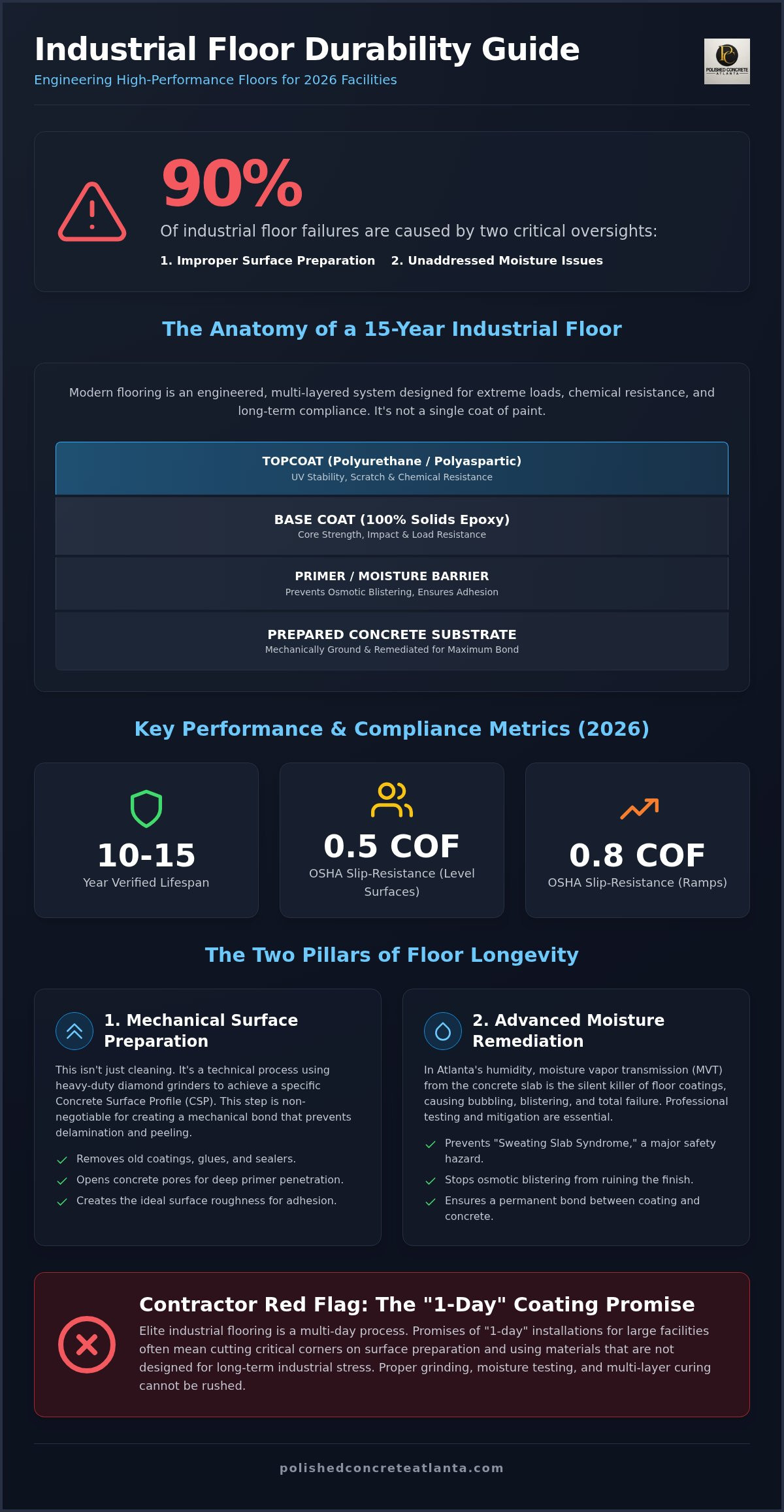
90% of industrial floor failures are caused by improper surface preparation and moisture issues. It's a sobering statistic for any facility manager. You know the frustration of watching a new coating bubble or peel just months after a costly installation. In Georgia's relentless humidity, these failures aren't just bad luck. They're the result of cutting corners on technical standards. You deserve a floor that works as hard as your team does. Period.
Mastering the selection of industrial floor coatings Atlanta requires moving past aesthetic fixes toward high-performance engineering. We've built this 2026 durability guide to help you navigate the 2026 Georgia Building Code and OSHA's updated slip-resistance standards. You'll learn how to achieve a verified 10 to 15 year lifespan while eliminating the risks of Sweating Slab Syndrome and osmotic blistering. This is a strategic investment in operational uptime and chemical resistance. We're breaking down the precise criteria for moisture mitigation, floor glue removal, and the shift toward sustainable, high-reflectivity polished concrete systems that define the modern industrial landscape.
Key Takeaways
- Identify the technical shift toward multi-layered resinous systems that meet 2026 Georgia Building Codes and OSHA slip-resistance requirements.
- Learn how to select the right industrial floor coatings Atlanta facilities need for a 15-year lifespan by prioritizing 100% solids epoxy and UV-stable topcoats.
- Discover why concrete floor grinding and moisture remediation are the most critical steps to prevent the osmotic blistering that ruins 90% of industrial projects.
- Recognize the red flags of "1-day" coating promises and learn the vetting criteria for elite industrial contractors who possess the right heavy-duty equipment.
- Master the specific strategies for remediating Sweating Slab Syndrome, a common safety hazard in Atlanta’s high-humidity environments.
Defining High-Performance Industrial Floor Coatings in 2026
High-performance flooring isn't a cosmetic upgrade. It's a structural necessity. In the heavy-duty environments of 2026, we define these systems as multi-layered resinous barriers engineered specifically for extreme load-bearing and chemical protection. Unlike thin sealers that fail under pressure, Seamless polymer flooring systems integrate with the concrete substrate to provide superior compressive strength and impact resistance. This engineering is vital for the massive warehouses and manufacturing plants that form the backbone of the city's logistics hub. Understanding how industrial floor coatings Atlanta protect these assets is the first step toward long-term facility integrity.
The standard for 2026 has shifted decisively toward sustainability. We've moved beyond high-VOC chemicals that compromise air quality and worker safety. Modern high-performance polymers now offer low-VOC profiles without sacrificing the rigid durability required for 24/7 operations. These systems aren't just "green"; they're tougher than their predecessors, offering improved resistance to the heavy point loads of robotic pickers and high-capacity forklifts.
The Evolution of Industrial Surface Standards
Facility compliance has become more rigorous. The 2026 Georgia Building Code and updated OSHA standards now mandate higher slip-resistance (COF) ratings to ensure worker safety. Specifically, surfaces must maintain a 0.5 COF for level areas and a 0.8 COF for ramps. Simple sealers simply can't meet these metrics over time. We've transitioned to comprehensive resinous systems that utilize specialized aggregates to maintain these safety standards under wet or oily conditions. Total Cost of Ownership for industrial floors is the aggregate of installation, maintenance, and downtime costs over a 15-year performance window.
Aesthetics vs. Utility: Finding the Balance
Aesthetics are a byproduct of quality, not a substitute for it. While some contractors focus on a "showroom look," we prioritize utility first. High-gloss finishes serve a functional purpose by increasing light reflectivity, which can significantly lower energy costs in large facilities. Choosing the right industrial floor coatings Atlanta also involves strategic color-coding. Using distinct colors for pedestrian safety zones and forklift traffic lanes isn't just about looks; it's about disciplined organization and accident prevention. We deliver "showroom quality" that's backed by industrial-grade durability. It's a floor that looks elite because it's built to last. Period.
Strategic Coating Systems: From High-Build Epoxy to Resinous Solutions
High-build systems aren't just thick paint. They're engineering. For industrial floor coatings Atlanta, 100% solids epoxy is the non-negotiable standard. Why? Because solvent-based alternatives lose volume as they cure, leaving behind a brittle, porous film. 100% solids stay exactly where you put them. This ensures the dry film thickness matches the wet application, providing the dense impact resistance needed for heavy manufacturing. It's about eliminating weakness. Period.
Topcoats add the final layer of defense. Polyaspartics offer rapid cure times and total UV stability, making them ideal for facilities with significant sunlight exposure or tight maintenance windows. Polyurethane, conversely, excels in scratch resistance and chemical shielding. For the heaviest impact zones, specialized mortar systems—blending high-strength resins with graded aggregates—provide a sacrificial layer that absorbs the punishment of dropped dies or heavy machinery. In massive logistics centers, we often deploy the Ashford Formula to densify the concrete slab itself. This creates a dust-proof, hardened surface that actually improves with traffic.
Epoxy Flooring: The Industrial Workhorse
Epoxy isn't just a surface layer. It's a permanent chemical bond. During the curing process, the resin and hardener create a cross-linked polymer structure that's virtually impenetrable by oils, fuels, or industrial solvents. This is what separates high-performance systems from the thin-mil coatings found in residential garages. If you're weighing your options, our polished concrete vs epoxy flooring breakdown offers a definitive technical verdict for facility managers.
Specialized Resinous Systems for Facility Needs
For homeowners looking to bring a similar level of professional organization and efficiency to their own spaces, The Garage RX offers specialized residential garage transformations that go beyond simple surface treatments.
Every environment has unique technical demands. Urethane concrete is the solution for thermal shock resistance, essential for food-grade environments where hot washdowns are frequent. For electronics manufacturing, Electrostatic Dissipative (ESD) coatings are mandatory to prevent static discharge from damaging sensitive components. Compliance with OSHA general requirements for walking-working surfaces ensures these floors remain safe and hazard-free. If your facility handles hazardous materials, chemical-resistant coatings provide the necessary secondary containment protection. Choosing the right system isn't a matter of preference. It's a matter of performance. You can consult with our industrial flooring experts to match your operational demands to the correct resinous chemistry.
The Non-Negotiable Standard: Surface Preparation and Moisture Remediation
Surface preparation is the most overlooked phase of any project, yet it's the single biggest factor in long-term performance. In Georgia, 90% of failures for industrial floor coatings Atlanta stem from poor substrate preparation. We don't just "clean" the floor. We engineer the surface for maximum adhesion. This involves rigorous concrete floor grinding to achieve the specific Concrete Surface Profile (CSP) required by the resinous system manufacturer. Without this mechanical profile, the coating has nothing to grip. It will fail. Period.
For warehouse renovations, floor glue removal Atlanta is a critical technical hurdle. Legacy adhesives and black mastic act as bond-breakers. If they aren't completely removed via mechanical grinding, the new coating won't bond. It's that simple. We also have to address Sweating Slab Syndrome. This phenomenon occurs when condensation builds up on cool slabs in Atlanta's humid air, creating a severe safety hazard and signaling underlying moisture issues that lead to osmotic blistering.
Moisture Mitigation: Beating the Georgia Humidity
Moisture is the primary enemy of resinous systems. We follow the ACI Guide for Concrete Slabs to identify and remediate vapor transmission risks before they become liabilities. Vapor Emission Control Systems (VECS) are mandatory when Relative Humidity (RH) levels exceed safe thresholds. Every reputable industrial flooring contractor in Atlanta must perform RH testing and ensure ASTM F3010 compliance. This prevents delamination and keeps your investment intact.
Adhesive and Contaminant Removal
Mechanical grinding is the only professional choice for substrate integrity. Chemical stripping is messy, unreliable, and often leaves residue that compromises the chemical bond. We grind away legacy floor glue and deep-seated contaminants to expose a clean, sound, and dry substrate. This is the foundation of high-performance flooring. Don't leave your project to chance. Contact Polished Concrete Atlanta to schedule a technical evaluation of your facility's substrate today.
Navigating Contractor Selection for Atlanta Industrial Facilities
Elite industrial floor coatings Atlanta projects require more than just a bucket and a roller. You need a partner with the logistical capacity to manage 50,000 square feet without missing a beat. This means heavy-duty planetary grinders, high-volume dust extraction, and a crew that understands chemical cross-linking. If a contractor promises a "1-day" industrial system, walk away. Legitimate resinous flooring requires a methodical, multi-day process to ensure proper outgassing and chemical bonding. Speed is no substitute for integrity. Period.
Project management is the silent driver of success. A seasoned contractor doesn't just show up; they coordinate with your production schedule to minimize operational downtime. They understand that a warehouse floor is a tool. If that tool is out of commission due to a botched installation, your bottom line suffers. You're looking for a disciplined partner who treats your facility with the respect it deserves.
The Professional Vetting Process
Start by interrogating their moisture testing protocols. Does the contractor use in-situ probes for Relative Humidity? If they don't mention ASTM F3010 compliance or moisture mitigation as a standard step, they aren't qualified for the Georgia climate. You must also evaluate their specific approach to concrete surface preparation. A general painter might suggest an acid wash; an authoritative expert knows that only mechanical grinding provides the necessary CSP. Verify references for projects exceeding 10,000 square feet. Scale changes everything.
Investing in Long-Term Facility Assets
The cheapest bid is often the most expensive mistake you'll ever make. A failed floor costs twice as much to fix because you're paying for the removal of the failure before the real work begins. We position ourselves as creative consultants and meticulous managers of detail. We don't settle for mediocrity, and neither should you. It's a premium investment in peace of mind and high-end craftsmanship. Consult with Polished Concrete Atlanta for your industrial flooring strategy to ensure your facility meets the highest standards for durability and safety.
Engineering Your Facility’s Long-Term Integrity
Your floor is a critical operational tool, not a decorative afterthought. We've established that high-performance industrial floor coatings Atlanta require rigorous technical preparation and the correct resinous chemistry to survive the heavy-duty demands of 2026. From mechanical grinding to ASTM F3010 moisture compliance, every step must be executed with precision. Cutting corners leads to delamination. We don't cut corners. Period.
With over 20 years of Atlanta industrial experience, we bring the gravitas of seasoned experts to every project. We are specialized moisture mitigation experts who prioritize no-nonsense project management over empty promises. Don't leave your facility's durability to chance. Secure your facility’s future with an industrial floor consultation from Polished Concrete Atlanta today. It's time to invest in a surface that matches the elite standards of your operations. We look forward to helping you build a foundation that stands the test of time.
Frequently Asked Questions
What is the best industrial floor coating for high-traffic warehouses in Atlanta?
The best choice for high-traffic warehouses is a 100% solids epoxy system paired with a UV-stable polyaspartic topcoat. This combination provides the rigid compressive strength required for heavy forklift traffic and the scratch resistance needed for long-term clarity. In Georgia's specific climate, these high-build systems outperform thin-mil alternatives by providing a dense, non-porous barrier. We recommend these industrial floor coatings Atlanta facilities rely on for 15-year performance lifespans.
How long does a professional industrial epoxy floor installation take?
A professional industrial installation typically requires three to five days depending on the square footage and substrate condition. We prioritize a methodical approach that includes mechanical grinding, moisture testing, and proper cure times between layers. Beware of "1-day" systems that skip critical outgassing periods. Rushing the process compromises the chemical bond and leads to premature failure. We manage every detail to minimize your operational downtime without sacrificing the integrity of the final product.
Can industrial coatings be applied over concrete with high moisture levels?
Yes, but only after applying a dedicated Vapor Emission Control System (VECS) that complies with ASTM F3010 standards. Without this specialized moisture mitigation layer, high vapor transmission will cause the coating to delaminate or blister. We utilize advanced moisture-tolerant primers that create a permanent barrier against hydrostatic pressure. Testing for Relative Humidity (RH) is a non-negotiable step in our process to ensure the substrate is technically sound before any resinous material is applied.
What is the difference between a floor sealer and an industrial coating?
A floor sealer is typically a thin, penetrating liquid designed to repel water or dust without changing the floor's profile. An industrial coating is a high-build resinous system engineered for structural protection and chemical resistance. Coatings provide a thick, sacrificial layer that can withstand heavy impacts and abrasive wear. While sealers are suitable for basic dust-proofing, only high-performance industrial floor coatings Atlanta offer the load-bearing capacity required for 24/7 manufacturing and logistics operations.
How do I remove old floor glue and mastic before applying a new coating?
Mechanical grinding is the only professional method for removing legacy floor glue and black mastic. We utilize heavy-duty planetary grinders equipped with specialized diamond tooling to strip away contaminants and expose the raw concrete. Chemical strippers are unacceptable in industrial environments because they leave behind residues that act as bond-breakers for new coatings. This mechanical process also achieves the required Concrete Surface Profile (CSP), ensuring the new system achieves a permanent mechanical bond with the substrate.
Are industrial floor coatings slip-resistant for wet manufacturing environments?
Absolutely. We engineer slip-resistance by incorporating specialized aggregates like aluminum oxide or quartz into the topcoat. This ensures your facility remains compliant with OSHA standards for walking-working surfaces. For wet manufacturing environments, we can adjust the texture to achieve a 0.5 Coefficient of Friction on level floors or a 0.8 rating on ramps. This customization provides maximum traction without making the floor difficult to clean, effectively balancing worker safety with operational hygiene requirements.


