

Why are you still paying to "protect" a floor that fails every three years? In the high-demand Atlanta industrial market, where net absorption reached 4.4 million square feet in early 2026, you can't afford downtime caused by peeling topical sealers or hazardous silica dust. Most facility managers accept these failures as a consequence of Georgia's relentless humidity. It's a costly mistake. You know the frustration of seeing white dust settle on your inventory despite "professional" coatings. It's an endless cycle of maintenance and disappointment.
There's a definitive solution that eliminates the need for re-application. Professional Ashford Formula installation Atlanta doesn't just sit on top of your concrete; it penetrates the slab to create a permanent, hardened asset. This is a one-time investment that actually improves with age. You'll gain a floor that meets strict 2026 OSHA silica standards while providing the massive abrasion resistance required for heavy machinery. We're going to break down how this chemical densification process works, why it outperforms every topical alternative, and how it secures your facility's long-term value. Let's build something that lasts.
Key Takeaways
- Identify how Georgia’s high relative humidity triggers structural failures like "Sweating Slab Syndrome" and why topical coatings are an insufficient defense.
- Discover the chemical transformation that occurs during professional Ashford Formula installation Atlanta, turning porous concrete into a dustproof, high-density asset.
- Master the technical performance metrics of densification, including how the process increases surface hardness by up to 40% to withstand heavy machinery.
- Learn the critical steps of the professional application protocol, from precise mechanical surface preparation to deep-penetration chemical saturation.
- Evaluate the long-term financial advantages of a "one and done" flooring solution that eliminates the costly 3-5 year re-coating cycle.
Eliminating Concrete Dusting and Moisture Risks in Atlanta Facilities
Concrete dusting is not a housekeeping problem. It is a structural failure. When untreated concrete "dusts," the surface is literally disintegrating, releasing microscopic particulates that settle on inventory and destroy sensitive electronics. For facility managers, this is a liability that degrades HVAC efficiency and compromises air quality. Ashford Formula installation Atlanta provides the permanent antidote to this porous degradation by fundamentally changing the slab's chemistry. We don't just cover the problem; we eliminate it.
The Impact of Atlanta’s Climate on Industrial Slabs
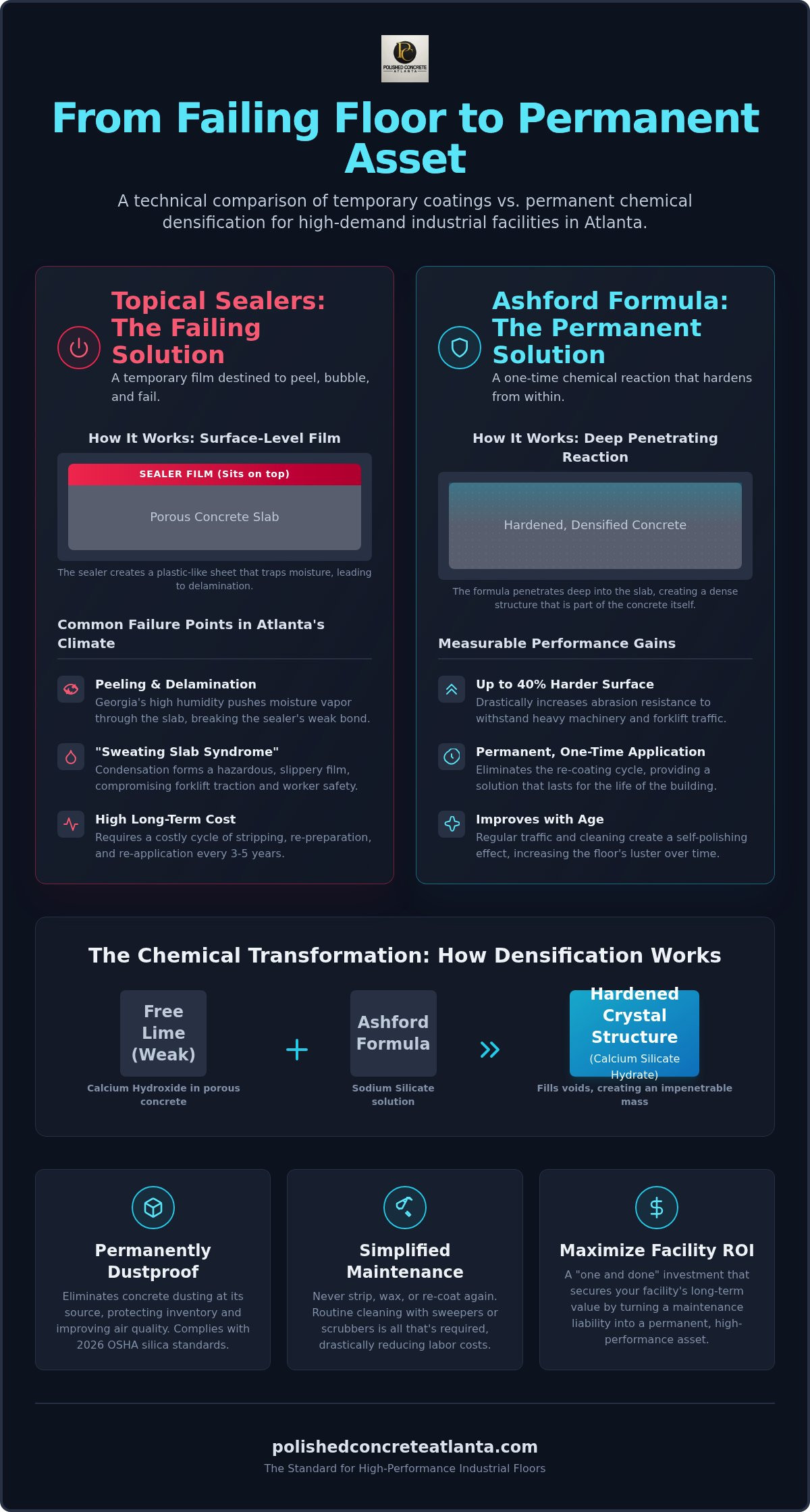
Georgia’s relentless humidity creates a unique set of challenges for unsealed warehouses. High moisture vapor transmission often leads to delamination, where topical coatings simply bubble and peel away from the substrate. Sweating Slab Syndrome occurs when moisture from the air condenses on a cold concrete surface, creating a hazardous, slippery film that compromises forklift traction and worker safety. By utilizing The Science of Concrete Densifiers, we close the capillary tracts within the concrete matrix. This process prevents moisture from migrating through the slab, stabilizing the surface against the local climate's volatility.
Beyond Surface Level: Why DIY Topical Sealers Fail
Many owners fall into the trap of using big-box retail sealers. These products are film-forming, meaning they sit on top of the concrete like a plastic sheet. In the humid Southeast, this is a recipe for disaster. Concrete must breathe. When moisture gets trapped under a non-breathable sealer, the bond breaks. You're left with a cycle of peeling, scraping, and re-application that drains your maintenance budget. Ashford Formula is a penetrating densifier, not a coating. It becomes part of the floor itself. There's no film to scratch or flake off, ensuring your Ashford Formula installation Atlanta remains intact for the life of the building. It’s a pragmatic, one-time solution for a high-stakes environment.
The Science of Densification: Why Ashford Formula Outperforms Topical Sealers
Topical sealers are a temporary fix for a permanent problem. They rely on basic mechanical adhesion to stay on the surface. Ashford Formula operates through a deep chemical reaction. When applied, the sodium silicate reacts with the free lime, or calcium hydroxide, within the concrete matrix. This process creates calcium silicate hydrate, a dense, crystalline structure that fills the internal voids. It effectively turns a porous sponge into a solid, impenetrable mass. This is why Ashford Formula installation Atlanta is the standard for facilities that demand longevity rather than frequent repairs.
The results are measurable. Professional densification increases surface hardness by up to 40%. This drastic shift in structural integrity provides the abrasion resistance necessary to withstand the constant friction of heavy-duty pallet jacks and high-volume forklift traffic. Unlike coatings that scratch and flake, this surface actually improves with age. Through a self-polishing phenomenon, regular traffic and routine cleaning buff the floor, increasing its luster over time. It doesn't just survive use; it thrives on it.
Hardening vs. Coating: A Technical Breakdown
Standard concrete typically ranks low on the Mohs scale of mineral hardness. After treatment, the surface moves significantly higher, resisting gouges that would destroy an epoxy floor. Maintenance becomes a simple matter of sweeping and occasional scrubbing. You'll never need to strip or wax this floor again. Because the formula is water-based and VOC-free, we can perform installations in occupied Atlanta workspaces without disrupting your operations or air quality. It's a clean, pragmatic upgrade for any active facility.
Curing New Concrete for Maximum Integrity
Timing is critical. Using Ashford Formula as a curing agent on fresh concrete prevents plastic shrinkage cracks by regulating moisture loss. It ensures uniform hydration throughout the slab, which is the foundation of a durable industrial floor. Proper application at this stage eliminates the need for messy curing blankets or temporary sealers that eventually fail. To understand how we prepare existing slabs for this process, review The Engineering of Adhesion: A Definitive Guide to Concrete Surface Preparation. If you're ready to secure your facility's future, consult with our industrial flooring experts to plan your project.
The Professional Installation Protocol: Preparation and Application
Expert results depend on a rigid adherence to technical standards. Professional Ashford Formula installation Atlanta is a four-stage operation that begins long before the first gallon is poured. We don't just apply product; we manage a chemical transformation. If the process is rushed or the prep is ignored, the floor will fail. It is that simple. Our team treats every slab as a unique structural challenge that requires a disciplined approach.
Critical Surface Preparation and Floor Glue Removal
The chemical reaction cannot occur if the concrete's pores are clogged. Slabs previously covered by tile or carpet often harbor hidden barriers. Residual mastic, paint, or old epoxy will prevent the formula from penetrating the substrate. This is why we prioritize comprehensive floor glue removal Atlanta. We use mechanical grinding to strip away contaminants and open the concrete matrix. This ensures the densifier reaches the necessary depth to create a permanent bond. If you skip the grind, you're wasting the product.
Once the surface is porous and clean, the application follows a precise sequence:
- Saturation and Agitation: We flood the surface and use industrial scrubbers to agitate the liquid. This mechanical action forces the chemical deep into the capillary tracts.
- Managing the Gel Phase: As the reaction begins, the liquid thickens into a gel. We must carefully monitor this phase to prevent "whitening," which occurs when excess sodium silicate dries on the surface and leaves permanent white streaks.
- Final Flushing: We rinse the floor thoroughly with clean water to remove all unreacted material. This step is non-negotiable for a clean, professional finish.
- Optional Burnishing: For facilities requiring immediate aesthetic appeal, high-speed burnishing provides a polished luster right away.
Avoiding Installation Disasters
Amateur installations often result in slippery, white-stained floors caused by over-application or poor rinsing. Temperature control is also vital. The slab must remain within specific ranges during the 24-hour curing window to ensure uniform hydration. In retail environments where a high-gloss finish is mandatory from day one, we employ the Spiff-Coat procedure to enhance the initial appearance while the internal densification matures. Don't leave your industrial asset to chance. Schedule a technical site evaluation to ensure your Ashford Formula installation Atlanta meets the highest industry standards.
Maximizing Facility ROI: The Long-Term Value of Chemical Hardening
Stop viewing your floor as a recurring expense. Most industrial coatings fail within 3 to 5 years, forcing you into a cycle of stripping, prepping, and re-applying. It's a waste of time and capital. Ashford Formula installation Atlanta adopts a "one and done" philosophy. By chemically altering the slab's internal structure, you eliminate the need for future coatings. It’s a permanent upgrade. This shift in strategy transforms a maintenance headache into a high-performing industrial asset that never peels.
The financial benefits extend beyond the surface. A densified floor increases light reflectivity, which can significantly reduce energy costs in massive Atlanta warehouses. It’s a pragmatic way to brighten a workspace without adding fixtures. This is why global leaders like Coca-Cola and Smuckers rely on this technology for their facilities. They don't gamble on unproven solutions. They choose the industrial standard that delivers consistent, measurable returns over decades, not months.
Maintenance Standards for Treated Floors
Long-term performance requires the right protocol. You don't need waxes, buffing compounds, or toxic strippers to keep this floor clean. Regular scrubbing with a walk-behind machine and specific pH-neutral cleaners is all it takes to sustain the densified surface. This simple routine keeps the floor functional while actually improving the shine over time. For a deeper look at maintaining these results, check The Standard for Polished Concrete Floors in Atlanta. It's about working smarter, not harder.
Choosing an Authorized Atlanta Installer
Local conditions dictate your success. Georgia’s soil and variable slab quality require a contractor who understands how local climate factors influence chemical penetration. We don't guess. We execute based on decades of field experience. Choosing Polished Concrete Atlanta means partnering with a team that prioritizes project integrity over cutting corners. We are your dedicated consultants for high-performance flooring. We handle the critical prep work that others skip to ensure your investment holds its value. Ready to secure your facility? Schedule a professional consultation for your Atlanta facility and get the job done right the first time.
Future-Proof Your Industrial Flooring Today
Choosing the right flooring isn't just about aesthetics; it's a strategic decision that impacts your facility's operational efficiency. You've seen how chemical densification outclasses temporary topical sealers by creating a permanent, dustproof shield. It’s the only way to effectively manage the moisture challenges inherent to Georgia's climate. By prioritizing a "one and done" solution, you eliminate recurring maintenance cycles and protect your inventory from hazardous particulates. This is a pragmatic investment in long-term durability.
Our team brings over 20 years of Atlanta industrial experience to every project. We specialize in Sweating Slab Syndrome remediation and precision floor prep, ensuring your slab is ready for a lifetime of heavy-duty use. We don't settle for mediocrity, and neither should you. When you choose a professional Ashford Formula installation Atlanta, you're partnering with a no-nonsense, results-driven team dedicated to the integrity of your floor. We handle the technical details so you can focus on your operations.
It's time to stop paying for temporary fixes and start investing in a permanent industrial asset. Secure your industrial asset with a professional Ashford Formula installation and experience the peace of mind that comes with high-end craftsmanship. Let's transform your concrete into a worry-free foundation for your business growth.
Frequently Asked Questions
Can Ashford Formula be applied to old or existing concrete floors?
Yes, we can apply Ashford Formula to existing concrete slabs to stop dusting and increase surface density. Professional Ashford Formula installation Atlanta breathes new life into aging industrial assets. We use mechanical grinding to remove old adhesives and contaminants that would otherwise block chemical penetration. It’s a permanent solution that hardens the concrete matrix without the need for recurring topical sealers or expensive slab replacements.
How long does the Ashford Formula installation process take?
The timeline for Ashford Formula installation Atlanta varies based on the slab's condition and total square footage. While the chemical application itself is efficient, the mechanical preparation of the surface is the most critical phase. Most industrial projects allow for light foot traffic within hours of completion. Heavy machinery can typically resume operations within 24 hours. We prioritize a disciplined schedule to minimize your facility's downtime while ensuring total chemical saturation.
Is Ashford Formula the same as polished concrete?
No, Ashford Formula is a chemical densifier, not a polishing process itself. Polished concrete involves a series of mechanical grinding and honing steps using diamond abrasives to achieve a specific gloss. Ashford Formula is the hardening agent used during that process to provide a dustproof seal. You can have a densified floor without a high-gloss finish, but you cannot have a high-performance polished floor without a quality densifier to secure the surface.
How much does Ashford Formula installation cost in Atlanta?
Project costs are determined by a technical site evaluation rather than a fixed rate. Several variables influence the final investment, including the current state of the concrete, the depth of required floor preparation, and the total square footage. We assess the complexity of removing existing contaminants to provide an accurate scope. Investing in this permanent solution eliminates the recurring costs of stripping and re-applying topical coatings every few years.
Does Ashford Formula make the floor slippery when wet?
Ashford Formula does not make floors inherently slippery. Because it is a penetrating densifier rather than a film-forming coating, it maintains the concrete's natural slip resistance. It actually meets or exceeds industry safety standards for floor traction. However, like any industrial surface, spills should be cleaned immediately to prevent accidents. Regular maintenance with a walk-behind scrubber helps keep the surface clean and safe for heavy forklift traffic and pedestrian workers.
What is the difference between Ashford Formula and standard lithium densifiers?
The primary difference lies in the chemical base and penetration depth. Ashford Formula is a sodium silicate-based densifier that reacts deeply within the concrete matrix to create a permanent, crystalline structure. Many lithium densifiers are designed for quick, surface-level applications during the polishing process. Ashford's long-term track record in industrial settings proves its superior ability to stop dusting and resist abrasion over decades. It remains the heavy-duty standard for high-traffic warehouses and manufacturing plants.


