

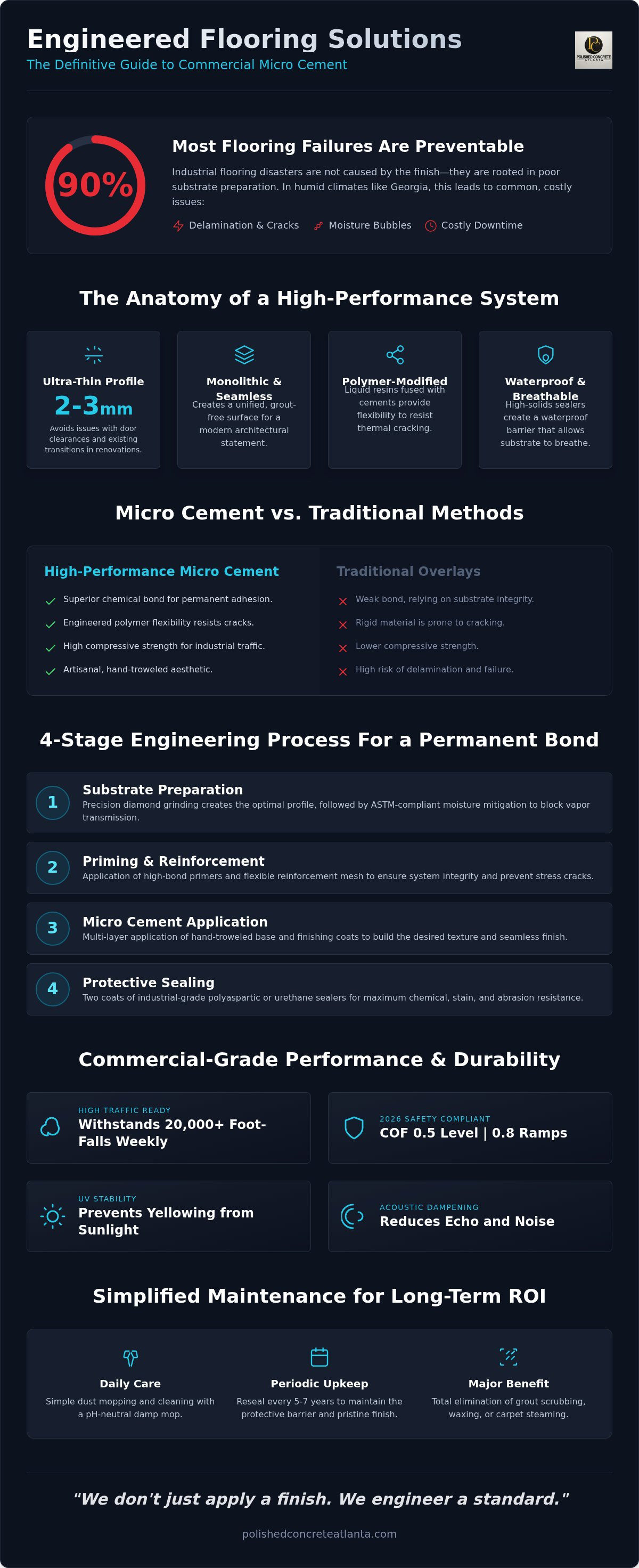
Ninety percent of industrial flooring failures are entirely preventable. These disasters don't happen because of the finish; they happen because a contractor ignored the technical demands of the substrate. In a climate as humid as Georgia's, mediocre preparation is a recipe for delamination and costly downtime. You deserve a surface that reflects the caliber of your brand without the looming threat of cracks or moisture-related bubbles. It's time to demand better. High-end commercial spaces require more than just a decorative coating; they require an engineered solution.
Choosing micro cement floors atlanta is a commitment to a seamless, monolithic aesthetic that defines modern architectural standards in 2026. We understand that your priority is a worry-free investment that combines industrial-grade durability with a sophisticated, grout-free finish. This article outlines the rigorous engineering requirements for a permanent installation, from ASTM F3010 moisture mitigation to precision diamond grinding. You'll learn exactly why micro cement has become the definitive choice for Atlanta's elite commercial interiors and how our technical protocols eliminate the uncertainty of traditional overlays. We don't just apply a finish. We engineer a standard.
Key Takeaways
- Modern micro cement floors atlanta provide a 2-3mm polymer-modified finish that eliminates grout lines and expansion joints for a truly monolithic architectural statement.
- Commercial-grade durability depends on meeting 2026 safety standards, including specific slip-resistance ratings for high-traffic retail and hospitality environments.
- Longevity is engineered through mechanical concrete grinding and moisture mitigation, ensuring the system bonds permanently to the substrate without risk of delamination.
- Successful industrial-scale applications require a partner with deep expertise in floor preparation and resinous systems to avoid the common pitfalls of unskilled installation.
What is Micro Cement and Why is it the Professional Choice?
Micro cement is a high-performance, polymer-modified cementitious coating engineered for extreme durability at a minimal profile. Applied at a thickness of only 2-3mm, it provides a seamless finish that eliminates the need for grout lines or expansion joints. This creates a unified architectural statement that traditional materials simply cannot replicate. For businesses considering micro cement floors atlanta, the appeal lies in this monolithic aesthetic combined with industrial-grade resilience. While many decision-makers compare this to What is Polished Concrete?, the two systems serve different structural needs. Polished concrete relies on the existing slab's integrity through mechanical refinement, whereas micro cement is a versatile, hand-applied layer that bonds to almost any stable substrate with uncompromising strength.
The Anatomy of a High-Performance Micro Cement System
The strength of this system comes from the fusion of liquid resins and specialized cements. These polymers provide the flexibility needed to resist the thermal expansion that often causes traditional concrete to crack. Because it adds only 3mm of height, it is a strategic advantage for commercial renovations where door clearances and floor transitions are already fixed. The process is a multi-layer discipline. It begins with high-bond primers and mesh reinforcement, followed by base and finishing coats, and concludes with industrial-grade protective sealers. We utilize high-solids resins that ensure the material remains breathable yet waterproof, a critical requirement for the humid Georgia environment.
Micro Cement vs. Traditional Concrete Overlays
Traditional overlays frequently fail in high-traffic environments because they lack the chemical bond strength found in modern polymer-modified systems. Micro cement achieves a superior compressive strength that stands up to the rigors of retail and hospitality use. The difference is also aesthetic. While mechanical grinding creates a uniform, stone-like appearance, micro cement offers a hand-troweled character. This provides a tactile, artisanal depth that remains incredibly easy to clean. It is a sophisticated alternative for spaces that require a custom look without the weight or depth of a full slab. Choosing micro cement floors atlanta ensures your facility benefits from a surface that is as tough as it is beautiful. We don't just apply a coating. We install a performance standard.
Commercial Performance: Durability and Maintenance Standards
Commercial environments demand surfaces that survive 20,000 foot-falls a week without showing distress. Professional micro cement floors atlanta are engineered to exceed these expectations. Unlike traditional finishes that chip under heavy impact, micro cement provides a resilient, polymer-modified matrix that bonds directly to the slab. This performance is validated by technical testing. Adhering to the ASTM E1155 Standard for floor flatness is a prerequisite for a safe, high-performance surface. Safety is non-negotiable. In 2026, updated Georgia building codes require a Coefficient of Friction (COF) of 0.5 for level surfaces and 0.8 for ramps. We achieve these ratings through specialized traction additives that provide grip without compromising the sleek, monolithic finish.
Engineered for High-Traffic Atlanta Facilities
Retail showrooms and modern office lobbies in Midtown or Buckhead require surfaces that resist UV degradation. Our systems utilize UV-stable binders that prevent yellowing even in spaces with expansive floor-to-ceiling windows. Beyond visual durability, there's a significant acoustic advantage. The polymer density of a seamless coating offers superior sound dampening compared to the "echo chamber" effect created by hard ceramic tile. This makes it a superior choice for collaborative workspaces where noise reduction is a priority. It's a holistic upgrade for any professional environment.
Maintenance Protocols for a Permanent Finish
Industrial-grade durability doesn't mean zero maintenance; it means simplified maintenance. The long-term ROI of micro cement is found in the total elimination of grout scrubbing and carpet steaming. Professional-grade polyaspartic or urethane sealers provide a critical barrier against oils, coffee, and chemical spills common in hospitality. Daily care requires only dust mopping and pH-neutral damp mopping to remove surface abrasives. A periodic reseal every 5 to 7 years ensures the moisture barrier remains intact and the aesthetic remains pristine. If you're planning a facility upgrade, consulting with a specialist in commercial concrete floors ensures your maintenance plan is as robust as the floor itself.
The chemical resistance of these systems is a primary differentiator. While standard concrete overlays might fail when exposed to harsh industrial cleaners, micro cement sealers are engineered for high abrasion and chemical resistance. This makes them suitable for medical offices, high-end restaurants, and retail spaces where hygiene and appearance are equally vital. You aren't just buying a floor. You're investing in a permanent architectural asset.
The Engineering of Adhesion: Non-Negotiable Surface Preparation
A micro cement floor is an engineering marvel, but its success is dictated by the unseen work beneath the surface. Your finish is only as reliable as the bond it shares with the slab. For micro cement floors atlanta, this begins with mechanical concrete grinding to achieve a specific Concrete Surface Profile (CSP). This isn't a superficial cleaning. It's a precise removal of the "laitance" layer to expose the open pores of the concrete. Without this mechanical key, the polymer resins have nothing to grip. We follow the ACI Guide to Concrete Floor and Slab Construction to ensure the substrate meets rigorous structural standards before we ever open a bucket of material.
Delamination is almost always the result of cutting corners during preparation. This is why we prioritize thorough floor glue removal and the extraction of deep-seated contaminants like oils or old waxes. If these impurities remain, the bond will fail. It's that simple. We also integrate advanced moisture mitigation systems to combat hydrostatic pressure, a common issue in the Southeast. We don't settle for "good enough" when it comes to adhesion.
Addressing Sweating Slab Syndrome and Georgia Humidity
Atlanta's climate presents a unique challenge for commercial flooring. High relative humidity and fluctuating temperatures can lead to Sweating Slab Syndrome, where moisture accumulates on the surface of the concrete. We don't guess. We test. Utilizing calcium chloride tests or in-situ probes, we measure the vapor emission rate of your slab. If levels exceed safe thresholds, we apply a specialized moisture vapor barrier that integrates directly with our primer layer. This proactive engineering ensures your investment doesn't bubble or peel when the Georgia summer hits. It's about eliminating uncertainty.
The Professional Installation Sequence
- Step 1: Mechanical Grinding. We use planetary grinders equipped with vacuum-contained dust extraction to create a clean, profiled surface.
- Step 2: Structural Repair. All cracks are chased and stabilized using high-modulus epoxies to prevent reflective cracking in the finish.
- Step 3: Multi-Stage Troweling. We apply the micro cement in thin, strategic layers to build depth, texture, and bond strength.
- Step 4: Topcoat Application. The system is sealed with high-solids polyurethane or epoxy topcoats for maximum abrasion resistance.
If you're ready to secure a surface that stands the test of time, our team provides the technical expertise required for floor moisture mitigation and precision preparation. We don't just cover your floor. We engineer it.
Selecting an Atlanta Micro Cement Partner for Industrial Scale
Commercial scale is not a playground for boutique contractors. While the finish is hand-troweled, the execution of micro cement floors atlanta requires a logistical powerhouse. It's a mistake to equate "hand-applied" with a DIY or small-crew approach. Professional-grade results in high-traffic facilities demand a contractor with deep roots in industrial floor coatings. This background ensures they understand chemical profiles, cure times, and the high-stakes environment of a live commercial site. Precision matters. Logistics matter.
Scalability is the true test of a partner. A contractor may deliver a beautiful 500-square-foot boutique but fail when faced with a 10,000-square-foot showroom. You must evaluate their mechanical resources. Do they own the heavy-duty planetary grinders and dust extraction systems required for proper surface prep? A partner who adheres to polished concrete standards brings a level of discipline that boutique installers simply lack. We don't settle for "good enough" results. Neither should you.
Questions to Ask Your Micro Cement Contractor
Vetting a partner requires moving beyond the portfolio. Ask these specific questions to separate the artisans from the engineers:
- Do you perform in-house moisture testing and mitigation? External testing causes delays; your contractor should own this critical step.
- What is your process for mechanical surface preparation? If they suggest "acid etching" instead of diamond grinding, they are not equipped for commercial work.
- Can you provide references for commercial projects exceeding 5,000 square feet? Scale changes the chemistry and the workflow entirely.
The Polished Concrete Atlanta Advantage
Our approach is rooted in no-nonsense pragmatism. We aren't just decorative finishers; we are technical managers who prioritize the long-term integrity of your facility. Our extensive experience in sealed concrete informs every micro cement application we perform. We understand the physics of bond strength and the chemistry of topcoat resistance. Choosing micro cement floors atlanta from a team that understands industrial rigors means your surface will perform long after the warranty expires. We partner with facility managers to ensure minimal downtime and maximum asset value. We don't just sell floors. We deliver peace of mind through technical dominance.
Secure the Future of Your Facility’s Design
The shift toward monolithic, high-performance surfaces is more than a trend; it's the new benchmark for Atlanta’s commercial landscape. You now understand that the longevity of micro cement floors atlanta is won or lost in the substrate. By prioritizing rigorous surface preparation and moisture mitigation, you eliminate the risks of delamination and cracking that plague unskilled installations. A seamless aesthetic should never come at the cost of structural integrity. It's about engineering a surface that performs as well as it looks.
We bring over 20 years of industrial flooring experience to every project. Our crews utilize specialized moisture mitigation equipment and adhere to the industry’s most comprehensive surface preparation standards to ensure your investment is permanent. Don't leave your facility's reputation to chance. It's time to partner with an expert who values technical excellence as much as you value your brand's image. Request a Technical Consultation for Your Atlanta Facility today. We look forward to engineering a surface that exceeds your expectations.
Frequently Asked Questions
How long do micro cement floors last in a commercial setting?
Micro cement floors in a commercial setting typically last between 10 and 15 years before requiring a professional reseal. Their longevity is directly tied to the quality of the industrial-grade topcoat and the frequency of maintenance. In high-traffic Atlanta retail environments, these surfaces maintain their integrity through polymer-modified strength. Regular dust mopping and pH-neutral cleaning prevent abrasive wear. This ensures the system remains a permanent architectural feature rather than a temporary aesthetic fix.
Can micro cement be applied over existing tile or wood?
Micro cement can be applied over existing tile provided the substrate is structurally sound and lacks loose pieces. We perform mechanical grinding to ensure the polymer resins bond to the ceramic or porcelain surface. However, applying it over wood in a commercial environment is generally discouraged due to the natural expansion and contraction of timber. For micro cement floors atlanta, we prioritize stable mineral-based substrates like concrete or tile to guarantee a crack-free, high-performance finish.
Is micro cement prone to cracking like traditional concrete?
Micro cement is significantly more resistant to cracking than traditional concrete because it contains liquid resins that provide essential flexibility. While it doesn't shrink or crack on its own, it can be affected by movement in the underlying slab. This is why we perform comprehensive crack repair and joint stabilization before application. By engineering the bond at the substrate level, we eliminate the risk of reflective cracking and ensure a monolithic appearance that lasts for years.
How much does micro cement flooring cost per square foot in Atlanta?
The investment for a professional installation varies based on the total square footage, the current condition of your substrate, and the complexity of the design. Factors such as the need for extensive floor glue removal or moisture mitigation will influence the final project scope. While material-only kits exist, commercial-grade results require specialized equipment and labor-intensive hand-troweling. We recommend a technical site assessment to determine the specific requirements for your micro cement floors atlanta project and ensure a high-performance outcome.
Is micro cement waterproof enough for commercial kitchens or bathrooms?
Yes, micro cement is an excellent choice for commercial bathrooms and kitchens when finished with high-solids polyurethane sealers. The seamless nature of the system eliminates grout lines where moisture and bacteria typically accumulate. This makes the surface entirely waterproof and highly hygienic for hospitality environments. In the humid Atlanta climate, we utilize breathable yet moisture-resistant coatings that prevent delamination while protecting the substrate from liquid penetration. It's a superior, modern alternative to traditional tile.
How long is the installation and curing process before foot traffic is allowed?
A standard commercial installation usually takes between three and five days depending on the number of layers required. You can typically allow light foot traffic within 24 to 48 hours after the final topcoat is applied. Full chemical cure for heavy equipment or industrial use generally takes seven days. We coordinate closely with facility managers to minimize downtime. Our efficient multi-stage process ensures your space returns to operational status without compromising the long-term durability of the finish.


