
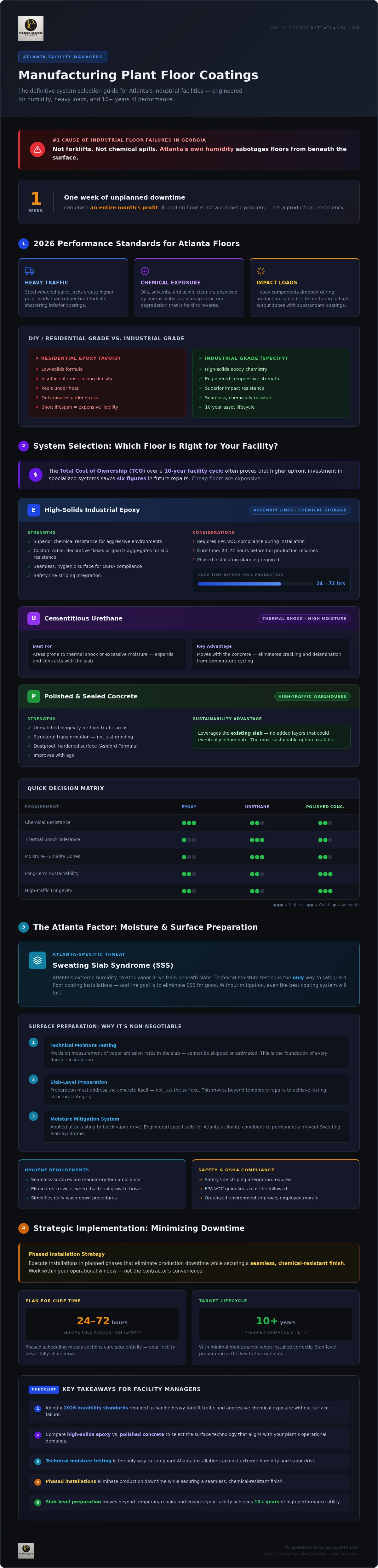
A high-performance floor is not an aesthetic choice. It's a critical production tool. Most industrial floor failures in Georgia aren't caused by heavy forklifts or chemical spills. They are sabotaged from beneath the surface by Atlanta’s own humidity. When you invest in manufacturing plant floor coatings Atlanta facilities deserve, you aren't just buying a bucket of epoxy. You're securing your operational uptime. Results matter.
You likely recognize that a single week of unplanned downtime to repair a peeling surface can erase a month’s worth of profit. It's a common frustration that we understand completely. This guide serves as your definitive roadmap for procuring industrial systems engineered specifically for the local climate. We'll examine the technical necessity of moisture mitigation, the precision of professional floor preparation, and how to eliminate Sweating Slab Syndrome for good. Expect a floor that lasts ten years with minimal maintenance. No excuses. No compromises. Just results.
Key Takeaways
- Identify the 2026 durability standards required to handle heavy forklift traffic and aggressive chemical exposure without surface failure.
- Compare high-solids epoxy systems against polished concrete to select the specific surface technology that aligns with your plant's operational demands.
- Understand why technical moisture testing is the only way to safeguard manufacturing plant floor coatings Atlanta installations against the city's extreme humidity and vapor drive.
- Learn how to execute phased installations that eliminate production downtime while securing a seamless, chemical-resistant finish.
- Focus on slab-level preparation to move beyond temporary repairs and ensure your facility achieves 10+ years of high-performance utility.
Defining Performance Standards for Atlanta Manufacturing Floors
Industrial durability in 2026 demands more than a simple coat of paint. It requires a system engineered to survive. In high-output Georgia environments, your floor faces a relentless assault from heavy forklift traffic, chemical spills, and high-velocity impact loads. Selecting the correct manufacturing plant floor coatings Atlanta system is the difference between a ten-year asset and a six-month liability. Mediocrity is expensive.
Residential-grade epoxies are a common trap for the uninformed. These low-solids products lack the necessary cross-linking density found in industrial-grade epoxy resin chemistry and properties. They peel under heat. They delaminate under stress. They fail. For a professional facility, a "DIY" approach is a liability. We prioritize systems that establish a baseline of uncompromising resilience and tangible ROI.
Assessing Traffic and Impact Requirements
The physics of your floor matter. Steel-wheeled pallet jacks exert significantly higher point loads than rubber-tired forklifts, creating localized stress that can shatter inferior coatings. You must determine the required compressive strength based on your heaviest machinery footprints. High-output zones require superior impact resistance to prevent brittle fracturing when heavy components are dropped during production. We don't guess. We engineer for the specific load requirements of your facility's workflow.
Chemical Resistance and Hygiene Standards
Atlanta facilities often manage a complex cocktail of oils, solvents, and acidic cleaners. A porous slab absorbs these toxins, leading to deep structural degradation that is difficult to reverse. Seamless surfaces are mandatory for modern compliance. They eliminate the crevices where bacterial growth thrives and simplify daily wash-downs. Beyond hygiene, modern manufacturing plant floor coatings Atlanta must integrate safety line striping. This isn't just for OSHA compliance; it's about creating an organized, high-morale environment where employees feel secure. Aesthetics drive efficiency and pride in craftsmanship.
Selecting the Right System: Epoxy, Urethane, or Polished Concrete?
Choosing the right surface is a strategic procurement decision. It defines your maintenance budget for the next decade. While some contractors push a one-size-fits-all approach, we analyze your specific traffic patterns and load requirements. The Total Cost of Ownership (TCO) over a 10-year facility cycle often proves that a higher upfront investment in specialized manufacturing plant floor coatings Atlanta systems saves six figures in future repairs. Cheap floors are expensive.
High-solids epoxy flooring provides superior chemical resistance for aggressive environments. When evaluating these systems, strict adherence to EPA guidelines on VOC emissions from industrial coatings ensures safety for your workforce during and after installation. For areas prone to thermal shock or excessive moisture, cementitious urethane is the definitive choice. It expands and contracts with the slab. It doesn't quit.
When to Choose Industrial Epoxy Flooring
Industrial epoxy is the workhorse of assembly lines and chemical storage rooms. It’s highly customizable. You can specify decorative flakes for aesthetics or quartz aggregates for aggressive slip resistance. It's a pragmatic solution for light manufacturing. However, you must account for cure times. Standard systems require 24 to 72 hours before returning to full production. Planning is essential. We work within your window, not ours.
The Case for Polished and Sealed Concrete
For high-traffic warehouses, polished concrete floors Atlanta facilities rely on offer unmatched longevity. This isn't just grinding; it's a structural transformation. By using sealed concrete treated with the Ashford Formula, you achieve a dustproof, hardened surface that actually improves with age. It’s the most sustainable option available. You're leveraging the existing slab rather than adding layers that could eventually delaminate. If you're unsure which system fits your operational reality, we can help you evaluate your facility's specific needs.
The Atlanta Factor: Moisture Mitigation and Surface Preparation
Atlanta's climate is a specialized challenge for industrial infrastructure. High humidity and high water tables create a constant upward drive of moisture vapor through concrete slabs. This vapor pressure can destroy a new floor in weeks by causing osmotic blistering and delamination. Without technical moisture testing, your investment in manufacturing plant floor coatings Atlanta facilities require is effectively a gamble. We don't gamble with your capital.
Sweating Slab Syndrome is a specific threat in unconditioned manufacturing spaces. When warm, humid air hits a cool concrete slab, moisture condenses on the surface. This isn't just a safety hazard; it's a sign of deeper hydrostatic pressure. Addressing this requires more than a surface coating. It requires a strategic moisture mitigation plan. Adhesion is only as strong as the preparation beneath it.
Moisture Mitigation Strategies for Georgia Facilities
Professional assessment involves both Calcium Chloride testing to measure moisture vapor emission rates and Relative Humidity (RH) probes for deep-slab data. We apply high-performance moisture barriers that can withstand up to 25 lbs of pressure. This creates an impermeable shield. It ensures the bond remains permanent despite the volatile Georgia soil conditions. If you skip this step, you're planning for failure.
Mechanical Preparation: Grinding vs. Shot Blasting
Adhesion is purely mechanical. As expert concrete surface preparation contractors, we define success by the Concrete Surface Profile (CSP). For most manufacturing plant floor coatings Atlanta projects, a CSP of 3 to 5 is the target. We use precision grinding for professional floor glue removal to reveal clean, open pores. Shot blasting is reserved for high-build systems that require a more aggressive texture for maximum resin penetration.
- Precision Grinding: Removes old adhesives, oils, and contaminants while leveling the slab.
- Shot Blasting: Strips the surface to create a deep mechanical profile for heavy-duty coatings.
- Dust Containment: Utilizes industrial HEPA filtration to keep your facility clean during the process.
A clean, open-pore structure is the only way to achieve a chemical bond that lasts. If your current floor is failing, it's likely a preparation issue. You can schedule a technical moisture assessment to identify the root cause before your next installation.
Strategic Implementation: Minimizing Downtime and Maximizing ROI
Success in industrial procurement isn't just about the product. It's about the execution. For high-output facilities, the cost of a floor is secondary to the cost of a shutdown. Professional industrial flooring contractors Atlanta facilities trust understand that every hour of halted production is lost revenue. We mitigate this through phased installations and meticulous project management. It's a strategic partnership, not just a service contract. Results matter.
The longevity of industrial floor coatings Atlanta plants install depends heavily on post-installation discipline. A floor engineered for 2026 standards can easily exceed a 10-year lifespan, provided a rigorous maintenance plan is in place. This includes immediate spill remediation and regular mechanical scrubbing with non-aggressive pads. Results are maintained through discipline. We provide the roadmap; you reap the ROI. No-nonsense pragmatism is our baseline.
Scheduling Around Production Cycles
We coordinate around your reality. Whether it's a holiday shutdown or a weekend sprint, we align our labor with your lowest activity windows. For facilities that cannot stop, we utilize fast-cure polyaspartic systems. These allow for a rapid return-to-service, often within 12 to 24 hours. Safety is non-negotiable. We ensure industrial-grade ventilation and strict adherence to environmental protocols to protect your workforce while we work. Efficiency doesn't cut corners. It optimizes them.
Final Inspection and Performance Verification
A project is only finished when the data proves it. We verify dry film thickness (DFT) to ensure the manufacturing plant floor coatings Atlanta systems meet the specified engineering standards. We also conduct slip resistance testing to guarantee your facility remains compliant with modern safety benchmarks. You deserve a partner who offers transparent, honest consultation from the initial slab assessment to the final walk-through. Integrity is built into the surface. If you're ready for a superior floor, consult with Polished Concrete Atlanta for your next facility upgrade.
Securing Your Operational Foundation
Your facility’s floor is the foundation of your entire production cycle. It shouldn't be an afterthought. We've established that high-performance surfaces are engineered from the slab up, requiring technical moisture mitigation and veteran-level precision in floor preparation. In the humid Georgia climate, skipping these steps isn't just a risk; it's a guarantee of future failure. You need a partner who understands the high-stakes reality of manufacturing plant floor coatings Atlanta facilities require to stay operational.
Polished Concrete Atlanta brings over 20 years of local expertise to every project. We are specialists in industrial moisture mitigation and Sweating Slab Syndrome remediation. We don't settle for mediocrity because we know your uptime depends on excellence. Our no-nonsense approach prioritizes tangible results and long-term durability over empty promises. It's time to invest in a surface that works as hard as your machinery. Precision matters. Results last.
Take the first step toward a worry-free, high-performance environment today. Request a Professional Consultation for Your Atlanta Manufacturing Facility. We look forward to engineering your success.
Frequently Asked Questions
How long does it take to install a manufacturing plant floor coating?
Installation timelines typically range from three to five days for standard multi-coat systems. The duration depends heavily on the level of floor preparation required and the specific resin chemistry selected. Fast-cure polyaspartic systems can allow foot traffic in as little as six hours, while industrial epoxy often requires 24 to 72 hours to reach full chemical resistance. We coordinate with your production schedule to minimize operational downtime through strategic, phased implementation.
What is the best floor coating for high-traffic forklift areas in Atlanta?
High-solids epoxy flooring and polished concrete are the most resilient choices for heavy forklift traffic. For manufacturing plant floor coatings Atlanta facilities rely on, we often recommend a system integrated with the Ashford Formula to densify the slab. This prevents the "dusting" common in high-traffic zones. If your facility handles aggressive chemical spills, a thick-build epoxy with a urethane topcoat provides the necessary impact resistance and long-term durability.
Can you apply epoxy over a slab with high moisture content?
You shouldn't apply standard epoxy over a high-moisture slab without a technical moisture mitigation barrier. High vapor drive in Georgia will cause osmotic blistering, leading to total coating failure within months. We utilize moisture-tolerant primers and specialized barriers designed to withstand hydrostatic pressure up to 25 lbs. This ensures a permanent bond even in unconditioned spaces prone to Atlanta's high humidity. Proper testing is the only way to eliminate this risk.
What is Sweating Slab Syndrome and how do you fix it?
Sweating Slab Syndrome occurs when warm, humid Atlanta air contacts a cool concrete surface, creating dangerous condensation. We remediate this through a combination of mechanical grinding and the application of specialized moisture-mitigation systems. By sealing the slab and managing the surface temperature profile, we eliminate the moisture accumulation that leads to slip hazards and equipment corrosion. It's a technical fix that requires precise slab-level intervention rather than a simple topcoat.
Is polished concrete durable enough for a heavy manufacturing environment?
Polished concrete is exceptionally durable for heavy manufacturing when treated with professional-grade densifiers. It offers a higher compressive strength than untreated concrete, making it resistant to the point loads of heavy machinery. Unlike coatings that can peel, polished surfaces are part of the slab itself. This makes them ideal for high-traffic aisles. However, for areas with frequent chemical exposure, we typically suggest a resinous system to provide a liquid-impermeable barrier.
How much does industrial floor preparation impact the total project cost?
Floor preparation typically accounts for 30% to 50% of the total project investment. This stage includes floor glue removal, diamond grinding, and moisture testing. While it's a significant portion of the budget, it's the most critical factor in the floor's lifespan. Cutting costs on preparation is the primary cause of premature delamination. We prioritize mechanical prep to ensure the manufacturing plant floor coatings Atlanta plants install achieve maximum resin penetration and a ten-year utility.


