
Your premium flooring investment is only as resilient as the slab beneath it. If you're looking at a concrete surface littered with old black adhesive, you aren't just looking at a mess; you're looking at a liability. Ignoring the chemical composition of old residues is the fastest way to trigger adhesion failure or costly project delays. Professional commercial floor mastic removal Atlanta demands more than just a scraper and a prayer. Precision is non-negotiable. It requires a disciplined, technical approach to ensure your facility meets 2026 safety standards and environmental regulations.
We understand the frustration of uncovering legacy adhesives that threaten your project timeline. You need a clean, CSP-compliant surface that guarantees your epoxy or polished finish will actually last. This guide delivers the definitive technical requirements for professional mastic removal. We'll examine the critical differences between mechanical grinding and chemical abatement, navigate the complexities of asbestos-containing materials, and show you how to prepare a slab that stands the test of time. Let's get it right the first time. No excuses. Just a foundation built for performance.
Key Takeaways
- Master the technical requirements of commercial floor mastic removal Atlanta to prevent chemical rejection and ensure the long-term bond of your new high-performance finish.
- Utilize mechanical grinding with Polycrystalline Diamond (PCD) bits to strip heavy industrial adhesives while maintaining the structural integrity of the underlying concrete slab.
- Mitigate legal and safety risks by identifying asbestos-containing materials in pre-1980 buildings and following strict Georgia EPD disposal protocols.
- Target a Concrete Surface Profile (CSP) of 3 or higher to provide the necessary mechanical bond for premium industrial coatings and polished concrete.
- Integrate moisture mitigation into your preparation strategy to prevent adhesion failure and "Sweating Slab Syndrome" in Georgia's humid environment.
Understanding Commercial Floor Mastic and the Removal Challenge
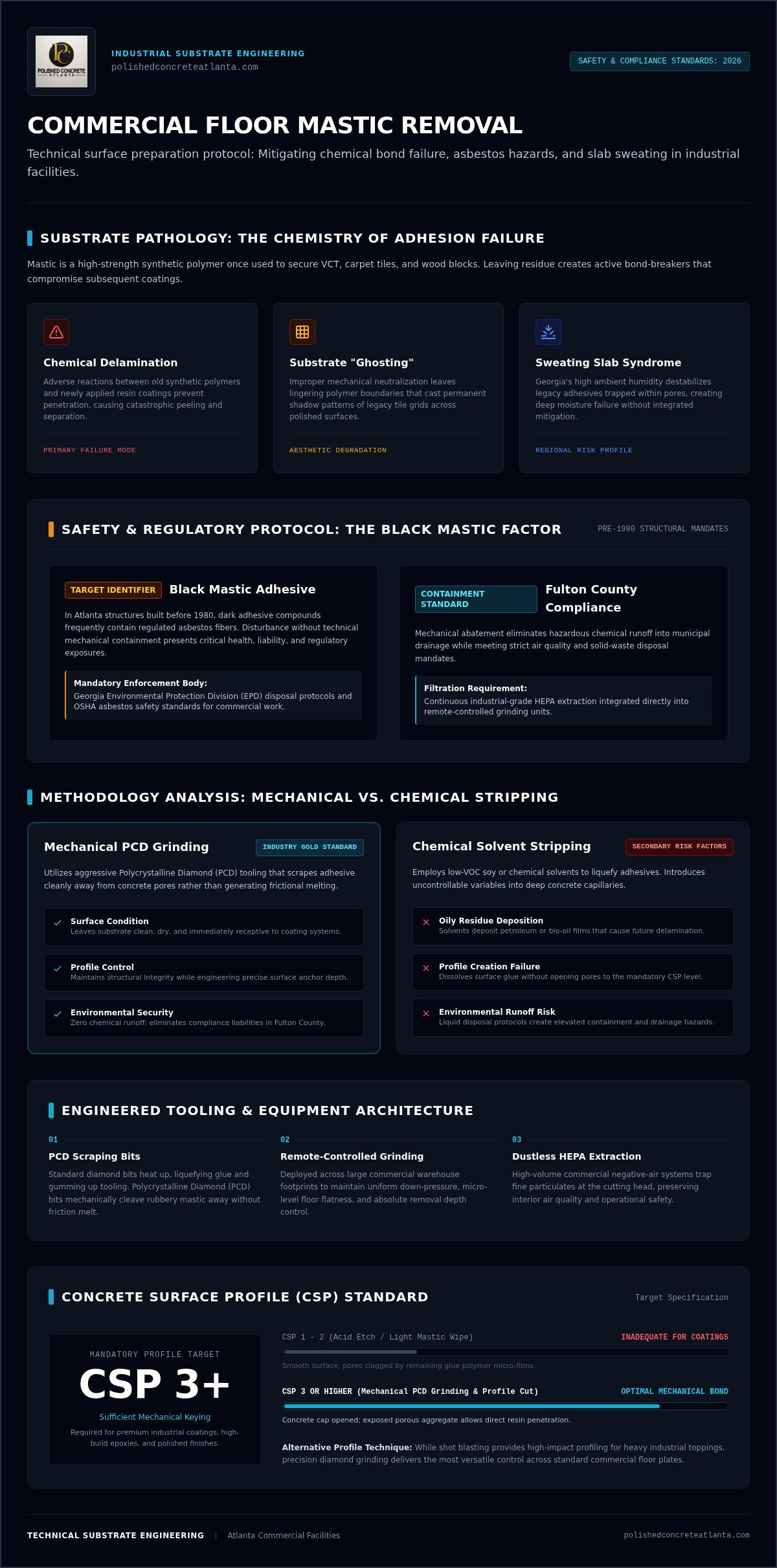
Mastic is the high-strength industrial adhesive that once anchored VCT, carpet tiles, or wood blocks to your facility's floor. In Atlanta's historic industrial corridors, these legacy adhesives are often decades old and chemically stubborn. Simply removing the top layer of flooring isn't enough. Professional commercial floor mastic removal Atlanta requires a deep understanding of how these polymers bond with the concrete pores. If you don't achieve the correct Concrete Surface Profile (CSP), your new floor is doomed before the first coat of epoxy is even mixed. A clean slab is the only acceptable starting point for a high-luster finish.
The Chemistry of Adhesion Failure
Residual glue acts as a bond-breaker. When you apply resinous coatings over poorly prepped slabs, the chemical reaction between the old adhesive and new resin leads to catastrophic delamination. Even in polished concrete projects, improper removal causes "ghosting," where the distinct pattern of the old tile grid permanently shadows the finished surface. Mastic is a complex synthetic polymer that demands aggressive mechanical disruption to be fully neutralized. Without this disruption, the new coating won't penetrate the concrete cap, leaving your investment vulnerable to peeling and failure.
Evaluating Your Concrete Slab in Atlanta
Every project starts with a forensic look at the existing slab. We analyze the thickness and tenacity of the adhesive layer to determine the necessary grit for our grinding equipment. "Black mastic" is an immediate red flag. In pre-1980 Atlanta structures, this dark adhesive frequently contains asbestos, requiring specialized handling to remain compliant with safety codes. Beyond the glue itself, we must account for Georgia's notorious humidity. High ambient moisture can destabilize old glue residues, leading to "Sweating Slab Syndrome" if the floor isn't properly mitigated during the prep phase. Precision here is the only way to ensure long-term durability. Ignoring these environmental factors is a gamble no facility manager should take.
Professional Methods for Mastic and Adhesive Removal
Selecting the right removal method is a strategic decision that dictates your project's success. For high-volume commercial floor mastic removal Atlanta, we don't rely on guesswork. We deploy heavy-duty mechanical solutions designed to strip the most resilient adhesives without compromising the slab's integrity. Precision matters. Results follow. While shot blasting is a powerful option for creating a high-impact profile for heavy industrial coatings, grinding remains the most versatile choice for the majority of Atlanta commercial spaces. Our dustless removal systems utilize industrial-grade HEPA filtration to maintain facility air quality, ensuring your operations remain safe and compliant throughout the process.
Mechanical Grinding with PCD Tooling
Standard diamond tooling often fails when facing thick, rubbery mastic. The heat generated by friction causes the glue to melt and gum up the diamonds, rendering them useless. We solve this by utilizing Polycrystalline Diamond (PCD) bits. These aggressive tools are engineered to scrape the adhesive away from the surface rather than grinding it down into the pores. For large-scale Atlanta warehouses, we utilize remote-controlled equipment to ensure a perfectly level surface and a consistent finish. This technology allows us to maintain absolute control over the depth of removal. Efficiency meets precision.
Chemical vs. Mechanical: A Strategic Comparison
While chemical stripping using low-VOC soy solvents is an option, it often introduces new variables that can compromise your floor. Mechanical methods are the gold standard for concrete surface preparation contractors because they leave a clean, dry, and profiled surface ready for immediate coating. Chemicals can leave oily residues that lead to future delamination. We prioritize mechanical commercial floor mastic removal Atlanta because it is the only way to guarantee the surface meets OSHA asbestos safety standards for commercial work when dealing with legacy adhesives. In Fulton County, environmental compliance is a top priority. Choosing mechanical removal eliminates the risk of chemical runoff and ensures your facility is ready for a premium finish. If you're ready to secure your facility's foundation, consider our professional floor glue removal services.
Safety, Compliance, and the Asbestos Factor
Safety isn't just a checkbox; it's a legal mandate. In Atlanta's older industrial districts, the risk of encountering asbestos-containing materials (ACM) is exceptionally high. Pre-1980 buildings often utilized black mastic, which is notorious for harboring asbestos fibers. Attempting commercial floor mastic removal Atlanta without professional oversight is an invitation for massive liability. OSHA and the Georgia Environmental Protection Division (EPD) enforce strict protocols for demolition and disposal. We don't guess. We verify. Certified testing before the first grinder touches the slab is the only way to protect your personnel and your bottom line.
Identifying and Handling Black Mastic
Black mastic is often easy to spot by its dark, tar-like appearance, but its chemical composition is what truly matters. Visual cues in older retail or manufacturing spaces should immediately trigger a stop-work order until testing is complete. While some 2026 standards allow for encapsulation, total removal is often the superior choice for facilities demanding a long-term architectural finish. This approach aligns with the safety benchmarks set by elite industrial flooring contractors Atlanta. We prioritize a clean, hazard-free slab over temporary fixes that might fail under future moisture stress.
Waste Disposal and Environmental Responsibility
Managing the byproduct of removal is as critical as the removal itself. We follow rigorous bagging and disposal procedures to ensure all waste is transported safely to approved Georgia landfills. Cross-contamination of HVAC systems is a common failure in amateur projects. We prevent this through strict site containment and high-efficiency filtration. This level of detail is necessary for commercial facility compliance audits. It's about maintaining the integrity of your entire environment. Don't risk your facility's safety or your reputation on a mediocre solution. If you need a partner who understands the complexities of hazardous adhesive removal, contact us for professional floor glue removal that meets every regulatory standard and protects your future investment.
Transitioning from Prep to High-Performance Flooring
Once the adhesive is gone, the real engineering begins. Achieving a bare slab is just the first milestone. For high-performance outcomes, we target a Concrete Surface Profile (CSP) of 3 or higher. This mechanical profile is essential for the chemical bond required by industrial floor coatings Atlanta. Cutting corners during commercial floor mastic removal Atlanta results in a surface that looks acceptable but fails within months. Professional preparation is a strategic investment. It prevents the catastrophic failure that occurs when coatings delaminate due to invisible residue. We don't settle for superficial cleanliness. We deliver structural readiness.
Moisture Mitigation and Slab Stabilization
Removing the glue often reveals underlying moisture issues that were previously trapped beneath the old flooring. We perform rigorous testing for the Moisture Vapor Emission Rate (MVER) immediately following removal. In the heavy humidity of the Georgia climate, an unmitigated slab is a liability. We apply advanced moisture barriers to prevent "Sweating Slab Syndrome," ensuring the long-term integrity of sealed concrete installations. Without this stabilization, osmotic pressure will eventually force your new finish to blister and peel. Precision testing is the only way to eliminate this uncertainty.
The Final Aesthetic Result
The quality of your prep dictates the clarity of your finish. Surgical-grade commercial floor mastic removal Atlanta is the only way to achieve high-clarity stained concrete floors Atlanta. Any residual glue staining will manifest as dark, blotchy patches once the dye or polish is applied. By utilizing precise grinding techniques, we achieve uniform aggregate exposure without the "ghosting" effects left by inferior methods. We don't settle for "clean enough." Our standard for floor preparation is grounded in a no-nonsense commitment to excellence. We provide a canvas ready for elite architectural expression, ensuring your facility reflects the high-end craftsmanship you expect.
Build Your Legacy on a Solid Foundation
Success in commercial flooring is determined by the discipline of your preparation. You've learned that professional commercial floor mastic removal Atlanta requires more than just scraping; it demands specialized PCD grinding technology to strip stubborn polymers without scarring the underlying slab. By prioritizing safety compliance and rigorous moisture mitigation, you eliminate the hidden variables that lead to delamination and costly rework. A clean, CSP-compliant surface is the only acceptable starting point for an elite finish.
We bring over 20 years of Atlanta-based industrial expertise to every project, ensuring your facility meets the highest architectural standards. We don't just clear the mess; we engineer the bond. Don't settle for a surface that looks clean but lacks the structural integrity to hold a premium finish. It's time to invest in a floor that performs as well as it looks. Secure your facility’s foundation with Polished Concrete Atlanta. Your vision for a world-class facility starts with the precision of the prep. Let's build something that lasts.
Frequently Asked Questions
How do I know if my floor mastic contains asbestos?
Visual identification is notoriously unreliable; laboratory testing is the only definitive method. Black mastic found in Atlanta buildings constructed before 1980 is a high-risk indicator for asbestos. Since many local industrial districts feature historic structures, we recommend certified testing before any mechanical disruption. Professional contractors use these results to determine if standard removal or hazardous abatement protocols are required to keep your facility compliant.
Can I install epoxy directly over old mastic residue?
You cannot achieve a reliable bond over adhesive residue. Epoxy requires a clean, profiled concrete surface to penetrate the pores effectively. Any remaining mastic acts as a bond-breaker, leading to catastrophic delamination and peeling. For successful commercial floor mastic removal Atlanta projects, the slab must be ground to a CSP 3 or higher. This mechanical profile ensures the new resinous coating adheres permanently to the concrete substrate.
How long does commercial floor mastic removal take for a 10,000 sq ft space?
A typical 10,000 square foot project generally takes two to four business days depending on the adhesive's thickness and tenacity. Factors such as the number of glue layers and the specific polymer type influence the total timeline. We utilize high-capacity planetary grinders and specialized PCD tooling to maximize efficiency. This allows us to maintain tight schedules for Atlanta facilities without sacrificing the surgical precision required for a high-end finish.
What is the difference between floor glue removal and concrete grinding?
Glue removal focuses on stripping the topical adhesive layer, while concrete grinding involves cutting into the concrete surface itself. In most professional applications, these steps are integrated into a single process. We use aggressive PCD bits to scrape away the bulk of the glue, followed by diamond-grit grinding to remove deep-seated stains. This dual approach ensures the slab is both chemically clean and properly profiled for future industrial coatings.
Will mastic removal create a lot of dust in my active facility?
Not when you utilize professional-grade dustless systems. We use industrial HEPA-filtered vacuums connected directly to our grinding equipment to capture 99.97% of airborne particles at the source. This is critical for maintaining air quality in active Atlanta warehouses or retail spaces. While no industrial process is entirely silent, our managed approach minimizes environmental impact. This allows adjacent operations to continue with minimal disruption to your facility's daily workflow.
Do I need moisture mitigation after the mastic is removed?
Moisture testing is essential after removal because old adhesives often trap vapor that causes new floors to fail. Georgia's high humidity frequently leads to "Sweating Slab Syndrome" once the concrete is exposed. We perform MVER testing to determine if a moisture barrier is necessary. If levels are high, specialized mitigation ensures your polished concrete or epoxy system remains stable and free from osmotic blistering for the long term.


