
Over 80% of industrial floor coating delaminations stem directly from improper surface preparation rather than product failure. It's a staggering reality for facility managers across the I-85 and Fulton Industrial corridors. You understand the frustration of seeing a premium epoxy system fail because the concrete lacked a sufficient mechanical anchor. When grinding isn't enough to bite through thick mastics or level aggressive joint curls, professional concrete scarifying services Atlanta provide the surgical precision required for a permanent bond. We don't settle for "good enough" prep work. We engineer surfaces for absolute adhesion.
You deserve a facility that operates without the constant threat of tripping hazards or delaminating floors. This article outlines the 2026 industrial standards for scarification, from achieving precise ICRI CSP 4-6 profiles to maintaining OSHA-compliant HEPA dust control in active environments. We'll examine how strategic milling removes decades of contaminants and old adhesives to prepare your slab for its next evolution. It's time to move beyond superficial fixes and embrace the technical rigor that defines a world-class industrial floor. Let's look at the mechanics of a perfect profile.
Key Takeaways
- Learn why scarifying is the definitive choice for removing thick-build coatings exceeding 1/8 inch where standard diamond grinding falls short.
- Understand how to engineer absolute adhesion by achieving the precise Concrete Surface Profile (CSP) required for your specific industrial floor finish.
- Evaluate the unique slab challenges found in Atlanta's legacy industrial corridors to ensure your facility meets modern durability standards.
- Discover how professional concrete scarifying services Atlanta eliminate the risks of recurring coating failures and tripping hazards through aggressive mechanical profiling.
- Master the strategy of integrating heavy-duty scarification with moisture mitigation to secure a permanent, high-performance flooring asset.
Concrete Scarifying vs. Grinding: Choosing the Right Surface Prep
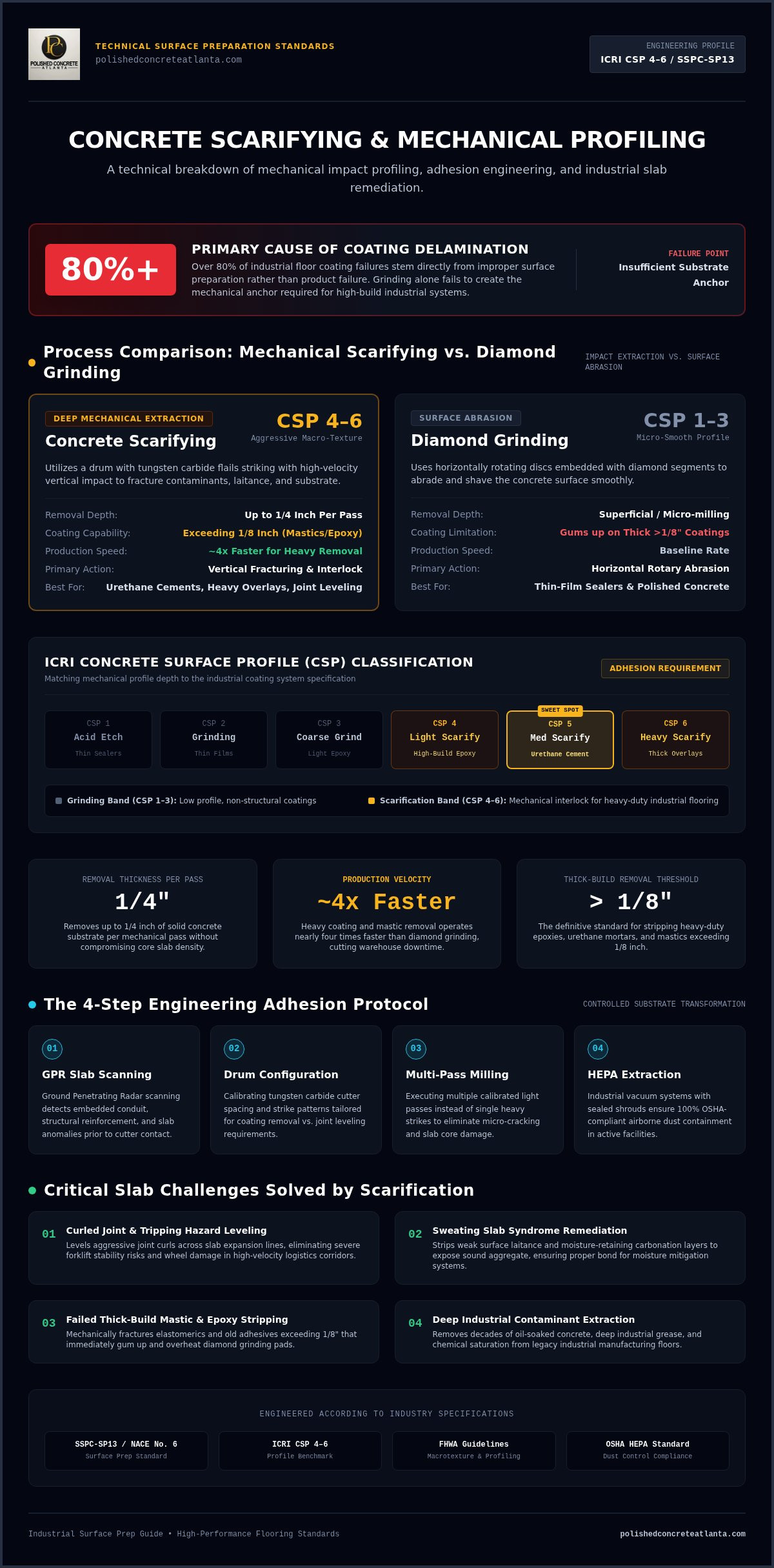
Grinding is a shave; scarifying is a deep extraction. In Atlanta's high-demand industrial sector, mistaking these two distinct mechanical processes leads to catastrophic floor failure. Professional concrete scarifying services Atlanta are the standard when you're facing decades of failed epoxy or uneven joints that threaten forklift safety. Grinding uses horizontally rotating discs embedded with diamonds to abrade the surface. Scarifying utilizes a drum with tungsten carbide flails that pummel the slab. This vertical impact fractures contaminants and removes up to 1/4 inch of solid substrate per pass. It's the difference between polishing a problem and removing it entirely.
The "Impact vs. Abrasion" debate isn't just academic. It's about the integrity of your facility's foundation. While grinding is gentle, it often glazes over contaminants or fails to bite into hard-troweled slabs. Scarifying creates a macro-texture that allows industrial coatings to "root" into the concrete. This aggressive approach is essential for high-velocity logistics centers along the I-20 West corridor where slab durability is non-negotiable. We don't settle for surface-level aesthetics. We build for performance.
When Scarifying is Non-Negotiable
Don't try to grind through 1/8 inch of heavy-duty epoxy or failed urethane cement. The heat generated by grinding will gum up diamond segments and waste labor hours. Scarifying is the only logical path for stripping thick-build systems or leveling curled expansion joints. It's also the definitive solution for remediating "Sweating Slab Syndrome." By removing surface laitance and the weak, moisture-retaining top layer, we expose sound aggregate. This process ensures your new floor system isn't sitting on a layer of dust and carbonation. It's pragmatism in action.
The Technical Comparison Framework
Choosing your method depends entirely on the requirements of your final finish. Grinding produces a Concrete Surface Profile (CSP) of 1 to 3, which is ideal for thin-film sealers or polished concrete. However, heavy-duty industrial overlays and mortars demand the mechanical tooth of a CSP 4 to 6. We strictly adhere to the SSPC-SP13/NACE No. 6 standard for concrete surface preparation to ensure every square foot is engineered for absolute adhesion. While the impact is more aggressive, the production rate for heavy removal is nearly 4x faster than grinding. This efficiency minimizes downtime in large Atlanta warehouse footprints. Precision is our standard. Results are our proof.
The Engineering of Adhesion: The Scarifying Process
Adhesion isn't an accident. It's the result of mechanical interlock engineered into the concrete substrate. Tungsten carbide-tipped cutters strike the surface with controlled force, fracturing the top layer to remove oil-soaked concrete and failed coatings. This process follows the FHWA surface texture and profiling guidelines to create a macrotexture that resinous systems can physically grab. We manage structural integrity through precise depth control. Deep removal shouldn't mean damaging the slab's core. Professional concrete scarifying services Atlanta prevent micro-cracking by using calibrated equipment and seasoned technicians who understand slab dynamics.
Step-by-Step Mechanical Scarification
Our process begins with a detailed slab assessment. We use Ground Penetrating Radar (GPR) scanning to identify reinforcement hazards or embedded conduit before any cutters touch the floor. We then configure the cutter drum patterns based on your specific goals. Stripping a thick epoxy requires a different cutter spacing than leveling a curled joint. We execute multiple light passes rather than one aggressive strike. This prevents deep gouging and ensures a uniform profile across the entire footprint. Dust control is managed via sealed shrouds and HEPA-filtered vacuum systems to protect your active facility and inventory.
Achieving CSP 4-6 Standards
Industrial coatings are only as strong as their bond. High-build systems, such as urethane cements or heavy-duty epoxies, require the aggressive "tooth" of a scarified surface. We verify our work by measuring the Concrete Surface Profile (CSP) against industry standards to ensure it meets your manufacturer's specifications. CSP 5 is the 'sweet spot' for heavy-duty resinous flooring. This profile provides enough surface area for maximum bond strength without compromising the slab's structural density. If you need a partner who understands the technical requirements of high-performance floors, our team provides the specialized floor preparation your project demands. We don't guess. We measure.
Atlanta Industrial Logistics: Local Site Considerations
Atlanta's industrial landscape is a mix of legacy grit and modern efficiency. Facilities in the Chattahoochee corridor often sit on slabs that have endured decades of chemical exposure and oil saturation. These environments demand more than a simple cleaning. Professional concrete scarifying services Atlanta provide the deep mechanical extraction necessary to reach sound concrete in these aging structures. We also manage Georgia's high ambient humidity, which can trigger delamination if moisture drive isn't addressed. Our team integrates scarification with comprehensive floor moisture mitigation to secure your investment against the local climate. Precision is our baseline.
Operating in active 24/7 logistics hubs like those in South Atlanta requires strict adherence to the OSHA respirable crystalline silica standard. We don't compromise on safety. Our high-capacity HEPA filtration systems ensure that your operations continue without interruption while we remediate the slab. We prioritize your production schedule. We deliver results without the dust.
Warehouse and Distribution Center Standards
High-velocity hubs in Norcross face relentless fork-truck traffic that leads to joint spalling and surface fatigue. Scarifying is the first step in remediating this damage before moving to an Ashford Formula Installation or heavy-duty sealer. We recently revitalized a 50,000 sq ft legacy warehouse floor by milling away 1/4 inch of oil-contaminated concrete. This restored the slab's structural integrity and provided a clean slate for a high-performance finish. We don't guess about depth. We engineer it.
Commercial and Retail Surface Prep
Renovating retail spaces often involves stripping decades of stubborn tile adhesive or black mastic. While we prepare these environments for Stained Concrete Floors Atlanta, we balance aggressive removal with the precision needed for a polishable final surface. It's a technical process. We remove the bond-breakers while ensuring the remaining slab is viable for decorative finishes. If you're ready to transform a compromised slab into a high-performance asset, contact our industrial floor specialists for a professional site evaluation. We turn liabilities into assets.
The Polished Concrete Atlanta Advantage
We don't settle for superficial fixes. Our no-nonsense approach to industrial floor restoration starts with the technical reality that most failures happen below the surface. By utilizing professional concrete scarifying services Atlanta, we address the root cause of slab instability before a single drop of coating is applied. This often involves integrating scarification with advanced Moisture Mitigation for Concrete Floors. It's about engineering a permanent solution, not a temporary patch. Our technical expertise is your primary defense against the "Concrete Floor Failing After Coating" disaster that plagues under-prepared facilities.
While scarifying is an aggressive mechanical process, it's also a critical precursor to high-end aesthetics. For projects transitioning to premium Polished Concrete Floors, we use scarifiers to eliminate deep stains and height variances before refining the slab with progressive diamond grinding. This hybrid approach ensures a level, durable foundation that supports a high-luster finish. We bridge the gap between heavy-duty preparation and elite craftsmanship.
A Strategic Partnership for Your Facility
We act as your creative consultant and meticulous manager of details. This partnership begins with a consultative selection of CSP levels based on your facility's specific forklift traffic and chemical exposure. We provide transparent communication regarding your slab's limitations. If a floor is too compromised for a certain finish, we'll tell you. We prioritize long-term value over short-term sales. High-end craftsmanship is visible in every pass. Reliability is our signature.
Next Steps for Your Atlanta Project
Securing a high-performance floor starts with a site-specific assessment. Our team evaluates your concrete's density, moisture levels, and existing contamination to determine the optimal removal depth. To prepare your space for our crew, ensure all equipment is cleared and power requirements are verified. We manage the rest. From the first strike of the carbide cutters to the final seal, we finalize the transition from surface prep to a high-performance industrial asset. Your facility deserves nothing less than the industrial standard.
Securing Your Industrial Asset for the Next Decade
We've detailed how scarification bridges the gap between a compromised slab and a permanent flooring asset. You now understand why achieving a CSP 4-6 profile is non-negotiable for high-performance coatings and how integrated moisture mitigation protects your facility from Georgia's relentless humidity. Precision is the difference between a floor that fails and one that endures. Selecting professional concrete scarifying services Atlanta ensures your floor preparation meets the 2026 industrial standard for absolute adhesion. We don't guess. We engineer for results.
Since 2004, we've specialized in industrial and commercial environments across the metro area. We provide expert-led consultations designed to build strategic flooring alliances based on transparency and tangible performance. Your facility deserves a foundation built on technical rigor and elite craftsmanship. Don't leave your infrastructure to chance. Request a Professional Floor Assessment for Your Atlanta Facility today. Let's transform your compromised concrete into a high-performance asset that stands the test of time.
Frequently Asked Questions
What is the difference between concrete scarifying and concrete milling?
Scarifying and milling are technically similar; they differ in scale and depth. Milling usually involves heavy-duty asphalt or concrete planers for deep substrate removal on infrastructure projects. Scarifying utilizes rotary drums with tungsten carbide flails to strip surface contaminants and achieve specific profiles. It's the standard for industrial floor preparation where you need to remove up to 1/4 inch of material to ensure absolute coating adhesion. This mechanical process creates the necessary anchor for high-performance systems.
Can scarifying remove old floor glue and mastic in Atlanta commercial buildings?
Professional concrete scarifying services Atlanta are the definitive solution for removing thick-build adhesives and black mastic that standard grinding can't touch. Many legacy commercial buildings in Atlanta contain multiple layers of old tile glue that gum up diamond segments. Scarifying shatters these bond-breakers by impacting the slab vertically. This mechanical process ensures a clean, sound substrate for your next floor system. We don't settle for surface-level scraping; we extract the problem entirely to guarantee a permanent bond.
How deep can a concrete scarifier go in a single pass?
A professional scarifier typically removes between 1/8 inch and 1/4 inch of concrete in a single pass. The exact depth depends on the slab's compressive strength and the configuration of the cutter drum. While it's tempting to go deep immediately, we often recommend multiple lighter passes. This strategy prevents micro-cracking and ensures a uniform surface profile across the entire footprint. It's about precision control rather than brute force. We prioritize the slab's long-term structural integrity.
Is concrete scarifying necessary for every industrial epoxy project?
No, scarifying isn't required for every project, but it's non-negotiable for high-performance systems. If your facility requires a CSP 4-6 for heavy-duty epoxy mortars or urethane cements, grinding won't suffice. Scarifying is also essential when remediating oil-saturated slabs or leveling curled joints. We evaluate each Atlanta facility individually to determine if aggressive profiling is necessary. We don't recommend overkill. We recommend what is required for a permanent, worry-free investment in your facility's infrastructure.
How do you control dust during the concrete scarifying process in an active warehouse?
We utilize high-capacity, HEPA-filtered vacuum systems integrated directly with our scarifying equipment. These units capture 99.97% of particles down to 0.3 microns, maintaining compliance with the OSHA respirable crystalline silica standard. Sealed shrouds around the cutter drum contain the debris at the source. This allows your Atlanta warehouse to remain operational in adjacent bays without the risk of cross-contamination. We manage the environment as meticulously as we manage the floor. Cleanliness is a standard, not an option.
What is the typical cost difference between scarifying and diamond grinding in Georgia?
Scarifying generally involves a higher investment than standard diamond grinding due to the increased wear on tungsten carbide cutters and the aggressive nature of the equipment. However, it's often the more cost-effective choice for heavy removal. Grinding through thick epoxies or mastics takes significantly more labor hours and diamond segments. By choosing professional concrete scarifying services Atlanta, you're investing in a faster, more reliable prep process that eliminates the risk of premature coating failure and ensures absolute adhesion.


