
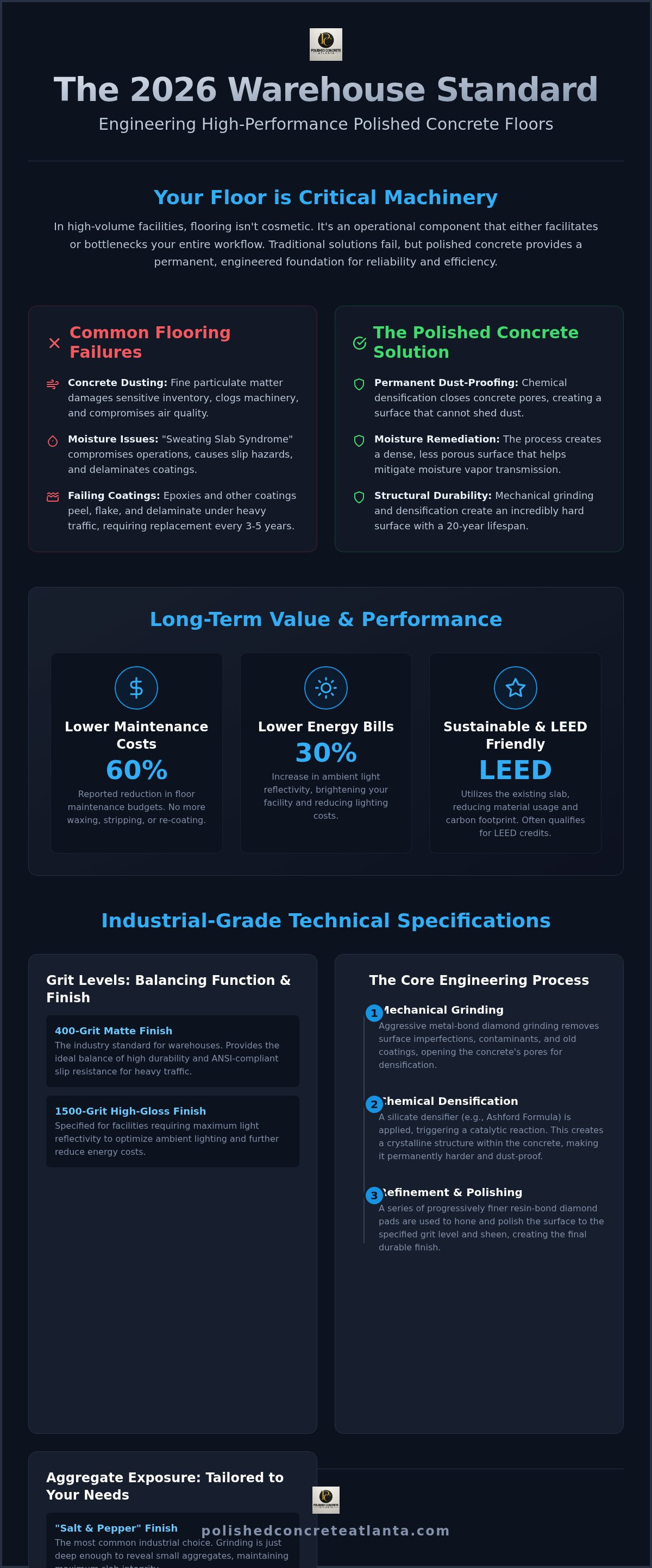
Most facility managers treat their flooring as a cosmetic finishing touch. They're wrong. In a high-volume environment, your floor is a critical piece of industrial machinery that either facilitates or bottlenecks your entire operation. If you're struggling with concrete dusting ruining your inventory or expensive coatings that fail after only three years, you're fighting a losing battle against your own facility. Investing in polished concrete warehouse floors isn't about aesthetics; it's about engineering a permanent solution to structural wear.
We understand that you need a surface that withstands relentless forklift traffic and solves moisture issues like Sweating Slab Syndrome once and for all. This guide provides the definitive 2026 roadmap for creating a high-luster, dust-free environment that can reduce your maintenance budget by up to 60 percent. We'll examine the latest ANSI slip-resistance standards and the precision densification process required for a 20-year lifespan. It's time to stop patching problems and start building a foundation of reliability.
Key Takeaways
- Understand how mechanical and chemical densification permanently eliminates concrete dusting to protect your inventory and facility air quality.
- Master the technical grit levels required for polished concrete warehouse floors to balance high-luster aesthetics with heavy-duty industrial utility.
- Identify the specific moisture vapor transmission risks inherent in Georgia slabs and how to remediate Sweating Slab Syndrome before it compromises your operations.
- Learn to conduct a professional Traffic Pattern Analysis to engineer a floor finish that withstands relentless forklift traffic without premature wear.
- Discover the critical equipment and scale requirements you must verify when vetting an industrial flooring partner for large-scale projects.
Engineering Durability: Why Polished Concrete is the 2026 Warehouse Standard
Industrial flooring isn't a design choice. It's a performance requirement. In the high-stakes environment of 2026 logistics, Polished concrete has moved from an option to a necessity. Unlike sacrificial coatings that eventually peel, flake, or delaminate under the stress of heavy machinery, polished concrete warehouse floors are engineered through a rigorous process of mechanical grinding and chemical densification. This transformation doesn't just make the floor look better; it changes the molecular structure of the surface to create a dense, impenetrable barrier.
One of the most immediate operational benefits is the total elimination of concrete dusting. Raw concrete slabs naturally shed fine particulate matter. This dust settles on sensitive inventory, clogs machinery filters, and compromises air quality for your workforce. By densifying the slab with silicates, we close the pores and create a surface that's physically incapable of dusting. This process also dramatically increases compressive strength. When you have forklifts carrying multi-ton loads 24 hours a day, you can't afford a floor that crumbles under pressure. You need a surface that becomes part of the building's structural integrity.
The Economic Argument: ROI and Life-Cycle Costs
While the upfront cost might seem comparable to high-end industrial systems, the 20-year life-cycle cost is where the value becomes undeniable. Businesses typically report a 40 to 60 percent reduction in floor maintenance budgets because there is no waxing, stripping, or re-coating required. Additionally, the high luster of these floors increases ambient light reflectivity by up to 30 percent. This directly translates to lower energy bills for large facilities. For those operating in the Southeast, following The Standard for Polished Concrete Floors in Atlanta ensures that your investment aligns with current regional industrial benchmarks and performance expectations.
Sustainability in Large-Scale Industrial Facilities
Using the existing slab is the most environmentally responsible choice a developer can make. By eliminating the need for additional materials like VCT or thick-film resins, you significantly reduce the project's carbon footprint. This approach often qualifies for LEED credits, making it a strategic move for modern warehouse development. Maintenance is equally sustainable; you'll no longer need the harsh, abrasive cleaning chemicals required for maintained surfaces. A simple neutral cleaner and water are usually enough to maintain the integrity of the finish for decades.
Technical Specifications for Industrial-Grade Polished Concrete
Engineering a high-performance floor requires more than just a passing knowledge of equipment. It demands strict adherence to the ACI 310.1-20 Specification, which outlines the rigorous standards for materials and execution in the polishing industry. The process begins with aggressive metal-bond diamond grinding to remove surface imperfections and open the concrete's molecular structure. We then transition through progressively finer resin-bond pads to refine the surface. For most polished concrete warehouse floors, a 400-grit matte finish provides the ideal balance of slip resistance and durability. However, facilities requiring maximum light reflectivity often specify a 1500-grit high-gloss finish to optimize ambient lighting and reduce energy consumption.
Aggregate exposure is another critical technical variable. Most industrial clients opt for a "salt and pepper" cut, which involves grinding just deep enough to reveal small aggregates while maintaining the slab's structural integrity. If your facility demands a specific aesthetic or higher slip resistance, you might choose a deeper aggregate exposure. This isn't just about looks. It's about tailoring the surface profile to your specific traffic patterns. If you're unsure which specification fits your operational needs, it's wise to consult with an industrial flooring specialist before the first machine touches your slab.
The Ashford Formula and Permanent Sealing
We don't settle for topical sealers that eventually wear away. We use the Ashford Formula to trigger a catalytic reaction within the concrete itself. This chemical process creates a crystalline structure that fills the pores of the slab, making it significantly harder and completely dustproof. Over time, the friction from daily traffic actually helps "self-heal" and polish the surface further. It's why this specific densification method is the preferred standard for global logistics giants who cannot afford downtime for floor repairs.
Precision Floor Preparation
A polished finish is only as good as the preparation beneath it. For older facilities or converted spaces, working with experienced concrete surface preparation contractors is non-negotiable. This phase includes meticulous floor glue removal and the remediation of old adhesives that would otherwise ghost through the final polish. Proper preparation ensures the slab is level and free of contaminants, preventing the delamination issues that plague inferior, rushed installations. We use industrial HEPA vacuums and planetary grinders to ensure the environment remains clean and the slab is perfectly primed for densification.
The Facility Manager’s Evaluation: Traffic, Moisture, and Sweating Slabs
Operational success in a high-volume facility depends on predictable performance. Before specifying a finish, we conduct a rigorous Traffic Pattern Analysis to identify high-wear zones where forklifts pivot or accelerate. This data ensures that your polished concrete warehouse floors are engineered for the specific stresses of your workflow. Safety is the other non-negotiable factor. As of late 2026, OSHA mandates a minimum coefficient of friction (COF) of 0.5 on all level industrial surfaces. While a high-luster floor looks slick, a correctly polished slab provides superior traction compared to many topical coatings, ensuring your facility remains compliant and your operators stay safe; for additional safety, professional StripeGuys Warhouse Line Striping can help define these critical traffic zones.
Maintaining your warranty requires more than just occasional cleaning. You must follow a disciplined maintenance schedule using neutral cleaners and specialized diamond-impregnated pads. This isn't just about aesthetics; it's about preserving the chemical densification achieved during the install. If you fail to remove abrasive grit or use acidic chemicals, you compromise the floor's integrity. If you're ready to secure your facility's future, schedule a technical site evaluation with our team to assess your slab's current condition.
Remediating Sweating Slab Syndrome (SSS)
In the heavy humidity of Atlanta, Sweating Slab Syndrome is a constant threat to safety and productivity. This occurs when warm, moisture-laden air hits a cold concrete slab, causing condensation to form instantly. The resulting "sweat" turns your warehouse into a skating rink for forklifts, leading to brake failure and slip-and-fall liabilities. We solve this by using specific lithium-based densifiers that tighten the concrete's surface. This process, combined with proper HVAC consultation, significantly reduces the surface's ability to collect moisture, keeping your operations moving regardless of the Georgia weather.
Moisture Mitigation and Vapor Barriers
Not every slab is a candidate for standard polishing. We utilize the ASTM F2170 standard for in-situ moisture testing, which now provides official readings in just 24 hours. If your slab shows high moisture vapor transmission, a standard polish may fail over time. In these cases, we deploy technical moisture mitigation systems to create a permanent vapor barrier. Understanding the Professional Verdict on Polished Concrete vs Epoxy is essential when dealing with "wet" slabs. We don't guess at moisture levels; we use precision probes to ensure the solution we install is the one that will actually last 20 years.
Selecting an Industrial Flooring Contractor in Atlanta
Choosing a partner for your facility isn't just about finding the lowest bid. It's about technical capability and the elimination of uncertainty. When you're managing 50,000 square feet or more, you need a contractor who understands the logistics of scale. Verify their fleet before mobilization. High-production planetary grinders and industrial HEPA vacuums are non-negotiable for maintaining air quality and project speed. A true expert won't hesitate to provide a technical breakdown of the densification chemicals they use. Transparency is the only way to ensure polished concrete warehouse floors meet the rigorous standards your operations demand.
High-traffic aisles are the primary point of failure in most facilities. If a contractor ignores "Joint Repair and Stabilization," they aren't providing a complete solution. Heavy forklift wheels will eventually spall the edges of untreated joints, leading to floor failure and equipment damage. We treat joints as a critical component of the structural system. Demand a plan that includes semi-rigid joint fillers designed to support heavy loads. In Georgia, any project valued over $2,500 requires a state-issued General Contractor license. Verify this credential and their $500,000 minimum liability insurance before any machine touches your slab. It's a baseline for professional character.
The Atlanta Advantage: Local Expertise Matters
Hiring industrial flooring contractors in Atlanta provides more than just proximity. It ensures your team understands the specific climate-driven preparation required for the region's high humidity and soil conditions. We manage massive warehouse projects with a no-nonsense approach to deadlines. We know that every hour your floor is under construction is an hour of lost productivity. Local teams move faster, arrive on-site with the right equipment, and react to site-specific challenges with seasoned authority.
Final Checklist Before You Sign
Never sign a contract based on a brochure or a generic sample. Your facility has unique variables that require a customized execution plan. Use this checklist to hold your contractor to a higher standard:
- Request a Mock-up: Always schedule a test area on your actual slab. This is the only way to verify aggregate exposure and gloss levels before the full project begins.
- Verify the Warranty: Ensure the agreement specifically covers dusting and shine retention. A 20-year solution should be backed by clear, written terms.
- Review Maintenance Plans: A dedicated partner provides a granular post-install maintenance schedule. This plan should include specific pad types and neutral cleaners to protect the integrity of the finish.
Your floor is a structural investment. Don't settle for mediocrity when you can have a high-performance surface engineered for the long term.
For those looking to complete their facility upgrade, high-quality storage and cabinetry from Floorguard provide the perfect organizational complement to a newly polished industrial floor.
Securing Your Facility’s Operational Future
Your warehouse floor is the foundation of your entire logistical chain. We've established that settling for thin-film coatings or raw concrete is a recipe for operational bottlenecks and recurring costs. By choosing polished concrete warehouse floors, you're investing in a surface that actually gets harder with age and traffic. It's about shifting your perspective from short-term fixes to a 20-year vision of durability and safety.
Success requires a partner who understands the high-stakes reality of industrial square footage. With over 20 years of Atlanta industrial experience, we bring the technical rigor required to handle everything from precision moisture mitigation to Sweating Slab Syndrome remediation. As certified Ashford Formula installers, we don't just polish concrete; we engineer high-performance environments that survive the most demanding traffic patterns.
Don't leave your facility's integrity to chance. Take the first step toward a dust-free, high-luster environment today. Request a Professional Industrial Floor Evaluation and let's build a foundation that lasts.
Frequently Asked Questions
Is polished concrete too slippery for warehouse forklift traffic?
No, it isn't. Properly polished concrete warehouse floors meet or exceed the 2026 OSHA mandate of a 0.5 coefficient of friction for level industrial surfaces. By removing the fine dust and laitance that makes raw concrete dangerous, we actually improve traction for heavy forklift tires. It's a safer, more predictable surface than untreated slabs or many topical coatings that can become slick when wet.
What is the Ashford Formula and why is it used on warehouse floors?
The Ashford Formula is a chemically reactive liquid densifier that creates a permanent, crystalline seal within the concrete matrix. It's used because it triggers a catalytic reaction to harden the slab and eliminate dusting forever. This isn't a topical sealer that wears off over time. It becomes a structural part of the floor, making it the preferred specification for global logistics facilities that demand 20-year durability.
How long does the polishing process take for a typical 50,000 sq ft warehouse?
A 50,000 square foot project typically requires 10 to 14 days to complete from mobilization to final walkthrough. This timeline accounts for rigorous floor preparation, multiple grinding stages, and the chemical densification process. We utilize high-production planetary grinders and industrial HEPA vacuums to maintain this pace without sacrificing quality. Your specific site conditions and traffic pattern requirements will dictate the final project schedule.
Can you polish an old warehouse floor with existing glue or epoxy?
Yes, we can restore older slabs that currently have glue, mastic, or failed epoxy coatings. The process starts with professional floor glue removal and aggressive diamond grinding to strip away the existing materials. We use industrial-grade equipment to reach the clean, virgin concrete underneath. Once the surface is properly prepared and leveled, we begin the standard polishing and densification sequence to transform the old floor.
What is Sweating Slab Syndrome and can polishing fix it?
Sweating Slab Syndrome is surface condensation caused by warm, humid air hitting a cold concrete slab. While no flooring can stop the laws of physics, our densification process significantly reduces the slab's porosity and surface tension. By tightening the surface with specific silicates, we make it much harder for moisture to collect and pool. This mitigation is essential for maintaining safety and forklift braking capability in Georgia's humid climate.
How does polished concrete compare to epoxy for industrial use?
Polished concrete is a permanent structural modification, while epoxy is a sacrificial coating that will eventually peel, flake, or delaminate. For most industrial applications, the primary advantage of polishing is the lower total cost of ownership. You'll avoid the expensive cycle of stripping and re-coating every few years. Polishing offers superior durability under heavy forklift traffic and can improve ambient light reflectivity by up to 30 percent.


