

Choosing a floor finish based on a color swatch alone is a strategy for failure. In a market where construction input prices have risen 4.8% year-over-year, making the wrong choice between concrete dye vs stain for commercial floors isn't just an aesthetic mistake; it's a financial liability. You need a surface that maintains its professional integrity under heavy industrial wear for a decade or more. Reliability is non-negotiable.
We understand the frustration of navigating technical jargon like acid-reactive versus water-based formulations. You want predictable results that match your brand standards without the fear of color fading in high-traffic zones. This guide eliminates the uncertainty. You will master the critical distinctions between chemical permanence and molecular precision to select a high-performance system that survives the rigors of 2026 industrial standards. We're moving beyond the surface to analyze how these technologies perform in real-world environments. It's time to secure a floor that reflects your commitment to excellence.
Key Takeaways
- Understand the fundamental chemical differences between reactive acid stains and non-reactive micro-dyes to ensure your facility's color remains permanent.
- Evaluate the performance metrics of concrete dye vs stain for commercial floors based on UV exposure and traffic patterns to prevent premature fading.
- Identify the optimal coloring system for your specific environment, prioritizing vibrant brand aesthetics for retail or industrial-grade durability for warehouses.
- Learn why professional-grade surface preparation and moisture mitigation are the non-negotiable foundations for a successful, high-performance flooring installation.
- Master the technical requirements of each system to achieve a low-maintenance, professional surface that resists industrial wear for over a decade.
The Science of Surface Pigmentation: Chemical Reaction vs. Molecular Penetration
Success in commercial flooring is dictated by chemistry. When comparing concrete dye vs stain for commercial floors, you aren't just choosing a color; you're selecting a delivery method for pigment. Stains rely on a chemical transformation of the concrete's top layer. Dyes rely on molecular penetration. Both require precision. It's a molecular transformation. We don't settle for surface-level aesthetics. We demand a permanent integration of color and substrate.
Concrete Stains: The Permanent Chemical Bond
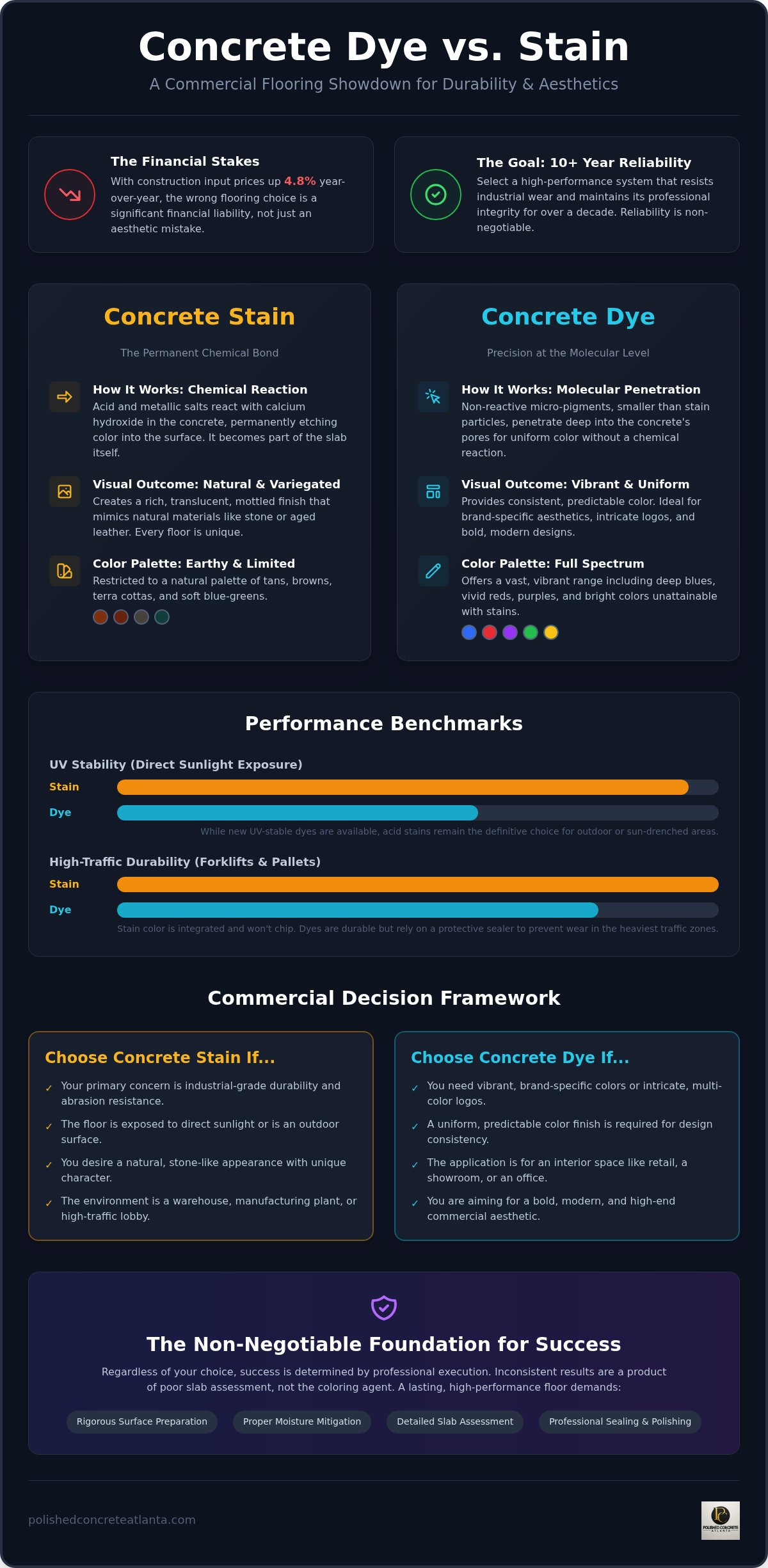
Acid-based stains are reactive agents. They utilize a mixture of water, hydrochloric acid, and metallic salts to trigger a reaction with the calcium hydroxide present in the concrete. This process permanently etches the color into the slab. The result is a variegated, translucent finish that mimics natural stone or aged leather. Because the reaction depends on the concrete's mineral content, the palette is strictly limited to earthy tones like tans, browns, and terra cottas. For facilities requiring a non-reactive option that still provides a semi-transparent look, water-based acrylic stains serve as a reliable alternative. They don't etch the surface but rather deposit pigment into the open pores. They offer more consistency but less depth than their acid-reactive counterparts.
Concrete Dyes: Precision at the Molecular Level
Dyes operate on a different scale. These are non-reactive micro-pigments with a molecular size significantly smaller than those found in stains. This allows for deep, uniform permeation without altering the concrete's pH. Solvent-based dyes offer rapid drying times and intense penetration, while water-based versions provide a safer, low-VOC application. Dyes are the definitive choice for brand-specific aesthetics. They offer a vibrant spectrum including deep blues, vivid reds, and purples that acid stains simply cannot achieve. This precision makes them the standard for intricate retail logos and multi-color patterns. They provide the control that high-end commercial designs demand.
Many facility managers fear the "unpredictability" of stained concrete. This is a misconception. Inconsistent results are almost always the product of poor slab assessment rather than a failure of the pigment itself. Understanding The Science of Polished Concrete is vital here. If the slab's porosity or chemical composition isn't analyzed before application, the reaction will be uneven. We don't guess. We engineer the outcome through rigorous testing and mechanical preparation. A predictable result is the only acceptable result.
Performance Benchmarks: Comparing Durability, UV Stability, and Color Vibrancy
Performance in a commercial environment is a matter of physics and local climate. In the high-heat, high-UV environment of Georgia, the choice between concrete dye vs stain for commercial floors hinges on long-term color stability. Historically, dyes were restricted to interior use because they lacked UV resistance. However, 2026 industry standards have introduced UV-stable dye formulations that significantly expand their application range. Despite these advances, acid-reactive stains remain the definitive choice for outdoor transitions or areas with direct sunlight. They don't just sit in the pores; they become part of the concrete matrix, ensuring the color remains colorfast for decades.
Maintenance cycles in Atlanta warehouses are often dictated by the sheer volume of traffic. While stains offer a lifespan of 50+ years with proper care, dyes provide more predictable brand-standard color matching. Achieving this requires Professional Concrete Surface Preparation to ensure the pigment reaches the necessary depth. Without this foundation, any color system will eventually succumb to industrial wear. We prioritize results that eliminate the need for frequent re-coating, saving you from the rising costs of construction labor and materials.
The Durability Factor in High-Traffic Zones
Forklift traffic and pallet dragging are the ultimate tests for any floor. Acid stains excel here because the color is chemically integrated into the slab. It won't chip or peel under heavy mechanical stress. Dyes, while sitting deep in the pores, can show wear if the surface isn't properly protected. This is why sealed concrete is the non-negotiable final step for any commercial project. A high-solids sealer protects the pigment from chemical spills and abrasion, ensuring the floor maintains its professional appearance. If you're managing a facility with high spill risks, the chemical resistance of an acid-reactive system provides the peace of mind you require.
Color Range and Aesthetic Control
Aesthetics shouldn't come at the cost of performance. If your goal is a natural, marbled patina for a boutique environment, acid stains deliver a unique earthy charm that cannot be replicated. For modern office lobbies or automotive showrooms, dyes provide the saturation and precision needed for vibrant, high-depth finishes. We often employ layering techniques, combining the permanence of stains with the vibrancy of dyes to create custom, high-performance surfaces. This strategic approach ensures your floor meets both your brand standards and your durability requirements. To find the right balance for your facility, consider a consultation with the experts at Polished Concrete Atlanta.
Selecting the Right System for Your Facility: A Commercial Decision Framework
The decision between concrete dye vs stain for commercial floors is a strategic choice between brand precision and chemical permanence. Facility function dictates the chemistry. Retailers and high-end showrooms prioritize the vibrant, uniform color palettes that only micro-dyes can deliver. Conversely, industrial environments require the uncompromising durability of acid-reactive stains. For outdoor walkways and patios exposed to the intense Georgia sun, UV-stable stains are the only viable professional choice. While 2026 dye formulations have improved, they still cannot match the deep-seated chemical bond of a reactive stain in high-UV zones. The logic is simple: match the chemistry to the environment.
Budgeting for these systems requires a 10-year lifecycle perspective. While initial application costs are influenced by slab condition, the long-term value is undeniable. Stained concrete offers a 50 to 70 percent cost savings compared to epoxy systems and can last over 50 years with professional maintenance. We don't just look at the day-one price. We look at the decade-one performance.
High-End Commercial Offices and Hospitality
Boutique environments demand a level of sophistication that traditional flooring cannot replicate. There is a growing preference for stained concrete floors Atlanta designers utilize to achieve a high-end, natural stone appearance. Dyes are often the primary tool here. They allow us to create uniform, saturated finishes that align perfectly with corporate brand standards. In hospitality settings, we balance these high-gloss aesthetics with rigorous slip-resistance requirements. It's about achieving a premium look without compromising safety or professional character.
Industrial and Heavy-Duty Applications
For chemical plants and massive distribution centers, durability is the only metric that matters. While industrial floor coatings Atlanta facilities often require for extreme chemical resistance are a staple, reactive staining provides a lower-maintenance alternative for standard warehouses. A 50,000 square foot facility benefits immensely from the permanence of acid stains. They don't peel. They don't flake. In the humid Georgia climate, we also must address Sweating Slab Syndrome (SSS). Proper product selection and moisture mitigation are non-negotiable to prevent osmotic blistering and color failure. If your facility faces high-traffic or moisture challenges, contact Polished Concrete Atlanta to engineer a solution that lasts.
The Professional Execution: Why Surface Preparation and Polishing Determine the Outcome
Pigment choice is secondary to preparation. In a market where construction input prices have climbed 4.8 percent year-over-year, you cannot afford the cost of a failed application. Whether you select concrete dye vs stain for commercial floors, the result depends entirely on the engineering of adhesion. We don't settle for basic cleaning. Mechanical grinding is the only professional method to open the concrete's capillary structure. This process ensures that the pigment doesn't just sit on the surface but integrates deeply into the slab. Without this mechanical profile, delamination is inevitable.
Moisture mitigation is the non-negotiable partner to surface preparation. Georgia's humidity levels can lead to osmotic blistering if vapor transmission isn't addressed before the first drop of color hits the floor. We utilize rigorous testing to identify moisture levels that could cause color delamination. By neutralizing these risks early, we protect your investment from the ground up. Reliability is our standard.
Surface Preparation: The Foundation of Color
Expert concrete surface preparation contractors understand that every slab has a history. If your facility previously used tile or carpet, floor glue removal and profile grinding are essential to eliminate "ghosting" patterns. These are the faint shadows of old floor coverings that semi-transparent stains will highlight rather than hide. We perform porosity tests to determine how the concrete will accept pigment. This data-driven approach allows us to adjust our grinding sequence to match the specific density of your floor. We eliminate the guesswork.
Polishing and Sealing for Longevity
The distinction between a "Grind and Seal" and "True Polished Concrete" is vital for long-term performance. For dyed floors, we typically apply the pigment at the 400-grit level. This specific grit provides the optimal balance of pore openness and surface smoothness for maximum color absorption. Achieving the desired luster in polished concrete floors Atlanta facilities require involves a methodical progression through resin-bonded diamonds. Burnishing is the heat-driven method of locking in color through high-speed friction. This step, combined with high-performance lithium densifiers and low-VOC sealers, creates a surface that resists industrial wear and chemical penetration. We deliver a floor that remains a professional asset for decades.
Engineering Your Facility's Legacy
The decision between concrete dye vs stain for commercial floors is a strategic choice that dictates your facility's operational future. You now understand that while micro-dyes offer the precision required for brand-standard aesthetics, acid-reactive stains provide the chemical permanence necessary for heavy industrial wear. Regardless of the pigment technology you select, success is built on the non-negotiable foundation of mechanical surface preparation and moisture mitigation. These engineering steps eliminate the uncertainty of delamination and ensure a high-performance surface that maintains its professional integrity for decades.
Polished Concrete Atlanta has served as the strategic partner for high-end commercial facilities since 2004. We specialize in comprehensive floor preparation and moisture mitigation services across the Greater Atlanta area, delivering results that prioritize long-term value over temporary fixes. Don't settle for a surface that fails to meet your standards. Request a Professional Consultation for Your Atlanta Facility to secure a flooring system engineered for elite performance. Your vision deserves the pride of high-end craftsmanship and the peace of mind that comes with a worry-free investment.
Professional Insights: Frequently Asked Questions
Is concrete dye more expensive than concrete stain for large commercial spaces?
Material costs for concrete dye vs stain for commercial floors are generally comparable on a per-square-foot basis, but the total investment varies by application. Dyes often require higher product volume to achieve deep, vibrant saturation, while acid stains involve a labor-intensive neutralization and cleaning process. We evaluate the total lifecycle cost rather than just the initial product price. The complexity of your design dictates the final budget.
How long does a stained or dyed commercial floor last before needing a touch-up?
A professionally installed system can last 50 years or more when integrated into a polished concrete matrix. In high-traffic Atlanta warehouses, the pigment itself is permanent, but the protective "guard" or sealer may require high-speed burnishing every 3 to 5 years. This maintenance cycle ensures the floor maintains its professional character under constant industrial stress. Reliability is built into the engineering of the surface.
Can I use concrete dye on an outdoor patio in Atlanta?
You should only use concrete dye outdoors if it's a verified UV-stable formulation. Traditional dyes are highly susceptible to rapid fading when exposed to the intense Georgia sun. For exterior walkways and patios, we recommend reactive acid stains. These create a permanent chemical bond that remains colorfast despite heavy UV exposure and weather fluctuations. It's the only definitive choice for exterior durability.
Which is better for hiding cracks and imperfections in old concrete: dye or stain?
Acid stains are superior for camouflaging minor surface imperfections due to their variegated, mottled appearance. Dyes provide a more uniform and translucent finish, which can actually highlight "ghosting" patterns from old tile or slab repairs. If your concrete has a history of previous floor coverings, the natural patina of a reactive stain offers a more forgiving and sophisticated aesthetic. We eliminate visual clutter through smart chemistry.
Do I need to wax my commercial dyed concrete floors regularly?
Regular waxing is unnecessary and often counterproductive for modern polished systems. We achieve a high-gloss luster through mechanical polishing and the application of high-performance densifiers. This creates a hard, durable surface that doesn't require the stripping and re-waxing cycles associated with inferior flooring. A simple cleaning regimen is all that's required to maintain excellence. We prioritize low-maintenance solutions that save you time.
What happens if my concrete floor has high moisture levels before staining?
High moisture levels will cause the coloring system to fail. If the slab hasn't been properly tested and mitigated, moisture vapor transmission leads to osmotic blistering and delamination of the protective sealer. This ruins the aesthetic and compromises the floor's integrity. We prioritize moisture mitigation as a non-negotiable step to ensure the long-term success of your project. Don't risk your investment on an untested slab.


