
A floor that requires recurring repair is not a floor; it's a liability. If your facility handles harsh corrosives, the cost of failure isn't just a maintenance issue. It's a failure of engineering. Most facility managers realize that a single chemical spill shouldn't lead to structural spalling or a compliance nightmare with the EPA. You need a surface that doesn't just survive; it dominates the environment. This requires a strategic approach to acid resistant concrete coatings that prioritizes a chemical bond over simple coverage.
You deserve a floor that functions as a permanent asset, not a line-item expense. This guide provides the technical expertise needed to master resin selection and high-performance specifications for your facility. We'll examine the critical 2026 standards for VOC compliance and why professional mechanical preparation accounts for 60 to 70 percent of your project’s total cost. It's time to eliminate the uncertainty of floor failure. Let's build something that lasts.
Key Takeaways
- Identify the "Sponge Effect" that allows corrosive chemicals to penetrate standard concrete and destroy your facility's foundation from within.
- Evaluate the superior cross-linking density of Novolac systems compared to standard epoxy when selecting high-performance acid resistant concrete coatings.
- Master the engineering of adhesion by utilizing mechanical grinding to reach the precise Concrete Surface Profile (CSP) required for a permanent bond.
- Apply a rigorous selection framework considering chemical concentration, temperature, and duration to ensure a maintenance-free, compliant flooring solution.
- Analyze the long-term ROI of engineered resins to avoid the recurring costs and safety hazards associated with low-bid industrial floor failures.
Understanding Chemical Attack: Why Standard Concrete Fails
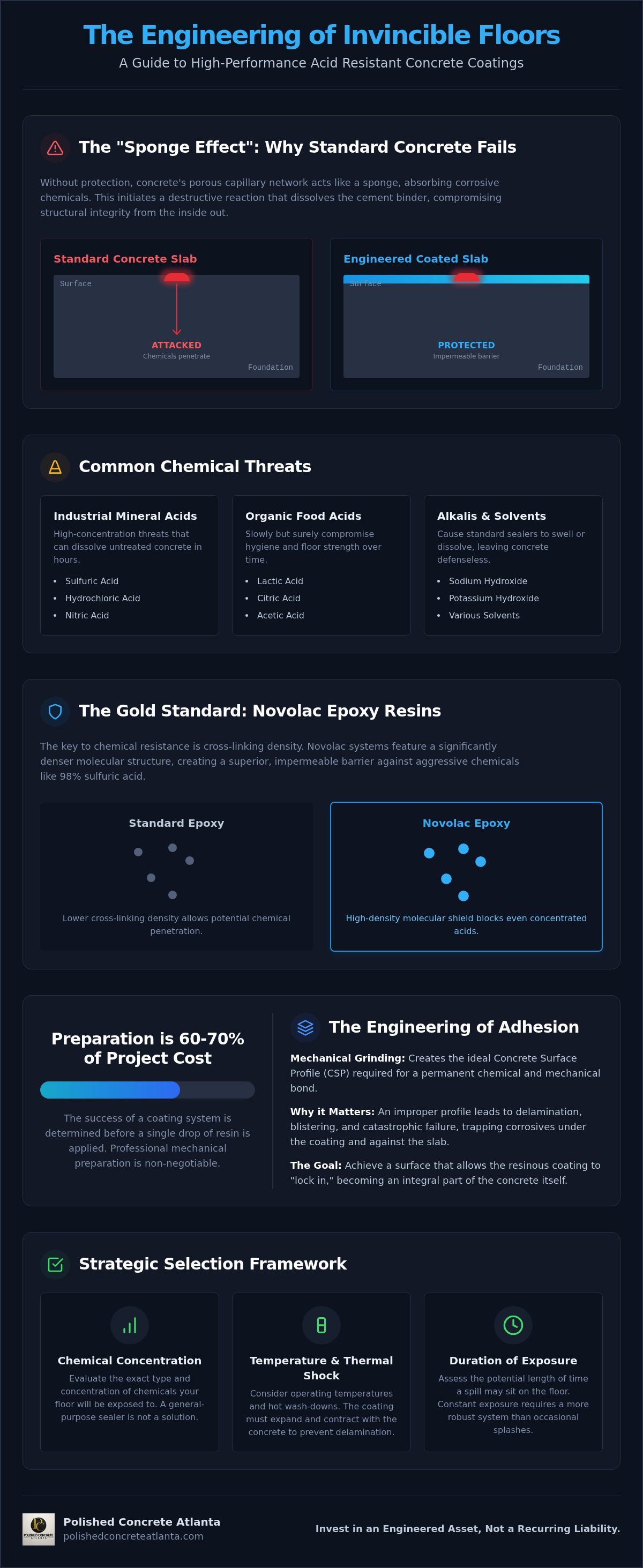
Standard concrete is a reliable building material for general construction, but in a chemical environment, it's a liability. Without acid resistant concrete coatings, your floor is essentially a massive, rigid sponge. This "Sponge Effect" occurs because concrete possesses a complex capillary network that naturally pulls liquids from the surface down into the core of the slab. When those liquids are corrosive, the results are catastrophic. These specialized resinous barriers are not decorative additions; they are engineered shields designed to decouple your structural assets from the chemicals that seek to destroy them.
The destruction isn't just surface-level. Acids specifically target the calcium hydroxide, or cement paste, that binds the aggregate together. When an acid contacts the slab, it initiates a chemical reaction that dissolves this binder, leaving behind a weakened, sandy matrix. This process is the primary driver of Understanding Concrete Degradation in industrial settings. Ignoring this vulnerability leads to more than just an ugly floor. It results in structural instability, safety hazards for your team, and potential environmental fines for soil contamination beneath the slab.
The Mechanism of Concrete Deterioration
Deterioration moves through distinct, aggressive phases. It often begins with simple surface staining, but this is a warning sign of a deeper crisis. Because standard Portland cement has a high alkaline pH, it is fundamentally reactive to acidic substances. As the acid eats the cement paste, the surface begins to spall, or flake away. This creates "unseen" damage where the slab's internal density is compromised long before the floor actually collapses. By the time you see the pits and cracks, the structural integrity is already in jeopardy.
Common Corrosives in Atlanta Facilities
Industrial operations in the Atlanta market face a broad spectrum of chemical threats that standard sealers cannot handle. We see three primary categories of attack:
- Industrial Mineral Acids: Sulfuric, Hydrochloric, and Nitric acids used in manufacturing and battery storage. These are high-concentration threats that can dissolve untreated concrete in hours.
- Organic Food Acids: Lactic and Citric acids common in food and beverage processing. These are deceptively destructive because they work slowly but surely to compromise hygiene and floor strength.
- Alkalis and Solvents: While not always acidic, these substances cause standard floor sealers to swell or dissolve. Once the sealer fails, the concrete is left defenseless against the next spill.
Relying on a general-purpose floor is a gamble you don't need to take. Professional acid resistant concrete coatings eliminate the uncertainty of chemical attack by creating a permanent, impermeable barrier.
Engineered Protection: Types of Acid Resistant Floor Coatings
Selection is not about color; it's about chemistry. While standard industrial epoxy works for light-duty warehouses, it fails under chemical stress. High-performance acid resistant concrete coatings are defined by their cross-linking density. This technical term refers to the number of chemical bonds between polymer chains. A higher density creates an impermeable barrier that blocks corrosive molecules from reaching the slab. When we specify a system, we're building a molecular shield that dictates how your floor will perform five years from now.
Thermal shock resistance is another critical factor often overlooked in chemical environments. If your facility uses hot water wash-downs or steam cleaning, the temperature spike can cause standard coatings to delaminate. The coating must be engineered to expand and contract at a rate similar to the concrete beneath it. Without this compatibility, the bond will break, leaving your floor vulnerable to the very chemicals you're trying to contain.
Novolac Epoxy: The Gold Standard for Corrosives
Novolac resins are the undisputed heavyweight for aggressive environments. Unlike standard epoxies, Novolac systems feature a high-density molecular structure that provides extreme resistance to concentrated acids. If your facility handles 98% sulfuric acid or concentrated nitric acid, standard resins will soften and fail. Novolac doesn't. It's the required specification for battery charging stations and chemical storage rooms where the risk of chemical attack on concrete is a constant threat. It provides the definitive peace of mind that a spill won't become a structural disaster.
Urethane Concrete and Vinyl Ester Systems
Some environments demand a hybrid approach to protection. Urethane concrete is the solution for facilities facing both chemical exposure and extreme thermal shock. It's a rugged system that survives the brutal cycle of cold chemical spills followed by high-heat sanitization. For the most extreme scenarios, such as secondary containment basins, vinyl ester systems offer a level of durability that standard epoxies cannot touch. These systems require a more complex installation process, but the long-term asset protection is unmatched.
High-performance floors don't have to look like a dark industrial dungeon. Modern systems offer various aesthetic finishes, from solid safety colors to decorative quartz aggregates. You can achieve a professional, high-end look without compromising on technical requirements. Getting the specification right requires an expert eye. If you're ready to upgrade your facility, our industrial floor services ensure your investment survives the harshest conditions.
The Engineering of Adhesion: Why Preparation Prevents Failure
A floor is only as strong as its bond to the substrate. Ninety percent of industrial coating failures originate from one source: inadequate surface preparation. It's a definitive statistic that highlights the difference between a temporary fix and an engineered solution. While some contractors rely on chemical etching, this method is insufficient for high-performance acid resistant concrete coatings. Concrete surface preparation must involve mechanical diamond grinding to achieve the specific Concrete Surface Profile (CSP) required for the resin to bite into the slab. Without this mechanical bond, the coating is merely sitting on top of the concrete, waiting to delaminate under chemical or thermal stress. This is why partnering with seasoned concrete surface preparation contractors is the only way to ensure structural integrity.
Moisture Mitigation and Georgia Humidity
In the Atlanta market, humidity isn't just an outdoor nuisance; it's a floor killer. High vapor emission rates within a slab lead to osmotic blistering, where moisture pressure forces the coating away from the concrete. Implementing professional moisture mitigation for concrete floors is a non-negotiable step in our process. We don't guess. We use rigorous testing protocols, including Relative Humidity (RH) probes and Calcium Chloride tests, to quantify moisture levels before a single drop of resin is mixed. This data-driven approach eliminates the uncertainty that leads to premature floor failure.
Removing Existing Contaminants
A clean floor is more than just a swept floor. Old oils, chemicals, and "ghosting" from previous adhesives will compromise the bond of any new system. Our team utilizes advanced floor glue removal techniques to strip away every trace of past failures. The goal is a "white metal" equivalent clean for your concrete, ensuring that the new coating bonds to the actual aggregate, not a layer of grime. We fix the mistakes other contractors leave behind.
Don't let poor preparation ruin your investment. Contact us for expert concrete floor grinding to secure your facility's future and ensure a permanent bond.
Strategic Implementation: Selecting and Maintaining Your Flooring
Selecting a flooring system is a calculation, not a guess. We utilize a definitive framework based on three critical variables: Chemical Concentration, Temperature, and Duration of exposure. If you miscalculate even one of these factors, the floor will fail. High-performance acid resistant concrete coatings are an investment in your facility's structural longevity. While a low-bid epoxy might save capital today, the recurring cost of repairs and operational downtime makes it a massive liability. In contrast, an engineered resin system provides a durable surface that survives harsh corrosives for decades. This is why we position ourselves as long-term strategic partners. We don't just apply a product; we engineer a result.
For facility managers who want to discover more about Professional Concrete Coating and Floor Finishing Services, understanding these engineering standards is the first step toward a permanent flooring solution.
Conducting a Facility Chemical Audit
Before installation, we map your facility to identify high-risk spill zones versus standard wash-down areas. We also evaluate mechanical stress, such as heavy forklift traffic or constant pallet jack movements, which can compromise a brittle coating. Future-proofing is essential. If you plan to upgrade your production lines or change your chemical profiles in the next five years, your floor must be ready for that transition. Our industrial floor coatings Atlanta guide outlines how we tailor these specifications to the unique climate of Georgia, where high humidity can affect cure rates and long-term adhesion.
Long-Term Maintenance and Inspection
Durability doesn't mean neglect. A no-nonsense maintenance protocol is required to protect your asset and maintain compliance. Daily cleaning should involve non-abrasive, pH-neutral cleaners to remove chemical residues before they have a chance to concentrate. We also recommend annual inspections to identify hairline cracks or joint failures early. Catching a minor issue before it becomes a structural catastrophe is the mark of a disciplined facility manager. By following these rigorous standards, you ensure that your floor remains a high-performing asset that meets all safety and environmental regulations. Professional maintenance is the final step in securing a worry-free investment.
Securing Your Facility’s Structural Future
Protecting your infrastructure from corrosive attack is a matter of precision engineering. We've established that high-performance acid resistant concrete coatings require more than a simple application; they demand a rigorous commitment to mechanical preparation and specific resin chemistry. By prioritizing high-density Novolac systems and addressing the critical variable of moisture mitigation, you eliminate the uncertainty of floor failure. A maintenance-free floor is the result of disciplined selection and a no-nonsense approach to installation. It's the difference between a recurring expense and a permanent asset.
Since 2004, Polished Concrete Atlanta has served the local market as specialists in heavy-duty industrial floor coatings. We don't settle for mediocrity, and neither should you. Our proven moisture mitigation protocols ensure that your investment is protected from the ground up, regardless of Georgia's humidity. It's time to stop reacting to floor damage and start investing in long-term asset protection. Your floor is the foundation of your operation. Make it indestructible.
Request a Professional Industrial Floor Evaluation from Polished Concrete Atlanta and secure your facility today.
Frequently Asked Questions
How long do acid resistant coatings last in an industrial environment?
Professionally installed acid resistant concrete coatings typically provide a service life of 10 to 15 years under heavy industrial use. This longevity is contingent on the resin’s cross-linking density and the quality of the initial surface preparation. In contrast, low-bid installations using inferior materials often fail within 3 to 5 years, leading to costly downtime and structural repairs.
Can I apply acid resistant coatings over existing epoxy floors?
We do not recommend applying high-performance systems over old coatings. A new barrier is only as reliable as the layer beneath it; if the existing epoxy delaminates, the new coating fails with it. Our process involves mechanical grinding to remove old materials and contaminants, ensuring the new resin achieves a direct, permanent bond with the concrete substrate.
What is the difference between chemical resistance and acid resistance?
Chemical resistance is a broad engineering term covering protection against solvents, alkalis, and oils. Acid resistance is a specific technical requirement for acid resistant concrete coatings designed to neutralize low-pH substances that aggressively dissolve the calcium hydroxide in concrete. You must select a resin based on the specific acid concentrations and temperatures present in your facility to ensure total protection.
How much downtime should my facility expect during installation?
Most industrial projects require a window of 3 to 5 days for mechanical preparation, application, and full chemical cure. While some rapid-cure systems are available, high-performance Novolac resins often need a longer cure time to reach their maximum molecular density. We prioritize a realistic schedule that ensures the floor is fully stabilized before it’s subjected to chemical or mechanical stress.
Are these coatings slip-resistant in wet conditions?
Yes, we engineer these surfaces with specific aggregates to meet OSHA safety standards for slip resistance. The texture is customized to provide traction in wet or chemically slick environments without making the floor impossible to clean. It's a balance of employee safety and facility hygiene that we calculate during the specification phase.
What happens if the coating is scratched or gouged?
A deep gouge requires immediate localized repair to prevent the "Sponge Effect" from destroying the slab. If the resinous barrier is breached, acids can migrate beneath the coating and begin dissolving the concrete binder, leading to "under-film" corrosion and widespread delamination. We provide no-nonsense repair protocols to seal these breaches before they compromise your facility’s structural integrity.


