

Your premium epoxy topcoat is destined to fail if you ignore the structural deviations hiding in your slab. It is a harsh reality of industrial facility management. Every dip, ridge, and uneven joint in your warehouse is a ticking clock for equipment wear and safety citations. Professional concrete floor leveling Atlanta isn't just about aesthetics; it is a critical engineering requirement. You need a surface that supports high-speed operations without the constant threat of floor failure or trip hazards. We understand that mediocrity is not an option for your facility.
You likely recognize that a perfectly flat floor is the backbone of a productive environment and a high-traffic retail space. It provides the stability your forklifts require and the seamless look your brand demands. This article explores how precision leveling eliminates uncertainty and prepares your slab for world-class polished or epoxy finishes. We will examine the technical standards for OSHA compliance, the importance of moisture mitigation, and the strategic process of achieving a reliable, high-performance surface while minimizing operational downtime. Precision is the standard. Excellence is the result.
Key Takeaways
- Precision concrete floor leveling Atlanta is a mechanical necessity that eliminates forklift damage and optimizes warehouse operational flow.
- Distinguish between surface leveling and slab lifting to ensure your facility achieves the specific Concrete Surface Profile required for premium industrial coatings.
- Master the professional sequence of inspection, grinding, and moisture mitigation to eliminate the risk of underlayment failure or finish delamination.
- Maximize your ROI by creating a foundation that prevents uneven wear patterns and ensures uniform aggregate exposure in high-end polished concrete.
Engineering the Foundation: Why Precision Leveling Matters for Atlanta Facilities
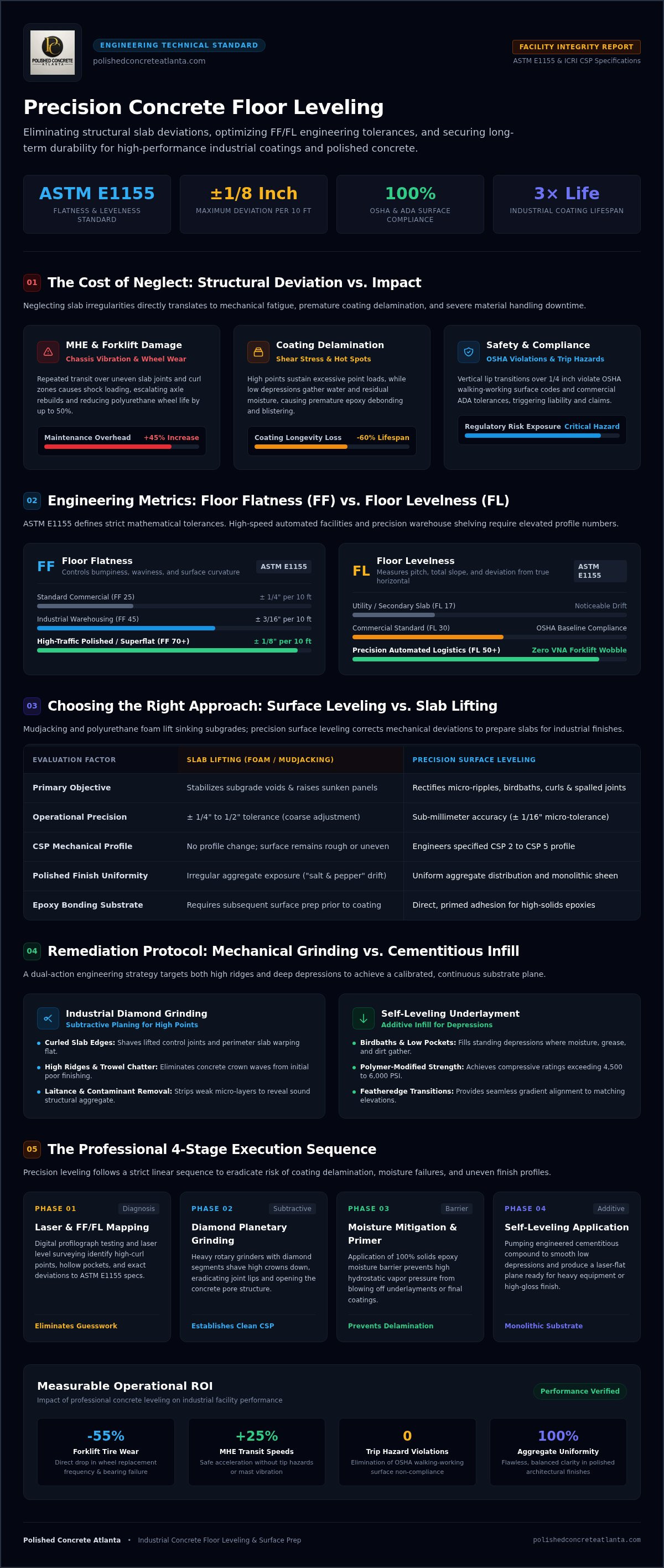
Concrete floor leveling Atlanta is the precise mechanical and chemical recalibration of your facility’s slab. It isn't just about smoothing out bumps. It is about achieving a specific engineering profile that supports high-performance finishes. In the professional flooring industry, we measure success through Floor Flatness (FF) and Floor Levelness (FL) numbers. These metrics determine how well your floor supports automated systems and heavy machinery. If your FF/FL numbers are off, your entire operation is at risk. High-gloss polished floors and heavy-duty epoxy systems require a substrate that meets these rigorous standards to prevent premature wear and unsightly "hot spots." We don't guess; we measure.
The Cost of Neglect: Operational Risks of Uneven Slabs
Neglecting your slab profile leads to catastrophic operational failures. Minor deviations often manifest as slab curl or joint spalling under heavy loads. When a five-ton forklift hits an uneven joint at speed, the impact vibrates through the chassis and the operator. This causes accelerated tire wear and mechanical fatigue. We often utilize polymer-modified self-leveling concrete to rectify these deviations before they compromise your equipment. This phase is non-negotiable. It's why we are recognized as elite concrete surface preparation contractors. We eliminate the variables that lead to floor failure. Proper prep reduces employee fatigue and keeps your machinery in the warehouse, not the repair shop. A stable floor is a productive floor.
Meeting Atlanta's Commercial Building Codes
Safety is a legal mandate, not a suggestion. Atlanta’s commercial hubs must adhere to strict OSHA standards regarding walking and working surfaces. Uneven floors create trip hazards that lead to costly worker compensation claims and potential litigation. Leveling also ensures your facility remains compliant with ADA requirements for commercial interiors, specifically regarding slope and transition tolerances. A perfectly flat floor eliminates the uncertainty of inspections. It protects your personnel and your bottom line. We deliver floors that meet every local code requirement without compromise. Our process provides the peace of mind that comes with high-end craftsmanship and regulatory adherence.
Surface Leveling vs. Slab Lifting: Choosing the Right Industrial Approach
Confusion between slab lifting and surface leveling often leads to project delays and budget overruns. While they sound similar, they solve entirely different problems. Slab lifting, often called mudjacking or foam injection, addresses structural subsidence by raising a sinking section of concrete from below. In contrast, concrete floor leveling Atlanta focuses on the surface profile itself. It rectifies waves, pits, and ridges to create a substrate that meets ASTM E1155 floor flatness and levelness standards. If your goal is a high-performance finish, lifting the slab is only half the battle. You still need a flat surface for the coating to bond correctly.
When to Grind and When to Fill
Every slab requires a unique strategy. Industrial diamond grinding is our primary weapon against "high spots" or ridges that interfere with equipment travel. However, when we encounter deep pits or significant low points, we utilize cementitious self-leveling underlayments. This dual approach is essential for industrial floor coatings Atlanta to achieve the correct Concrete Surface Profile (CSP). For polished concrete, leveling is the only way to guarantee consistent aggregate exposure. Without it, your floor will show a "salt and pepper" look in some spots and a "large stone" look in others. It's an aesthetic inconsistency that a professional facility cannot afford. If you aren't sure which method your slab needs, consulting with a surface specialist is the best way to eliminate uncertainty.
The Myth of the 'Quick Fix' Foam
Structural foam has its place, but it isn't a finishing solution. Foam can stabilize a rocking slab, but it cannot refine a rough surface or fix a spalled joint. In a commercial interior, the precision required for high-gloss polishing or heavy-duty epoxy is measured in millimeters. Mudjacking is simply too blunt an instrument for this level of detail. It lacks the control needed to establish a reliable foundation for world-class flooring. We prioritize mechanical refinement and high-strength toppings because they offer predictable, tangible results. Don't let a "quick fix" compromise the integrity of your investment. Excellence requires a meticulous approach to surface preparation.
The Technical Process: Grinding, Underlayments, and Moisture Mitigation
Execution determines the lifespan of your floor. A successful outcome for concrete floor leveling Atlanta relies on a disciplined, multi-stage sequence: inspection, mechanical grinding, moisture testing, and precision leveling. Skipping a single step invites failure. We start by stripping the slab of all previous bond breakers. This includes the total removal of old mastics, oils, and contaminants. A clean surface is the only acceptable starting point for an industrial-grade result. We don't just pour material over problems; we solve them at the source.
Mechanical Grinding: Precision Material Removal
We utilize heavy-duty planetary grinders equipped with industrial diamonds to shave down high points and lippage at joint lines. This mechanical refinement does more than level the floor. It opens the concrete’s capillary structure to ensure a tenacious bond with the underlayment. This phase often incorporates floor glue removal Atlanta to ensure no residual adhesive interferes with the new profile. Safety remains a priority. Our equipment utilizes shroud-equipped HEPA-filtered dust extraction to meet OSHA respirable crystalline silica regulations. We keep your facility clean and your air breathable while we work.
Self-Leveling Underlayments: Achieving a Mirror-Flat Surface
Once the slab is prepped, we apply high-strength cementitious self-leveling compounds. These aren't standard retail products. These are engineered, polymer-modified materials specifically designed for industrial traffic and heavy loads. The rapid-cure technology is a game-changer for active Atlanta businesses. It allows for foot traffic in hours and heavy equipment in days. We manage the "pour" with technical precision, ensuring the material flows into every low spot to create a mirror-flat substrate ready for any finish.
Moisture Mitigation: The Silent Floor Killer
Georgia’s humidity is a constant threat to floor integrity. High moisture vapor emission rates (MVER) will cause even the best leveling compounds to delaminate if left unaddressed. We perform exhaustive testing before a single drop of material hits the floor. If moisture levels exceed the manufacturer’s threshold, we install a dedicated moisture vapor barrier. This creates an impermeable seal between the slab and the leveling layer. It is the ultimate insurance policy for your floor. Don't risk a total delamination because of a hidden moisture problem. Contact our team to schedule a technical site evaluation and secure your facility’s foundation today.
Maximizing ROI: How Level Floors Protect Your Polished or Epoxy Investment
Investing in a premium finish without addressing the slab profile is a strategic error. Concrete floor leveling Atlanta ensures that your topcoat, whether it's high-build epoxy or a decorative polish, performs as engineered. Without a level substrate, high points in the concrete become "hot spots." These areas absorb a disproportionate amount of foot and equipment traffic, leading to localized thinning of the coating and premature failure. We eliminate these vulnerabilities before they manifest. A perfectly flat floor distributes weight evenly, preserving the integrity of your finish for years longer than a neglected slab.
Think of leveling as the ultimate insurance policy for your facility. It's a one-time investment that pays dividends by reducing decades of maintenance costs. When your floor is flat, cleaning becomes more efficient and the risk of delamination drops to near zero. We don't build floors that require constant intervention; we build foundations that last. Precision is the only way to safeguard your capital investment.
Aesthetic Excellence in Retail and Showrooms
Uniformity is the hallmark of professional craftsmanship. When we install polished concrete floors Atlanta, the aggregate exposure must be consistent across the entire footprint. A wavy floor results in "patchy" exposure where the grinder bites too deep in some areas and skips others. Leveling establishes the flatness required for maximum light reflectivity. This creates the high-luster, mirror-like finish that defines modern commercial showrooms. If your floor isn't flat, it won't shine. It is that simple.
Long-Term Durability for Heavy Industry
Industrial environments demand resilience. Professional concrete floor leveling Atlanta prevents the impact damage that occurs when forklift wheels hit uneven slab joints. These impacts cause spalling and cracking that eventually require expensive structural repairs. It's a no-nonsense approach to facility management. You do the job right the first time to avoid the cycle of temporary patches. A level floor is a durable floor. It protects your equipment, your personnel, and your bottom line. Contact Polished Concrete Atlanta for a professional floor evaluation to secure your facility’s future and eliminate the uncertainty of your flooring project.
Securing Your Industrial Foundation for the Future
A world-class floor begins long before the final coat of epoxy or the last pass of a polishing pad. It starts with the uncompromising precision of concrete floor leveling Atlanta. You've seen how mechanical grinding and technical moisture mitigation eliminate the variables that lead to delamination and equipment wear. A flat slab isn't a luxury; it's a prerequisite for operational efficiency and long-term durability in any commercial hub. By prioritizing professional surface preparation, you protect your capital investment and ensure a surface that meets the highest industrial standards.
Don't settle for a substrate that compromises your facility's performance. As specialists in commercial and industrial prep with over 20 years of proven craftsmanship, we provide the expertise needed to transform problematic slabs into reliable assets. We're Atlanta's authority on high-performance concrete, dedicated to delivering results that stand up to heavy traffic and rigorous scrutiny. Secure Your Facility's Future with a Precision Leveling Quote. Let's build a foundation that reflects the excellence of your brand.
Frequently Asked Questions
Is concrete floor leveling the same as mudjacking?
No, these are distinct processes that solve different problems. Mudjacking is a structural repair designed to lift a sinking slab from below using pressurized grout or foam. In contrast, concrete floor leveling Atlanta focuses on the surface profile itself. We use mechanical grinding and high-strength cementitious underlayments to rectify waves, ridges, and pits on the slab's face. This creates the flat foundation required for high-performance finishes like polished concrete or industrial epoxy. We specialize in surface refinement, not structural lifting.
How long does it take for a leveled floor to be ready for traffic?
Most industrial self-leveling compounds utilize rapid-cure technology to minimize facility downtime. Foot traffic is typically permissible within 4 to 6 hours after the application is completed. However, heavy equipment and forklift traffic generally require 24 to 48 hours to ensure the material has reached sufficient compressive strength. We coordinate the application sequence to align with your operational schedule, ensuring the floor is ready for the next phase of finishing without unnecessary delays or compromise to the bond.
Can you level a concrete floor that has significant moisture issues?
Yes, but only after implementing a technical moisture mitigation system. Georgia's high humidity often leads to elevated moisture vapor emission rates that can cause leveling compounds to delaminate. We perform exhaustive testing to determine the slab's condition. If moisture levels are excessive, we apply a specialized epoxy moisture barrier before the leveling layer. This engineered seal prevents moisture from compromising the bond and ensures the long-term integrity of your industrial floor. We don't guess; we test and mitigate.
Will leveling my floor fix cracks in the concrete?
Leveling hides surface imperfections, but structural cracks require specific treatment before the leveling process begins. We utilize high-modulus epoxy injections or rigid joint fillers to stabilize active cracks and prevent them from telegraphing through the new surface. Leveling is a corrective measure for the floor's profile, not a structural fix for a failing slab. Our comprehensive preparation process addresses these flaws at the source to guarantee a seamless, mirror-flat result that stands up to heavy industrial loads.
How much thickness does a self-leveling underlayment add to the floor?
The thickness of a self-leveling pour depends entirely on the slab's deviations. Most industrial applications range from 1/8 inch to 1 inch in thickness. In cases with extreme low spots or significant pitch issues, we can apply deeper pours to achieve the required Floor Flatness (FF) standards. We calculate the exact volume needed during the inspection phase to ensure the new profile integrates perfectly with existing drains, doorways, and adjacent flooring transitions. Precision measurement is the only way to ensure a successful integration.
Do I need to level my floor before installing industrial epoxy?
Leveling is highly recommended for any high-performance epoxy system. An uneven slab causes the epoxy to pool in low spots and thin out over high ridges. These thin spots become points of premature wear and potential failure under heavy forklift traffic. Precision concrete floor leveling Atlanta ensures a uniform thickness across the entire footprint. This maximizes the coating’s lifespan, improves impact resistance, and provides the aesthetic consistency expected in professional commercial environments. It is a one-time investment in long-term durability.


