
A floor that peels under heavy forklift traffic isn't just a maintenance headache. It's a failure of engineering. You've likely dealt with the frustration of coatings that bubble due to moisture or surfaces that lose their grip after only a few months of operation. It's exhausting to manage constant downtime for repairs that never seem to stick. You deserve a facility that works as hard as your team. Selecting the right warehouse floor coating options requires more than a quick glance at a color chart. It demands a strategic understanding of how chemical resistance and mechanical preparation intersect.
We're here to eliminate the uncertainty. This guide provides the definitive blueprint for selecting an industrial flooring system that matches your specific traffic and safety requirements. We'll break down the technical differences between high-performance epoxy, polished concrete, and advanced moisture mitigation strategies. You'll learn how to justify the capital expenditure by focusing on long-term value and facility safety. Let's find the "set it and forget it" solution your warehouse requires.
Key Takeaways
- Understand why your floor is a strategic engineered asset that directly impacts forklift longevity and operator safety.
- Compare the leading warehouse floor coating options to identify the specific chemistry that withstands your facility's unique chemical and mechanical stresses.
- Master the engineering framework required to match surface durability with your facility's specific point loads and traffic volume.
- Recognize why rigorous mechanical preparation and moisture mitigation are the non-negotiable foundations of a "set it and forget it" floor.
Why Warehouse Floor Coatings are Strategic Assets, Not Just Maintenance
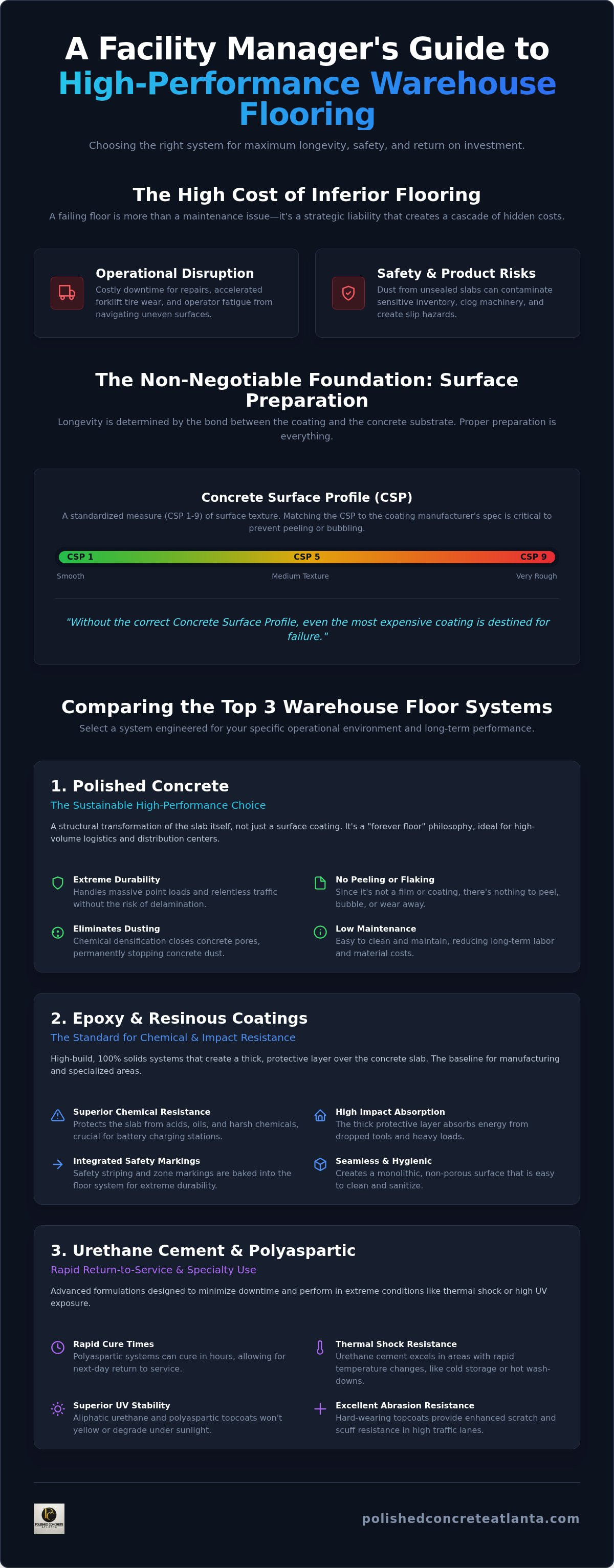
Your warehouse floor is an engineered component of your facility, not a passive surface. It acts as a protective barrier for the structural slab, shielding it from the relentless assault of heavy machinery, impact, and chemical exposure. When you evaluate warehouse floor coating options, you aren't just shopping for aesthetics. You're investing in the longevity of your entire operation. A failing floor creates a cascade of hidden costs. It starts with accelerated forklift tire wear and ends with operator fatigue from navigating a compromised, vibrating surface. High-performance finishes also serve a dual purpose by increasing light reflectivity. This improves facility safety and significantly reduces overhead on lighting costs. It's a pragmatic choice for a high-achieving environment. Precision matters.
The High Cost of Inferior Industrial Flooring
Inferior coatings are a liability. When a cheap epoxy begins to delaminate, the cost isn't measured in square feet of material. It's measured in the total facility shutdown required for a complete strip and re-application. Dust contamination from a failing, unsealed slab can ruin sensitive inventory and clog precision machinery. A professional system offers a 10-year lifecycle that far outweighs the deceptive savings of a budget-grade product. Reliability is the only metric that matters in a high-traffic environment. Don't settle for a temporary fix that leads to a permanent problem.
Understanding the Science of Surface Adhesion
Longevity is determined by the bond between the coating and the concrete. A mechanical bond is achieved through rigorous grinding to create a physical "anchor" for the coating, while a chemical bond occurs when the material cross-links directly with the concrete pores. Professional installers prioritize the Concrete Surface Profile (CSP) above all else. CSP is a standardized measure of surface texture, ranging from 1 to 9, that dictates exactly how warehouse floor coating options will anchor to the concrete substrate to prevent future peeling or bubbling. Without the correct CSP, even the most expensive coating is destined for failure. We don't leave that to chance.
Comparing the Top 3 Warehouse Floor Coating Systems
Selecting from available warehouse floor coating options isn't about finding a one-size-fits-all product. It's about engineering a system that survives your specific operational environment. Whether you prioritize impact resistance or rapid cure times, the decision should center on long-term restorability. You don't want a system you'll have to rip out every five years. You want one you can maintain. For many modern logistics centers, polished concrete floors Atlanta represent the pinnacle of this "forever floor" philosophy. It's the ultimate no-nonsense solution for high-traffic facilities.
Polished Concrete: The Sustainable High-Performance Choice
Polished concrete isn't just a finish; it's a structural transformation of the slab. We utilize the Ashford Formula for densification, a process that chemically closes the pores of the concrete to eliminate "dusting" permanently. It's built for high-volume traffic. There's no film to peel and no coating to flake. It handles massive point loads without the risk of delamination common in resinous systems. This is pragmatism in its purest form. If you're ready to upgrade, exploring industrial floor coatings Atlanta provides the technical clarity needed for a sound investment.
Epoxy and Resinous Coatings: The Standard for Chemical Resistance
When your operations involve harsh chemicals or heavy impacts, 100% solids epoxy becomes the baseline. These systems provide a high-build protective layer that absorbs energy. For areas like battery charging stations, specialized warehouse floor coating options offer the acid resistance necessary to protect the structural integrity of your slab. They also allow for integrated safety striping and zone marking that's literally baked into the floor system. Consistency is key. A professional installation ensures these markings won't wear away under forklift tires.
Urethane Cement and Polyaspartic: Rapid Return-to-Service
Downtime is a profit killer. Polyaspartic coatings solve this by offering cure times that allow for next-day operations. This speed doesn't compromise quality. These systems excel in environments facing thermal shock, such as cold storage or food-grade sections, where temperatures fluctuate rapidly. Additionally, urethane topcoats provide superior UV stability for facilities with extensive natural light. They won't yellow or degrade under the sun. You get total coverage and total reliability. Don't settle for less than an engineered result.
Engineering Your Floor: Matching Coatings to Demands
Engineering your facility starts with data. You don't guess when it comes to structural integrity, and you shouldn't guess when selecting warehouse floor coating options. Every square foot must be matched to the actual physical demands of your fleet and inventory. We analyze the critical intersection of total load and point load. While your slab might support the weight of your racking, the high-pressure point load of a narrow-aisle forklift tire can crush an inferior coating. We eliminate that risk through precise material selection. Reliability is the only acceptable outcome.
Safety standards are equally non-negotiable. We adhere strictly to ANSI/NFSI slip-resistance benchmarks to protect your personnel and your bottom line. In Georgia, these standards are under constant threat from high humidity and fluctuating slab temperatures. These environmental factors aren't just weather reports. They're variables that dictate the chemistry of your floor. If you're ready to engineer a permanent solution, consult with our industrial specialists to audit your facility's specific requirements.
Addressing Moisture Mitigation and Sweating Slab Syndrome
Moisture vapor transmission (MVT) is the primary cause of industrial floor failure. It's the silent force that pushes coatings off the slab from the bottom up. For older facilities, moisture mitigation concrete floors are a prerequisite for any resinous application. This process addresses the underlying hydrostatic pressure that causes bubbling. We also specialize in remediating Sweating Slab Syndrome. This occurs when warm, humid air hits a cold slab, creating dangerous condensation. A simple sealer won't fix this. You need an engineered system that manages the dew point and surface tension.
Chemical Exposure and Cleanability Standards
Your floor is a target for hydraulic fluid, battery acid, and carbon black tire marks. We distinguish between coatings that merely resist contaminants and those that repel them. A "resist" rating means the coating can withstand a spill for a limited window, while a "repel" system provides a total barrier. Maintaining the integrity of these systems requires specific maintenance protocols. If you don't follow the prescribed cleaning regimen, you risk voiding the warranty and compromising the chemical bond. We provide the roadmap to keep your floor in peak condition. No excuses.
Executing the Industrial Floor Plan: From Preparation to Final Finish
Executing a high-performance industrial floor plan is a disciplined exercise in precision. It isn't just a physical application; it's a series of high-stakes engineering decisions. We don't cut corners because we know that when you explore warehouse floor coating options, the final result is only as good as the work done before the first drop of resin hits the floor. Preparation is 90% of the job. We deploy a fleet of high-torque planetary grinders and industrial-grade HEPA dust extraction systems to transform your slab into a receptive canvas. This rigorous approach ensures a clean, profiled surface that's ready for a permanent bond. Choosing the right industrial flooring contractors Atlanta turns a standard maintenance task into a strategic facility upgrade.
Why Surface Preparation is the Foundation of Quality
Some competitors push "no-prep" primers as a convenience. That's a deceptive shortcut that leads to delamination and expensive facility shutdowns. As expert concrete surface preparation contractors, we insist on total surface decontamination. This includes comprehensive floor glue removal and the stripping of all previous sealers. Diamond grinding is the gold standard for this phase. It mechanically opens the concrete pores to create a specific profile that ensures your chosen warehouse floor coating options achieve an unbreakable chemical bond. Without this foundation, the coating is merely sitting on top of the slab, waiting to fail.
Selecting a Partner for Industrial-Scale Execution
Transparency is the hallmark of a professional partnership. You deserve an exhaustive bidding process that outlines every technical specification, from CSP requirements to ASTM slip-resistance ratings. A local Atlanta partner brings an essential understanding of regional variables, such as Georgia's high clay content and its impact on slab moisture. We don't just provide a service; we act as consultants who manage every detail of the project lifecycle. This level of discipline eliminates the uncertainty of capital expenditures. You're not just buying a floor; you're securing a worry-free investment that reflects the high standards of your brand. The pride of craftsmanship is visible in every square foot.
Securing Your Industrial Infrastructure for the Next Decade
Your facility's floor is the literal foundation of your operational efficiency. We've established that the right choice among warehouse floor coating options is never a matter of chance; it's a matter of engineering. Success requires a strategic alignment between rigorous mechanical preparation and the chemical requirements of your specific traffic patterns. With over 20 years of Atlanta industrial experience, we understand that a floor only succeeds when the underlying slab is stabilized. Our specialized expertise in moisture mitigation and floor glue removal ensures that your investment remains bonded and durable for the long term. We don't settle for mediocrity. Neither should you.
Are you ready to eliminate the uncertainty of floor failure? Precision is the baseline for everything we do. We bring authoritative standards to every polished concrete and epoxy system we install. Consult with our industrial flooring experts for a definitive facility assessment. Let's build a surface that reflects the high-end craftsmanship and reliability your brand demands.
Frequently Asked Questions
What is the most durable warehouse floor coating for heavy forklift traffic?
Polished concrete densified with the Ashford Formula is the most durable choice for high-volume forklift traffic. Unlike thin-film coatings, this process transforms the concrete slab into a dense, dust-proof surface that cannot peel or flake under pressure. For environments requiring extreme chemical resistance alongside heavy loads, 100% solids epoxy provides a high-build barrier. We recommend matching the system to your facility's specific point load requirements to ensure long-term structural integrity.
How long does a warehouse epoxy floor coating typically last?
A professionally installed industrial epoxy system typically lasts between 5 and 10 years in a standard warehouse environment. Longevity depends entirely on the quality of the initial surface preparation and the volume of daily traffic your facility handles. Without a proper mechanical bond, coatings can fail in under a year. High-traffic zones often require a sacrificial urethane topcoat to extend the system's lifespan and maintain its aesthetic excellence. Precision matters.
Can I apply a new coating over old warehouse floor paint or glue?
No, you shouldn't apply a new industrial coating over existing paint or adhesive residues. New warehouse floor coating options require a clean, porous concrete substrate to achieve a permanent mechanical bond. Applying material over old glue leads to immediate delamination and system failure. We utilize diamond grinding to strip old layers and expose the raw concrete. This is the only way to guarantee the integrity and warranty of the new finish.
What is the difference between a concrete sealer and a warehouse floor coating?
Concrete sealers are typically thin, penetrating liquids designed to repel water and dust, whereas warehouse floor coatings are high-build systems that provide a structural layer of protection. Sealers don't offer significant impact or chemical resistance. Coatings, such as epoxy or urethane cement, create a durable barrier that withstands heavy machinery and harsh industrial contaminants. Selecting a coating is a strategic move for facilities requiring long-term slab protection and enhanced operator safety.
How does moisture in the concrete slab affect warehouse floor coatings?
Excessive moisture vapor transmission is the leading cause of industrial coating failure. When moisture trapped in the slab migrates to the surface, it creates hydrostatic pressure that forces the coating to bubble and peel from the bottom up. We utilize specialized moisture mitigation systems to create a moisture-resistant barrier before the final application. Addressing this issue during the preparation phase is non-negotiable for any facility located in high-humidity regions like Georgia.
What is the fastest warehouse floor coating option for minimal downtime?
Polyaspartic coatings are the fastest resinous option, often allowing for a full return to service within 24 hours of application. These systems cure rapidly even in fluctuating temperatures, making them ideal for high-production environments that can't afford a shutdown. Polished concrete also offers minimal downtime since there is no chemical cure time involved after the final densification. We prioritize these warehouse floor coating options when operational continuity is your primary requirement.


