
A floor that merely "meets code" is a liability waiting to happen in a high-volume Atlanta warehouse. You have likely seen the cycle before. A fresh coating looks great for six months, then the first signs of delamination appear under the constant grind of heavy machinery. It is frustrating to watch operations stall because your forklift resistant flooring failed to handle the literal weight of your business. We understand that downtime is not just an inconvenience; it is a direct hit to your bottom line. Professional results require more than a bucket of paint. They require an engineered solution.
You deserve a surface that stands up to 2026 industrial demands without flinching. This article explores how to engineer high-performance slabs that withstand massive point loads and tire abrasion while conquering the unique humidity challenges of the Georgia climate. We will show you how to eliminate "sweating slab syndrome" and achieve strict OSHA and ANSI safety compliance for a floor that lasts over a decade. We are moving beyond surface-level aesthetics to focus on molecular bonds and substrate integrity. It is time to treat your facility floor as the strategic asset it is.
Key Takeaways
- Understand how dynamic point loads from heavy machinery exceed stationary weight limits and why standard concrete fails under the stress of 10,000-pound forklifts.
- Evaluate high-performance systems like polished concrete and epoxy mortar based on their long-term repairability and total life-cycle cost.
- Combat Atlanta’s humidity by implementing forklift resistant flooring solutions that neutralize "sweating slab syndrome" and prevent dangerous slip hazards.
- Master a strategic selection framework that prioritizes joint protection, the most frequently overlooked factor in maintaining industrial floor integrity.
The Physics of Failure: Why Standard Concrete Floors Crack Under Forklifts
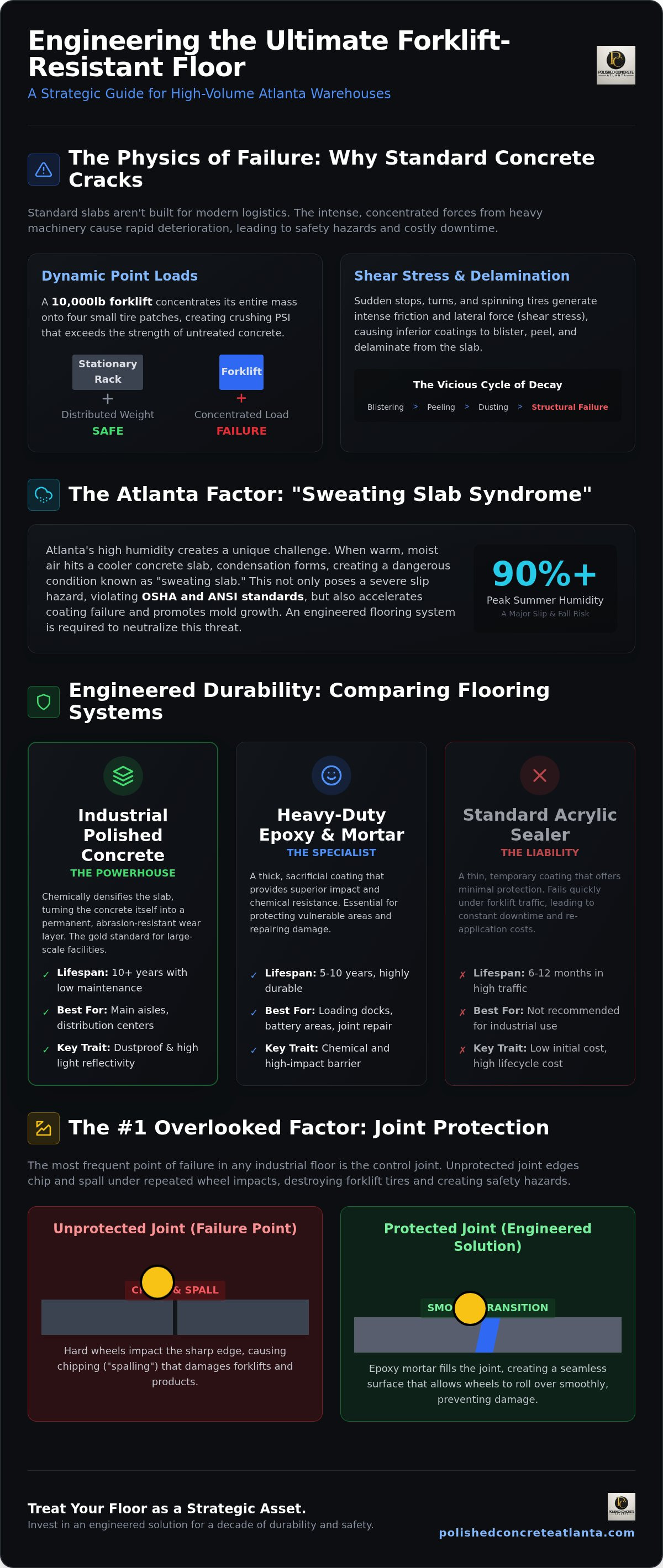
Standard slabs aren't built for the 2026 logistics pace. True forklift resistant flooring is a specialized system engineered to withstand intense PSI point loads and the relentless shear stress of heavy machinery. Most facility managers mistake thick concrete for durable concrete. They're wrong. While a stationary rack spreads weight over a wide base, a 10,000lb forklift concentrates its entire mass onto four small tire contact patches. This dynamic weight creates a crushing force that frequently exceeds the tensile strength of untreated slabs.
Beyond weight, friction is the silent killer. When tires spin or brake, they generate localized heat that causes standard acrylic sealers to blister and peel. This exposes the underlying concrete to the "dusting" cycle. As traffic continues, the weak top layer of concrete paste breaks down into hazardous silica dust. This isn't just a cleaning headache. It's a safety violation and a clear sign of structural decay. You need a surface that refuses to crumble.
Point Loads vs. Distributed Weight
Logistics operations often rely on 3,000 PSI concrete, but this is insufficient for modern equipment. The pressure at the wheel contact patch can easily spike beyond the slab's capacity. We solve this through the use of concrete densifiers. These chemical treatments penetrate the pores to increase surface Mohs hardness, turning a porous sponge into a solid shield. It's about changing the chemistry of the floor to handle the physics of the load. Results require density.
Shear Stress and Delamination
Sudden stops and tight turns don't just push down; they pull sideways. This lateral force, or shear stress, is what causes inferior coatings to delaminate from the substrate. To prevent this, we prioritize mechanical bonding. Different industrial flooring systems require specific preparation levels to stay intact. We define CSP, or Concrete Surface Profile, as the industry standard for measuring the surface texture needed for a permanent mechanical bond. Without the correct CSP, your forklift resistant flooring is just a temporary cover. Precision in preparation is the only way to guarantee longevity.
Engineered Durability: Comparing Industrial Flooring Systems
Choosing the right forklift resistant flooring isn't about picking a color; it's about calculating life-cycle costs and operational downtime. While sealed concrete offers the lowest entry price, its lack of durability leads to frequent re-sealing and disruption. In contrast, polished concrete and heavy-duty epoxy systems provide the structural integrity required for 2026 forklift resistant flooring standards. High-rack warehouses benefit from the high light reflectivity of polished surfaces, while loading docks often require the impact resistance of thick epoxy mortars. Safety is the non-negotiable bottom line. Poor floor conditions are a documented factor in many forklift accidents, making your choice a matter of risk management as much as facility maintenance.
Industrial Polished Concrete: The Low-Maintenance Powerhouse
For massive distribution centers, polished concrete floors Atlanta are the gold standard. This system eliminates the need for temporary waxes or topical coatings that eventually peel under tire heat. By utilizing professional Ashford Formula installation, we chemically densify the slab to create a permanent, dustproof surface. This process turns the concrete itself into the wear layer. It won't flake, it won't dust, and it won't trap the tire marks that plague inferior systems. It's the most sustainable way to achieve a high-performance industrial environment.
Heavy-Duty Epoxy and Industrial Coatings
There are environments where polished concrete isn't enough. When dealing with battery charging stations or chemical processing areas, industrial floor coatings Atlanta provide the necessary barrier against corrosive spills. These systems are particularly vital for spalled joint repair. An epoxy mortar system can rebuild a failing joint, creating a seamless transition that prevents the "thumping" that destroys forklift tires and axles. This is the professional verdict: use polished concrete for your main aisles and epoxy for your high-impact work zones. To see which system fits your specific traffic patterns, you can explore our industrial floor services for a custom consultation.
The Atlanta Factor: Moisture, Humidity, and Sweating Slab Syndrome
Atlanta’s climate is a relentless adversary for industrial facilities. High humidity combined with dense red clay soil creates a perfect storm for Sweating Slab Syndrome (SSS). This occurs when warm, moisture-laden air enters a warehouse and condenses on the cooler concrete surface. The result is a dangerous "skating rink" effect where forklift tires lose all traction. For any facility manager, investing in forklift resistant flooring is impossible without first addressing these environmental realities. Georgia's high water table forces moisture through the slab, making moisture mitigation concrete floors the critical foundation of a successful project.
Moisture Vapor Emission Rate (MVER) Testing
Guessing at moisture levels is a recipe for catastrophic coating failure. We rely on rigorous technical standards to quantify the risk before a single tool touches the floor. MVER is the measurement of water vapor escaping a slab. This data is non-negotiable for high-stakes environments. We typically utilize a combination of methods:
- ASTM F1869: Calcium chloride testing to measure vapor emission from the surface.
- ASTM F2170: In-situ relative humidity probes to determine moisture deep within the slab.
These tests ensure the substrate meets the strict USDA flooring requirements for durability and hygiene. If your vapor levels are too high, no coating will stay bonded. We don't leave this to chance.
Remediation and Surface Preparation
Old warehouse floors carry the baggage of previous failures. To achieve a true industrial-grade bond, you need the expertise of concrete surface preparation contractors who understand the local geology. This process often begins with professional floor glue removal to clear legacy adhesives that interfere with new systems. We choose between shot blasting and diamond grinding based on the required profile. Shot blasting provides a deeper "tooth" for heavy coatings, while diamond grinding ensures a smooth, refined finish for polished systems. Both methods are essential for creating a surface where forklift resistant flooring can thrive. If you're struggling with moisture issues or failing slabs, our team provides the definitive floor moisture mitigation solutions your facility requires.
Implementing a Forklift-Ready Floor: Selection and Maintenance
Selection is a strategic decision that dictates your facility's operational efficiency for the next decade. Engineering a high-performance environment isn't about guessing. It requires a systematic approach that accounts for the literal weight of your business. Most failures occur because managers prioritize short-term savings over long-term structural integrity. To secure true forklift resistant flooring, you must look beyond the surface level and focus on the technical requirements of your specific traffic patterns. Results require discipline.
The 5-Step Selection Matrix
- Step 1: Audit Traffic. Hard poly tires exert different stresses than pneumatic ones. You must match the floor's hardness to your specific equipment.
- Step 2: Substrate Testing. Verify MVER and compressive strength. A coating is only as strong as the concrete it bonds to.
- Step 3: Define Requirements. Determine your needs for chemical resistance and slip-resistance based on your inventory and safety protocols.
- Step 4: Analyze Lifecycle Costs. Balance initial CAPEX with a 10-year OPEX view. Cheap sealers often cost more in repairs over time.
- Step 5: Select Your Partner. Choose a contractor with the industrial-scale equipment and technical expertise to execute the plan.
Joint protection is the most overlooked aspect of forklift resistant flooring. If your control joints aren't filled with industrial-grade semi-rigid polyurea, they will spall under heavy loads. Once a joint edge breaks, every forklift pass acts like a hammer, shattering the concrete and destroying vehicle axles. It's a cascading failure that's entirely preventable with the right preparation and professional execution.
Maintenance for High-Traffic Industrial Assets
Standard mopping fails in an industrial setting. It merely moves dirt around rather than removing it. High-performance floors require auto-scrubbers equipped with pH-neutral cleaners to suspend and extract abrasive grit that would otherwise act like sandpaper. For polished concrete, periodic high-speed burnishing is vital. This process doesn't just restore gloss; it maintains the densified surface and keeps the floor "closed" to contaminants. Execution is everything. Partnering with elite industrial flooring contractors Atlanta ensures your facility's foundation is built to last.
Future-Proof Your Industrial Asset
Your facility floor is more than just a walking surface; it's the bedrock of your entire logistics operation. We've detailed how dynamic point loads compromise standard concrete and why Atlanta's specific climate demands proactive moisture management. Transitioning to a high-performance forklift resistant flooring system is a strategic investment that eliminates the dusting, cracking, and traction issues that plague lesser facilities. You don't have to settle for a surface that fails every six months.
Expertise matters when the stakes are this high. Since 2004, we've secured the industrial corridor of Georgia, engineering high-performance systems for Fortune 500 logistics hubs and specializing in critical Sweating Slab Syndrome remediation. Our team understands the technical nuances of substrate preparation and mechanical bonding better than anyone in the region. It's time to stop reacting to floor failures and start building for long-term durability.
Request a Professional Industrial Floor Audit from Polished Concrete Atlanta today to secure the integrity of your facility. Let's engineer a floor that stands up to the heaviest demands of 2026 and beyond.
Frequently Asked Questions
What is the best flooring for a warehouse with 24/7 forklift traffic?
Industrial polished concrete is the definitive choice for 24/7 operations. By utilizing Ashford Formula installation, we turn the concrete into a dustproof, high-density surface that won't peel or flake under constant tire friction. This system offers the lowest total cost of ownership because it eliminates the need for repeated recoating. It's built for the relentless pace of modern logistics hubs.
Can I apply forklift-resistant epoxy over old, oil-stained concrete?
You can, but success depends entirely on the preparation phase. We utilize heavy-duty diamond grinding to remove contaminated layers and apply specialized oil-mitigating primers. Without this meticulous process, any forklift resistant flooring will eventually delaminate. We don't cut corners on substrate integrity. Success requires a clean, mechanical bond to the underlying slab.
How long does a forklift-resistant floor take to cure before traffic can return?
Return-to-service times vary by system. Polished concrete often allows for immediate foot traffic, with forklifts returning in as little as 24 hours. High-performance epoxy coatings typically require a 48 to 72-hour window to reach full chemical and mechanical hardness. We coordinate schedules to minimize your operational downtime. Precision planning ensures a worry-free restart for your facility.
What causes forklift tire marks on polished concrete, and how do I prevent them?
Tire marks occur when heat from friction causes rubber transfer or "burning" on the floor surface. Prevent this by switching to high-quality non-marking tires and maintaining a rigorous burnishing schedule. A properly densified floor resists these stains far better than untreated concrete. It's about maintaining the surface density we've engineered into the slab during the initial installation.
Is polished concrete or epoxy more slip-resistant for forklift operators?
Both systems are engineered for safety. Polished concrete provides excellent traction that meets 2026 ANSI slip-resistance standards even in high-traffic zones. In areas prone to spills or moisture, we recommend epoxy systems with broadcast aggregates for enhanced grip. We audit your specific environmental risks to ensure your forklift resistant flooring keeps operators safe and productive every day.
How much does it cost to install forklift-resistant flooring in Atlanta?
Total investment is determined by your slab's current condition and your specific performance requirements. Key variables include the degree of floor leveling needed, the extent of moisture mitigation, and the complexity of joint repairs. We provide a granular breakdown after a professional site audit. Every project is a custom engineering solution designed for elite craftsmanship and long-term value.


