

A micro cement floor is only as reliable as the substrate engineering beneath it. If you're managing a high-traffic facility or a luxury commercial space, you've likely considered the seamless, architectural look of micro cement floors Atlanta professionals are increasingly specifying. You want the aesthetic, but you're rightfully concerned about bond failure and how Georgia's humidity affects cure times. You need more than a decorative overlay; you need an industrial-grade solution that won't delaminate under pressure.
We understand that uncertainty is the enemy of a successful project. This guide provides a rigorous, technical framework to help you evaluate and oversee installations that stand the test of time. We'll break down the critical prep work, the impact of the 2024 International Building Code updates, and the engineering benchmarks required for a surface that handles heavy cart traffic without flinching. This is about moving past the visual appeal to ensure total structural integrity. It's time to build with confidence.
Key Takeaways
- Understand why substrate engineering is the definitive factor in preventing delamination for micro cement floors Atlanta businesses invest in.
- Evaluate system specifications based on tangible facility data like cart traffic and chemical exposure rather than aesthetics alone.
- Implement a rigorous installation audit to verify contractor skill and ensure proper curing in Georgia's humid environment.
- Adopt a lifecycle management mindset that utilizes screen and recoat techniques to maximize your flooring asset's longevity and ROI.
Substrate Integrity: Why Micro Cement Success is Won or Lost in the Prep
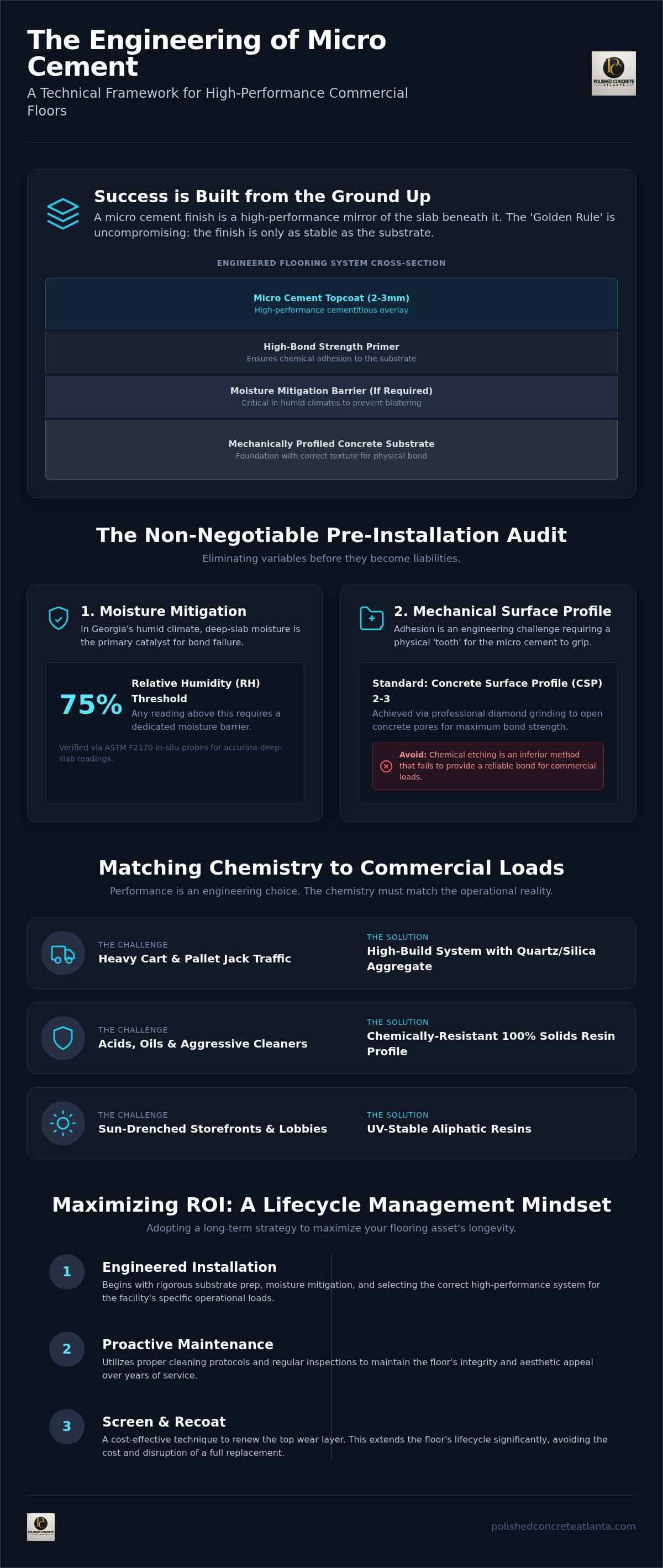
A professional installation of micro cement floors Atlanta standards requires a departure from purely decorative thinking. We define these surfaces as an engineered, 2-3mm cementitious coating specifically formulated for high-bond strength and flexural resilience. It isn't paint. It isn't a simple skim coat. It is a high-performance system that functions as a mirror of the slab beneath it. The 'Golden Rule' of thin-set overlays is uncompromising: the finish is only as stable as the substrate. If your slab moves, cracks, or breathes moisture, your micro cement will eventually fail. There are no shortcuts here.
Before any material touches the floor, you must identify 'red flag' substrates that compromise adhesion. Oil-soaked slabs in automotive or industrial settings, residues from old adhesives, and structurally unsound concrete are non-negotiable obstacles. These contaminants prevent the chemical and mechanical bond required for longevity. Mechanical profiling is the only acceptable method for ensuring commercial-grade adhesion. We don't rely on luck; we rely on physics.
The Moisture Mitigation Checklist
In the humid Georgia climate, moisture is the primary catalyst for surface failure. We verify Relative Humidity (RH) using ASTM F2170 in-situ probes to detect deep-slab moisture that surface tests miss. Simultaneously, we check the Moisture Vapor Emission Rate (MVER) via ASTM F1869 calcium chloride tests. If a slab exceeds 75% RH, we specify a dedicated moisture barrier. This prevents osmotic blistering and ensures the bond remains permanent regardless of seasonal humidity shifts. It's about eliminating variables before they become liabilities.
Mechanical Surface Profile (CSP) Standards
Adhesion is an engineering challenge, not an aesthetic one. We demand a Concrete Surface Profile (CSP) of 2-3, achieved through professional diamond grinding. This process removes laitance and opens the concrete pores to accept the micro cement matrix. Expert concrete surface preparation contractors understand that chemical etching is an inferior and unreliable method for commercial environments. It leaves behind acid residues and fails to provide the consistent 'tooth' required for industrial-grade durability. We grind to succeed; we don't etch and hope.
System Selection: Matching Coating Chemistry to Atlanta Facility Loads
Aesthetics are a commodity; performance is an engineering choice. When specifying micro cement floors Atlanta projects, the visual appeal often drives the initial conversation, but the technical specifications must dictate the final decision. You can't treat a high-traffic retail environment the same way you treat a residential loft. The chemistry must match the operational reality. We evaluate traffic volume by differentiating between standard foot traffic and the localized point loads of light-industrial carts. If your facility uses pallet jacks or heavy rolling racks, a standard decorative overlay will fail. It's that simple.
Chemical exposure is another critical variable. Does your facility handle battery acids, hydraulic oils, or aggressive disinfecting cleaners? Without the correct resin profile, these substances will penetrate the surface and cause irreparable staining or delamination. You also have to account for Georgia's intense UV exposure. Sun-drenched storefronts in Midtown or Buckhead require UV-stable aliphatic resins to prevent yellowing over time. We prioritize 100% solids resin components because they provide the density and durability that water-based alternatives simply cannot match.
High-Build Resins vs. Standard Overlays
Structural integrity in a thin-set system comes from the aggregate matrix. We integrate specific quartz and silica blends into the mix to increase compressive strength and surface hardness. These heavy duty industrial flooring standards are the baseline for our commercial micro cement installations. We verify the Taber Abrasion resistance rating to quantify exactly how much material loss occurs under friction. If the data doesn't support your facility's specific load, we adjust the chemistry until it does. Selecting the right system starts with a comprehensive technical consultation to align our solutions with your operational demands.
Performance Load Checklist
- Impact Resistance: Can the floor handle dropped tools or heavy equipment vibration? Our high-modulus resins are designed to absorb energy rather than fracturing.
- Slip Resistance: Safety is a non-negotiable legal requirement. We specify the Dynamic Coefficient of Friction (DCOF) to ensure public spaces and wet areas remain compliant.
- VOC Compliance: We ensure every system meets Georgia's 2026 indoor air quality standards. This is especially vital for commercial renovations in occupied buildings where air quality is a priority.
Installation Audit: Verifying Craftsmanship in High-Humidity Environments
The success of micro cement floors Atlanta projects depends entirely on the discipline of the installation crew. It's one thing to understand the chemistry; it's another to execute under the pressure of a commercial timeline in Georgia's thick humidity. We use a 'Contractor Competency' test to vet every team. This means verifying their experience with large-scale industrial floor coatings Atlanta benchmarks. If a contractor lacks a background in heavy-duty resinous systems, they won't have the technical rigor required for high-performance micro cement. They focus on the look. We focus on the bond.
Dust control is a non-negotiable mandate. We require HEPA-filtered industrial vacuums for every grinding stage. Airborne particulates aren't just a nuisance; they are bond-breakers. If dust settles on a primed surface, the next layer will fail. Similarly, we demand total transparency in mixing. Resins must never be 'stretched' with water or solvents to extend coverage. This compromises the polymer density and leads to premature wear. Quality is found in the details that most people never see.
Environmental and Site Verification
Georgia’s climate dictates the installation window. We monitor the dew point and ambient temperature continuously. Micro cement should never be applied during high-humidity spikes, as this disrupts the evaporation rate and weakens the final cure. Before the first primer coat, we confirm the slab is 'open' and porous through a standard water drop test. We also insist on rigorous masking and containment. Protecting your existing assets and adjacent finishes from fine cement dust is a hallmark of a professional operation. We leave nothing to chance.
Layer-by-Layer Quality Control
A superior finish is built through repetitive, disciplined steps. Base coat saturation is the first hurdle. The primer must fully penetrate the concrete pores to lock out air and prevent pinholes. Between every layer, we perform inter-coat sanding and industrial cleaning to remove 'nibs' and debris. This ensures the next application sits perfectly flat. Finally, we audit the topcoat for uniformity. We look for a consistent sheen and the absolute absence of roller marks or imperfections. If it isn't perfect, it isn't finished. Ready to secure a floor that lasts? Contact our technical team for an on-site evaluation today.
Lifecycle Management: Maximizing ROI for Your Micro Cement Asset
Your flooring is a capital investment. To maximize its value, you must shift your perspective from the initial installation cost to the total lifecycle cost-per-year. High-performance micro cement floors Atlanta businesses commission are built for durability, but they aren't indestructible. Without a proactive management plan, you're leaving your asset to chance. We view the floor as a 'silent partner' in your facility. When it's clean, safe, and intact, it improves productivity and reduces liability. When it's neglected, it becomes a visible failure of management.
The 'Screen and Recoat' strategy is the most effective way to extend the life of your floor without a full tear-out. This involves light mechanical abrasion of the existing topcoat followed by the application of a fresh high-performance sealer. It's a fraction of the cost of a new installation. We often integrate this into a broader commercial epoxy flooring Atlanta asset management plan. By treating your floors as a technical system rather than a static surface, you ensure long-term aesthetic and structural success. Reliability is built through consistency.
The Maintenance Protocol
- Mandatory pH-neutral cleaners: Don't use acidic or alkaline chemicals. They destroy the sealer bond and dull the finish over time.
- Debris management: Georgia red clay is highly abrasive. Use high-quality walk-off mats at all entrances to trap grit before it reaches the micro cement surface.
- Immediate spill response: Establish a protocol for corrosive or staining agents. Even the best sealers have a 'dwell time' limit before penetration occurs.
Long-Term Performance Audits
Professional discipline doesn't end when the crew leaves the site. We recommend annual inspections to identify edge delamination or impact chips early. Catching a small issue now prevents a major repair later. Plan for a strategic topcoat refresh every 3-5 years in high-traffic zones to maintain the protective barrier. This proactive approach keeps the floor in a 'like-new' state indefinitely. A micro cement floor is a premium asset that requires a premium management strategy.
Secure Your Flooring Asset with Engineered Precision
Success with micro cement floors Atlanta facilities require depends on moving beyond the aesthetic. It requires a commitment to rigorous substrate preparation and a technical understanding of resin chemistry. We've established that without mechanical profiling and moisture mitigation, even the most beautiful finish is a liability. You need a partner who prioritizes the engineering of adhesion over the speed of installation. High-performance flooring isn't a happy accident; it's the result of disciplined execution and elite craftsmanship.
Since 2004, we've specialized in industrial-grade floor preparation and moisture mitigation for the most demanding commercial environments. We apply a no-nonsense engineering approach to every decorative concrete project, ensuring your surface withstands the reality of heavy foot and cart traffic. Don't settle for decorative promises when you can have proven performance. Request a Professional Site Evaluation from Polished Concrete Atlanta to begin your project with total confidence. We're ready to deliver a surface that represents the pinnacle of durability and design. Your facility deserves a floor that performs as well as it looks.
Frequently Asked Questions
Are micro cement floors durable enough for a commercial warehouse in Atlanta?
Micro cement floors Atlanta industrial facilities utilize are engineered to handle significant commercial loads. While often viewed as a decorative finish, these systems use high-build resins and silica aggregates to withstand light-industrial cart traffic and constant foot traffic. It's a robust solution for warehouses that require a seamless, non-porous surface without the weight and thickness of a full concrete pour.
How long does the typical micro cement installation take for a 5,000 sq ft space?
A project of this scale typically requires five to seven working days to complete. This timeline accounts for mechanical substrate preparation, multiple layering stages, and the necessary curing windows between coats. Georgia's humidity can influence these windows, so we monitor site conditions to ensure the chemical bond reaches full strength before the floor is returned to service. Efficiency shouldn't come at the cost of integrity.
Can micro cement be installed over existing tile or epoxy in commercial buildings?
Yes, micro cement can be successfully applied over existing hard surfaces provided the bond to the original slab is sound. We use specialized diamond grinding equipment to profile the existing tile or epoxy, creating the mechanical tooth needed for adhesion. This approach often saves facility managers the significant time and cost associated with full demolition. It's an intelligent way to modernize a space without the mess of a tear-out.
How does micro cement compare to polished concrete in terms of maintenance?
Both systems offer low-maintenance benefits, but they require different management strategies. Polished concrete relies on internal densification, while micro cement floors Atlanta businesses specify are sealed systems. You'll need to use pH-neutral cleaners and plan for a topcoat refresh every few years to keep the barrier intact. This ensures the floor remains resistant to staining and abrasive wear in high-traffic zones.
What is the average cost per square foot for commercial micro cement in Georgia?
Pricing for professional installation is tiered based on the condition and type of your existing substrate. Factors such as the required level of moisture mitigation, the complexity of the layout, and the specific resin chemistry chosen for your facility's load will dictate the final investment. We provide detailed technical evaluations to ensure your budget aligns with the necessary engineering standards. Quality is an investment in long-term performance.
Will micro cement floors crack if the building slab moves?
Micro cement has higher flexural strength than standard concrete, but it's not a substitute for structural slab integrity. If a building's substrate experiences significant movement or settling, those cracks can telegraph through the finish. We address existing stable cracks during the prep phase with high-modulus epoxies to minimize this risk, but the floor's longevity always starts with the slab. We don't hide problems; we solve them.


