
Why settle for a flooring system that requires constant babysitting? If you're managing a high-traffic facility, you already know that traditional surfaces fail under the pressure of heavy equipment and Georgia’s relentless humidity. You need a solution that works as hard as your team does. It's about more than aesthetics. It's about engineering.
We understand the frustration of rising maintenance budgets and poor lighting in expansive warehouses. This is why high gloss concrete floors commercial environments now demand are becoming the 2026 industry benchmark. You'll learn how these surfaces leverage light reflectivity to slash energy costs while exceeding the updated OSHA coefficient of friction standards. We'll also cover critical moisture mitigation strategies like ASTM F2170 testing to ensure your investment doesn't fall victim to sweating slab syndrome. This isn't a temporary fix. It's a permanent upgrade to your building's structural integrity. We're moving past the era of superficial coatings and into an age of precision refinement. Zero fluff. Just performance.
Key Takeaways
- Learn why high-gloss finishes are a structural refinement of the concrete slab rather than a superficial coating or wax.
- Understand how chemical densifiers and progressive diamond grinding create a surface that withstands the most demanding industrial traffic.
- Discover the framework for selecting the right grit level to balance aesthetic mirror effects with the practical needs of your facility.
- Analyze the Total Cost of Ownership advantage that high gloss concrete floors commercial facilities use to eliminate recurring maintenance expenses.
- Identify the critical role of moisture mitigation and surface preparation in preventing floor failure in humid environments.
What Defines High Gloss Concrete Floors for Commercial Use?
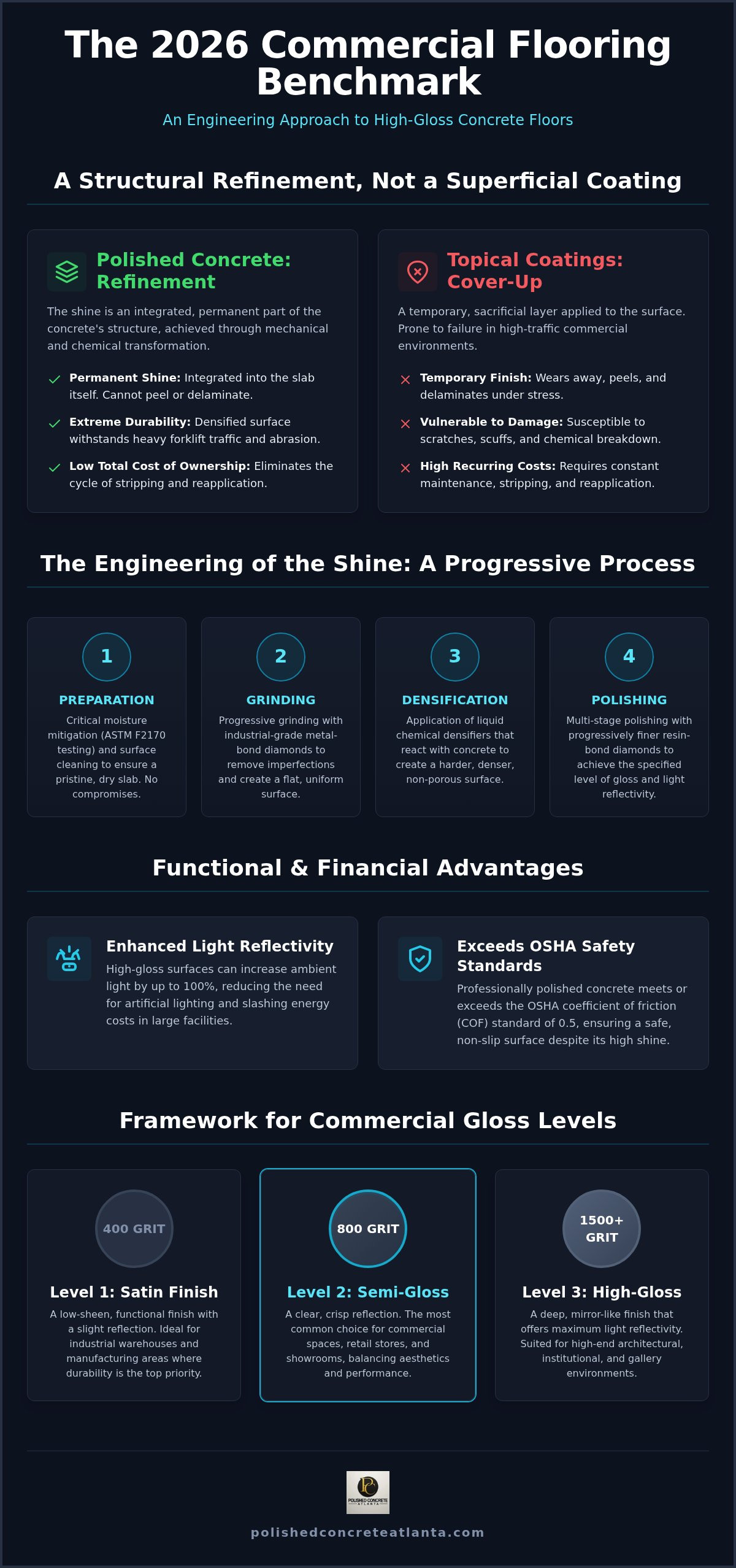
High gloss concrete floors commercial facilities utilize are not the result of a topical glaze or a temporary wax. This finish is a structural byproduct of mechanical refinement. We achieve this through a rigorous, multi stage process of progressive grinding and diamond polishing that transforms the raw concrete slab into a dense, high luster asset. By using industrial grade abrasives and chemical densifiers, we close the surface pores. This creates a floor that is harder and more reflective than the original pour. It's a total transformation of the material. Results matter.
For a technical Polished Concrete Overview, it's clear that the process relies on physical grit progression rather than chemical masks. You aren't just buying a look; you're investing in the slab's density. This refinement process ensures that the shine is permanent and integrated into the floor's DNA.
Refinement vs. Topical Coatings: The Professional Distinction
Traditional waxes and sealers are destined to fail in high traffic environments. They peel. They delaminate. They require constant stripping and reapplication. Mechanical polishing eliminates these risks entirely. Because the shine is part of the concrete itself, there's no topical layer to fail. In 2026 facilities, the choice between polished concrete and epoxy often comes down to longevity. While epoxy is excellent for chemical resistance, high gloss polished concrete offers a level of durability that topical systems simply cannot match. No peeling. No excuses.
The Aesthetic and Functional Utility of High-Luster Surfaces
Strategic light reflectivity is a massive advantage for large scale operations. High gloss surfaces significantly increase a room's Light Reflectivity Value (LRV). This means your existing overhead fixtures work harder, often allowing for fewer lights or lower wattage bulbs. It's a direct path to lower energy bills. In a warehouse or retail center, this brightness translates to better visibility and a safer workspace.
There's also the matter of safety. A common myth suggests that high luster equals high risk. This is false. When processed to professional standards, these floors meet or exceed the OSHA minimum coefficient of friction (COF) of 0.5 for level surfaces. You get the mirror finish without the slip hazard. It's the perfect marriage of form and function.
Beyond the numbers, these floors project a no-nonsense professional character. It tells your clients and partners that you value precision and long term stability. High-gloss concrete is a sustainable, LEED-contributing flooring choice that utilizes your existing building materials to maximize performance.
The Engineering of the Shine: A Progressive Polishing Process
Achieving the high gloss concrete floors commercial facilities rely on requires a strict adherence to mechanical refinement. Excellence isn't accidental. It's a sequence. The quality of the final gloss is dictated by the integrity of the initial surface preparation. If the foundation is flawed, the finish will fail. We don't guess. We measure. Every slab undergoes a rigorous assessment to determine the necessary grit progression to reach a true mirror finish. Skipping a single step in the grit sequence leads to "ghosting" where scratches from previous stages remain visible under the light. This is an engineering failure we don't tolerate.
Critical Foundation: Floor Preparation and Moisture Mitigation
Georgia's humidity presents a unique challenge for industrial slabs. High moisture vapor emission rates can lead to sweating slab syndrome, causing safety hazards and structural degradation. We prioritize moisture mitigation and professional floor glue removal to ensure the concrete is ready for refinement. A clean, dry slab is the only acceptable starting point for a high-performance floor. For a deeper look at these requirements, consult our guide on concrete surface preparation contractors to understand the mechanics of a proper start.
The Chemical Advantage: Liquid Densifiers and Hardeners
The secret to a high-gloss floor that resists heavy forklift traffic lies in densification. Raw concrete is porous and prone to "dusting" as the surface breaks down under use. We apply liquid densifiers that chemically react with the free lime in the concrete. This reaction creates calcium silicate hydrate, effectively filling the pores and turning a soft slab into a dense, hard surface. It's a permanent change. We often utilize the Ashford Formula as an industry standard for achieving this level of protection.
Adhering to the ACI 310.1-20 Engineering Specification ensures that every application meets rigorous professional standards. Once densified, we transition to resin-bond diamonds. These tools provide the final "mirror" polish that defines elite high gloss concrete floors commercial spaces need for maximum light reflectivity. If you're planning a facility upgrade, our team provides the polished concrete floors that transform your slab into a high-value building asset. We manage the details so you can focus on your operations. Results driven. No excuses.
Choosing Your Shine: A Framework for Commercial Gloss Levels
Selecting the appropriate finish for high gloss concrete floors commercial projects is a strategic decision. It's not a matter of taste. It's a matter of performance. We define gloss through measurable grit levels and specular reflection values. The higher the grit, the higher the light reflectivity. However, more shine isn't always the answer. You must balance the visual impact with the operational demands of your facility. We help you navigate these specifications with technical precision.
Aggregate exposure also plays a critical role in the final aesthetic. A "salt and pepper" finish provides a fine, uniform look that enhances the depth of the gloss. Large stone exposure offers a more dramatic, terrazzo like appearance. Both options require a dense, well refined slab to hold the luster over time. If the refinement is shallow, the gloss will fade. We ensure the depth of the polish matches the expected foot traffic of your environment.
Level 3 vs. Level 4 Gloss: High-End Retail and Showrooms
Level 3 (800 grit) is the industry standard for commercial polished concrete Atlanta retail spaces. It provides a crisp, clear reflection without the extreme maintenance of a true mirror finish. For those seeking the ultimate architectural statement, Level 4 (1500 to 3000 grit) delivers a total mirror effect. This is the choice for high end corporate lobbies where brand perception is paramount. You can see these principles in action in our commercial polished concrete Atlanta retail case study.
Industrial Utility: Gloss Levels for Warehouses and Distribution Centers
In industrial settings, utility is the priority. Level 2 (400 grit) is the standard for polished concrete warehouse floors. This level offers a satin sheen that improves ambient light without causing glare that distracts forklift operators. It's about safety. Refined floors enhance the visibility of safety markings and aisle designations. The refinement process also ensures a dust free environment, protecting sensitive inventory and machinery from the abrasive concrete dust found in raw slabs.
Specifying the right gloss level requires an understanding of both your budget and your long term maintenance capabilities. We provide the technical expertise to ensure your high gloss concrete floors commercial investment meets your exact operational needs. If you're ready to upgrade your facility, contact us for a consultation on polished concrete floors. We deliver results that stand the test of time. No guesswork. Just engineering.
Maximizing ROI: Maintenance and Long-Term Performance
High gloss concrete floors commercial managers invest in are low maintenance, not "no maintenance." Anyone claiming otherwise is selling a fantasy. The true ROI is found in the Total Cost of Ownership (TCO) over a 10-year facility lifecycle. While traditional flooring requires annual stripping and waxing, polished concrete relies on its own structural density. You save on labor. You save on materials. It's a calculated financial win that compounds over time. Consistency is the only requirement for success.
Preserving that mirror finish requires discipline. Use professional-grade, pH-neutral cleaners and microfiber pads. These are non-negotiable tools for any facility manager. Harsh chemicals or abrasive pads will etch the surface and kill the luster. For high-traffic zones, periodic high-speed burnishing is the secret to restoring the original shine. This mechanical process "pops" the gloss back to life without the need for topical coatings or expensive waxes. It's a clean, efficient restoration of your existing asset.
The Atlanta Advantage: Navigating Local Slab Conditions
Georgia's climate is brutal on industrial concrete. High humidity often triggers "sweating slab syndrome," where moisture condenses on the surface and creates safety hazards. Without local expertise, your floor becomes a liability. We ensure the standard for polished concrete floors in Atlanta is met through rigorous moisture testing and site-specific mitigation strategies. Our professional consultation identifies these risks before we ever start the grinders. We don't leave your results to chance.
Your Next Strategic Move: Facility Assessment
Success starts with a comprehensive slab evaluation. Not every floor is a candidate for high-gloss polishing. We examine structural integrity, past surface treatments, and moisture vapor emission rates. We also insist on a "mock-up" area. This allows you to verify the exact gloss levels and aggregate exposure in your specific lighting conditions before full-scale execution. It eliminates uncertainty. You see the results before the project is finalized.
Investing in a high-gloss finish is a commitment to your facility's future and operational excellence. It provides the peace of mind that comes with a premium, worry-free floor investment.
The Standard for 2026 and Beyond
Your facility's floor is more than just a walking surface. It's a structural asset that dictates your operational efficiency and long-term maintenance overhead. We've demonstrated that the high gloss concrete floors commercial environments demand are the result of rigorous mechanical refinement and chemical densification. This is not a temporary glaze. It's a permanent transformation that resists heavy traffic while slashing energy bills through superior light reflectivity. You deserve a floor that performs without compromise.
Don't leave your investment to chance with contractors who ignore the complexities of Georgia's humidity. Our team brings over 20 years of Atlanta-based flooring expertise to every project. We are specialists in complex floor preparation and moisture mitigation, ensuring your slab remains a high-performance asset for the long haul. We deliver premium results grounded in no-nonsense industrial pragmatism. It's time to move past the uncertainty of superficial coatings.
Request a Strategic Consultation for Your Atlanta Facility. Secure your building's future with a floor that reflects your commitment to quality.
Frequently Asked Questions
Are high-gloss concrete floors slippery for commercial customers?
High-gloss concrete is not inherently slippery when kept clean and dry. In fact, these surfaces often exceed the OSHA minimum coefficient of friction of 0.5 for level surfaces. The mechanical polishing process increases the surface area contact between the floor and footwear, providing reliable traction. However, safety decreases when contaminants like oil or water are present. We ensure every project meets rigorous safety specifications to protect your staff and clients.
How long does a high-gloss concrete floor last in a high-traffic warehouse?
A professionally polished slab can last 20 years or more in a high-traffic warehouse environment. Because the finish is a structural part of the concrete rather than a topical film, it cannot peel, flake, or delaminate under heavy forklift traffic. You aren't managing a temporary coating; you're managing the slab itself. While a high-speed burnish may be needed every few years to restore luster, the floor's integrity remains permanent.
Can any commercial concrete slab be polished to a high-gloss finish?
Most commercial slabs are candidates for polishing, but the final result depends on the initial pour quality and current condition. Slabs with low compressive strength or extensive surface damage may require specialized floor preparation or leveling before refinement begins. We conduct a thorough site evaluation and a mock-up area to verify if your specific slab can achieve the desired high gloss concrete floors commercial standards. We don't guess; we test.
What is the difference between high-gloss polished concrete and a high-gloss epoxy coating?
The difference lies in the delivery of the shine. High-gloss polished concrete is a mechanical refinement of the existing slab, while epoxy is a topical resin coating applied over the surface. Epoxy offers superior chemical resistance but is susceptible to peeling and scratching over time. Polished concrete is a "no-peel" solution that breathes, making it the superior choice for facilities concerned with long-term durability and moisture vapor transmission.
How much does it cost to maintain a high-gloss concrete floor compared to VCT?
Maintenance costs for polished concrete are significantly lower than Vinyl Composition Tile (VCT). VCT requires a recurring cycle of stripping, waxing, and buffing that consumes labor and chemical budgets. High-gloss concrete eliminates these requirements entirely. Daily auto-scrubbing with clean water and a pH-neutral cleaner is typically all that's required. Over a 10-year period, the savings in labor and materials often pay for the initial polishing investment. Efficiency is the standard.
Does a high-gloss floor help with energy efficiency and lighting costs?
High-gloss surfaces act as a massive reflector for your facility's lighting. By increasing the Light Reflectivity Value (LRV) of the floor, you can often reduce the number of active light fixtures or switch to lower wattage bulbs without sacrificing visibility. This is a direct path to lower energy bills. In large-scale warehouses or retail centers, the cumulative savings on electricity provide a measurable return on investment that topical floors simply cannot match.


