
Ninety percent of industrial floor failures are traced back to improper surface preparation. It's a staggering figure that highlights the risk of treating your facility's foundation as an afterthought. When weighing stained concrete vs sealed concrete, you aren't just choosing a visual finish. You're making a strategic investment in your building's operational longevity. We know you want a floor that reflects elite brand quality without the constant fear of moisture damage or costly delamination. Results matter. Mediocrity is not an option.
This guide provides the definitive technical roadmap to ensure your facility meets the 2026 Georgia Building Code and OSHA's updated 0.5 coefficient of friction standards. You'll discover how to balance sophisticated aesthetics with the rugged durability required for high-traffic environments. We'll break down the chemistry behind each option, the reality of 10-year maintenance costs, and why professional moisture mitigation is the non-negotiable anchor of any successful project in the humid Atlanta climate. From strategic alliances to rigorous standards, we simplify the complex so you can lead with confidence.
Key Takeaways
- Master the technical distinctions between stained concrete vs sealed concrete to align your flooring choice with your facility's specific performance requirements.
- Learn how topical sealers act as a sacrificial barrier to protect your underlying color layer from heavy forklift and pedestrian traffic.
- Identify the optimal finish for your industry, ranging from brand-focused retail environments to the high-efficiency requirements of Atlanta distribution centers.
- Discover why 100% removal of old mastics and adhesives is the non-negotiable first step for successful stain penetration and long-term bonding.
- Evaluate the 10-year maintenance outlook for different finishes to ensure your floor remains a premium, worry-free investment for your brand.
Defining Stained vs. Sealed Concrete for Commercial Facilities
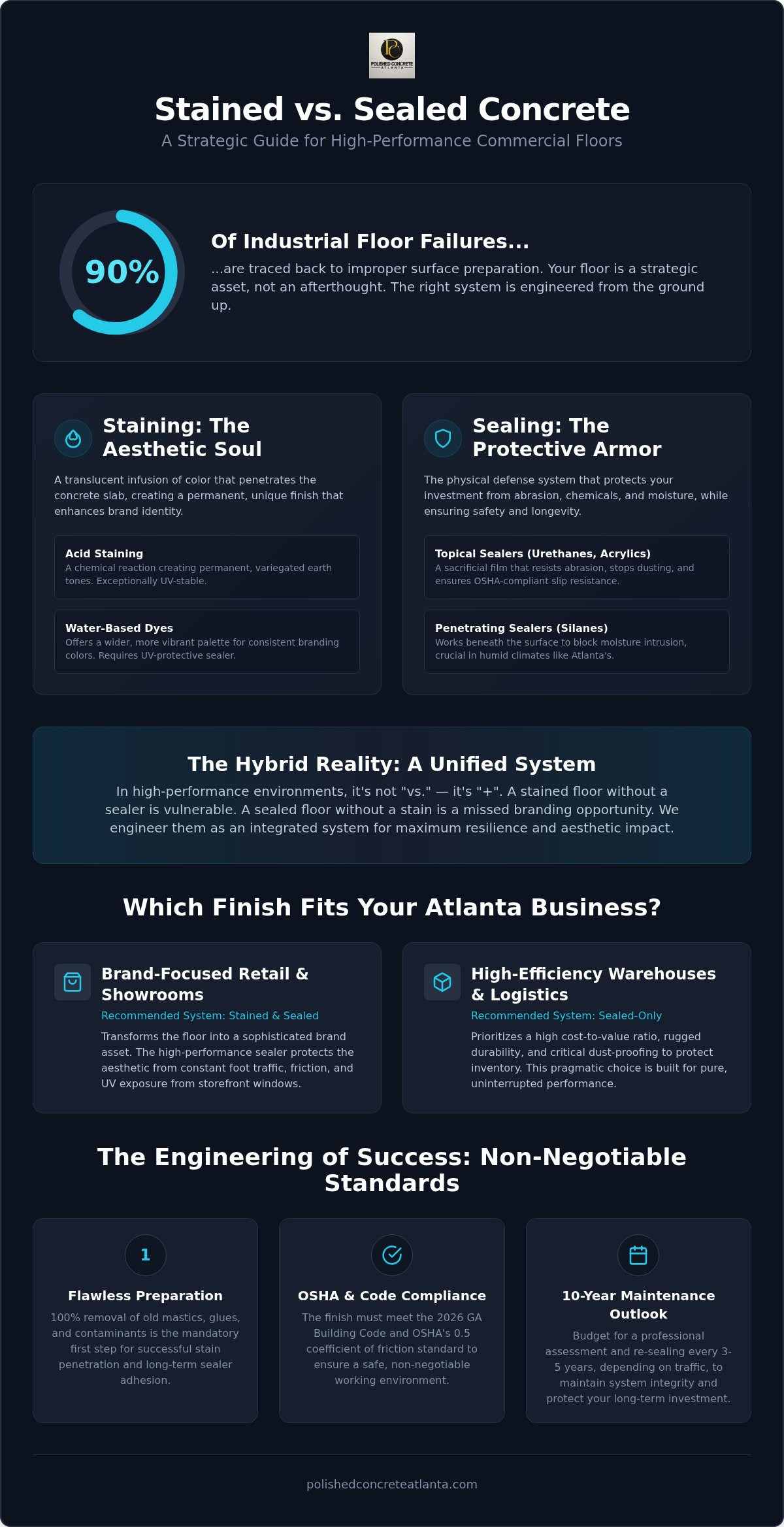
Choosing between stained concrete vs sealed concrete isn't a binary decision; it's a strategic engineering choice. Staining provides the visual identity, while sealing provides the physical defense. In high-performance commercial environments, we rarely install one without the other. Treating them as separate entities is a recipe for premature floor failure. You need a system that balances elite aesthetics with industrial-grade resilience. Mediocrity has no place in your facility.
Staining: The Aesthetic Soul of the Floor
Staining isn't paint. It's a translucent infusion of color that penetrates the slab to create a permanent finish. Acid staining is a chemical reaction between metallic salts and the calcium hydroxide in the concrete that creates permanent, variegated earth tones. For more vibrant or consistent branding, water-based dyes offer a wider palette. These processes highlight the concrete's natural character. They don't mask defects; they celebrate the unique "mottled" texture of the pour. This is why stained concrete floors Atlanta businesses choose must start with a flawless substrate. Precision is the standard.
Sealing: The Protective Industrial Armor
If staining is the soul, the Concrete sealer is the armor. Without it, your investment is vulnerable to oils, chemicals, and abrasion. We categorize these into two main types: penetrating and topical. Penetrating sealers like silanes work beneath the surface to prevent moisture intrusion. Topical sealers, such as high-performance urethanes or acrylics, create a sacrificial film. This film is vital. It eliminates "concrete dusting" that ruins inventory and ensures your facility meets the 2026 OSHA standard of a 0.5 coefficient of friction for level surfaces and 0.8 for ramps. Safety is non-negotiable. Results are the priority.
The hybrid reality is simple. A stained floor without a sealer is a sponge for contaminants. A sealed floor without a stain is a missed branding opportunity. We engineer these as unified systems to protect your slab asset for the next decade. No fluff. Just performance. By integrating these technologies, we eliminate uncertainty and deliver a floor that stands up to the rigors of industrial use while reflecting the quality of your brand.
The Strategic Comparison: Aesthetics, Durability, and Maintenance
Success in commercial flooring depends on aligning your finish with your facility's specific operational demands. When evaluating stained concrete vs sealed concrete, the primary differentiator is the balance between high-end branding and utilitarian function. Staining is a creative strategy. It transforms a standard slab into a sophisticated asset that reflects your brand's quality. Sealed concrete, conversely, is the pragmatic choice for logistics hubs and back-of-house areas where clean, professional efficiency is the only requirement. Both systems demand industrial-grade execution.
Abrasion resistance is where these systems diverge in technical application. A stained floor relies entirely on its topical sealer to protect the delicate color layer from the constant grinding of forklift tires and heavy foot traffic. Without this sacrificial barrier, the stain will wear unevenly, leading to a patchy, neglected appearance. Chemical defense is equally critical. High-performance sealers provide the necessary resistance to oils, salts, and harsh industrial cleaners that would otherwise penetrate and permanent damage an unprotected slab. We don't settle for "good enough" protection. We engineer for the 10-year lifecycle.
Commercial Durability Benchmarks
In a 24/7 retail environment, your floor never sleeps. Stained surfaces in these high-traffic showrooms must withstand constant friction and potential UV exposure from large storefront windows. While acid stains are exceptionally UV-stable, some water-based dyes can fade over time if not protected by a high-solids sealer. For pure logistics hubs and warehouses, "sealed only" systems remain the industry standard. These floors prioritize cost-to-value ratio and dust-proofing over aesthetics. They're built to work. They don't need to impress; they need to perform.
Maintenance and Long-Term Care
Facility managers must budget for re-sealing intervals to maintain the integrity of the system. In 2026, we recommend a professional assessment every 3 to 5 years depending on traffic volume. Neglecting this maintenance window leads to coating failure and increased long-term costs. Cleaning protocols are also vital. You must avoid harsh acidic or high-alkaline cleaners that can strip the sealer and expose the underlying stain. It's a simple fact that sealed concrete reduces janitorial labor costs by creating a non-porous surface that releases dirt and spills with minimal effort. This efficiency is a tangible return on investment. If you're ready to optimize your facility's performance, you can consult with our specialists to design a system tailored to your traffic patterns.
The Decision Framework: Which Finish Fits Your Atlanta Business?
Choosing between stained concrete vs sealed concrete requires more than a glance at a color chart. It's about matching the finish to the specific environmental stressors of the Georgia landscape. For high-end retail and hospitality, the decision is often driven by brand-aligned aesthetics. These facilities prioritize the sophisticated, multi-tonal depth of stained concrete floors Atlanta designers demand. Conversely, warehousing and distribution centers focus on the pragmatic efficiency of grind-and-seal industrial floors. These systems provide a clean, dust-free environment without the added cost of decorative dyes. Modern office spaces often land in the middle, utilizing low-reflectivity matte finishes to achieve a minimalist, professional look that doesn't distract staff or clients.
Evaluating Your Facility’s Traffic Patterns
The physical load on your floor dictates the technical specs of the sealer. High-traffic retail areas need slip resistance that meets or exceeds the 2026 OSHA 0.5 COF standard. However, if your facility handles heavy forklift traffic, a thin decorative sealer will quickly delaminate under the sheer force of turning tires. In these scenarios, industrial floor coatings Atlanta manufacturing plants rely on provide the necessary build and bond strength to survive 24/7 operations. We don't guess at these requirements; we engineer for them. Precision is our baseline.
Moisture and Environmental Considerations
Georgia's high humidity introduces a unique risk: Sweating Slab Syndrome. In non-climate-controlled warehouses, moisture vapor can condense on the surface of an improperly sealed floor, creating a severe slip hazard and risking coating failure. This is why moisture mitigation is the non-negotiable first step in our process. We use strategic vapor barriers and rigorous testing to ensure the slab's moisture vapor emission rate (MVER) is within safe limits before any stain or sealer is applied. Eliminating uncertainty is the only way to guarantee a 10-year lifespan. If you're dealing with moisture issues or need a professional assessment, contact our Atlanta team today to secure your facility's foundation.
The Engineering of Success: Why Professional Preparation is Non-Negotiable
Success is not accidental. In the high-stakes environment of commercial flooring, the technical distinction between stained concrete vs sealed concrete matters little if the substrate is compromised. We operate with a no-nonsense pragmatism: your floor is only as reliable as the preparation beneath it. Ninety percent of industrial floor failures are traced back to improper surface preparation. We refuse to let your facility become part of that statistic. A premium finish requires a meticulous, mechanical bond that only industrial-grade engineering can provide.
Technical Surface Preparation Steps
Our approach to zero-failure installations follows a rigorous, three-step protocol designed to eliminate uncertainty and ensure long-term value. We don't cut corners. We grind them.
- Step 1: Industrial-grade floor glue removal. We ensure 100% removal of old mastics, adhesives, and thin-sets. Leaving even a trace of old material leads to "ghosting" patterns that ruin the translucent beauty of a stain.
- Step 2: Precision diamond grinding. Using heavy-duty planetary grinders, we achieve the specific Concrete Surface Profile (CSP) required for your system. This process opens the concrete pores, allowing for deep chemical bonding rather than a superficial surface sit.
- Step 3: Rigorous moisture testing. We utilize Calcium Chloride tests or In-Situ Probes to verify the slab's moisture vapor emission rate. In the humid Georgia climate, this step is the only way to prevent future delamination and osmotic blistering.
The Professional Verdict
Low-bid contractors often treat preparation as a cleaning exercise. It isn't. DIY or cut-rate solutions frequently skip the necessary diamond grinding, leading to immediate color loss and peeling sealers. This creates a cycle of constant repair that disrupts your operations and drains your budget. Real savings come from the durability of a professional installation. Partnering with industrial flooring contractors Atlanta who prioritize rigorous concrete surface preparation is a strategic investment in your facility's future. We don't just apply a finish; we engineer a foundation that reflects your brand's commitment to quality. Don't settle for mediocrity. Secure your facility's operational integrity by scheduling a professional consultation today.
Securing Your Facility’s Foundation for the Next Decade
Your facility floor is more than a walking surface; it's a critical operational asset. Navigating the choice between stained concrete vs sealed concrete requires a deep understanding of your building's traffic patterns and environmental stressors. Whether you prioritize high-luster branding or utilitarian durability, the final outcome depends on a zero-failure approach to surface preparation and moisture mitigation. Decades of Atlanta-based craftsmanship have taught us that there is no substitute for rigorous engineering. We don't just install floors; we protect your long-term investment. Mediocrity has no place in a high-performance workspace.
By choosing a system designed for the 2026 industrial landscape, you eliminate uncertainty and ensure compliance with the latest safety standards. Our team specializes in complex commercial and industrial environments, bringing advanced moisture mitigation expertise to every project. It's time to move from vision to execution with a partner who understands the technical stakes. Request a Professional Flooring Evaluation for Your Atlanta Facility today. Let's build a floor that reflects the elite quality of your brand and stands the test of time.
Frequently Asked Questions
Is stained concrete more expensive than sealed concrete?
Stained concrete generally requires a higher investment than basic sealed concrete due to the specialized labor and chemical dyes involved. While sealed concrete offers a professional, utilitarian finish, staining adds a decorative dimension that requires multiple application stages. We view this as a strategic choice between pure industrial function and brand-aligned aesthetics. Both systems benefit from the same high-standard surface preparation to ensure longevity in your Atlanta facility.
Can you stain concrete that has already been sealed?
You cannot apply stain directly over an existing sealer because the barrier prevents the chemical or dye from penetrating the concrete pores. To achieve a successful finish, we must perform professional floor grinding to remove all old coatings and reach the proper Concrete Surface Profile. This mechanical preparation is non-negotiable for stained concrete vs sealed concrete systems to ensure the color bonds permanently with the substrate. Precision is our baseline.
How long do I need to wait after pouring new concrete to stain or seal it?
Standard industry practice requires a minimum cure time of 28 days before you apply any decorative stain or high-performance sealer. Applying finishes too early traps moisture within the slab, which leads to osmotic blistering and coating failure. While Polished Concrete Atlanta doesn't provide new concrete pouring, we meticulously test every slab's moisture vapor emission rate before we begin our finishing process. We don't guess; we verify readiness.
Will sealed concrete make my commercial floor slippery when wet?
Smooth sealed surfaces can be slippery when wet, but we eliminate this risk by integrating slip-resistant traction additives into the final topcoat. Our installations are engineered to meet the 2026 OSHA standard of a 0.5 coefficient of friction for level commercial surfaces. Whether you choose stained concrete vs sealed concrete, safety remains a primary design requirement. We provide the grip necessary for high-traffic environments without compromising the floor's aesthetic luster.
What is the best way to clean stained and sealed concrete floors?
The most effective maintenance strategy involves using a neutral pH cleaner and avoiding harsh acidic or high-alkaline chemicals. Strong industrial cleaners can strip the protective sealer and expose the underlying stain to abrasion and chemical damage. We recommend a regular schedule of dust mopping and damp mopping to remove grit that acts like sandpaper under foot traffic. Proper care preserves the high-end craftsmanship of your facility's foundation for years.
Do I need moisture mitigation if my concrete slab is old?
Age does not exempt a slab from moisture risks; in fact, many older Atlanta facilities lack modern under-slab vapor barriers. Moisture vapor continues to migrate through porous concrete regardless of the slab's age, which can cause delamination of even the most durable finishes. We always perform rigorous moisture testing before installation. Our specialized moisture mitigation services act as an insurance policy against "Sweating Slab Syndrome" and premature floor failure.


