
Most property managers treat floor aesthetics like a simple coat of paint. In the high-humidity environment of Georgia, that surface-level thinking is a recipe for peeling and costly failure. You want a floor that commands respect without requiring a constant maintenance budget. You've likely searched for concrete floor staining near me because you're tired of coatings that flake under heavy equipment or bubble up when the Atlanta humidity spikes. We understand that frustration. It's the result of cutting corners on preparation. Results matter.
Professional concrete staining isn't a top-layer fix; it's a permanent chemical integration that transforms your existing slab. This article reveals how to choose a system that withstands industrial traffic while ensuring long-term durability. We'll examine the technical ROI between staining and epoxy, the impact of the 2024 International Building Code updates on your facility, and why moisture mitigation is the non-negotiable foundation of every successful project. Stop settling for mediocrity. Start investing in a floor that lasts.
Key Takeaways
- Understand that professional polished concrete staining is a permanent chemical integration into the slab, ensuring the finish never peels or flakes like inferior surface coatings.
- Learn the technical differences between acid-reactive and water-based stains to determine which system meets your facility's specific aesthetic and performance requirements.
- Discover why searching for concrete floor staining near me should lead you to industrial-grade contractors who prioritize rigorous moisture mitigation and advanced surface preparation.
- Identify the "delamination factor" and why chemical stains offer a superior lifecycle for high-traffic environments compared to traditional resinous coatings.
- Gain a clear understanding of the industrial standards for floor glue removal and prep work that guarantee a flawless, high-luster result.
Table of Contents
- Polished Concrete Floor Staining Near Me: Why Professionals Choose Chemical Stains Over Paint
- Acid Stain vs. Water-Based Systems: The Technical Breakdown for Facilities
- Stained Concrete vs. Epoxy Flooring: Navigating the Choice for High-Traffic Environments
- The Engineering Behind the Finish: Why Surface Preparation and Moisture Mitigation Matter
- Executing Your Vision: Professional Concrete Staining in the Greater Atlanta Area
Concrete Floor Staining Near Me: Why Professionals Choose Chemical Stains Over Paint
Searching for concrete floor staining near me often returns a list of residential painters who treat concrete like drywall. This is a fundamental mistake. A professional commercial finish is not an opaque layer of paint that sits on the surface waiting to chip. It is a sophisticated chemical integration. True stained concrete involves a reaction that penetrates the pores of the slab; it becomes part of the structure itself. This distinction is critical for Atlanta facility managers who cannot afford the downtime associated with floor failure. Results matter.
Residential contractors typically lack the heavy-duty planetary grinders and industrial vacuum systems required for proper floor preparation. They might offer a "decorative" look, but without the mechanical profile created by professional grinding, the stain won't reach its full potential. In Georgia's humid climate, moisture mitigation is not optional. High humidity levels can trap vapors beneath the surface, causing inferior coatings to bubble and peel. We don't guess. We test. Our process ensures that the chemical bond is absolute, regardless of the outdoor dew point.
The Science of the Bond: Acid vs. Water-Based Stains
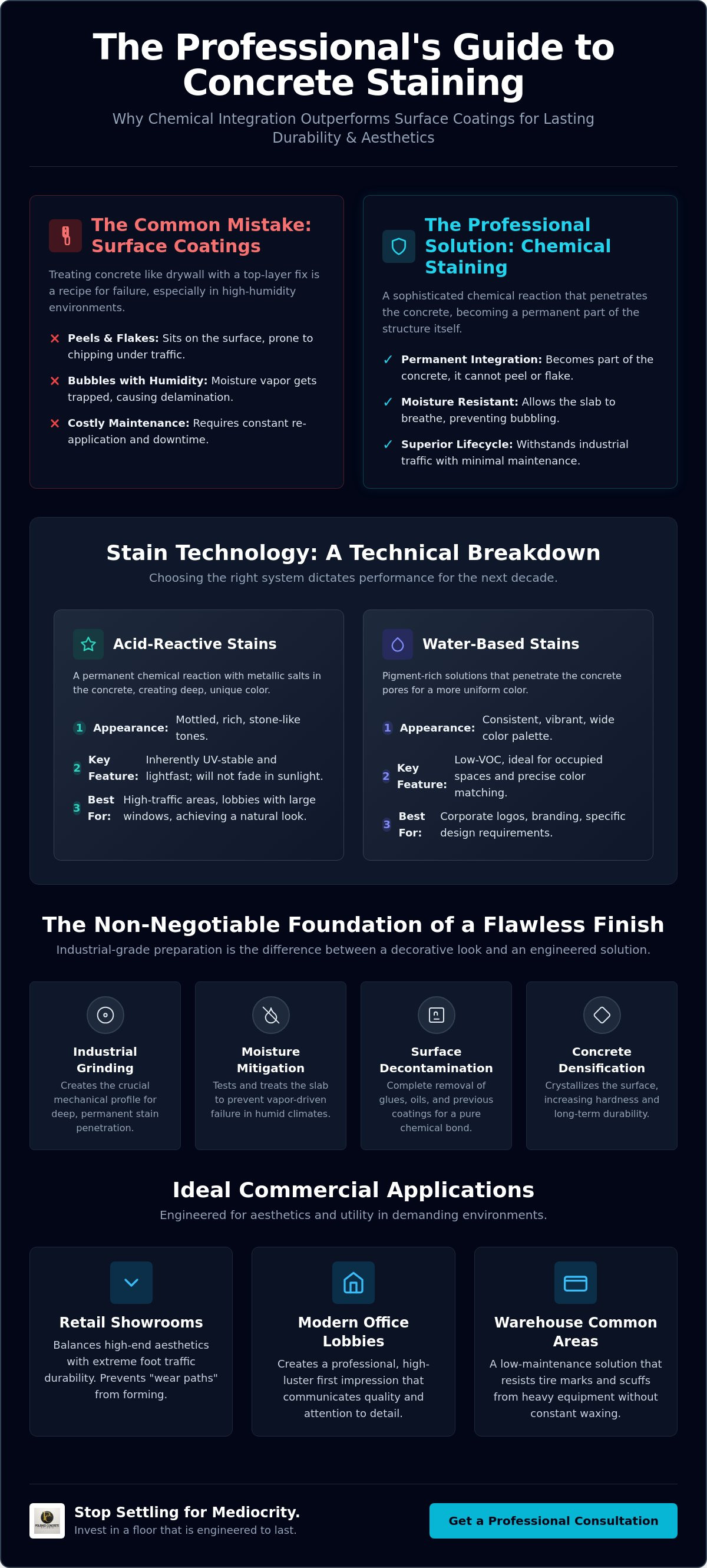
Understanding the chemistry is the first step toward a successful facility upgrade. Acid stains utilize metallic salts to etch and permanently color the concrete matrix. Acid staining is a permanent chemical alteration of the concrete surface. This process creates deep, mottled tones that mimic natural stone, making it a staple for Decorative concrete in high-traffic zones because there is no film to wear away. Conversely, water-based stains are pigment-rich solutions. They provide a consistent, vibrant color palette. These are the preferred choice for precise branding and logos where color accuracy is non-negotiable. They also meet strict low-VOC requirements, which is essential for projects in occupied commercial buildings.
Commercial Applications: Where Staining Excels
Stained concrete isn't just about looks. It's about utility. We've mastered the application of these systems in diverse environments across the Greater Atlanta area. Consider the specific needs of your facility:
- Retail Showrooms: You need to balance high-end aesthetics with extreme foot traffic durability. Staining provides a custom look that won't show a "wear path" after the first holiday season.
- Modern Office Lobbies: Create a professional, high-luster first impression that tells clients you prioritize quality and attention to detail.
- Warehouse Common Areas: These spaces require low-maintenance solutions that resist tire marks and scuffs from equipment. Stained and sealed concrete delivers this without the high price tag of constant waxing.
Choosing the right system means looking beyond the immediate cost. It means looking at the lifecycle of the floor. When you search for concrete floor staining near me, you aren't just looking for a color change. You're looking for an industrial-grade solution that stands up to the rigors of your business.
Acid Stain vs. Water-Based Systems: The Technical Breakdown for Facilities
Choosing a flooring system requires technical foresight. When you search for concrete floor staining near me, you're looking for a solution that handles both aesthetics and industrial-grade utility. It's not a one-size-fits-all process. You must choose between reactive acid stains and non-reactive water-based systems. Each has a specific role in commercial environments. Decisions made at this stage dictate the maintenance schedule for the next decade. Precision is mandatory.
Atlanta's architectural trend toward large glass facades makes UV stability a primary concern for facility managers. Acid-reactive stains are inherently lightfast. They won't fade under the intense Georgia sun that pours through lobby windows. Water-based systems require specific UV-resistant topcoats to maintain their vibrancy over time. Regardless of the stain type, we utilize advanced densifiers to crystallize the concrete surface. This increases abrasion resistance and extends the lifecycle of your investment. Successful staining requires rigorous moisture testing and mitigation to prevent hydrostatic pressure from compromising the bond of the final sealer.
Acid Staining: The Uncompromising Industrial Choice
Acid staining is the gold standard for longevity. The process relies on a mild hydrochloric acid solution that acts as a catalyst to open the concrete's pores. Once the surface is receptive, metallic salts react with the calcium hydroxide in the concrete to create a permanent color change. This results in the classic "mottled" or variegated look often seen in high-end showrooms. You'll find a palette of earthy tones like deep tans, rich browns, and terra cottas. Because the effect is translucent, it doesn't hide the character of the slab; it enhances it. It's a raw, sophisticated aesthetic that never peels. If you're unsure which system fits your facility's traffic patterns, our team at Polished Concrete Atlanta can provide a technical consultation.
Water-Based Stains: Precision and Versatility
When your project requires bold colors or intricate branding, water-based stains are the superior tool. These solutions don't rely on a chemical reaction. Instead, they deposit micro-pigments deep into the concrete's surface profile. This allows for a much broader color spectrum, including vibrant blues, greens, and reds that acid stains simply cannot achieve. They are ideal for branded environments where color consistency is a requirement. Another critical advantage is the low-odor application. You can refresh a floor in an active commercial building without disrupting air quality or necessitating a total shutdown. Don't confuse these with hardware store "stains" that are essentially thin paints. Our industrial-grade water-based systems use advanced polymers to ensure the pigment remains locked within the concrete matrix, even under heavy foot traffic. We don't settle for surface-level results. We deliver depth.
Stained Concrete vs. Epoxy Flooring: Navigating the Choice for High-Traffic Environments
Choosing between stained concrete and epoxy isn't just about color. It's about engineering. Facility managers searching for concrete floor staining near me often weigh the visual appeal of reactive stains against the heavy-duty reputation of epoxy. While epoxy provides a thick, protective shield, staining offers a permanent integration. One sits on top. The other becomes the floor. This distinction is the difference between a surface that can fail and a surface that endures. We prioritize the right system for the right environment. Performance is the only metric that counts.
Delamination is the primary failure point for industrial flooring. Epoxy relies on a mechanical bond to the concrete surface. If the preparation is subpar or moisture levels are too high, the resin will eventually peel or bubble. Stained concrete eliminates this risk entirely. Because the stain reacts chemically with the slab, there is no film to delaminate. It cannot flake. It cannot chip. In high-traffic Atlanta facilities, this reliability is a strategic asset. You don't have time for repairs that disrupt your workflow. You need a floor that stays put.
The financial argument for staining becomes clear when you analyze the 10-year lifecycle cost. Initial investment for staining is often lower than high-build epoxy systems. However, the true value lies in the maintenance. Epoxy requires periodic recoating to maintain its integrity and appearance. Staining, when paired with a high-quality densifier and sealer, requires only basic cleaning and occasional buffing. The ROI is undeniable. We match the floor to your facility's specific hazards, balancing impact resistance with chemical requirements to ensure your investment remains protected for the long haul.
When Staining is the Strategic Choice
Facilities with high vapor emission rates need a breathable solution. Staining allows moisture to pass through the slab without causing pressure-induced failure. This makes it ideal for older Atlanta slabs where an original vapor barrier might be compromised. In high-traffic retail environments, a stained floor is also preferable because it doesn't show a "wear path" or scratches as clearly as a glossy resinous coating. It's the definitive choice for projects with tight budgets that still require a premium, polished appearance that commands respect.
When Epoxy is Mandatory
Industrial environments with heavy chemical spills or frequent power washing require the impermeable barrier of epoxy. Food processing areas specifically need seamless, antimicrobial surfaces to meet health and safety regulations; joints and pores are simply not an option. Furthermore, if your facility has a slab with significant imperfections, deep cracks, or uneven patches, epoxy is the necessary tool to hide these defects. It creates a monolithic, level surface that staining cannot provide. We evaluate your slab's integrity before making a recommendation. We don't guess. We verify.
The Engineering Behind the Finish: Why Surface Preparation and Moisture Mitigation Matter
The success of any industrial flooring project is decided long before the first drop of color hits the slab. We operate by a definitive "Golden Rule" in this industry: the quality of the finish is a direct reflection of the preparation. When you investigate concrete floor staining near me, you must look for a partner who prioritizes mechanical engineering over cosmetic shortcuts. A slab that hasn't been properly profiled will reject chemical stains, leading to splotchy results and premature wear. We don't settle for surface-level cleaning. We re-engineer the surface itself.
Our process begins with industrial planetary grinders equipped with diamond-tipped blades. This equipment does more than just clean; it removes the weak "cream" layer of the concrete to expose the open pores of the matrix. This creates a specific "profile" that allows the stain to penetrate deeply and react as intended. Without this mechanical opening, the stain remains a superficial film. Results matter. By utilizing precision grinding, we ensure that the chemical integration is absolute and the final luster is built into the concrete, not just sitting on top of it.
Professional Floor Glue and Adhesive Removal
Old flooring residues are the primary enemy of a uniform stain. Many contractors rely on messy chemical strippers that can actually drive contaminants deeper into the concrete. We utilize mechanical grinding for all floor glue removal. This is the only way to eliminate "ghosting" patterns left behind by previous carpet tiles or VCT installations. Ensuring a uniform surface is the only way to achieve consistent stain absorption across a 10,000-square-foot facility. If the previous adhesive isn't completely eradicated, the stain will appear darker or lighter in those zones, ruining the professional aesthetic of your space.
Addressing Moisture Vapor Transmission (MVT)
Georgia's high water table and humid climate create a constant threat of hydrostatic pressure. Moisture Vapor Transmission (MVT) occurs when water vapor travels through the porous slab and exerts pressure on the surface finish. If left unaddressed, this pressure can cloud sealers or cause coatings to fail from the bottom up. We utilize rigorous testing standards, including Relative Humidity (RH) probes and Calcium Chloride tests, to quantify the risk before we begin. Moisture mitigation is the process of neutralizing vapor pressure before it reaches the surface. This step is non-negotiable for long-term durability in Atlanta commercial spaces. If your facility shows signs of dampness or efflorescence, our floor moisture mitigation systems provide the necessary barrier to protect your investment.
Executing Your Vision: Professional Concrete Staining in the Greater Atlanta Area
Searching for concrete floor staining near me shouldn't lead you to a list of generic contractors. It should lead you to a strategic partner. At Polished Concrete Atlanta, we recognize that your commercial facility is a high-value asset. We don't settle for "good enough" because we know that a single flooring failure can disrupt your entire operation. Our team brings a holistic project-management approach to every square foot. We manage the transition from raw slab to high-luster finish with the precision of a veteran who has seen every possible scenario. Excellence isn't an accident. It's a standard.
Our reach extends across the entire Atlanta metro, from the logistics hubs in South Fulton to the high-rise corridors of Buckhead. We understand that Georgia's climate demands a specific level of expertise in moisture management and curing times. This isn't a process you can rush. We've mastered the timing required to ensure every chemical reaction within the concrete reaches its peak potential. By choosing a local expert, you're investing in a team that understands the specific challenges of the region's high humidity and soil composition. We build floors that last. We aren't here to just sell a service; we're here to deliver a permanent flooring solution that reflects the professional caliber of your brand.
The Polished Concrete Atlanta Advantage
We combine elite technical skill with a blue-collar work ethic. This means we handle the granular details of floor preparation and chemical application so you can focus on running your business. Transparency is the foundation of our client relationships. If your slab isn't a candidate for staining due to structural integrity issues or severe contamination, we'll tell you. We value honesty over a signed contract. With decades of experience in commercial and industrial concrete finishing, we provide the peace of mind that comes from working with a seasoned industry leader. We don't just follow industry trends. We set them.
Next Steps for Your Facility
Your project begins with a definitive site assessment. We evaluate your concrete's condition, testing for moisture and existing residues to ensure a flawless chemical bond. We also offer custom color consultations to align your floors with your brand's specific aesthetic. Don't leave your facility's reputation to chance. Take the next step toward a floor that balances industrial utility with high-end craftsmanship. When you look for concrete floor staining near me, prioritize the partner who understands the engineering behind the beauty. Contact Polished Concrete Atlanta for a definitive quote on your staining project.
Secure a Foundation of Industrial Excellence
Your commercial floor is more than a walking surface; it's a long-term investment in your facility's operational efficiency. We've established that the difference between a failing coating and a permanent chemical bond lies in the engineering. By prioritizing industrial-grade preparation and understanding the specific chemistry of your slab, you eliminate the risks of delamination and high maintenance costs. When you search for concrete floor staining near me, you deserve a partner who brings more than just a bucket of stain to the job site. You deserve a veteran who understands the stakes.
Polished Concrete Atlanta has been serving the metro area since 2004. We utilize specialized industrial-grade grinding equipment to ensure the perfect profile every time. Our comprehensive process includes professional glue removal and moisture mitigation as standard practice, not an afterthought. We don't cut corners. We build floors that command respect. It's time to transform your space with a finish that won't flake, chip, or fade. Results matter. Let's get to work.
Request a Professional Site Assessment from Polished Concrete Atlanta to begin your facility's transformation. Let's build something that lasts.
Frequently Asked Questions
How long does professional concrete staining last in a commercial setting?
A professional stain lasts indefinitely because it is a permanent chemical integration into the concrete matrix. While the color itself won't fade or peel, the protective sealer requires periodic maintenance based on traffic volume. Most commercial facilities refresh the topcoat every three to five years to maintain the high-luster finish. It's a lifecycle investment that consistently outperforms temporary surface coatings.
Can you stain old concrete floors that have had carpet or tile on them?
Old concrete can be stained successfully if the slab undergoes rigorous mechanical preparation. We use planetary grinders to eliminate all traces of previous adhesives, which is why professional floor glue removal is non-negotiable. This prevents "ghosting" patterns where old tile or carpet once sat. If you are searching for concrete floor staining near me for a renovation, ensure your contractor prioritizes this industrial-grade prep.
Is stained concrete slippery when wet, especially in retail environments?
Stained concrete is no more slippery than traditional tile or polished stone when dry. For retail environments where wet feet or spills are common, we incorporate anti-slip additives into the final sealer. This increases the dynamic coefficient of friction to meet safety standards. We don't compromise safety for aesthetics. Your facility remains functional, compliant, and safe for both employees and customers.
How much maintenance does a stained concrete floor actually require?
Maintenance involves simple daily sweeping and weekly mopping with a pH-neutral cleaner. You don't need expensive chemicals or heavy scrubbing equipment to keep the floor looking elite. In high-traffic zones, we recommend a sacrificial floor finish that can be buffed or reapplied to protect the permanent stain beneath. It's a pragmatic, low-cost maintenance profile that saves your facility money over time.
What is the difference between concrete staining and concrete painting?
The difference is chemical integration versus surface adhesion. Staining reacts with the concrete's minerals to change the color from within, while paint is a superficial film. Paint will inevitably delaminate under the pressure of foot traffic and equipment. Stain cannot peel because it has no film to fail. The results are permanent and built into the slab itself.
How long does the staining process take for a 5,000 square foot facility?
A 5,000 square foot project typically requires five to seven business days for a complete professional installation. This timeline accounts for the essential stages of mechanical grinding, stain reaction time, neutralization, and multiple sealer applications. We respect your operational schedule. We coordinate the workflow to minimize downtime and ensure the facility returns to service as quickly as possible.
Can concrete staining hide cracks and patches in my existing floor?
Staining will not hide cracks or patches; it will likely emphasize them. Because chemical stains are translucent, they celebrate the natural character and history of the slab. If your goal is to mask significant slab imperfections, you should consider a high-build epoxy flooring system instead. We provide honest, technical assessments of your slab's suitability before we begin any work.
Is acid staining safe for indoor use in occupied office buildings?
Acid staining is safe for indoor use when handled by experts who manage the neutralization and ventilation process correctly. For active office environments where air quality is a primary concern, we often suggest water-based stains. These systems are low-VOC and low-odor, making them the superior choice for occupied buildings. When looking for concrete floor staining near me, choose a partner who understands these safety requirements.


